“All movements go too far.”
— Bertrand Russell, 1950s, Unpopular Essays






















































































































































Explore our curated collection of the most famous and impactful Bertrand Russell quotes.
“All movements go too far.”
“Choose your parents wisely.”
“I've got a one-dimensional mind.”

“Drunkenness is temporary suicide.”
“Why? Surely they can find other men.”
“The camera is as subjective as we are.”
“Change is one thing, progress is another.”

“We need a science to save us from science.”
“Of course not. After all, I may be wrong...”
“Whatever we know without inference is mental.”
“The above proposition is occasionally useful.”
“Either Man will abolish war, or war will abolish Man.”
“Power may be defined as the production of intended effects.”

“There is much pleasure to be gained from useless knowledge.”
“Even when the experts all agree, they may well be mistaken.”
“Most people would sooner die than think; in fact, they do so.”
“Righteousness cannot be born until self-righteousness is dead.”

“I should say that the universe is just there, and that is all.”

“The state is primarily an organization for killing foreigners.”

“The good life is one inspired by love and guided by knowledge.”
“Philosophy seems to me on the whole a rather hopeless business.”
“No rules, however wise, are a substitute for affection and tact.”
“The universe is what it is, not what I choose that it should be.”
“Too little liberty brings stagnation, and too much brings chaos.”
“How much good it would do if one could exterminate the human race.”
Find exactly what you are looking for by browsing this categorized list of Bertrand Russell quotes by topic.
“So far as I can remember, there's not one word in the Gospels in praise of intelligence.”
“I say quite deliberately that the Christian religion, as organized in its churches, has been and still is the principal enemy of moral progress in the world.”
“The Spaniards in Mexico and Peru used to baptize Indian infants and then immediately dash their brains out: by this means they secured these infants went to Heaven.”
“What was best in the Cynic doctrine passed over into Stoicism, which was an altogether more complete and rounded philosophy.”
“If virtue is the sole good, there can be no reason against cruelty and injustice, since, as the Stoics are never tired of pointing out, cruelty and injustice afford the sufferer the best opportunities for the exercise of virtue.”
“Stoicism, unlike the earlier purely Greek philosophies, is emotionally narrow, and in a certain sense fanatical; but it also contains religious elements of which the world felt the need, and which the Greeks seemed unable to supply.”
“The good life is one inspired by love and guided by knowledge.”
“Life and hope for the world are to be found only in the deeds of love.”
“To fear love is to fear life, and those who fear life are already three parts dead.”
“Pi's face was masked, and it was understood that none could behold it and live. But piercing eyes looked out from the mask, inexorable, cold and enigmatic.”
“Mathematics takes us still further from what is human, into the region of absolute necessity, to which not only the world, but every possible world, must conform.”
“I like mathematics because it is not human and has nothing particular to do with this planet or with the whole accidental universe – because, like Spinoza's God, it won't love us in return.”
“Science is what we know, and philosophy is what we don't know.”
“Philosophy seems to me on the whole a rather hopeless business.”
“When people begin to philosophize they seem to think it necessary to make themselves artificially stupid.”
“The most savage controversies are those about matters as to which there is no good evidence either way. Persecution is used in theology, not in arithmetic, because in arithmetic there is knowledge, but in theology there is only opinion.”
“Not only philosophers were influenced by Plato. Why did the Puritans object to the music and painting and gorgeous ritual of the Catholic Church? You will find the answer in the tenth book of the Republic. Why are children compelled to learn arithmetic? The reasons are given in the seventh book.”
“Mystical doctrines as to the relation of time to eternity are also reinforced by pure mathematics, for the mathematical objects, such as numbers, if real at all, are eternal and not in time. Such eternal objects can be conceived as God's thoughts. Hence Plato's doctrine that God is a geometer, and Sir James Jeans' belief that He is addicted to arithmetic.”
“Religion is based, I think, primarily and mainly upon fear.”
“To fear love is to fear life, and those who fear life are already three parts dead.”
“Do not fear to be eccentric in opinion, for every opinion now accepted was once eccentric.”
“The Greeks... discovered mathematics and the art of deductive reasoning. Geometry, in particular, is a Greek invention, without which modern science would have been impossible.”
“I may as well say at once that I do not distinguish between inference and deduction. What is called induction appears to me to be either disguised deduction or a mere method of making plausible guesses.”
“It has only been very slowly that scientific method, which seeks to reach principles inductively from observation of particular facts, has replaced the Hellenic belief in deduction from luminous axioms derived from the mind of the philosopher.”
“Facts have to be discovered by observation, not by reasoning.”
“A hallucination is a fact, not an error; what is erroneous is a judgment based upon it.”
“Historical facts, many of them, have an intrinsic value, a profound interest on their own account, which makes them worthy of study, quite apart from any possibility of linking them together by means of causal laws.”
“The human race may well become extinct before the end of the century. Speaking as a mathematician, I should say the odds are about three to one against survival.”
“Suppose atomic bombs had reduced the population of the world to one brother and one sister, should they let the human race die out? I do not know the answer, but I do not think it can be in the affirmative merely on the ground that incest is wicked.”
“One must expect a war between U.S.A. and U.S.S.R. which will begin with the total destruction of London. I think the war will last 30 years, and leave a world without civilised people, from which everything will have to be built afresh — a process taking (say) 500 years.”
“There is much pleasure to be gained from useless knowledge.”
“The good life is one inspired by love and guided by knowledge.”
“All definite knowledge — so I should contend — belongs to science; all dogma as to what surpasses definite knowledge belongs to theology. But between theology and science there is a No Man’s Land, exposed to attack by both sides; this No Man’s Land is philosophy.”
“The good life is one inspired by love and guided by knowledge.”
“Life and hope for the world are to be found only in the deeds of love.”
“To fear love is to fear life, and those who fear life are already three parts dead.”
“[Patriotism is the] willingness to kill and be killed for trivial reasons.”
“"patriotism," i.e., a willingness to kill and be killed for trivial reasons.”
“Patriots always talk of dying for their country, and never of killing for their country.”
“I dislike Communism because it is undemocratic, and capitalism because it favors exploitation.”
“I think all the great religions of the world - Buddhism, Hinduism, Christianity, Islam and Communism – both untrue and harmful.”
“The hopes which inspire communism are, in the main, as admirable as those instilled by the Sermon on the Mount, but they are held as fanatically and are as likely to do as much harm.”
“The pursuit of knowledge is, I think, mainly actuated by love of power. And so are all advances in scientific technique.”
“The fundamental concept in social science is Power, in the same sense in which Energy is the fundamental concept in physics.”
“Next to enjoying ourselves, the next greatest pleasure consists in preventing others from enjoying themselves, or, more generally, in the acquisition of power.”
“Mysticism is, in essence, little more than a certain intensity and depth of feeling in regard to what is believed about the universe.”
“The essence of liberalism is an attempt to secure a social order not based on irrational dogma, and insuring stability without involving more restraints than are necessary for the preservation of the community.”
“The essence of the Liberal outlook lies not in what opinions are held, but in how they are held: instead of being held dogmatically, they are held tentatively, and with a consciousness that new evidence may at any moment lead to their abandonment.”
“The atomists, unlike Socrates, Plato, and Aristotle, sought to explain the world without introducing the notion of purpose or final cause.”
“Bacon not only despised the syllogism, but undervalued mathematics, presumably as insufficiently experimental. He was virulently hostile to Aristotle, but he thought very highly of Democritus, Although he did not deny that the course of nature exemplifies a Divine purpose, he objected to any admixture of teleological explanation in the actual investigation of phenomena; everything, he held, should be explained as following necessarily from efficient causes.”
“The atomists asked the mechanistic question, and gave a mechanistic answer. Their successors, until the Renaissance, were more interested in the teleological question, and thus led science up a blind alley. In regard to both questions alike, there is a limitation which is often ignored, both in popular thought and in philosophy. Neither question can be asked intelligibly about reality, as a whole (including God), but only about parts of it. ...The conception of purpose, therefore, is only applicable within reality, not to reality as a whole.”
“All traditional logic habitually assumes that precise symbols are being employed. It is therefore not applicable to this terrestial life but only to an imagined celestial existence... logic takes us nearer to heaven than other studies.”
“The question of "unreality," which confronts us at this point, is a very important one. Misled by grammar, the great majority of those logicians who have dealt with this question have dealt with it on mistaken lines. They have regarded grammatical form as a surer guide in analysis than, in fact, it is. And they have not known what differences in grammatical form are important.”
“The apparent world goes through developments which are the same as those the logician goes through if he starts from Pure Being and travels on to the Absolute Idea. [...] Why the world should go through this logical evolution is not clear; one is tempted to suppose that the Absolute Idea did not quite understand itself at first, and made mistakes when it tried to embody itself in events. But this, of course, was not what Hegel would have said.”
“From India to Spain, the brilliant civilization of Islam flourished. What was lost to Christendom at this time was not lost to civilization, but quite the contrary… To us it seems that West-European civilization is civilization; but this is a narrow view."”
“It was the duty of the faithful to conquer as much of the world as possible for Islam. ... The Arabs, although they conquered a great part of the world in the name of a new religion were not a very religious race; the motive of their conquests was plunder and wealth rather than religion.”
“Bolshevism combines the characteristics of the French Revolution with those of the rise of Islam. … Among religions, Bolshevism is to be reckoned with Mohammedanism rather than with Christianity and Buddhism. Christianity and Buddhism are primarily personal religions, with mystical doctrines and a love of contemplation. Mohammedanism and Bolshevism are practical, social, unspiritual, concerned to win the empire of the world.”
“Envy is the basis of democracy.”
“A fanatical belief in democracy makes democratic institutions impossible.”
“Democracy is the process by which people choose the man who'll get the blame.”
“What science cannot discover, mankind cannot know.”
“Science is what we know, and philosophy is what we don't know.”
“Gradually, … the aspect of science as knowledge is being thrust into the background by the aspect of science as the power of manipulating nature. It is because science gives us the power of manipulating nature that it has more social importance than art. Science as the pursuit of truth is the equal, but not the superior, of art. Science as a technique, though it may have little intrinsic value, has a practical importance to which art cannot aspire.”
“To realise the unimportance of time is the gate of wisdom.”
“There is the instance of the Gadarene swine, where it certainly was not very kind to the pigs to put the devils into them and make them rush down the hill into the sea. You must remember that He was omnipotent, and He could have made the devils simply go away; but He chose to send them into the pigs. Then there is the curious story of the fig-tree, which always rather puzzled me. You remember what happened about the fig-tree. "He was hungry; and seeing a fig-tree afar off having leaves, He came if haply He might find anything thereon; and when he came to it He found nothing but leaves, for the time of figs was not yet. And Jesus answered and said unto it: 'No man eat fruit of thee hereafter for ever'.... and Peter.... saith unto Him: 'Master, behold the fig-tree which thou cursedst is withered away.'" This is a very curious story, because it was not the right time of year for figs, and you really could not blame the tree. I cannot myself feel that either in the matter of wisdom or in the matter of virtue Christ stands quite as high as some other people known to History. I think I should put Buddha and Socrates above Him in those respects.”
“Having granted the excellence of these maxims, I come to certain points in which I do not believe that one can grant either the superlative wisdom or the superlative goodness of Christ as depicted in the Gospels... there one does find some things that do not seem to be very wise. For one thing, he certainly thought that His second coming would occur in clouds of glory before the death of all the people who were living at that time. There are a great many texts that prove that. He says, for instance, "Ye shall not have gone over the cities of Israel till the Son of Man be come." Then he says, "There are some standing here which shall not taste death till the Son of Man comes into His kingdom"; and there are a lot of places where it is quite clear that He believed that His second coming would happen during the lifetime of many then living. That was the belief of His earlier followers, and it was the basis of a good deal of His moral teaching. When He said, "Take no thought for the morrow," and things of that sort, it was very largely because He thought that the second coming was going to be very soon, and that all ordinary mundane affairs did not count. I have, as a matter of fact, known some Christians who did believe that the second coming was imminent. I knew a parson who frightened his congregation terribly by telling them that the second coming was very imminent indeed, but they were much consoled when they found that he was planting trees in his garden. The early Christians did really believe it, and they did abstain from such things as planting trees in their gardens, because they did accept from Christ the belief that the second coming was imminent. In that respect, clearly He was not so wise as some other people have been, and He was certainly not superlatively wise.”
“Men are born ignorant, not stupid; they are made stupid by education.”
“We are faced with the paradoxical fact that education has become one of the chief obstacles to intelligence and freedom of thought.”
“I found one day in school a boy of medium size ill-treating a smaller boy. I expostulated, but he replied: 'The bigs hit me, so I hit the babies; that's fair.' In these words he epitomized the history of the human race.”
“To be without some of the things you want is an indispensable part of happiness.”
“The secret of happiness is to face the fact that the world is horrible, horrible, horrible.”
“The good life, as I conceive it, is a happy life. I do not mean that if you are good you will be happy; I mean that if you are happy you will be good.”
“What is wanted is not the will-to-believe, but the wish to find out, which is its exact opposite.”
“We may define "faith" as a firm belief in something for which there is no evidence. Where there is evidence, no one speaks of "faith". We do not speak of faith that two and two are four or that the earth is round. We only speak of faith when we wish to substitute emotion for evidence.”
“If you think that your belief is based upon reason, you will support it by argument, rather then by persecution, and will abandon it if the argument goes against you. But if your belief is based on faith, you will realize that argument is useless, and will therefore resort to force either in the form of persecution or by stunting and distorting the minds of the young in what is called "education". This last is particularly dastardly, since it takes advantage of the defencelessness of immature minds. Unfortunately it is practiced in greater or less degree in the schools of every civilised country.”
“A certain small income, sufficient for necessaries, should be secured to all, whether they work or not.”
“Whatever merit there may be in the production of goods must be entirely derivative from the advantage to be obtained by consuming them.”
“This sort of thing, is the result of regarding the virtue of hard work as an end in itself, rather than as a means to a state of affairs in which it is no longer needed.”
“The infliction of cruelty with a good conscience is a delight to moralists. That is why they invented Hell.”
“Belief in eternal hell fire was an essential item of Christian belief until pretty recent times. In this country, as you know, it ceased to be an essential item because of a decision of the Privy Council, and from that decision the Archbishop of Canterbury and the Archbishop of York dissented; but in this country our religion is settled by Act of Parliament, and therefore the Privy Council was able to override Their Graces and hell was no longer necessary to a Christian. Consequently I shall not insist that a Christian must believe in hell.”
“You will find that in the Gospels Christ said: 'Ye serpents, ye generation of vipers, how can ye escape the damnation of hell?' That was said to people who did not like His preaching. … Then Christ says: 'The Son of Man shall send forth His angels, and they shall gather out of His kingdom all things that offend, and them which do iniquity, and shall cast them into a furnace of fire; there shall be wailing and gnashing of teeth'; and He goes on about the wailing and gnashing of teeth. … Then you all, of course, remember about the sheep and the goats; how at the second coming to divide the sheep and the goats He is going to say to the goats: 'Depart from me, ye cursed, into everlasting fire.' He continues: 'And these shall go away into everlasting fire.' Then He says again: 'If thy hand offend thee, cut it off; it is better for thee to enter into life maimed, than having two hands to go into hell, into the fire that never shall be quenched; where the worm dieth not and the fire is not quenched.' He repeats that again and again also. I must say that I think all this doctrine, that hell-fire is a punishment for sin, is a doctrine of cruelty.”
“I believe that love of truth is the basis of all real virtue, and that virtues based upon lies can only do harm.”
“Truth is a shining goddess, always veiled, always distant, never wholly approachable, but worthy of all the devotion of which the human spirit is capable.”
“When you are studying any matter, or considering any philosophy, ask yourself only: What are the facts, and what is the truth that the facts bear out. Never let yourself be diverted, either by what you wish to believe, or what you think could have beneficent social effects if it were believed; but look only and solely at what are the facts.”
“The fundamental cause of the trouble is that in the modern world the stupid are cocksure while the intelligent are full of doubt.”
“We are speaking on this occasion, not as members of this or that nation, continent, or creed, but as human beings, members of the species Man, whose continued existence is in doubt.”
“William James used to preach the "will-to-believe." For my part, I should wish to preach the "will-to-doubt." None of our beliefs are quite true; all at least have a penumbra of vagueness and error. What is wanted is not the will to believe, but the will to find out, which is the exact opposite.”
“If there were a God, I think it very unlikely that he would have such an uneasy vanity as to be offended by those who doubt his existence.”
“If I were granted omnipotence, and millions of years to experiment in, I should not think Man much to boast of as the final result of all my efforts.”
“Pragmatists explained that Truth is what it pays to believe. Historians of morals reduced the Good to a matter of tribal custom. Beauty was abolished by artists in a revolt against the sugary insipidities of a philistine epoch and in a mood of fury in which satisfaction is to be derived only from what hurts. And so the world was swept clear not only of God as a person but of God's essence as an ideal to which man owed an ideal allegiance.”
“Empiricism and idealism alike are faced with a problem to which, so far, philosophy has found no satisfactory solution. This is the problem of showing how we have knowledge of other things than ourself and the operations of our own mind.”
“Until the publication of Kant's Critique of Pure Reason in 1781, it might have seemed as if the older philosophical tradition of Descartes, Spinoza, and Leibniz were being definitely overcome by the newer empirical method. The newer method, however, had never prevailed in German universities, and after 1792 it was held responsible for the horrors of the Revolution. Recanting revolutionaries such as Coleridge found in Kant an intellectual support for their opposition to French atheism. The Germans, in their resistance to the French, were glad to have a German philosophy to uphold them. Even the French, after the fall of Napoleon, were glad of any weapon against Jacobinism. All these factors favored Kant.”
“The difference in method, here, may be characterized as follows: in Locke and Hume, a comparatively modest conclusion is drawn from a broad survey of facts, whereas in Leibniz, a vast edifice of deduction is pyramided upon a pin-point of logical principle. In Leibniz, if the principle is completely true and the deductions are entirely valid, all is well; but the structure in unstable, and the slightest flaw anywhere brings it down in ruins. In Locke and Hume, on the other contrary, the base of the pyramid is on the solid ground of observed fact, and the pyramid tapers upward, not downward; consequently the equilibrium is stable, and a flaw here and there can be rectified without total disaster. This difference of method survived Kant's attempt to incorporate something of the empirical philosophy: from Descartes to Hegel on the one side, and from Locke to John Stuart Mill on the other, it remains unvarying.”
“Work is of two kinds: first, altering the position of matter at or near the earth's surface relatively to other such matter; second, telling other people to do so. The first kind is unpleasant and ill paid; the second is pleasant and highly paid.”
“Modern technique has made it possible for leisure, within limits, to be not the prerogative of small privileged classes, but a right evenly distributed throughout the community. The morality of work is the morality of slaves, and the modern world has no need of slavery.”
“A narcissist, for example, inspired by the homage paid to great painters, may become an art student; but, as painting is for him a mere means to an end, the technique never becomes interesting … The result is failure and disappointment, with ridicule instead of the expected adulation. … All serious success in work depends upon some genuine interest. … Consequently, the man whose sole concern with the world is that is shall admire him is not likely to achieve his object.”
“Mathematical induction, which is purely ordinal... may be stated as follows: A series generated by a one-one relation, and having a first term, is such that any property, belonging to the first term and to the successor of any possessor of the property, belongs to every term of the series.”
“The use of mathematical induction in demonstrations was, in the past, something of a mystery. There seemed no reasonable doubt that it was a valid method of proof, but no one quite knew why it was valid. Some believed it to be really a case of induction, in the sense in which that word is used in logic. Poincaré considered it to be a principle of the utmost importance, by means of which an infinite number of syllogisms could be condensed into one argument. We now know that all such views are mistaken, and that mathematical induction is a definition, not a principle.”
“Dedekind proves mathematical induction, while Peano regards it as an axiom. This gives Dedekind an apparent superiority, which must be examined. ...not because of any logical superiority, it seems simpler to begin with mathematical induction. And it should be observed that, in Peano's method, it is only when theorems are to be proved concerning any number that mathematical induction is required. The elementary Arithmetic of our childhood, which discusses only particular numbers, is wholly independent of mathematical induction; though to prove that this is so for every particular number would itself require mathematical induction. In Dedekind's method, on the other hand, propositions concerning particular numbers, like general propositions, demand the consideration of chains. Thus there is, in Peano's method, a distinct advantage of simplicity, and a clearer separation between the particular and the general propositions of Arithmetic. But from a purely logical point of view, the two methods seem equally sound; and it is to be remembered that, with the logical theory of cardinals, both Peano's and Dedekind's axioms become demonstrable.”
“The attitude of capitalists to war, it is true, has fluctuated... In modern times, big business, everywhere, has come into such intimate relations with the national State that the situation is greatly changed. But even now, both in England and in America, big business on the whole dislikes war.”
“In studying a philosopher, the right attitude is nether reverence nor contempt, but first a kind of hypothetical sympathy, until it is possible to know what it feels like to believe in his theories, and only then a revival of the critical attitude, which should resemble, as far as possible, the state of mind of a person abandoning opinions which he has hitherto held. Contempt interferes with the first part of this process, and reverence with the second.”
“The attitude of man toward the non-human environment has differed profoundly at different times. The Greeks, with their dread of hubris and their belief in a Necessity or Fate superior even to Zeus, carefully avoided what would have seemed to them insolence towards the universe. The Middle Ages carried submission much further: humility towards God was a Christian's first duty. Initiative was cramped by this attitude, and great originality was scarcely possible. The Renaissance restored human pride, but carried it to the point where it led to anarchy and disaster. Its works were largely undone by the Reformation and the Counter-reformation. But modern technique, while not altogether favorable to the lordly individual of the Renaissance, has revived the sense of the collective power of human communities. Man, formerly too humble, begins to think of himself as almost a God.”
“Ever since Plato most philosophers have considered it part of their business to produce ‘proofs’ of immortality and the existence of God. They have found fault with the proofs of their predecessors — Saint Thomas rejected Saint Anselm's proofs, and Kant rejected Descartes' — but they have supplied new ones of their own. In order to make their proofs seem valid, they have had to falsify logic, to make mathematics mystical, and to pretend that deep seated prejudices were heaven-sent intuitions.”
“[T]here used to be in the old days three intellectual arguments for the existence of God, all of which were disposed of by Immanuel Kant in the Critique of Pure Reason; but no sooner had he disposed of those arguments than he invented a new one, a moral argument, and that quite convinced him. He was like many people: in intellectual matters he was skeptical, but in moral matters he believed implicitly in the maxims that he had imbibed at his mother's knee. That illustrates what the psychoanalysts so much emphasize — the immensely stronger hold upon us that our very early associations have than those of later times.”
“George Berkeley … is important in philosophy through his denial of the existence of matter—a denial which he supported by a number of ingenious arguments. He maintained that material objects only exist through being perceived. To the objection that, in that case, a tree, for instance, would cease to exist if no one was looking at it, he replied that God always perceives everything; if there were no God, what we take to be material objects would have a jerky life, suddenly leaping into being when we look at them; but as it is, owing to God’s perceptions, trees and rocks and stones have an existence as continuous as common sense supposes. This is, in his opinion, a weighty argument for the existence of God.”
“It is only in the last thirty or forty years that mathematicians have provided the requisite mathematical foundations for a philosophy of the Calculus; and these foundations, as is natural, are as yet little known among philosophers, except in France. Philosophical works on the subject, such as Cohen's Princip der Infinitesimalmethode und seine Geschichte, are vitiated, as regards the constructive theory, by an undue mysticism inherited from Kant, and leading to such results as the identification of intensive magnitude with the extensive infinitesimal.”
“It seems necessary to say something at the outset in justification of the scientific as against the mystical attitude. Metaphysics, from the first, has been developed by the union or the conflict of these two attitudes. Among the earliest Greek philosophers, the Ionians were more scientific and the Sicilians more mystical. But among the latter, Pythagoras, for example, was in himself a curious mixture of the two tendencies: the scientific attitude led him to his proposition on right-angled triangles, while his mystic insight showed him that it is wicked to eat beans. Naturally enough, his followers divided into two sects, the lovers of right-angled triangles and the abhorrers of beans; but the former sect died out, leaving, however, a haunting flavour of mysticism over much Greek mathematical speculation, and in particular over Plato's views on mathematics. Plato, of course, embodies both the scientific and the mystical attitudes in a higher form than his predecessors, but the mystical attitude is distinctly the stronger of the two, and secures ultimate victory whenever the conflict is sharp. Plato, moreover, adopted from the Eleatics the device of using logic to defeat common sense, and thus to leave the field clear for mysticism—a device still employed in our own day by the adherents of the classical tradition.
The logic used in defence of mysticism seems to me faulty as logic...”
“Mathematics has ceased to seem to me non-human in its subject matter. I have come to believe, though very reluctantly, that it consists of tautologies. I fear that, to a mind of sufficient intellectual power, the whole of mathematics would appear trivial, as trivial as the statement that a four-footed animal is an animal. I think that the timelessness of mathematics has none of the sublimity that it once seemed to me to have, but consists merely in the fact that the pure mathematician is not talking about time. I can no longer find any mystical satisfaction in the contemplation of mathematical truth. ...
One effect of the War was to make it impossible to go on living in a world of abstraction. ...
I have no longer the feeling that intellect is superior to sense, and that only Plato's world of ideas gives access to the 'real' world. I used to think of sense, and of thought which is built on sense, as a prison... I now think of sense, and of thoughts built on sense, as windows... I think that we can, however imperfectly, mirror the world, like Leibniz's monads; and I think it is the duty of the philosopher to make himself as undistorting a mirror as he can. ...to recognize such distortions ...Of these, the most fundamental is that we view the world from the here and now, not with that large impersonality which theists attribute to the Deity. To achieve such impartiality is impossible for us, but we can travel a certain distance towards it. To show the road to this end is the supreme duty of the philosopher.”
“The past alone is truly real: the present is but a painful, struggling birth into the immutable being of what is no longer. Only the dead exist fully. The lives of the living are fragmentary, doubtful, and subject to change; but the lives of the dead are complete, free from the sway of Time, the all but omnipotent lord of the world. Their failures and successes, their hopes and fears, their joys and pains, have become eternal—our efforts cannot now abate one jot of them. Sorrows long buried in the grave, tragedies of which only a fading memory remains, loves immortalized by Death's hallowing touch these have a power, a magic, an untroubled calm, to which no present can attain. ... On the banks of the river of Time, the sad procession of human generations is marching slowly to the grave; in the quiet country of the Past, the march is ended, the tired wanderers rest, and the weeping is hushed.”
“It is true that numerous instances are not always necessary to establish a law, provided the essential and relevant circumstances can easily be disentangled. But, in history, so many circumstances of a small and accidental nature are relevant, that no broad and simple uniformities are possible. Where our main endeavour is to discover general laws, we regard these as intrinsically more valuable than any of the facts which they inter-connect. In astronomy, the law of gravitation is plainly better worth knowing than the position of a particular planet on a particular night, or even on every night throughout a year. There are in the law a splendour and simplicity and sense of mastery which illuminate a mass of otherwise uninteresting details. ... But in history the matter is far otherwise... Historical facts, many of them, have an intrinsic value, a profound interest on their own account, which makes them worthy of study, quite apart from any possibility of linking them together by means of causal laws.”
“Elementary education, in all advanced countries, is in the hands of the State. Some of the things taught are known to be false by the officials who prescribe them, and many others are known to be false, or at any rate very doubtful, by every unprejudiced person. Take, for example, the teaching of history. Each nation aims only at self-glorification in the school text-books of history. When a man writes his autobiography he is expected to show a certain modesty; but when a nation writes its autobiography there is no limit to its boasting and vainglory. When I was young, school books taught that the French were wicked and the Germans virtuous; now they teach the opposite. In neither case is there the slightest regard for truth. German school books, dealing with the battle of Waterloo, represent Wellington as all but defeated when Blücher saved the situation; English books represent Blücher as having made very little difference. The writers of both the German and the English books know that they are not telling the truth. American school books used to be violently anti-British; since the War they have become equally pro-British, without aiming at truth in either case (see The Freeman, Feb. 15, 1922, p. 532). Both before and since, one of the chief purposes of education in the United States has been to turn the motley collection of immigrant children into “good Americans.” Apparently it has not occurred to any one that a “good American,” like a “good German” or a “good Japanese,” must be, pro tanto, a bad human being. A “good American” is a man or woman imbued with the belief that America is the finest country on earth, and ought always to be enthusiastically supported in any quarrel. It is just possible that these propositions are true; if so, a rational man will have no quarrel with them. But if they are true, they ought to be taught everywhere, not only in America. It is a suspicious circumstance that such propositions are never believed outside the particular country which they glorify. Meanwhile the whole machinery of the State, in all the different countries, is turned on to making defenceless children believe absurd propositions the effect of which is to make them willing to die in defence of sinister interests under the impression that they are fighting for truth and right. This is only one of countless ways in which education is designed, not to give true knowledge, but to make the people pliable to the will of their masters. Without an elaborate system of deceit in the elementary schools it would be impossible to preserve the camouflage of democracy.”
“Dedekind proves mathematical induction, while Peano regards it as an axiom. This gives Dedekind an apparent superiority, which must be examined. ...not because of any logical superiority, it seems simpler to begin with mathematical induction. And it should be observed that, in Peano's method, it is only when theorems are to be proved concerning any number that mathematical induction is required. The elementary Arithmetic of our childhood, which discusses only particular numbers, is wholly independent of mathematical induction; though to prove that this is so for every particular number would itself require mathematical induction. In Dedekind's method, on the other hand, propositions concerning particular numbers, like general propositions, demand the consideration of chains. Thus there is, in Peano's method, a distinct advantage of simplicity, and a clearer separation between the particular and the general propositions of Arithmetic. But from a purely logical point of view, the two methods seem equally sound; and it is to be remembered that, with the logical theory of cardinals, both Peano's and Dedekind's axioms become demonstrable.”
“The present work has two main objects. One of these, the proof that all pure mathematics deals exclusively with concepts definable in terms of a very small number of fundamental logical concepts, and that all its propositions are deducible from a very small number of fundamental logical principles... and will be established by strict symbolic reasoning... The demonstration of this thesis has, if I am not mistaken, all the certainty and precision of which mathematical demonstrations are capable. As the thesis is very recent among mathematicians, and is almost universally denied by philosophers, I have undertaken... to defend... against such adverse theories as appeared most widely held or most difficult to disprove. I have also endeavoured to present, in language as untechnical as possible, the more important stages in the deductions by which the thesis is established.
The other object of this work... is the explanation of the fundamental concepts which mathematics accepts as indefinable. This is a purely philosophical task, and I cannot flatter myself that I have done more than indicate a vast field of inquiry, and give a sample of the methods by which the inquiry may be conducted. The discussion of indefinables—which forms the chief part of philosophical logic—is the endeavour to see clearly... the entities concerned, in order that the mind may have that kind of acquaintance with them which it has with redness or the taste of a pineapple. Where, as in the present case, the indefinables are obtained primarily as the necessary residue in a process of analysis, it is often easier to know that there must be such entities than actually to perceive them...”
“Mathematics and logic, historically speaking, have been entirely distinct studies. Mathematics has been connected with science, logic with Greek. But both have developed in modern times: logic has become more mathematical and mathematics has become more logical. The consequence is that it has now become wholly impossible to draw a line between the two; in fact, the two are one. They differ as boy and man: logic is the youth of mathematics and mathematics is the manhood of logic. This view is resented by logicians who, having spent their time in the study of classical texts, are incapable of following a piece of symbolic reasoning, and by mathematicians who have learnt a technique without troubling to inquire into its meaning or justification. Both types are now fortunately growing rarer. So much of modern mathematical work is obviously on the border-line of logic, so much of modern logic is symbolic and formal, that the very close relationship of logic and mathematics has become obvious to every instructed student. The proof of their identity is, of course, a matter of detail: starting with premises which would be universally admitted to belong to logic, and arriving by deduction at results which as obviously belong to mathematics, we find that there is no point at which a sharp line can be drawn, with logic to the left and mathematics to the right. If there are still those who do not admit the identity of logic and mathematics, we may challenge them to indicate at what point, in the successive definitions and deductions of Principia Mathematica, they consider that logic ends and mathematics begins. It will then be obvious that any answer must be quite arbitrary.”
“There is much pleasure to be gained from useless knowledge.”
“Next to enjoying ourselves, the next greatest pleasure consists in preventing others from enjoying themselves, or, more generally, in the acquisition of power.”
“In a just world, there would be no possibility of 'charity'.”
“You will remember that Christ said, "Judge not lest ye be judged." That principle I do not think you would find was popular in the law courts of Christian countries. I have known in my time quite a number of judges who were very earnest Christians, and none of them felt that they were acting contrary to Christian principles in what they did. Then Christ says, "Give to him that asketh of thee, and from him that would borrow of thee turn not thou away." That is a very good principle. ... Then there is one other maxim of Christ which I think has a great deal in it, but I do not find that it is very popular among some of our Christian friends. He says, "If thou wilt be perfect, go and sell that which thou hast, and give to the poor." That is a very excellent maxim, but, as I say, it is not much practised. All these, I think, are good maxims, although they are a little difficult to live up to. I do not profess to live up to them myself; but then, after all, it is not quite the same thing as for a Christian.”
“Science is what we know, and philosophy is what we don't know.”
“Physics is mathematical, not because we know so much about the physical world, but because we know so little: it is only its mathematical properties that we can discover. For the rest our knowledge is negative.”
“Too little liberty brings stagnation, and too much brings chaos.”
“Advocates of capitalism are very apt to appeal to the sacred principles of liberty, which are embodied in one maxim: The fortunate must not be restrained in the exercise of tyranny over the unfortunate.”
“Men are born ignorant, not stupid; they are made stupid by education.”
“The fundamental cause of the trouble is that in the modern world the stupid are cocksure while the intelligent are full of doubt.”
“I am as firmly convinced that religions do harm as I am that they are untrue.”
“I do not think that the real reason why people accept religion is anything to do with argumentation. They accept religion on emotional grounds. One is often told that it is a very wrong thing to attack religion, because religion makes men virtuous. So I am told; I have not noticed it.”
“To fear love is to fear life, and those who fear life are already three parts dead.”
“I believe that when I die I shall rot, and nothing of my ego will survive. I am not young and I love life. But I should scorn to shiver with terror at the thought of annihilation. Happiness is nonetheless true happiness because it must come to an end, nor do thought and love lose their value because they are not everlasting. Many a man has borne himself proudly on the scaffold; surely the same pride should teach us to think truly about man's place in the world. Even if the open windows of science at first make us shiver after the cosy indoor warmth of traditional humanizing myths, in the end the fresh air brings vigour, and the great spaces have a splendour of their own.”
“Not to be absolutely certain is, I think, one of the essential things in rationality.”
“Dogmatism and skepticism are both, in a sense, absolute philosophies; one is certain of knowing, the other of not knowing. What philosophy should dissipate is certainty, whether of knowledge or ignorance.”
“The fundamental defect of fathers is that they want their children to be a credit to them.”
“The place of the father in the modern suburban family is a very small one – particularly if he plays golf.”
“Do not fear to be eccentric in opinion, for every opinion now accepted was once eccentric.”
“The opinions that are held with passion are always those for which no good ground exists; indeed the passion is the measure of the holder's lack of rational conviction. Opinions in politics and religion are almost always held passionately.”
“The morality of work is the morality of slaves, and the modern world has no need of slavery.”
“Without a considerable amount of leisure a man is cut off from many of the best things. There is no longer any reason why the bulk of the population should suffer this deprivation; only a foolish asceticism, usually vicarious, makes us continue to insist on work in excessive quantities now that the need no longer exists.”
“I dislike Communism because it is undemocratic, and capitalism because it favors exploitation.”
“Advocates of capitalism are very apt to appeal to the sacred principles of liberty, which are embodied in one maxim: The fortunate must not be restrained in the exercise of tyranny over the unfortunate.”
“Brief and powerless is man's life; on him and all his race the slow, sure doom falls pitiless and dark.”
“The slave is doomed to worship time and fate and death, because they are greater than anything he finds in himself, and because all his thoughts are of things which they devour.”
“Only on the firm foundation of unyielding despair, can the soul's habitation henceforth be safely built.”
“If either the absence or the presence of novelty is equally annoying, it would hardly seem that either could be the true cause of despair.”
“Every man, wherever he goes, is encompassed by a cloud of comforting convictions, which move with him like flies on a summer day.”
“Religion is based . . . mainly on fear . . . fear of the mysterious, fear of defeat, fear of death. Fear is the parent of cruelty, and therefore it is no wonder if cruelty and religion have gone hand in hand. . . . My own view on religion is that of Lucretius. I regard it as a disease born of fear and as a source of untold misery to the human race.”
“Man is a credulous animal, and must believe something; in the absence of good ground for belief, he will be satisfied with bad ones.”
“Man is essentially a dreamer, wakened sometimes for a moment by some peculiarly obtrusive element in the outer world, but lapsing again quickly into the happy somnolence of imagination. Freud has shown how largely our dreams at night are the pictured fulfilment of our wishes; he has, with an equal measure of truth, said the same of day-dreams; and he might have included the day-dreams which we call beliefs.”
“There is something feeble and a little contemptible about a man who cannot face the perils of life without the help of comfortable myths.”
“If a man is offered a fact which goes against his instincts, he will scrutinize it closely, and unless the evidence is overwhelming, he will refuse to believe it. If, on the other hand, he is offered something which affords a reason for acting in accordance with his instincts, he will accept it even on the slenderest evidence. The origin of myths is explained in this way.”
“The businessman's religion and glory demand that he should make much money; therefore, like the Hindu widow, he suffers the torment gladly.”
“The working life of the businessman has the psychology of a hundred-yards race, but as the race upon which he is engaged is one whose only goal is the grave, the concentration, which is appropriate enough for a hundred yards, becomes in the end somewhat excessive.”
“If I were granted omnipotence, and millions of years to experiment in, I should not think Man much to boast of as the final result of all my efforts.”
“There is the instance of the Gadarene swine, where it certainly was not very kind to the pigs to put the devils into them and make them rush down the hill into the sea. You must remember that He was omnipotent, and He could have made the devils simply go away; but He chose to send them into the pigs. Then there is the curious story of the fig-tree, which always rather puzzled me. You remember what happened about the fig-tree. "He was hungry; and seeing a fig-tree afar off having leaves, He came if haply He might find anything thereon; and when he came to it He found nothing but leaves, for the time of figs was not yet. And Jesus answered and said unto it: 'No man eat fruit of thee hereafter for ever'.... and Peter.... saith unto Him: 'Master, behold the fig-tree which thou cursedst is withered away.'" This is a very curious story, because it was not the right time of year for figs, and you really could not blame the tree. I cannot myself feel that either in the matter of wisdom or in the matter of virtue Christ stands quite as high as some other people known to History. I think I should put Buddha and Socrates above Him in those respects.”
“The Calculus required continuity, and continuity was supposed to require the infinitely little; but nobody could discover what the infinitely little might be.”
“The philosophical theory of the Calculus has been, ever since the subject was invented, in a somewhat disgraceful condition. Leibniz himself... had ideas, upon this topic which can only be described as extremely crude. He appears to have held that... the Calculus is only approximate, but is justified practically by the fact that the errors... are less than those of observation. When he was thinking of Dynamics, his belief in the actual infinitesimal hindered him from discovering that the Calculus rests on the doctrine of limits, and made him regard his dx and dy as neither zero, nor finite, nor mathematical fictions, but as really representing the units to which... infinite division was supposed to lead. And in his mathematical expositions of the subject, he avoided giving careful proofs, contenting himself with the enumeration of rules. At other times... he definitely rejects infinitesimals as philosophically valid; but he failed to show how, without the use of infinitesimals, the results obtained by means of the Calculus could yet be exact, and not approximate. In this respect, Newton is preferable to Leibniz: his Lemmas give the true foundation of the Calculus in the doctrine of limits, and, assuming the continuity of space and time in Cantor's sense, they give valid proofs of its rules so far as spatio-temporal magnitudes are concerned. But Newton was... ignorant of the fact that his Lemmas depend upon the modern theory of continuity; moreover, the appeal to time and change, which appears in the word fluxion, and to space, which appears in the Lemmas, was wholly unnecessary, and served merely to hide the fact that no definition of continuity had been given. Whether Leibniz avoided this error, seems highly doubtful... in his first published account of the Calculus, he defined the differential coefficient by means of the tangent to a curve. And by his emphasis on the infinitesimal, he gave a wrong direction to speculation as to the Calculus, which misled all mathematicians before Weierstrass (with the exception, perhaps, of De Morgan), and all philosophers down to the present day. It is only in the last thirty or forty years that mathematicians have provided the requisite mathematical foundations for a philosophy of the Calculus; and these foundations... are as yet little known among philosophers...”
“The typical Westerner wishes to be the cause of as many changes as possible in his environment; the typical Chinaman wishes to enjoy as much and as delicately as possible.”
“The Chinese are a great nation, incapable of permanent suppression by foreigners. They will not consent to adopt our vices in order to acquire military strength; but they are willing to adopt our virtues in order to advance in wisdom. I think they are the only people in the world who quite genuinely believe that wisdom is more precious than rubies. That is why the West regards them as uncivilized.”
“Aristotle could have avoided the mistake of thinking that women have fewer teeth than men, by the simple device of asking Mrs Aristotle to keep her mouth open while he counted.”
“Aristotle, so far as I know, was the first man to proclaim explicitly that man is a rational animal. His reason for this view was one which does not now seem very impressive; it was, that some people can do sums.”
“The Greeks... discovered mathematics and the art of deductive reasoning. Geometry, in particular, is a Greek invention, without which modern science would have been impossible.”
“The influence of geometry upon philosophy and scientific method has been profound. Geometry, as established by the Greeks, starts with axioms which are (or are deemed to be) self-evident, and proceeds, by deductive reasoning, to arrive at theorems which are very far from self-evident. The axioms and theorems are held to be true of actual space, which is something given in experience. It thus appeared to be possible to discover things about the actual world by first noticing what is self-evident and then using deduction. This view influenced Plato and Kant, and most of the intermediate philosophers... The eighteenth century doctrine of natural rights is a search for Euclidean axioms in politics. The form of Newton's Principia, in spite of its admittedly empirical material, is entirely dominated by Euclid. Theology, in its exact scholastic forms, takes its style from the same source.”
“Against my will, in the course of my travels, the belief that everything worth knowing was known at Cambridge gradually wore off. In this respect my travels were very useful to me.”
“I am looking forward very much to getting back to Cambridge, and being able to say what I think and not to mean what I say: two things which at home are impossible. Cambridge is one of the few places where one can talk unlimited nonsense and generalities without anyone pulling one up or confronting one with them when one says just the opposite the next day.”
“For my part I distrust all generalizations about women, favorable and unfavorable, masculine and feminine, ancient and modern; all alike, I should say, result from paucity of experience.”
“An extra-terrestrial philosopher, who had watched a single youth up to the age of twenty-one and had never come across any other human being, might conclude that it is the nature of human beings to grow continually taller and wiser in an indefinite progress towards perfection; and this generalization would be just as well founded as the generalization which evolutionists base upon the previous history of this planet.”
“I do not think it possible to get anywhere if we start from scepticism. We must start from a broad acceptance of whatever seems to be knowledge and is not rejected for some specific reason.”
“When one admits that nothing is certain one must, I think, also admit that some things are much more nearly certain than others. It is much more nearly certain that we are assembled here tonight than it is that this or that political party is in the right. Certainly there are degrees of certainty, and one should be very careful to emphasize that fact, because otherwise one is landed in an utter skepticism, and complete skepticism would, of course, be totally barren and completely useless.”
“Francis Bacon not only despised the syllogism, but undervalued mathematics, presumably as insufficiently experimental. He was virulently hostile to Aristotle, but though very highly of Democrates.”
“We now know that Limelightlimelight and a brass band do more to persuade than can be done by the most elegant train of syllogisms. It may be hoped that in time anybody will be able to persuade anybody of anything if he can catch the patient young and is provided by the State with money and equipment.”
“Boys and girls should be taught respect for each other's liberty; they should be made to feel that nothing gives one human being rights over another, and that jealousy and possessiveness kill love.”
“I found one day in school a boy of medium size ill-treating a smaller boy. I expostulated, but he replied: "The bigs hit me, so I hit the babies; that's fair." In these words he epitomized the history of the human race.”
“The essence of good manners consists in making it clear that one has no wish to hurt. When it is clearly necessary to hurt, it must be done in such a way as to make it evident that the necessity is felt to be regrettable.”
“Manners consist in pretending that we think as well of others as of ourselves. Manners are necessary because, as a rule, there is a pretence; when our good opinion of others is genuine, manners look after themselves.
Perhaps instead of teaching manners, parents should teach the statistical probability that the person you are speaking to is just as good as you are. It is difficult to believe this; very few of us do, in our instincts, believe it. One's own ego seems so incomparably more sensitive, more perceptive, wiser and more profound than other people's. Yet there must be very few of whom this is true, and it is not likely that oneself is one of those few. There is nothing like viewing oneself statistically as a means both to good manners and to good morals.”
“The conception of the necessary unit of all that is resolves itself into the poverty of the imagination, and a freer logic emancipates us from the straitwaistcoated benevolent institution, which idealism palms off as the totality of being.”
“The true function of logic,... as applied to matters of experience,... is analytic rather than constructive; taken a priori, it shows the possibility of hitherto unsuspected alternatives more often than the impossibility of alternatives which seemed prima facie possible. Thus, while it liberates imagination as to what the world may be, it refuses to legislate as to what the world is.”
“There is not infrequently, in marriage, a suggestion of purchase, of acquiring a woman on condition of keeping her in a certain standard of material comfort. Often and often, a marriage hardly differs from prostitution except by being harder to escape from.”
“[C]hildren are what makes marriage important. But for children, there would be no need of any institution concerned with sex, but as soon as children enter in, the husband and wife, if they have any offspring, are compelled to realise that their feelings towards each other are no longer what is of most importance.”
“I do not think that the real reason why people accept religion is anything to do with argumentation. They accept religion on emotional grounds. One is often told that it is a very wrong thing to attack religion, because religion makes men virtuous. So I am told; I have not noticed it.”
“My own view on religion is that of Lucretius. I regard it as a disease born of fear and as a source of untold misery to the human race. I cannot, however, deny that it has made some contributions to civilization. It helped in early days to fix the calendar, and it caused Egyptian priests to chronicle eclipses with such care that in time they became able to predict them. These two services I am prepared to acknowledge, but I do not know of any others.”
“Our use of the phrase 'The Dark Ages' to cover the period from 600 to 1000 marks our undue concentration on Western Europe. [...] From India to Spain, the brilliant civilisation of Islam flourished. What was lost to Christendom at this time was not lost to civilisation, but quite the contrary. [...] To us it seems that West-European civilisation is civilisation, but this is a narrow view.”
“Contacts with the Mohammedans in Spain, and to a lesser extent in Sicily, made the West aware of Aristotle; also of Arabic numerals, algebra, and chemistry. It was this contact that began the revival of learning in the eleventh century, leading to the Scholastic philosophy. It was later, from the thirteenth century onward, that the study of the Greek enabled men to go direct to the works of Plato and Aristotle and other Greeks writers of antiquity. But if the Arabs had not preserved the tradition, the men of the Renaissance might not have suspected how much was to be gained by the revival of classical learning.”
“Love and knowledge, so far as they were possible, led upward toward the heavens. But always pity brought me back to earth. Echoes of cries of pain reverberate in my heart. Children in famine, victims tortured by oppressors, helpless old people a burden to their sons, and the whole world of loneliness, poverty, and pain make a mockery of what human life should be. I long to alleviate this evil, but I cannot, and I too suffer.”
“The next stage in the development of a desirable form of sensitiveness is sympathy. There is a purely physical sympathy: a very young child will cry because a brother or sister is crying. This, I suppose, affords the basis for the further developments. The two enlargements that are needed are: first, to feel sympathy even when the sufferer is not an object of special affection; secondly, to feel it when the suffering is merely known to be occurring, not sensibly present. The second of these enlargements depends mainly upon intelligence. It may only go so far as sympathy with suffering which is portrayed vividly and touchingly, as in a good novel; it may, on the other hand, go so far as to enable a man to be moved emotionally by statistics. This capacity for abstract sympathy is as rare as it is important.”
“The mere abolition of rent would not remove injustice, since it would confer a capricious advantage upon the occupiers of the best sites and the most fertile land. It is necessary that there should be rent, but it should be paid to the state or to some body which performs public services; or, if the total rental were more than is required for such purposes, it might be paid into a common fund and divided equally among the population.”
“In this capricious world nothing is more capricious than posthumous fame. One of the most notable victims of posterity's lack of judgement is the Eleatic Zeno. Having invented four arguments all immeasurably subtle and profound, the grossness of subsequent philosophers pronounced him to be a mere ingenious juggler, and his arguments to be one and all sophisms. After two thousand years of continual refutation, these sophisms were reinstated, and made the foundation of a mathematical renaissance, by a German professor, who probably never dreamed of any connexion between himself and Zeno. Weierstrass, by strictly banishing all infinitesimals, has at last shown that we live in an unchanging world, and that the arrow at every moment of its flight is truly at rest.”
“...revenge. ...This reaction is still admired by most people, when the injury is great, and such as to arouse moral horror in disinterested people. Nor can it be wholly condemned, for it is one of the forces generating punishment, and punishment is something necessary. Moreover, from the point of view of mental health, the impulse to revenge is likely to be so strong that, if allowed no outlet, a man's whole outlook on life may become distorted and more or less insane.”
“...revenge is a very dangerous motive.... it allows a man to be the judge in his own case, which is exactly what the law tries to prevent. Moreover it is usually an excessive motive; it seeks to inflict more punishment than is desirable. Torture, for example, should not be punished by torture, but the man maddened by lust for vengeance will think a painless death too good for the object of his hate. Moreover, and it is here that Spinoza is in the right - a life dominated by single passion is a narrow life, incompatible with every kind of wisdom. Revenge as such is therefore not the best reaction to injury.”
“Mathematics, rightly viewed, possesses not only truth, but supreme beauty – a beauty cold and austere, like that of sculpture, without appeal to any part of our weaker nature, without the gorgeous trappings of painting or music, yet sublimely pure, and capable of a stern perfection such as only the greatest art can show. The true spirit of delight, the exaltation, the sense of being more than Man, which is the touchstone of highest excellence, is to be found in mathematics as surely as in poetry.”
“I do not understand where the 'beauty' and 'harmony' of nature are supposed to be found. Throughout the animal kingdom, animals ruthlessly prey upon each other. Most of them are either cruelly killed by other animals or slowly die of hunger. For my part, I am unable to see any very great beauty or harmony in the tapeworm. Let it not be said that this creature is sent as a punishment for our sins, for it is more prevalent among animals than among humans. I suppose what is meant by this 'beauty' and 'harmony' are such things as the beauty of the starry heavens. But one should remember that the stars every now and again explode and reduce everything in their neighborhood to a vague mist. Beauty, in any case, is subjective and exists only in the eye of the beholder.”
“Mathematics, rightly viewed, possesses not only truth, but supreme beauty—a beauty cold and austere, like that of sculpture, without appeal to any part of our weaker nature, without the gorgeous trappings of painting or music, yet sublimely pure, and capable of a stern perfection such as only the greatest art can show. The true spirit of delight, the exaltation, the sense of being more than man, which is the touchstone of the highest excellence, is to be found in mathematics as surely as in poetry.”
“You will remember that Christ said, "Judge not lest ye be judged." That principle I do not think you would find was popular in the law courts of Christian countries. I have known in my time quite a number of judges who were very earnest Christians, and none of them felt that they were acting contrary to Christian principles in what they did. Then Christ says, "Give to him that asketh of thee, and from him that would borrow of thee turn not thou away." That is a very good principle. ... Then there is one other maxim of Christ which I think has a great deal in it, but I do not find that it is very popular among some of our Christian friends. He says, "If thou wilt be perfect, go and sell that which thou hast, and give to the poor." That is a very excellent maxim, but, as I say, it is not much practised. All these, I think, are good maxims, although they are a little difficult to live up to. I do not profess to live up to them myself; but then, after all, it is not quite the same thing as for a Christian.”
“As regards knowledge of truths, there is a dualism. We may believe what is false as well as what is true. ...Since erroneous beliefs are often held just as strongly as true beliefs, it becomes a difficult question how they are to be distinguished from true beliefs. How are we to know, in a given case, that our belief is not erroneous? This is a question of the very greatest difficulty, to which no completely satisfactory answer is possible. There is, however, a preliminary question which is rather less difficult, and that is: What do we mean by truth and falsehood?”
“Death, says Socrates, is the separation of the soul from the body. Here we come upon Plato's dualism: between reality and appearance, ideas and sensible objects, reason and sense perception, soul and body. These pairs are connected: the first in each pair is superior to the second both in reality and in goodness. An ascetic morality was the natural consequence of this dualism. Christianity adopted this doctrine in part, but never wholly. There were two obstacles. The first was that the creation of the visible world, if Plato was right, must have been an evil deed, and therefore the Creator could not be good. The second was that orthodox Christianity could never bring itself to condemn marriage, though it held celibacy to be nobler. The Manichaeans were more consistent in both respects.”
“Pure Mathematics is the class of all propositions of the form “p implies q,” where p and q are propositions containing one or more variables, the same in the two propositions, and neither p nor q contains any constants except logical constants. And logical constants are all notions definable in terms of the following: Implication, the relation of a term to a class of which it is a member, the notion of such that, the notion of relation, and such further notions as may be involved in the general notion of propositions of the above form. In addition to these, mathematics uses a notion which is not a constituent of the propositions which it considers, namely the notion of truth.”
“Pure mathematics consists entirely of assertions to the effect that, if such and such a proposition is true of anything, then such and such another proposition is true of that thing. It is essential not to discuss whether the first proposition is really true, and not to mention what the anything is, of which it is supposed to be true … If our hypothesis is about anything, and not about some one or more particular things, then our deductions constitute mathematics. Thus mathematics may be defined as the subject in which we never know what we are talking about, nor whether what we are saying is true. People who have been puzzled by the beginnings of mathematics will, I hope, find comfort in this definition, and will probably agree that it is accurate.”
“I think that the timelessness of mathematics has none of the sublimity that it once seemed to me to have, but consists merely in the fact that the pure mathematician is not talking about time. ...I think that we can ...mirror the world, like Leibniz's monads; and I think it is the duty of the philosopher to make himself as undistorting a mirror as he can. ...to recognize such distortions ...Of these, the most fundamental is that we view the world from the here and now, not with that large impersonality which theists attribute to the Deity. To achieve such impartiality is impossible for us, but we can travel a certain distance towards it. To show the road to this end is the supreme duty of the philosopher.”
“The arguments for the contention that time is unreal and that the world of sense is illusory must, I think, be regarded as fallacious. Nevertheless there is some sense—easier to feel than to state—in which time is an unimportant and superficial characteristic of reality. Past and future must be acknowledged to be as real as the present, and a certain emancipation from slavery to time is essential to philosophic thought. The importance of time is rather practical than theoretical, rather in relation to our desires than in relation to truth. A truer image of the world, I think, is obtained by picturing things as entering into the stream of time from an eternal world outside, than from a view which regards time as the devouring tyrant of all that is. Both in thought and in feeling, even though time be real, to realise the unimportance of time is the gate of wisdom.”
“Sin is geographical.”
“Ants and savages put strangers to death.”
“What is mind? no matter; what is matter? never mind.”
“In a just world, there would be no possibility of 'charity'.”
“Facts have to be discovered by observation, not by reasoning”
“Men are born ignorant, not stupid; they are made stupid by education.”
“Life and hope for the world are to be found only in the deeds of love.”
“Mystery is delightful, but unscientific, since it depends upon ignorance.”
“Obscenity is whatever happens to shock some elderly and ignorant magistrate.”
“Few people can be happy unless they hate some other person, nation, or creed.”
“The idea that the poor should have leisure has always been shocking to the rich.”
“Dread of disaster makes everybody act in the very way that increases the disaster.”
“Every advance in civilization has been denounced as unnatural while it was recent.”
“Not to be absolutely certain is, I think, one of the essential things in rationality.”
“I have a very simple creed: that life and joy and beauty are better than dusty death.”
“Of all forms of caution, caution in love is perhaps the most fatal to true happiness.”
“I find that the whiter my hair becomes the more ready people are to believe what I say.”
“So far as I can remember, there's not one word in the Gospels in praise of intelligence.”
“Patriots always talk of dying for their country, and never of killing for their country.”
“To acquire immunity to eloquence is of the utmost importance to the citizens of a democracy.”
“The greatest challenge to any thinker is stating the problem in a way that will allow a solution.”
“Italy, and the spring and first love all together should suffice to make the gloomiest person happy.”
“He was not an ascetic, but he despised luxury and the pursuit of artificial pleasures of the senses.”
“The most savage controversies are those about matters as to which there is no good evidence either way.”
“There are two motives for reading a book: one, that you enjoy it; the other, that you can boast about it.”
“Ethics is in origin the art of recommending to others the sacrifices required for co-operation with oneself.”
“It is preoccupation with possession, more than anything else, that prevents men from living freely and nobly.”
“One of the symptoms of an approaching nervous breakdown is the belief that one’s work is terribly important.”
“One of the symptoms of an approaching nervous breakdown is the belief that one’s work is terribly important.”
“The degree of one's emotions varies inversely with one's knowledge of the facts: the less you know the hotter you get.”
“It is not by prayer and humility that you cause things to go as you wish, but by acquiring a knowledge of natural laws.”
“In all affairs it's a healthy thing now and then to hang a question mark on the things you have long taken for granted.”
“It is not by delusion, however exalted, that mankind can prosper, but only by unswerving courage in the pursuit of truth.”
“Boredom is therefore a vital problem for the moralist, since at least half the sins of mankind are caused by the fear of it.”
“A dog cannot relate his autobiography; however eloquently he may bark, he cannot tell you that his parents were honest but poor.”
“A dog cannot relate his autobiography; however eloquently he may bark, he cannot tell you that his parents were honest but poor.”
“The fundamental cause of the trouble is that in the modern world the stupid are cocksure while the intelligent are full of doubt.”
“Euclid's Elements is certainly one of the greatest books ever written, and one of the most perfect monuments of the Greek intellect.”
“Man is a credulous animal, and must believe something; in the absence of good grounds for belief, he will be satisfied with bad ones.”
“Drunkenness, for example, is temporary suicide: the happiness that it brings is merely negative, a momentary cessation of unhappiness.”
“Fanaticism is the danger of the world, and always has been, and has done untold harm. I might almost say that I was fanatical against fanaticism.”
“I say quite deliberately that the Christian religion, as organized in its churches, has been and still is the principal enemy of moral progress in the world.”
“If a man is offered a fact which goes against his instincts, he will scrutinize it closely, and unless the evidence is overwhelming, he will refuse to believe it.”
“The Spaniards in Mexico and Peru used to baptize Indian infants and then immediately dash their brains out: by this means they secured these infants went to Heaven.”
“The Spaniards in Mexico and Peru used to baptize Indian infants and then immediately dash their brains out: by this means they secured these infants went to Heaven.”
“The Spaniards in Mexico and Peru used to baptize Indian infants and then immediately dash their brains out: by this means they secured these infants went to Heaven.”
“The Spaniards in Mexico and Peru used to baptize Indian infants and then immediately dash their brains out: by this means they secured these infants went to Heaven.”
“What a monstrous thing that a University should teach journalism! I thought that was only done at Oxford. This respect for the filthy multitude is ruining civilisation.”
“If evolutionary ethics were sound, we ought to be entirely indifferent as to what the course of evolution may be, since whatever it is is thereby proved to be the best.”
“People seem good while they are oppressed, but they only wish to become oppressors in their turn: life is nothing but a competition to be the criminal rather than the victim.”
“Aristotle could have avoided the mistake of thinking that women have fewer teeth than men, by the simple device of asking Mrs Aristotle to keep her mouth open while he counted.”
“It is a curious fact that the more democratic a country becomes, the less respect it has for its rulers. Aristocracies and foreign conquerors may be hated but they are not despised.”
“It is a curious fact that the more democratic a country becomes, the less respect it has for its rulers. Aristocracies and foreign conquerors may be hated but they are not despised.”
“The hopes which inspire communism are, in the main, as admirable as those instilled by the Sermon on the Mount, but they are held as fanatically and are as likely to do as much harm.”
“I am completely at a loss to understand how it came about that some people who are both humane and intelligent could find something to admire in the vast slave camp produced by Stalin.”
“Logic, I should maintain, must no more admit a unicorn than zoology can; for logic is concerned with the real world just as truly as zoology, though with its more abstract and general features.”
“Logic, I should maintain, must no more admit a unicorn than zoology can; for logic is concerned with the real world just as truly as zoology, though with its more abstract and general features.”
“We all have a tendency to think that the world must conform to our prejudices. The opposite view involves some effort of thought, and most people would die sooner than think — in fact they do so.”
“We all have a tendency to think that the world must conform to our prejudices. The opposite view involves some effort of thought, and most people would die sooner than think — in fact they do so.”
“Fear is the main source of superstition, and one of the main sources of cruelty. To conquer fear is the beginning of wisdom, in the pursuit of truth as in the endeavour after a worthy manner of life.”
“I knew a parson who frightened his congregation terribly by telling them that the second coming was very imminent indeed, but they were much consoled when they found that he was planting trees in his garden.”
“No satisfaction based upon self-deception is solid, and, however unpleasant the truth may be, it is better to face it once for all, to get used to it, and to proceed to build your life in accordance with it.”
“Humankind has become so much one family that we cannot ensure our own prosperity except by ensuring that of everyone else. If you wish to be happy yourself, you must resign yourself to seeing others also happy.”
“The ‘practical’ man, as this word is often used, is one who recognizes only material needs, who realizes that men must have food for the body, but is oblivious of the necessity of providing food for the mind.”
“The fact that all Mathematics is Symbolic Logic is one of the greatest discoveries of our age; and when this fact has been established, the remainder of the principles of mathematics consists in the analysis of Symbolic Logic itself.”
“The fact that all Mathematics is Symbolic Logic is one of the greatest discoveries of our age; and when this fact has been established, the remainder of the principles of mathematics consists in the analysis of Symbolic Logic itself.”
“Ordinary language is totally unsuited for expressing what physics really asserts, since the words of everyday life are not sufficiently abstract. Only mathematics and mathematical logic can say as little as the physicist means to say.”
“It appeared to me that the dignity of which human existence is capable is not attainable by devotion to the mechanism of life, and that unless contemplation of eternal things is preserved, mankind will become no better than well-fed pigs.”
“A totalitarian government with a scientific bent might do things that to us would seem horrifying. The Nazis were more scientific than the present rulers of Russia, and were more inclined towards the sort of atrocities that I have in mind.”
“The opinions that are held with passion are always those for which no good ground exists; indeed the passion is the measure of the holder's lack of rational conviction. Opinions in politics and religion are almost always held passionately.”
“Skepticism with regard to the senses had troubled Greek philosophers from a very early stage... The Sophists, notably Protagoras and Gorgias, had been led by the ambiguities and apparent contradictions of sense-perception to a subjectivism not unlike Hume's.”
“For my part, the thing I would wish to obtain from money would be leisure with security. But what the typical modern man desires to get with it is more money, with a view to ostentation, splendour, and the outshining of those who have hitherto been his equals.”
“A logical theory may be tested by its capacity for dealing with puzzles, and it is a wholesome plan, in thinking about logic, to stock the mind with as many puzzles as possible, since these serve much the same purpose as is served by experiments in physical science.”
“I have sought it, finally, because in the union of love I have seen, in a mystic miniature, the prefiguring vision of the heaven that saints and poets have imagined. This is what I sought, and though it might seem too good for human life, this is - at last what – I have found.”
“Man is a rational animal – so at least I have been told. Throughout a long life, I have looked diligently for evidence in favor of this statement, but so far I have not had the good fortune to come across it, though I have searched in many countries spread over three continents.”
“In the past, there was a small leisure class and a larger working class. The leisure class enjoyed advantages for which there was no basis in social justice; this necessarily made it oppressive, limited its sympathies, and caused it to invent theories by which to justify its privileges.”
“I remember a man whom I knew when I was young, who was small, anaemic, and timid, but used to proclaim himself an anarchist. He never realised that his whole existence depended upon police protection, or that in a world without government he would be robbed of all his possessions and left to starve.”
“There is one other maxim of Christ which I think has a great deal in it, but I do not find that it is very popular among some of our Christian friends. He says: 'If thou wilt be perfect, go and sell that thou hast, and give to the poor.' That is a very excellent maxim, but, as I say, it is not much practised.”
“It appeared to me obvious that the happiness of mankind should be the aim of all action, and I discovered to my surprise that there were those who thought otherwise. Belief in happiness, I found, was called Utilitarianism, and was merely one among a number of ethical theories. I adhered to it after this discovery.”
“Latin philosophers took over Greek theories. To the end, Rome was culturally parasitic on Greece. The Romans invented no art forms, constructed no original system of philosophy, and made no scientific discoveries. They made good roads, systematic legal codes, and efficient armies; for the rest they looked to Greece.”
“So far, no method has been found which would make it possible to invent hypothesis by rule. Usually some hypothesis is a necessary preliminary to the collection of facts, since the selection of facts demands some way of determining relevance. Without something of this kind, the mere multiplicity of facts is baffling.”
“Among religions, Bolshevism is to be reckoned with Mohammedanism rather than with Christianity and Buddhism. Christianity and Buddhism are primarily personal religions, with mystical doctrines and a love of contemplation. Mohammedanism and Bolshevism are practical, social, unspiritual, concerned to win the empire of the world.”
“I was much cheered, on my arrival, by the warder at the gate, who had to take particulars about me. '''He asked my religion and I replied 'agnostic'. He asked how to spell it, and remarked with a sigh: 'Well, there are many religions, but I suppose they all worship the same God.'''' This remark kept me cheerful for about a week.”
“I remember the precise moment, one day in 1894, as I was walking along Trinity Lane, when I saw in a flash (or thought I saw) that the ontological argument is valid. I had gone out to buy a tin of tobacco; on my way back, I suddenly threw it up in the air, and exclaimed as I caught it: "Great Scott, the ontological argument is sound!"”
“It is clear that thought is not free if the profession of certain opinions makes it impossible to earn a living. It is clear also that thought is not free if all the arguments on one side of a controversy are perpetually presented as attractively as possible, while the arguments on the other side can only be discovered by diligent search.”
“The conception of duty, speaking historically, has been a means used by the holders of power to induce others to live for the interests of their masters rather than for their own. Of course the holders of power conceal this fact from themselves by managing to believe that their interests are identical with the larger interests of humanity.”
“One of the bad effects of an anti-intellectual philosophy, such as that of Bergson, is that it thrives upon the errors and confusions of the intellect. Hence it is led to prefer bad thinking to good, to declare every momentary difficulty insoluble, and to regard every foolish mistake as revealing the bankruptcy of intellect and the triumph of intuition.”
“Let us begin by a definition of Socialism. The definition must consist of two parts, economic and political. The economic part consists in State ownership of ultimate economic power, which involves, as a minimum, land and minerals, capital, banking, credit and foreign trade. The political part requires that the ultimate political power should be democratic.”
“There is a popular notion that vegetarians are mild and gentle folk who would not hurt a fly. Perhaps they would not hurt a fly. As to this, I cannot speak, but their charity towards flies certainly does not extend to human beings. Perhaps the most powerful argument in favour of a vegetarian diet is the vigour and pugnacity which it gives to those who practice it.”
“Domestic animals expect food when they see the person who usually feeds them. We know that all these rather crude expectations of uniformity are liable to be misleading. The man who has fed the chicken every day throughout its life at last wrings its neck instead, showing that more refined views as to the uniformity of nature would have been useful to the chicken.”
“Most of clergymen condemn birth control None of them condemns the brutality of a husband who causes his wife to die of too frequent pregnancies. I knew a fashionable clergyman whose wife had nine children in nine years. The doctors told him that if she had another she would die. Next year she had another and died. No one condemned; he retained his benefice and married again.”
“It is a misfortune for Anglo-American friendship that the two countries are supposed to have a common language. A Frenchman in America is not expected to talk like an American, but an Englishman speaking his mother tongue is thought to be affected and giving himself airs. Or else he is taken for a German or a Dutchman, and is complimented on his grammatical mastery of the language of another nation.”
“Man is essentially a dreamer, wakened sometimes for a moment by some peculiarly obtrusive element in the outer world, but lapsing again quickly into the happy somnolence of imagination. Freud has shown how largely our dreams at night are the pictured fulfilment of our wishes; he has, with an equal measure of truth, said the same of day-dreams; and he might have included the day-dreams which we call beliefs.”
“I mean by intellectual integrity the habit of deciding vexed questions in accordance with the evidence, or of leaving them undecided where the evidence is inconclusive. This virtue, though it is underestimated by almost all adherents of any system of dogma, is to my mind of the very greatest social importance and far more likely to benefit the world than Christianity or any other system of organized beliefs.”
“In the visible world, the Milky Way is a tiny fragment; within this fragment, the solar system is an infinitesimal speck, and of this speck our planet is a microscopic dot. On this dot, tiny lumps of impure carbon and water, of complicated structure, with somewhat unusual physical and chemical properties crawl about for a few years, until they are dissolved again into the elements of which they are compounded.”
“Most of us are not neutral in feeling, but, as human beings, we have to remember that, if the issues between East and West are to be decided in any manner that can give any possible satisfaction to anybody, whether Communist or anti-Communist, whether Asian or European or American, whether White or Black, then these issues must not be decided by war. We should wish this to be understood, both in the East and in the West.”
“If everything must have a cause, then God must have a cause. If there can be anything without a cause, it may just as well be the world as God, so that there cannot be any validity in that argument. It is exactly of the same nature as the Hindu's view, that the world rested upon an elephant and the elephant rested upon a tortoise; and when they said, 'How about the tortoise?' the Indian said, "Suppose we change the subject."”
“Bolshevism combines the characteristics of the French Revolution with those of the rise of Islam. … Among religions, Bolshevism is to be reckoned with Mohammedanism rather than with Christianity and Buddhism. Christianity and Buddhism are primarily personal religions, with mystical doctrines and a love of contemplation. Mohammedanism and Bolshevism are practical, social, unspiritual, concerned to win the empire of the world.”
“The mere abolition of rent would not remove injustice, since it would confer a capricious advantage upon the occupiers of the best sites and the most fertile land. It is necessary that there should be rent, but it should be paid to the state or to some body which performs public services; or, if the total rental were more than is required for such purposes, it might be paid into a common fund and divided equally among the population.”
“In the happy days of Queen Victoria men used to write Utopias to suggest the likelihood of even greater happiness in the future. In the unhappy days in which it is our lot to live, Utopias are written in order to make us still more unhappy. Mr. Aldous Huxley, in his Brave New World, has shown his usual masterly skill in producing this result upon the reader, for he has undertaken to make us sad by the contemplation of a world without sadness.”
“A narcissist, for example, inspired by the homage paid to great painters, may become an art student; but, as painting is for him a mere means to an end, the technique never becomes interesting … The result is failure and disappointment, with ridicule instead of the expected adulation. … All serious success in work depends upon some genuine interest. … Consequently, the man whose sole concern with the world is that is shall admire him is not likely to achieve his object.”
“The Catholic Church was derived from three sources. Its sacred history was Jewish, its theology was Greek, its government and canon law were, at least indirectly, Roman. The Reformation rejected the Roman elements, softened the Greek elements, and greatly strengthened the Judaic elements. It thus co-operated with the nationalist forces which were undoing the work of social cohesion which had been effected first by the Roman Empire and then by the Roman Church.”
“Owing to the identification of religion with virtue, together with the fact that the most religious men are not the most intelligent, a religious education gives courage to the stupid to resist the authority of educated men, as has happened, for example, where the teaching of evolution has been made illegal. So far as I can remember, there is not one word in the Gospels in praise of intelligence; and in this respect ministers of religion follow gospel authority more closely than in some others.”
“Since the world is what it is, it is clear that valid reasoning from sound principles cannot lead to error; but a principle may be so nearly true as to deserve theoretical respect, and yet may lead to practical consequences which we feel to be absurd. There is therefore a justification for common sense in philosophy, but only as showing that our theoretical principles cannot be quite correct so long as their consequences are condemned by an appeal to common sense which we feel to be irresistible.”
“In Catholic doctrine, divine revelation did not end with the scriptures, but continued from age to age through the medium of the Church... Protestants, on the contrary, rejected the Church as a vehicle of revelation; truth was to be sought only in the Bible, which each man could interpret for himself. ...In practice, the State claimed the right that had formerly belonged to the Church, but this was a usurpation. In Protestant theory, there should be no earthly intermediary between the soul and God.”
“Ever since Plato most philosophers have considered it part of their business to produce ‘proofs’ of immortality and the existence of God. They have found fault with the proofs of their predecessors — Saint Thomas rejected Saint Anselm's proofs, and Kant rejected Descartes' — but they have supplied new ones of their own. In order to make their proofs seem valid, they have had to falsify logic, to make mathematics mystical, and to pretend that deep seated prejudices were heaven-sent intuitions.”
“There is no impersonal reason for regarding the interests of human beings as more important than those of animals. We can destroy animals more easily than they can destroy us; that is the only solid basis of our claim to superiority. We value art and science and literature, because these are things in which we excel. But whales might value spouting, and donkeys might maintain that a good bray is more exquisite than the music of Bach. We cannot prove them wrong except by the exercise of arbitrary power.”
“The unassisted reader who opens the Ethics casually is likely to be completely misled as to Spinoza’s purpose. In the first book he will find only pantheism; in the second he will find antiquated physiology, with a suggestion of materialism; in the third he will be tempted to regard Spinoza as a pedantic La Rochefoucauld, retaining the cynicism without the wit. It is only in the fourth and fifth books that Spinoza’s purpose becomes obvious; but the casual reader is hardly likely to persevere until he reaches them.”
“Christianity offers reasons for not fearing death or the universe, and in so doing it fails to teach adequately the virtue of courage. The craving for religious faith being largely an outcome of fear, the advocates of faith tend to think that certain kinds of fear are not to be deprecated. In this, to my mind, they are gravely mistaken. To allow oneself to entertain pleasant beliefs as a means of avoiding fear is not to live in the best way. In so far as religion makes its appeal to fear, it is lowering to human dignity.”
“All who are not lunatics are agreed about certain things. That it is better to be alive than dead, better to be adequately fed than starved, better to be free than a slave. Many people desire those things only for themselves and their friends; they are quite content that their enemies should suffer. These people can be refuted by science: Mankind has become so much one family that we cannot insure our own prosperity except by insuring that of everyone else. If you wish to be happy yourself, you must resign yourself to seeing others also happy.”
“With nearly a million children educated in our schools, we not only must demonstrate a profound commitment to stamp out such stereotyping and bullying, but we must also take action. We are therefore developing a programme for use in our schools, taking the best advice we can find anywhere, that specifically targets such bullying... I found one day in school a boy of medium size ill-treating a smaller boy. I expostulated, but he replied: "The bigs hit me, so I hit the babies; that's fair." In these words he epitomized the history of the human race.”
“The use of mathematical induction in demonstrations was, in the past, something of a mystery. There seemed no reasonable doubt that it was a valid method of proof, but no one quite knew why it was valid. Some believed it to be really a case of induction, in the sense in which that word is used in logic. Poincaré considered it to be a principle of the utmost importance, by means of which an infinite number of syllogisms could be condensed into one argument. We now know that all such views are mistaken, and that mathematical induction is a definition, not a principle.”
“The beliefs appropriate to the impulse of aggression may be seen in Bernhardi, or in the early Mohammedan conquerors, or, in full perfection, in the Book of Joshua. There is first of all a conviction of the superior excellence of one's own group, a certainty that they are in some sense the chosen people. This justifies the feeling that only the good and evil of one's own group is of real importance, and that the rest of the world is to be regarded merely as material for the triumph or salvation of the higher race. In modern politics this attitude is embodied in imperialism.”
“In the United States at the present day, the reverence which the Greeks gave to the oracles and the Middle Ages to the Pope is given to the Supreme Court. Those who have studied the working of the American Constitution know that the Supreme Court is part of the forces engaged in the protection of the plutocracy. But of the men who know this, some are on the side of the plutocracy, and therefore do nothing to weaken the traditional reverence for the Supreme court, while others are discredited in the eyes of the ordinary quiet citizens by being said to be subversive and Bolshevik.”
“John Locke seems, in an abstract and academic way, to regret economic inequality, but he certainly does not think that it would be wise to take such measures as might prevent it. No doubt he was impressed, as all men of his time were, by the gains to civilization that were due to rich men, chiefly as patrons of art and letters. The same attitude exists in modern America, where science and art are largely dependent upon the benefactions of the very rich. To some extent, civilization is furthered by social injustice. This fact is the basis of what is most respectable in conservatism.”
“Friends of Russia here think of the dictatorship of the proletariat as merely a new form of representative government, in which only working men and women have votes, and the constituencies are partly occupational, not geographical. They think that "proletariat" means "proletariat", but "dictatorship" does not quite mean "dictatorship". This is the opposite of the truth. When a Russian Communist speaks of dictatorship, he means the word literally, but when he speaks of the proletariat, he means the word in a Pickwickian sense. He means the "class-conscious" part of the proletariat, i.e., the Communist Party.”
“To understand Plato, and indeed many later philosophers, it is necessary to know something of Sparta. Sparta had a double effect on Greek thought: through the reality, and through the myth. Each is important. The reality enabled the Spartans to defeat Athens in war; the myth influenced Plato's political theory, and that of countless subsequent writers. The myth, fully developed, is to be found in Plutarch’s Life of Lycurgus; the ideals that it favours have had a great part in framing the doctrines of Rousseau, Nietzsche, and National Socialism. The myth is of even more importance, historically, than the reality.”
“Among present-day religions Buddhism is the best. The doctrines of Buddhism are profound; they are almost reasonable, and historically they have been the least harmful and the least cruel. But I cannot say that Buddhism is positively good, nor would I wish to have it spread all over the world and believed by everyone. This is because Buddhism only focuses on the question of what Man is, not on what the universe is like. Buddhism does not really pursue the truth; it appeals to sentiment and, ultimately, tries to persuade people to believe in doctrines which are based on subjective assumptions not objective evidence.”
“For our purposes, the essential discovery of psycho-analysis is this: that an impulse which is prevented, by behaviourist methods, from finding overt expression in action, does not necessarily die, but is driven underground, and finds some new outlet which has not been inhibited by training. Often the new outlet will be more harmful than the one that has been prevented, and in any case the deflection involves emotional disturbance and unprofitable expenditure of energy. It is therefore necessary to pay more attention to emotion, as opposed to overt behaviour, than is done by those who advocate conditioning as alone sufficient in the training of character.”
“The supposed wisdom of proverbs is mainly imaginary. As a rule, proverbs go in pairs which say opposite things. The opposite of 'More haste, less speed' is 'A stitch in time saves nine.' The opposite of 'Take care of the pence and the pounds will take care of themselves,' 'Penny wise, pound foolish.' The opposite of 'Two heads are better than one,' is 'Too many cooks spoil the broth.' And so on.
The great advantage of a proverb in argument is that it is supposed to be incontrovertible, as embodying the quintessential sagacity of our ancestors. But when once you have realised that proverbs go in pairs which say opposite things you can never again be downed by a proverb; you merely quote the opposite.”
“Parental feeling, as I have experienced it, is very complex. There is, first and foremost, sheer animal affection, and delight in watching what is charming in the ways of the young. Next, there is the sense of inescapable responsibility, providing a purpose for daily activities which skepticism does not easily question. Then there is an egoistic element, which is very dangerous: the hope that one's children may succeed where one has failed, that they may carry on one's work when death or senility puts an end to one's own efforts, and, in any case, that they will supply a biological escape from death, making one's own life part of the whole stream, and not a mere stagnant puddle without any overflow into the future. All this I experienced, and for some years it filled my life with happiness and peace.”
“In philosophy, hitherto, ethical neutrality has been seldom sought and hardly ever achieved. Men have remembered their wishes, and have judged philosophies in relation to their wishes. Driven from the particular sciences, the belief that the notions of good and evil must afford a key to the understanding of the world has sought a refuge in philosophy. But even from this last refuge, if philosophy is not to remain a set of pleasing dreams, this belief must be driven forth [out]. It is a commonplace that happiness is not best achieved by those who seek it directly; and it would seem that the same is true of the good. In thought, at any rate, those who forget the good and evil and seek only to know the facts are more likely to achieve good than those who view the world through the distorting medium of their own desires.”
“It is only when we think abstractly that we have such a high opinion of man. Of men in the concrete, most of us think the vast majority very bad. Civilized states spend more than half their revenue on killing each other's citizens. Consider the long history of the activities inspired by moral fervour: human sacrifices, persecutions of heretics, witch-hunts, pogroms leading up to wholesale extermination by poison gases ... Are these abominations, and the ethical doctrines by which they are prompted, really evidence of an intelligent Creator? And can we really wish that the men who practised them should live for ever? The world in which we live can be understood as a result of muddle and accident; but if it is the outcome of a deliberate purpose, the purpose must have been that of a fiend. For my part, I find accident a less painful and more plausible hypothesis.”
“The attitude of man toward the non-human environment has differed profoundly at different times. The Greeks, with their dread of hubris and their belief in a Necessity or Fate superior even to Zeus, carefully avoided what would have seemed to them insolence towards the universe. The Middle Ages carried submission much further: humility towards God was a Christian's first duty. Initiative was cramped by this attitude, and great originality was scarcely possible. The Renaissance restored human pride, but carried it to the point where it led to anarchy and disaster. Its works were largely undone by the Reformation and the Counter-reformation. But modern technique, while not altogether favorable to the lordly individual of the Renaissance, has revived the sense of the collective power of human communities. Man, formerly too humble, begins to think of himself as almost a God.”
“That man is the product of causes which had no prevision of the end they were achieving; that his origin, his growth, his hopes and fears, his loves and beliefs, are but the outcome extension of accidental collocations of atoms; that no fire, no heroism, no intensity of thought or feeling can preserve a life beyond the grave; that all labors of the ages; all the devotion, all the inspiration, all the noon day brightness of human genius, are destined to extinction in the vast death of the solar system; and the whole temple of Man's achievement must inevitably be buried beneath the debris of a universe in ruins—all these things, if not quite beyond dispute, are yet so nearly certain that no philosophy which rejects then can hope to stand. Only within the scaffolding of these results, only on the firm foundation of unyielding despair, can the safe habitation of the soul be safely built.”
“THE Russian Revolution is one of the great heroic events of the world s history. It is natural to compare it to the French Revolution, but it is in fact something of even more importance. It does more to change daily life and the structure of society : it also does more to change men s beliefs. The difference is exemplified by the difference between Marx and Rousseau : the latter sentimental and soft, appealing to emotion, obliterating sharp out lines ; the former systematic like Hegel, full of hard intellectual content, appealing to historic necessity and the technical development of industry, suggesting a view of human beings as puppets in the grip of omnipotent material forces. Bolshevism combines the characteristics of the French Revolution with those of the rise of Islam ; and the result is something radically new, which can only be understood by a patient and passionate effort of imagination.”
“Suppose that, at a given moment, a certain number of people are engaged in the manufacture of pins. They make as many pins as the world needs, working (say) eight hours a day. Someone makes an invention by which the same number of men can make twice as many pins: pins are already so cheap that hardly any more will be bought at a lower price. In a sensible world, everybody concerned in the manufacturing of pins would take to working four hours instead of eight, and everything else would go on as before. But in the actual world this would be thought demoralizing. The men still work eight hours, there are too many pins, some employers go bankrupt, and half the men previously concerned in making pins are thrown out of work. There is, in the end, just as much leisure as on the other plan, but half the men are totally idle while half are still overworked. In this way, it is insured that the unavoidable leisure shall cause misery all round instead of being a universal source of happiness.”
“You will remember that Christ said, "Judge not lest ye be judged." That principle I do not think you would find was popular in the law courts of Christian countries. I have known in my time quite a number of judges who were very earnest Christians, and none of them felt that they were acting contrary to Christian principles in what they did. Then Christ says, "Give to him that asketh of thee, and from him that would borrow of thee turn not thou away." That is a very good principle... Then there is one other maxim of Christ which I think has a great deal in it, but I do not find that it is very popular among some of our Christian friends. He says, "If thou wilt be perfect, go and sell that which thou hast, and give to the poor." That is a very excellent maxim, but, as I say, it is not much practised. All these, I think, are good maxims, although they are a little difficult to live up to. I do not profess to live up to them myself; but then, after all, it is not quite the same thing as for a Christian.”
“Whenever it has been my ill fortune to be present in court during the hearing of a case about which I had some first-hand knowledge, I have been struck by the fact that no crude truth is allowed to penetrate within those august portals. The truth that gets into a law court is not the naked truth but the truth in court dress, with all its less decent portions concealed. I do not say that this applies to the trial of straightforward crimes, such as murder or theft, but it applies to all those into which an element of prejudice enters, such as political trials, or trials for obscenity. I believe that in this respect England is worse than America, for England has brought to perfection the almost invisible and half-conscious control of everything unpleasant by means of feelings of decency. If you wish to mention in a law court any unassimilable fact, you will find that it is contrary to the laws of evidence to do so, and that not only the judge and the opposing counsel but also counsel on your side will prevent the said fact from coming out.”
“Oligarchies, throughout past history, have always thought more of their own advantage than of that of the rest of the community. It would be foolish to be morally indignant with them on this account; human nature, in the main and in the mass, is egoistic, and in most circumstances a fair dose of egoism is necessary for survival. It was revolt against the selfishness of past political oligarchies that produced the Liberal movement in favour of democracy, and it was revolt against economic oligarchies that produced Socialism. But although everybody who was in any degree progressive recognised the evils of oligarchy throughout the past history of mankind, many progressives were taken in by an argument for a new kind of oligarchy. "We, the progressives" — so runs the argument — "are the wise and good; we know what reforms the world needs; if we have power, we shall create a paradise." And so, narcissistically hypnotised by contemplation of their own wisdom and goodness, they proceeded to create a new tyranny, more drastic than any previously known.”
“Pure mathematics consists entirely of assertions to the effect that, if such and such a proposition is true of anything, then such and such another proposition is true of that thing. It is essential not to discuss whether the first proposition is really true, and not to mention what the anything is, of which it is supposed to be true. Both these points would belong to applied mathematics. We start, in pure mathematics, from certain rules of inference, by which we can infer that if one proposition is true, then so is some other proposition. These rules of inference constitute the major part of the principles of formal logic. We then take any hypothesis that seems amusing, and deduce its consequences. If our hypothesis is about anything, and not about some one or more particular things, then our deductions constitute mathematics. Thus mathematics may be defined as the subject in which we never know what we are talking about, nor whether what we are saying is true. People who have been puzzled by the beginnings of mathematics will, I hope, find comfort in this definition, and will probably agree that it is accurate.”
“The Platonic Socrates was a pattern to subsequent philosophers for many ages... His merits are obvious. He is indifferent to worldly success, so devoid of fear that he remains calm and urbane and humorous to the last moment, caring more for what he believes to be the truth than for anything else whatever. He has, however, some very grave defects. He is dishonest and sophistical in argument, and in his private thinking he uses intellect to prove conclusions that are to him agreeable, rather than in a disinterested search for knowledge. There is something smug and unctuous about him, which reminds one of a bad type of cleric. His courage in the face of death would have been more remarkable if he had not believed that he was going to enjoy eternal bliss in the company of the gods. Unlike some of his predecessors, he was not scientific in his thinking, but was determined to prove the universe agreeable to his ethical standards. This is treachery to truth, and the worst of philosophic sins. As a man, we may believe him admitted to the communion of saints; but as a philosopher he needs a long residence in a scientific purgatory.”
“To modern educated people, it seems obvious that matters of fact are to be ascertained by observation, not by consulting ancient authorities. But this is an entirely modern conception, which hardly existed before the seventeenth century. Aristotle maintained that women have fewer teeth than men; although he was twice married, it never occurred to him to verify this statement by examining his wives' mouths. He said also that children would be healthier if conceived when the wind is in the north. One gathers that the two Mrs. Aristotles both had to run out and look at the weathercock every evening before going to bed. He states that a man bitten by a mad dog will not go mad, but any other animal will (Hiss. Am., 704a); that the bite of the shrewmouse is dangerous to horses, especially if the mouse is pregnant (ibid., 604.b); that elephants suffering from insomnia can be cured by rubbing their shoulders with salt, olive oil, and warm water (ibid., 605.a); and so on and so on. Nevertheless, classical dons, who have never observed any animal except the cat and the dog, continue to praise Aristotle for his fidelity to observation.”
“You will find that in the Gospels Christ said: 'Ye serpents, ye generation of vipers, how can ye escape the damnation of hell?' That was said to people who did not like His preaching. ... Then Christ says: 'The Son of Man shall send forth His angels, and they shall gather out of His kingdom all things that offend, and them which do iniquity, and shall cast them into a furnace of fire; there shall be wailing and gnashing of teeth'; and He goes on about the wailing and gnashing of teeth. ... Then you all, of course, remember about the sheep and the goats; how at the second coming to divide the sheep and the goats He is going to say to the goats: 'Depart from me, ye cursed, into everlasting fire.' He continues: 'And these shall go away into everlasting fire.' Then He says again: 'If thy hand offend thee, cut it off; it is better for thee to enter into life maimed, than having two hands to go into hell, into the fire that never shall be quenched; where the worm dieth not and the fire is not quenched.' He repeats that again and again also. I must say that I think all this doctrine, that hell-fire is a punishment for sin, is a doctrine of cruelty.”
“Soon after my arrival in Moscow I had an hour's conversation with Lenin in English, which he speaks fairly well... I have never met a personage so destitute of self-importance. He looks at his visitors very closely, and screws up one eye, which seems to increase alarmingly the penetrating power of the other. He laughs a great deal; at first his laugh seems merely friendly and jolly, but gradually I came to feel it rather grim. He is dictatorial, calm, incapable of fear, extraordinarily devoid of self-seeking, an embodied theory. The materialist conception of history, one feels, is his life-blood. He resembles a professor in his desire to have the theory understood and in his fury with those who misunderstand or disagree, as also in his love of expounding, I got the impression that he despises a great many people and is an intellectual aristocrat....When I suggested that whatever is possible in England can be achieved without bloodshed, he waved aside the suggestion as fantastic... He described the division between rich and poor peasants, and the Government propaganda among the latter against the former, leading to acts of violence which he seemed to find amusing.”
“When Benjamin Franklin invented the lightning-rod, the clergy, both in England and America, with the enthusiastic support of George III, condemned it as an impious attempt to defeat the will of God. For, as all right-thinking people were aware, lightning is sent by God to punish impiety or some other grave sin—the virtuous are never struck by lightning. Therefore if God wants to strike any one, Benjamin Franklin [and his lightning-rod] ought not to defeat His design; indeed, to do so is helping criminals to escape. But God was equal to the occasion, if we are to believe the eminent Dr. Price, one of the leading divines of Boston. Lightning having been rendered ineffectual by the “iron points invented by the sagacious Dr. Franklin,” Massachusetts was shaken by earthquakes, which Dr. Price perceived to be due to God’s wrath at the “iron points.” In a sermon on the subject he said, “In Boston are more erected than elsewhere in New England, and Boston seems to be more dreadfully shaken. Oh! there is no getting out of the mighty hand of God.” Apparently, however, Providence gave up all hope of curing Boston of its wickedness, for, though lightning-rods became more and more common, earthquakes in Massachusetts have remained rare.”
“When we try to be definite, as to what we mean when we say that this or that is "the Good," we find ourselves involved in very great difficulties. Bentham's creed, that pleasure is the Good, roused furious opposition, and was said to be a pig's philosophy. Neither he nor his opponents could advance any argument. In a scientific question, evidence can be adduced on both sides, and, in the end, one side is seen to have the better case — or, if this does not happen, the question is left undecided. But in a question, as to whether this, or that, is the ultimate Good, there is no evidence, either way; each disputant can only appeal to his own emotions, and employ such rhetorical devices as shall rouse similar emotions in others … Questions as to "values" — that is to say, as to what is good or bad on its own account, independently of its effects — lie outside the domain of science, as the defenders of religion emphatically assert. I think that, in this, they are right, but, I draw the further conclusion, which they do not draw, that questions as to "values" lie wholly outside the domain of knowledge. That is to say, when we assert that this, or that, has "value", we are giving expression to our own emotions, not to a fact, which would still be true if our personal feelings were different.”
“When, in youth, I learned what was called "philosophy" … no one ever mentioned to me the question of "meaning." Later, I became acquainted with Lady Welby's work on the subject, but failed to take it seriously. I imagined that logic could be pursued by taking it for granted that symbols were always, so to speak, transparent, and in no way distorted the objects they were supposed to "mean." Purely logical problems have gradually led me further and further from this point of view. Beginning with the question whether the class of all those classes which are not members of themselves is, or is not, a member of itself; continuing with the problem whether the man who says "I am lying" is lying or speaking the truth; passing through the riddle "is the present King of France bald or not bald, or is the law of excluded middle false?" I have now come to believe that the order of words in time or space is an ineradicable part of much of their significance – in fact, that the reason they can express space-time occurrences is that they are space-time occurrences, so that a logic independent of the accidental nature of spacetime becomes an idle dream. These conclusions are unpleasant to my vanity, but pleasant to my love of philosophical activity: until vitality fails, there is no reason to be wedded to one's past theories.”
“Mathematics and logic, historically speaking, have been entirely distinct studies. Mathematics has been connected with science, logic with Greek. But both have developed in modern times: logic has become more mathematical and mathematics has become more logical. The consequence is that it has now become wholly impossible to draw a line between the two; in fact, the two are one. They differ as boy and man: logic is the youth of mathematics and mathematics is the manhood of logic. This view is resented by logicians who, having spent their time in the study of classical texts, are incapable of following a piece of symbolic reasoning, and by mathematicians who have learnt a technique without troubling to inquire into its meaning or justification. Both types are now fortunately growing rarer. So much of modern mathematical work is obviously on the border-line of logic, so much of modern logic is symbolic and formal, that the very close relationship of logic and mathematics has become obvious to every instructed student. The proof of their identity is, of course, a matter of detail: starting with premises which would be universally admitted to belong to logic, and arriving by deduction at results which as obviously belong to mathematics, we find that there is no point at which a sharp line can be drawn, with logic to the left and mathematics to the right. If there are still those who do not admit the identity of logic and mathematics, we may challenge them to indicate at what point, in the successive definitions and deductions of Principia Mathematica, they consider that logic ends and mathematics begins. It will then be obvious that any answer must be quite arbitrary.”
“I come to certain points in which I do not believe that one can grant either the superlative wisdom or the superlative goodness of Christ as depicted in the Gospels... there one does find some things that do not seem to be very wise. For one thing, he certainly thought that His second coming would occur in clouds of glory before the death of all the people who were living at that time. There are a great many texts that prove that. He says, for instance, "Ye shall not have gone over the cities of Israel till the Son of Man be come." Then he says, "There are some standing here which shall not taste death till the Son of Man comes into His kingdom"; and there are a lot of places where it is quite clear that He believed that His second coming would happen during the lifetime of many then living. That was the belief of His earlier followers, and it was the basis of a good deal of His moral teaching. When He said, "Take no thought for the morrow," and things of that sort, it was very largely because He thought that the second coming was going to be very soon, and that all ordinary mundane affairs did not count. I have, as a matter of fact, known some Christians who did believe that the second coming was imminent. I knew a parson who frightened his congregation terribly by telling them that the second coming was very imminent indeed, but they were much consoled when they found that he was planting trees in his garden. The early Christians did really believe it, and they did abstain from such things as planting trees in their gardens, because they did accept from Christ the belief that the second coming was imminent. In that respect, clearly He was not so wise as some other people have been, and He was certainly not superlatively wise.”
“Having granted the excellence of these maxims, I come to certain points in which I do not believe that one can grant either the superlative wisdom or the superlative goodness of Christ as depicted in the Gospels... there one does find some things that do not seem to be very wise. For one thing, he certainly thought that His second coming would occur in clouds of glory before the death of all the people who were living at that time. There are a great many texts that prove that. He says, for instance, "Ye shall not have gone over the cities of Israel till the Son of Man be come." Then he says, "There are some standing here which shall not taste death till the Son of Man comes into His kingdom"; and there are a lot of places where it is quite clear that He believed that His second coming would happen during the lifetime of many then living. That was the belief of His earlier followers, and it was the basis of a good deal of His moral teaching. When He said, "Take no thought for the morrow," and things of that sort, it was very largely because He thought that the second coming was going to be very soon, and that all ordinary mundane affairs did not count. I have, as a matter of fact, known some Christians who did believe that the second coming was imminent. I knew a parson who frightened his congregation terribly by telling them that the second coming was very imminent indeed, but they were much consoled when they found that he was planting trees in his garden. The early Christians did really believe it, and they did abstain from such things as planting trees in their gardens, because they did accept from Christ the belief that the second coming was imminent. In that respect, clearly He was not so wise as some other people have been, and He was certainly not superlatively wise.”
“Having granted the excellence of these maxims, I come to certain points in which I do not believe that one can grant either the superlative wisdom or the superlative goodness of Christ as depicted in the Gospels... there one does find some things that do not seem to be very wise. For one thing, he certainly thought that His second coming would occur in clouds of glory before the death of all the people who were living at that time. There are a great many texts that prove that. He says, for instance, "Ye shall not have gone over the cities of Israel till the Son of Man be come." Then he says, "There are some standing here which shall not taste death till the Son of Man comes into His kingdom"; and there are a lot of places where it is quite clear that He believed that His second coming would happen during the lifetime of many then living. That was the belief of His earlier followers, and it was the basis of a good deal of His moral teaching. When He said, "Take no thought for the morrow," and things of that sort, it was very largely because He thought that the second coming was going to be very soon, and that all ordinary mundane affairs did not count. I have, as a matter of fact, known some Christians who did believe that the second coming was imminent. I knew a parson who frightened his congregation terribly by telling them that the second coming was very imminent indeed, but they were much consoled when they found that he was planting trees in his garden. The early Christians did really believe it, and they did abstain from such things as planting trees in their gardens, because they did accept from Christ the belief that the second coming was imminent. In that respect, clearly He was not so wise as some other people have been, and He was certainly not superlatively wise.”
“Passing from quantity to quality of population, we come to the question of eugenics. We may perhaps assume that, if people grow less superstitious, government will acquire the right to sterilize those who are not considered desirable as parents. This power will be used, at first, to diminish imbecility, a most desirable object. But probably, in time, opposition to the government will be taken to prove imbecility, so that rebels of all kinds will be sterilized. Epileptics, consumptives, dipsomaniacs and so on will gradually be included; in the end, there will be a tendency to include all who fail to pass the usual school examinations. The result will be to increase the average intelligence; in the long run, it may be greatly increased. But probably the effect upon really exceptional intelligence will be bad. Mr. Micawber, who was Dickens's father, would hardly have been regarded as a desirable parent. How many imbeciles ought to outweigh one Dickens I do not profess to know.Eugenics has, of course, more ambitious possibilities in a more distant future. It may aim not only at eliminating undesired types, but at increasing desired types. Moral standards may alter so as to make it possible for one man to be the sire of a vast progeny by many different mothers. When men of science envisage a possibility of this kind, they are prone to a type of fallacy which is common also in other directions. They imagine that a reform inaugurated by men of science would be administered as men of science would wish, by men similar in outlook to those who have advocated it. In like manner women who advocated votes for women used to imagine that the woman voter of the future would resemble the ardent feminist who won her the vote; and socialist leaders imagine that a socialist State would be administered by idealistic reformers like themselves. These are, of course, delusions; a reform, once achieved, is handed over to the average citizen. So, if eugenics reached the point where it could increase desired types, it would not be the types desired by present-day eugenists that would be increased, but rather the type desired by the average official. Prime Ministers, Bishops, and others whom the State considers desirable might become the fathers of half the next generation. Whether this would be an improvement it is not for me to say, as I have no hope of ever becoming either a Bishop or a Prime Minister.”
“The philosophical theory of the Calculus has been, ever since the subject was invented, in a somewhat disgraceful condition. Leibniz himself—who, one would have supposed, should have been competent to give a correct account of his own invention—had ideas, upon this topic which can only be described as extremely crude. He appears to have held that, if metaphysical subtleties are left aside, the Calculus is only approximate, but is justified practically by the fact that the errors to which it gives rise are less than those of observation. When he was thinking of Dynamics, his belief in the actual infinitesimal hindered him from discovering that the Calculus rests on the doctrine of limits, and made him regard his dx and dy as neither zero, nor finite, nor mathematical fictions, but as really representing the units to which, in his philosophy, infinite division was supposed to lead. And in his mathematical expositions of the subject, he avoided giving careful proofs, contenting himself with the enumeration of rules. At other times, it is true, he definitely rejects infinitesimals as philosophically valid; but he failed to show how, without the use of infinitesimals, the results obtained by means of the Calculus could yet be exact, and not approximate. In this respect, Newton is preferable to Leibniz: his Lemmas give the true foundation of the Calculus in the doctrine of limits, and, assuming the continuity of space and time in Cantor's sense, they give valid proofs of its rules so far as spatio-temporal magnitudes are concerned. But Newton was, of course, entirely ignorant of the fact that his Lemmas depend upon the modern theory of continuity; moreover, the appeal to time and change, which appears in the word fluxion, and to space, which appears in the Lemmas, was wholly unnecessary, and served merely to hide the fact that no definition of continuity had been given. Whether Leibniz avoided this error, seems highly doubtful; it is at any rate certain that, in his first published account of the Calculus, he defined the differential coefficient by means of the tangent to a curve. And by his emphasis on the infinitesimal, he gave a wrong direction to speculation as to the Calculus, which misled all mathematicians before Weierstrass (with the exception, perhaps, of De Morgan), and all philosophers down to the present day. It is only in the last thirty or forty years that mathematicians have provided the requisite mathematical foundations for a philosophy of the Calculus; and these foundations, as is natural, are as yet little known among philosopher...”
“Before leaving the subject of education, I will take another example from America—not because America is any worse than other countries, but because it is the most modern, showing the dangers that are growing rather than those that are diminishing. In the State of New York a school cannot be established without a licence from the State, even if it is to be supported wholly by private funds. A recent law decrees that a licence shall not be granted to any school “where it shall appear that the instruction proposed to be given includes the teachings of the doctrine that organized Governments shall be overthrown by force, violence, or unlawful means.” As the New Republic points out, there is no limitation to this or that organized Government. The law therefore would have made it illegal, during the War, to teach the doctrine that the Kaiser’s Government should be overthrown by force; and, since then, the support of Kolchak or Denikin against the Soviet Government would have been illegal. Such consequences, of course, were not intended, and result only from bad draughtsmanship. What was intended appears from another law passed at the same time, applying to teachers in State schools. This law provides that certificates permitting persons to teach in such schools shall be issued only to those who have “shown satisfactorily” that they are “loyal and obedient to the Government of this State and of the United States,” and shall be refused to those who have advocated, no matter where or when, “a form of government other than the Government of this State or of the United States.” The committee which framed these laws, as quoted by the New Republic, laid it down that the teacher who “does not approve of the present social system ... must surrender his office,” and that “no person who is not eager to combat the theories of social change should be entrusted with the task of fitting the young and old for the responsibilities of citizenship.” Thus, according to the law of the State of New York, Christ and George Washington were too degraded morally to be fit for the education of the young. If Christ were to go to New York and say, “Suffer the little children to come unto me,” the President of the New York School Board would reply: “Sir, I see no evidence that you are eager to combat theories of social change. Indeed, I have heard it said that you advocate what you call the kingdom of heaven, whereas this country, thank God, is a republic. It is clear that the Government of your kingdom of heaven would differ materially from that of New York State, therefore no children will be allowed access to you.” If he failed to make this reply, he would not be doing his duty as a functionary entrusted with the administration of the law.”
“The life of the mind, although supremely excellent in itself, can not bring health into the life of instinct ...it is, as a rule, too widely separated from instinct... to afford either a vehicle for instinct, or a means of subtilizing and refining it. Thought is in its essence impersonal and detached, instinct is in its essence personal and tied to particular circumstances: between the two, unless both reach a high level, there is a war which is not easily appeased. ...Thought which does not rise above what is personal is not thought in any true sense: it is merely a more or less intelligent use of instinct. It is thought and spirit that raise man above the level of the brutes. ...Thought must achieve its full growth before a reconciliation with instinct is attempted. ...
When refined thought and unrefined instinct coexist, as they do in many intellectual men, the result is a complete disbelief in any important good to be achieved by the help of instinct. According to their disposition, some such men will as far as possible discard instinct and become ascetic, while others will accept it as a necessity, leaving it degraded and separated from all that is really important in their lives. Either of these courses prevents instinct from remaining vital, or from being a bond with others; either produces a sense of physical solitude... so long as this sense of unity is absent, instinct and spirit cannot be in harmony, nor can the life of the community have vigor...
The life of the mind, because of its detachment, tends to separate a man inwardly from other men, so long as it is not balanced by the life of the spirit. For this reason, mind without spirit can render instinct corrupt or atrophied... On this ground, some men are hostile to thought. But no good purpose is served by trying to prevent the growth of thought, which has its own insistence, and if checked in the directions in which it tends naturally, will turn into other directions where it is more harmful. ...But the opposition is not irreconciliable: all that is necessary is that both thought and instinct should be informed by the life of the spirit. ...
In order that human life should have vigor, it is necessary for the instinctive impulses to be strong and direct; but in order that human life should be good, these impulses must be dominated and controlled by desires less personal and ruthless, less liable to lead to conflict than those that are inspired by instinct alone. Something impersonal and universal is needed over and above what springs out of the principle of individual growth. It is this that is given by the life of the spirit. ...
The life of the spirit demands readiness for renunciation when the occasion arises, but is in its essence as positive and as capable of enriching individual existence as mind and instinct are. It brings with it the joy of vision, of the mystery and profundity of the world, of the contemplation of life, and above all the joy of universal love. It liberates those who have it from the prison-house of insistent personal passion and mundane cares. It gives freedom and breadth and beauty to men's thoughts and feelings, and to all their relations with others. It brings the solution of doubts, the end of the feeling that all is vanity. It restores harmony between mind and instinct, and leads the separated unit back into his place in the life of mankind. For those who have once entered the world of thought, it is only through spirit that happiness and peace can return.”
Discover personal opinions Bertrand Russell shared regarding contemporaries.
“Berkeley, after abolishing matter, is only saved from complete subjectivism by a use of God which most subsequent philosophers have regarded as illegitimate.”
“Berkeley advances valid arguments in favour of a certain important conclusion, though not quite in favour of the conclusion that he thinks he is proving. He thinks he is proving that all reality is mental; what he is proving is that we perceive qualities, not things, and that qualities are relative to the percipient.”
“In the second Dialogue Philonous sums up the discussion, so far as it has gone, in the words: “Besides spirits, all that we know or conceive are our own ideas.” He ought not, of course, to make an exception for spirits, since it is just as impossible to know spirit as to know matter. The arguments, in fact, are almost identical in both cases.”
“I do not agree with Plato, but if anything could make me do so, it would be Aristotle's arguments against him.”
“Aristotle is the last Greek philosopher who faces the world cheerfully; after him, all have, in one form or another, a philosophy of retreat.”
“Aristotle could have avoided the mistake of thinking that women have fewer teeth than men, by the simple device of asking Mrs Aristotle to keep her mouth open while he counted.”
“It is generally taken for granted that we should all agree that [Christ was the best and the wisest of men]. I do not myself.”
“Christ said "Thou shalt love thy neighbor as thyself" and when asked "who is thy neighbour? went on to the parable of the Good Samaritan. If you wish to understand this parable as it was understood by his hearers, you should substitute "Germans and Japanese" for Samaritan. I fear my modern day Christians would resent such a substitution, because it would compel them to realize how far they have departed from the teachings of the founder of their religion.”
“You will remember that Christ said, "Judge not lest ye be judged." That principle I do not think you would find was popular in the law courts of Christian countries. I have known in my time quite a number of judges who were very earnest Christians, and none of them felt that they were acting contrary to Christian principles in what they did. Then Christ says, "Give to him that asketh of thee, and from him that would borrow of thee turn not thou away." That is a very good principle... Then there is one other maxim of Christ which I think has a great deal in it, but I do not find that it is very popular among some of our Christian friends. He says, "If thou wilt be perfect, go and sell that which thou hast, and give to the poor." That is a very excellent maxim, but, as I say, it is not much practised. All these, I think, are good maxims, although they are a little difficult to live up to. I do not profess to live up to them myself; but then, after all, it is not quite the same thing as for a Christian.”
“Spinoza (1634-77) is the noblest and most lovable of the great philosophers. Intellectually, some others have surpassed him, but ethically he is supreme.”
“Speaking of Spinoza he [Nietzsche] says: "How much of personal timidity and vulnerability does this masquerade of a sickly recluse betray!" Exactly the same may be said of him, with the less reluctance since he has not hesitated to say it of Spinoza. It is obvious that in his day-dreams he is a warrior, not a professor; all the men he admires were military.”
“[We] will discuss Soul and Body, the doctrine of God, and Ethics. ...We shall find that Leibniz no longer shows great originality, but tends, with slight alterations of phraseology, to adopt (without acknowledgment) the views of the decried Spinoza. We shall find also many more minor inconsistencies than in the earlier part of [Leibniz's] system, these being due chiefly to the desire to avoid the impieties of the Jewish Atheist, and the still greater impieties to which Leibniz's own logic should have led him.”
“W. is very excitable: he has more passion about philosophy than I have; his avalanches make mine seem mere snowballs. He has the pure intellectual passion in the highest degree; it makes me love him. His disposition is that of an artist, intuitive and moody. He says every morning he begins his work with hope, and every evening he ends in despair — he has just the sort of rage when he can't understand things as I have.”
“The later Wittgenstein, on the contrary, seems to have grown tired of serious thinking and to have invented a doctrine which would make such an activity unnecessary. I do not for one moment believe that the doctrine which has these lazy consequences is true. I realize, however, that I have an overpoweringly strong bias against it, for, if it is true, philosophy is, at best, a slight help to lexicographers, and at worst, an idle tea-table amusement.”
“I got a letter from him written from Monte Cassino, saying that a few days after the Armistice, he had been taken prisoner by the Italians, but fortunately with his manuscript. It appears he had written a book in the trenches, and wished me to read it. He was the kind of man who would never have noticed such small matters as bursting shells when he was thinking about logic. ... It was the book which was subsequently published under the title Tractatus Logico-Philosophicus.”
“In Leibniz, a vast edifice of deduction is pyramided upon a pin-point of logical principle. In Leibniz, if the principle is completely true and the deductions are entirely valid, all is well; but the structure in unstable, and the slightest flaw anywhere brings it down in ruins.”
“Plato, in the Theaetetus, had set to work to refute the identification of knowledge with perception, and from his time onwards almost all philosophers, down to and including Descartes and Leibniz, had taught that much of our most valuable knowledge is not derived from experience.”
“In Locke's own day, his chief philosophical opponents were the Cartesians and Leibniz. ...Until the publication of Kant's ''Critique of Pure Reason'' in 1781, it might have seemed as if the older philosophical tradition of Descartes, Spinoza, and Leibniz were being definitely overcome by the newer empirical method. The newer method, however, had never prevailed in German universities, and after 1792 it was held responsible for the horrors of the Revolution.”
“Hegel published his proof that there must be exactly seven planets just a week before the discovery of the eighth. The matter was hushed up, and a new, revised edition was hastily prepared; nevertheless, there were some who scoffed.”
“When I was young, most teachers of philosophy in British and American universities were Hegelians, so that, until I read Hegel, I supposed there must be some truth to his system; I was cured, however, by discovering that everything he said on the philosophy of mathematics was plain nonsense.”
“Hegel's philosophy is so odd that one would not have expected him to be able to get sane men to accept it, but he did. He set it out with so much obscurity that people thought it must be profound. It can quite easily be expounded lucidly in words of one syllable, but then its absurdity becomes obvious.”
“When I met Lenin, I had much less impression of a great man than I had expected; my most vivid impressions were of bigotry and Mongolian cruelty. When I put a question to him about socialism in agriculture, he explained with glee how he had incited the poorer peasants against the richer ones, "and they soon hanged them from the nearest tree—ha! ha! ha!" His guffaw at the thought of those massacred made my blood run cold.”
“Bolshevism is not merely a political doctrine; it is also a religion, with elaborate dogmas and inspired scriptures. When Lenin wishes to prove some proposition, he does so, if possible, by quoting texts from Marx and Engels. A full-fledged Communist is not merely a man who believes that land and capital should be held in common, and their produce distributed as nearly equally as possible. He is a man who entertains a number of elaborate and dogmatic beliefs—such as philosophic materialism, for example—which may be true, but are not, to a scientific temper, capable of being known to be true with any certainty.”
“My impression [of Lenin] was not so good as I'd rather thought it would be. I, of course, realised that he had immense strength of will, and integrity in the sense that I think all his public acts were dictated by something that he really believed to be for the public good. But his defects, as they struck me, were two. One, that he was very narrowly orthodox in his adherence to Marx. If he wanted to prove a point, he thought it enough to quote a text of Marx. No fundamentalist was ever more addicted to scripture than he was to Marx. And I thought that seemed to me rather narrow. The other thing I didn't like about him was that he was quite clearly rather cruel. In both these respects I thought he resembled Oliver Cromwell. In fact, I thought he might be a reincarnation of Oliver Cromwell.”
“Socrates was the chief saint of the Stoics throughout their history; his attitude at the time of his trial, his refusal to escape, his calmness in the face of death, and his contention that the perpetrator of injustice injures himself more than his victim, all fitted in perfectly with Stoic teaching. So did his indifference to heat and cold, his plainness in matters of food and dress, and his complete independence of all bodily comforts.”
“We are told that Socrates, though indifferent to wine, could, on occasion, drink more than anybody else, without ever becoming intoxicated. It was not drinking that he condemned, but pleasure in drinking. In like manner, the philosopher must not care for the pleasures of love, or for costly raiment, or sandals, or other adornments of the person. He must be entirely concerned with the soul, and not with the body: "He would like, as far as he can, to get away from the body and to turn to the soul."”
“The Platonic Socrates was a pattern to subsequent philosophers for many ages... His merits are obvious. He is indifferent to worldly success, so devoid of fear that he remains calm and urbane and humorous to the last moment, caring more for what he believes to be the truth than for anything else whatever. He has, however, some very grave defects. He is dishonest and sophistical in argument, and in his private thinking he uses intellect to prove conclusions that are to him agreeable, rather than in a disinterested search for knowledge. There is something smug and unctuous about him, which reminds one of a bad type of cleric. His courage in the face of death would have been more remarkable if he had not believed that he was going to enjoy eternal bliss in the company of the gods. Unlike some of his predecessors, he was not scientific in his thinking, but was determined to prove the universe agreeable to his ethical standards. This is treachery to truth, and the worst of philosophic sins. As a man, we may believe him admitted to the communion of saints; but as a philosopher he needs a long residence in a scientific purgatory.”
“Personal religion is derived from ecstasy, theology from mathematics, and both are to be found in Pythagoras.”
“Pythagoras, as everyone knows, said that "all things are numbers." This statement, interpreted in a modern way, is logical nonsense, but what he meant was not exactly nonsense. He discovered the importance of numbers in music and the connection which he established between music and arithmetic survives in the mathematical terms "harmonic mean" and "harmonic progression." He thought of numbers as shapes, as they appear on dice or playing cards. We still speak of squares or cubes of numbers, which are terms that we owe to him. He also spoke of oblong numbers, triangular numbers, pyramidal numbers, and so on. These were the numbers of pebbles [or calculi] (or as we would more naturally say, shot) required to make the shapes in question.”
“The combination of mathematics and theology, which began with Pythagoras, characterized religious philosophy in Greece, in the Middle Ages, and in modern times down to Kant. Orphism before Pythagoras was analogous to Asiatic mystery religions. But in Plato, Saint Augustine, Thomas Aquinas, Descartes, Spinoza, and Kant there is an intimate blending of religion and reasoning, of moral aspiration with logical admiration of what is timeless, which comes from Pythagoras, and distinguishes the intellectualized theology of Europe from the more straightforward mysticism of Asia. It is only in quite recent times that it has been possible to say clearly that Pythagoras was wrong. I do not know of any other man who has been as influential as he was in the sphere of thought. I say this because what appears as Platonism is, when analyzed, found to be in essence Pythagoreanism. The whole conception of an eternal world, revealed to the intellect but not to the senses, is derived from him. But for him, Christians would not have thought of Christ as the Word; but for him, theologians would not have sought logical proofs of God and immortality.”
“Marx's father became a Christian when Marx was a little boy, and some, at least, of the dogmas he must have then accepted seem to have born fruit in his son's psychology.”
“In yet another aspect he is the last of the great system-builders, the successor of Hegel, a believer, like him, in a rational formula summing up the evolution of mankind.”
“My objections to Marx are of two sorts: one, that he was muddle-headed; and the other, that his thinking was almost entirely inspired by hatred. The doctrine of surplus value, which is supposed to demonstrate the exploitation of wage-earners under capitalism, is arrived at: (a) by surreptitiously accepting Malthus's doctrine of population, which Marx and all his disciples explicitly repudiate; (b) by applying Ricardo's theory of value to wages, but not to the prices of manufactured articles. He is entirely satisfied with the result, not because it is in accordance with the facts or because it is logically coherent, but because it is calculated to rouse fury in wage-earners. Marx's doctrine that all historical events have been motivated by class conflicts is a rash and untrue extension to world history of certain features prominent in England and France a hundred years ago. His belief that there is a cosmic force called Dialectical Materialism which governs human history independently of human volitions, is mere mythology. His theoretical errors, however, would not have mattered so much but for the fact that, like Tertullian and Carlyle, his chief desire was to see his enemies punished, and he cared little what happened to his friends in the process. […] I have always disagreed with Marx… But my objections to modern Communism go deeper than my objections to Marx. It is the abandonment of democracy that I find particularly disastrous.”
“Speaking of Spinoza he [Nietzsche] says: "How much of personal timidity and vulnerability does this masquerade of a sickly recluse betray!" Exactly the same may be said of him, with the less reluctance since he has not hesitated to say it of Spinoza. It is obvious that in his day-dreams he is a warrior, not a professor; all the men he admires were military. His opinion of women, like every man's, is an objectification of his own emotion towards them, which is obviously one of fear. "[Thou goest to woman?] Forget not thy whip"—but nine women out of ten would get the whip away from him, and he knew it, so he kept away from women, and soothed his wounded vanity with unkind remarks.”
“Nietzsche's objection to Christianity is that it caused acceptance of what he calls 'slave morality'. It is curious to observe the contrast between his arguments and those of the French philosophes who preceded the Revolution. They argued that Christian dogmas are untrue; that Christianity teaches submission to what is deemed to be the will of God, whereas self-respecting human beings should not bow before any higher Power; and that the Christian Churches have become the allies of tyrants, and are helping the enemies of democracy to deny liberty and continue to grind the faces of the poor. Nietzsche is not interested in the metaphysical truth of either Christianity or any other religion; being convinced that no religion is really true, he judges all religions entirely by their social effects. He agrees with the philosophes in objecting to submission to the supposed will of God, but he would substitute for it the will of earthly 'artist-tyrants'. Submission is right, except for these supermen, but not submission to the Christian God. As for the Christian Churches' being allies of tyrants and enemies of democracy, that, he says, is the very reverse of the truth. The French Revolution and Socialism are, according to him, essentially identical in spirit with Christianity; to all alike he is opposed, and for the same reason: that he will not treat all men as equal in any respect whatever.”
“In spite of Nietzsche's criticism of the romantics, his outlook owes much to them; it is that of aristocratic anarchism, like Byron's, and one is not surprised to find him admiring Byron. He attempts to combine two sets of values which are not easily harmonized: on the one hand he likes ruthlessness, war, and aristocratic pride; on the other hand, he loves philosophy and literature and the arts, especially music. Historically, these values coexisted in the Renaissance; Pope Julius II, fighting for Bologna and employing Michelangelo, might be taken as the sort of man whom Nietzsche would wish to see in control of governments. It is natural to compare Nietzsche with Machiavelli, in spite of important differences between the two men. As for the differences: Machiavelli was a man of affairs, whose opinions had been formed by close contact with public business, and were in harmony with his age; he was not pedantic or systematic, and his philosophy of politics scarcely forms a coherent whole; Nietzsche, on the contrary, was a professor, an essentially bookish man, and a philosopher in conscious opposition to what appeared to be the dominant political and ethical trends of his time. The similarities, however, go deeper. Nietzsche's political philosophy is analogous to that of The Prince (not The Discourses), though it is worked out and applied over a wider field. Both Nietzsche and Machiavelli have an ethic which aims at power and is deliberately anti-Christian, though Nietzsche is more frank in this respect. What Caesar Borgia was to Machiavelli, Napoleon was to Nietzsche: a great man defeated by petty opponents.”
“Hitler is an outcome of Rousseau; Roosevelt and Churchill, of Locke.”
“My method of achieving happiness was discovered by one of the despised race of philosophers, namely, John Locke. You will find it set forth in great detail in his book on education. This is his most important contribution to human happiness; other minor contributions were the English, American, and French revolutions.”
“At the present time, Hitler is an outcome of Rousseau; Roosevelt and Churchill, that of Locke.”
“Liberty is the nominal goal of Rousseau's thought, but in fact it is equality that he values, and he seeks to secure even at the expense of liberty.”
“One may say that he [Shaw] did much good and some harm. As an iconoclast he was admirable, but as an eikon rather less so.”
“[Shaw] had just learned, more less, to ride a bicycle. And I went out for a country ride with him, and at the bottom of a steep hill the road forked and I didn't know which way to go, and Shaw was behind me. And I got off my bicycle to ask which way we should go. And he wasn't able to manage his machine, and he ran slap into my bicycle. My bicycle buckled. He was precipitated 20 teet through the air and landed on his back on the hard road. He got up, his bicycle undamaged, rode home: I had to go home by train.”
“Lucretius, who follows [Epicurus] in denouncing love, sees no harm in sexual intercourse provided it is divorced from passion.”
“Lucretius was passionate, and much more in need of exhortations to prudence than Epicurus was. He committed suicide, and appears to have suffered from periodic insanity – brought on, so some averred, by the pains of love or the unintended effects of a love philtre.”
“Beyond doubt ... he was one of the most original minds of the later nineteenth century and certainly the greatest American thinker ever.”
“Peirce was a man of tremendous energy, producing a multitude of ideas, good, bad, and indifferent. He reminds on of a volcano spouting vast masses of rock, of which some, on examination, turn out to be nuggets of pure gold. He holds―and I confess that an examination of scientific inference has made me feel the force of this view―that man is adapted, by his congenital constitution, to the apprehension of natural laws which cannot be proved by experience, although experience is in conformity with them.”
“Oh, he was a lovely man, Einstein. Oh, lovely man. He had the most perfect simplicity and perfect modesty, and all his feelings were humane.”
“Men like Einstein proclaim obvious truths about war but are not listened to. So long as Einstein is unintelligible, he is thought wise, but as soon as he says anything that people can understand, it is thought that his wisdom has departed from him.”
“Gregory is in a very real sense the last of the Romans. His tone of command, while justified by his office, has its instinctive basis in Roman aristocratic pride.”
“Gregory's letters are extraordinarily interesting, not only as showing his character, but as giving a picture of his age. His tone, except to the emperor and the ladies of the Byzantine court, is that of a head master-sometimes commending, often reproving, never showing the faintest hesitation as to his right to give orders.”
“When I came to read Freud himself, I was amazed to discover how sensible his writings are and how much milder than what passes for Freudianism among the pseudo-intelligent.”
“Man is essentially a dreamer, wakened sometimes for a moment by some peculiarly obtrusive element in the outer world, but lapsing again quickly into the happy somnolence of imagination. Freud has shown how largely our dreams at night are the pictured fulfilment of our wishes; he has, with an equal measure of truth, said the same of day-dreams; and he might have included the day-dreams which we call beliefs.”
“There are still many people in America who regard depressions as acts of God. I think Keynes proved that the responsibility for these occurrences does not rest with Providence.”
“Keynes's intellect was the sharpest and clearest that I have ever known. When I argued with him, I felt that I took my life in my hands, and I seldom emerged without feeling something of a fool. I was sometimes inclined to feel that so much cleverness must be incompatible with depth, but I do not think that this feeling was justified.”
“Shelley appealed to me from his hatred of tyranny. And also from his very vivid sense of beauty, natural beauty, and every kind of beauty. And I thought he sort of portrayed a lovely world of the imagination.”
“Shelley, whose talents would otherwise have made him eligible, was an outcast from the first ... They always knew where to draw the line and they drew it, emphatically, at Shelley. I was informed that Byron could be forgiven because, though he had sinned, he had been led into sin by the unfortunate circumstances of his youth, and had always been haunted by remorse, but that for Shelley's moral character there was nothing to be said since he acted on principle and therefore he could not be worth reading.”
“From childish fear springs the desire to externalise the ego. Metaphysicians do this in thought: Kant, who, in real life, never went more than ten miles from his native city of Königsberg, maintained that the whole of space existed only in his imagination. This grandiose philosophy was merely the obverse of his practical timidity.”
“[T]here used to be in the old days three intellectual arguments for the existence of God, all of which were disposed of by Immanuel Kant in the Critique of Pure Reason; but no sooner had he disposed of those arguments than he invented a new one, a moral argument, and that quite convinced him. He was like many people: in intellectual matters he was skeptical, but in moral matters he believed implicitly in the maxims that he had imbibed at his mother's knee. That illustrates what the psychoanalysts so much emphasize — the immensely stronger hold upon us that our very early associations have than those of later times.”
“In science [Anaxagoras] had great merit. It was he who first explained that the moon shines by reflected light... Anaxagoras gave the correct theory of eclipses, and knew that the moon was below the sun. The sun and stars, he said, are fiery stones, but we do not feel the heat of the stars because they are too distant. The sun is larger than the Peloponnesus. The moon has mountains, and (he thought) inhabitants.”
“Anaxagoras held that everything is infinitely divisible, and that even the smallest portion of matter contains some of each element. Things appear to be that of which they contain the most. Thus, for example, everything contains some fire, but we only call it fire if that element preponderates. He argues against the void, saying that the clepsydra or an inflated skin shows that there is air where there seems to be nothing.”
“[According to St. Thomas] the soul is not transmitted with the semen, but is created afresh with each man. There is, it is true, a difficulty: when a man is born out of wedlock, this seems to make God an accomplice in adultery. This objection, however, is only specious. (There is a grave objection, which troubled Saint Augustine, and that is as to the transmission of original sin. It is the soul that sins, and if the soul is not transmitted, but created afresh, how can it inherit the sin of Adam? This is not discussed.)”
“There is little of the true philosophic spirit in Aquinas. He does not, like the Platonic Socrates, set out to follow wherever the argument may lead. He is not engaged in an inquiry, the result of which it is impossible to know in advance. Before he begins to philosophize, he already knows the truth; it is declared in the Catholic faith. If he can find apparently rational arguments for some parts of the faith, so much the better; if he cannot, he need only fall back on revelation. The finding of arguments for a conclusion given in advance is not philosophy, but special pleading. I cannot, therefore, feel that he deserves to be put on a level with the best philosophers either of Greece or of modern times.”
“It is therefore important to discover whether there is any answer to Hume within the framework of a philosophy that is wholly or mainly empirical. If not, there is no intellectual difference between sanity and insanity. The lunatic who believes that he is a poached egg is to be condemned solely on the ground that he is in a minority, or rather—since we must not assume democracy—on the ground that the government does not agree with him. This is a desperate point of view, and it must be hoped that there is some way of escaping from it.”
“Hume's philosophy, whether true or false, represents the bankruptcy of eighteenth-century reasonableness. He starts out, like Locke, with the intention of being sensible and empirical, taking nothing on trust, but seeking whatever instruction is to be obtained from experience and observation. But having a better intellect than Locke's, a greater acuteness in analysis, and a smaller capacity for accepting comfortable inconsistencies, he arrives at the disastrous conclusion that from experience and observation nothing is to be learnt. There is no such thing as a rational belief... We cannot help believing, but no belief can be grounded in reason. Nor can one line of action be more rational than another, since all alike are based upon irrational convictions. This last conclusion, however, Hume seems not to have drawn... It was inevitable that such a self-refutation of rationality should be followed by a great outburst of irrational faith. The quarrel between Hume and Rousseau is symbolic: Rousseau was mad but influential; Hume was sane but had no followers.”
“As a teacher I regard Whitehead as perfect.”
“The first notable product of the Hellenic civilization.”
“It has always been correct to praise Plato, but not to understand him.”
“There's a Bible on that shelf there. But I keep it next to Voltaire – poison and antidote.”
“Did you know T.S. Eliot's little poem about me, called "Mr. Apollinax"? He seems to have noticed the madness.”
“Protestant success, at first amazingly rapid, was checked mainly as a resultant of Loyola's creation of the Jesuit order.”
“Every housemaid expects at least once a week as much excitement as would have lasted a Jane Austen heroine throughout a whole novel.”
“He was a man I greatly admired from the moment I met him for the first time in 1900 at a Congress of Philosophy, which he dominated by the exactness of his mind.”
“Aristotle could have avoided the mistake of thinking that women have fewer teeth than men, by the simple device of asking Mrs Aristotle to keep her mouth open while he counted.”
“In his comfortable parsonage, he contemplated the misery of the great majority of mankind with equanimity, and pointed out the fallacies of the reformers who hoped to alleviate it.”
“I know nothing of the mother of Attila, but I rather suspect that she spoilt the little darling, who subsequently found the world irritating because it sometimes resisted his whims.”
“General Franco, whom Sir Winston Churchill has praised as a "gallant Christian gentleman", has forbidden any work of fiction alluding to adultery, though I believe he had made a special exception for the Iliad.”
“You could always tell by his conversation which volume of the Encyclopedia Britannica he'd been reading. One day it would be Alps, Andes and Apennines, and the next it would be the Himalayas and the Hippocratic Oath.”
“In his youth Wordsworth sympathized with the French Revolution, went to France, wrote good poetry, and had a natural daughter. At this period he was called a "bad" man. Then he became "good", abandoned his daughter, adopted correct principles, and wrote bad poetry.”
“I do not think that the ease with which he might have taken more tempting paths is understood. I do not believe his greatness is fully appreciated, but I have every confidence that if mankind is allowed to survive he will be recognised in a manner adequate to his stature.”
“Socrates was the chief saint of the Stoics throughout their history; his attitude at the time of his trial, his refusal to escape, his calmness in the face of death, and his contention that the perpetrator of injustice injures himself more than his victim, all fitted in perfectly with Stoic teaching.”
“He was a friend of my parents, and I didn't know him through that because my parents died when I was quite tiny; but nevertheless it made me know he existed, and so I read his books. And, well, they were the sort of books that would appeal to me. They were empiricist and liberal and humane. And I liked him very much.”
“I have been reading Madame Roland's memoirs and have come to the conclusion that she was a very over-rated woman; snobbish, vain, sentimental, envious — rather a German type. Her last days before her execution were spent in chronicling petty social snubs or triumphs of many years back. She was a democrat chiefly from envy of the noblesse.”
“Although there have been many wars in China, the natural outlook of the Chinese is very pacifistic. I do not know of any other country where a poet would have chosen, as Po-Chui did in one of the poems translated by Mr. Waley, called by him The Old Man with the Broken Arm, to make a hero of a recruit who maimed himself to escape military service.”
“The Orphics were an ascetic sect; wine, to them, was only a symbol, as, later, in the Christian sacrament. The intoxication that they sought was that of "enthusiasm," of union with the god. They believed themselves, in this way, to acquire mystic knowledge not obtainable by ordinary means. This mystical element entered into Greek philosophy with Pythagoras, who was a reformer of Orphism as Orpheus was a reformer of the religion of Dionysus. From Pythagoras Orphic elements entered into the philosophy of Plato, and from Plato into most later philosophy that was in any degree religious.”
“Children are made to learn bits of Shakespeare by heart, with the result that ever after they associate him with pedantic boredom. If they could meet him in the flesh, full of jollity and ale, they would be astonished, and if they had never heard of him before they might be led by his jollity to see what he had written. But if at school they had been inoculated against him, they will never be able to enjoy him. [...] Shakespeare did not write with a view to boring school-children; he wrote with a view to delighting his audiences. If he does not give you delight, you had better ignore him.”
“He had a mystical philosophy of "blood" which I disliked. "There is," he said, "another seat of consciousness than the brain and nerves. There is a blood consciousness which exists in us independently of the ordinary mental consciousness. One lives, knows and has one's being in the blood, without any reference to nerves and brain. This is one half of life belonging to the darkness. When I take a woman, then the blood percept is supreme. My blood knowing is overwhelming. We should realize that we have a blood being, a blood consciousness, a blood soul complete and apart from a mental and nerve consciousness." This seemed to me frankly rubbish, and I rejected it vehemently, though I did not then know that it led straight to Auschwitz.”
“In this capricious world nothing is more capricious than posthumous fame. One of the most notable victims of posterity's lack of judgement is the Eleatic Zeno. Having invented four arguments all immeasurably subtle and profound, the grossness of subsequent philosophers pronounced him to be a mere ingenious juggler, and his arguments to be one and all sophisms. After two thousand years of continual refutation, these sophisms were reinstated, and made the foundation of a mathematical renaissance, by a German professor, who probably never dreamed of any connexion between himself and Zeno. Weierstrass, by strictly banishing all infinitesimals, has at last shown that we live in an unchanging world, and that the arrow at every moment of its flight is truly at rest.”
“The oldest known Chinese sage is Lao-Tze, the founder of Taoism. "Lao Tze" is not really a proper name, but means merely "the old philosopher." He was (according to tradition) an older contemporary of Confucius, and his philosophy is to my mind far more interesting. He held that every person, every animal, and every thing has a certain way or manner of behaving which is natural to him, or her, or it, and that we ought to conform to this way ourselves and encourage others to conform to it. "Tao" means "way," but used in a more or less mystical sense, as in the text: "I am the Way and the Truth and the Life." I think he fancied that death was due to departing from the "way," and that if we all lived strictly according to nature we should be immortal, like the heavenly bodies.”
“Those who still think that Carlyle was in some sense more or less Liberal should read his chapter on Democracy in Past and Present. Most of it is occupied with praise of William the Conqueror, and with a description of the pleasant lives enjoyed by serfs in his day. Then comes a definition of liberty : “ The true liberty of a man , you would say, consisted in his finding out, or being forced to find out, the right path, and to walk thereon"...He passes on to the statement that democracy " means despair of finding any Heroes to govern you, and contented putting up with the want of them." The chapter ends by stating, in eloquent prophetical language, that, when democracy shall have run its full course, the problem that will remain is " that of finding government by your Real-Superiors." Is there one word in all this to which Hitler would not subscribe?”
“I must confess that I am unable to appreciate the merits of Confucius. His writings are largely occupied with trivial points of etiquette, and his main concern is to teach people how to behave correctly on various occasions. When one compares him, however, with the traditional religious teachers of some other ages and races, one must admit that he has great merits, even if they are mainly negative. His system, as developed by his followers, is one of pure ethics, without religious dogma; it has not given rise to a powerful priesthood, and it has not led to persecution. It certainly has succeeded in producing a whole nation possessed of exquisite manners and perfect courtesy. Nor is Chinese courtesy merely conventional; it is quite as reliable in situations for which no precedent has been provided. And it is not confined to one class; it exists even in the humblest coolie. It is humiliating to watch the brutal insolence of white men received by the Chinese with a quiet dignity which cannot demean itself to answer rudeness with rudeness. Europeans often regard this as weakness, but it is really strength, the strength by which the Chinese have hitherto conquered all their conquerors.”
“Boethius is a singular figure. Throughout the Middle Ages he was read and admired, regarded always as a devout Christian and treated almost as if he had been one of the Fathers. Yet his Consolations of Philosophy, written in 524 while he was awaiting execution, is purely Platonic; it does not prove that he was not a Christian, but it does show that pagan philosophy had a much stronger hold on him than Christian theology. Some theological works, especially one on the Trinity, which are attributed to him, are by many authorities considered to be spurious; but it was probably owing to them that the Middle Ages were able to regard him as orthodox, and to imbibe from him much Platonism which would otherwise have been viewed with suspicion. . . . The tone of the book is more like that of Plato than that of Plotinus. There is no trace of the superstition or morbidness of the age, no obsession with sin, no excessive straining after the unattainable. There is perfect philosophic calm—so much that, if the book had been written in prosperity, it might almost have been called smug. Written when it was, in prison under sentence of death, it is as admirable as the last moments of the Platonic Socrates. One does not find a similar outlook until after Newton. . . . [Boethius’s] combination with great learning and zeal for the public good was unique in that age. During the two centuries before his time and the ten centuries after it, I cannot think of any European man of learning so free from superstition and fanaticism. Nor are his merits merely negative; his survey is lofty, disinterested, and sublime. He would have been remarkable in any age; in the age in which he lived, he is utterly amazing.”
“One of the bad effects of an anti-intellectual philosophy, such as that of Bergson, is that it thrives upon the errors and confusions of the intellect. Hence it is led to prefer bad thinking to good, to declare every momentary difficulty insoluble, and to regard every foolish mistake as revealing the bankruptcy of intellect and the triumph of intuition. There are in Bergson’s works many allusions to mathematics and science, and to a careless reader these allusions may seem to strengthen his philosophy greatly. As regards science, especially biology and physiology, I am not competent to criticize his interpretations. But as regards mathematics, he has deliberately preferred traditional errors in interpretation to the more modern views which have prevailed among mathematicians for the last eighty years. In this matter, he has followed the example of most philosophers. In the eighteenth and early nineteenth centuries, the infinitesimal calculus, though well developed as a method, was supported, as regards its foundations, by many fallacies and much confused thinking. Hegel and his followers seized upon these fallacies and confusions, to support them in their attempt to prove all mathematics self-contradictory. Thence the Hegelian account of these matters passed into the current thought of philosophers, where it has remained long after the mathematicians have removed all the difficulties upon which the philosophers rely. And so long as the main object of philosophers is to show that nothing can be learned by patience and detailed thinking, but that we ought rather to worship the prejudices of the ignorant under the title of ‘reason’ if we are Hegelians, or of ‘intuition’ if we are Bergsonians, so long philosophers will take care to remain ignorant of what mathematicians have done to remove the errors by which Hegel profited.”
Gain deeper perspective through quotes about Bertrand Russell from others.
“Bertrand Russell would not have wished to be called a saint of any description; but he was a great and good man.”
“The popular conception of a philosopher as one who combines universal learning with the direction of human conduct was more nearly satisfied by Bertrand Russell than by any other philosopher of our time.”
“Bertrand Russell found Frege's famous error: Frege had overlooked what is now known as the Russell paradox. Namely, Frege's rules allowed one to define the class of x such that P(x) is true for any "concept" P. Frege's idea was that such a class was an object itself, the class of objects "falling under the concept P." Russell used this principle to define the class R of concepts that do not fall under themselves. This concept leads to a contradiction... argument: (1) if R falls under itself then it does not fall under itself; (2) this contradiction shows that it does not fall under itself; (3) therefore by definition it does fall under itself after all.”
“As we all know, Mr. Russell produces a different system of philosophy every few years...”

“What a contrast between the audacious philosophy of Dante reposeful, contemplative, infinitely confident and this view! To Russell, man is but the chance and temporary product of a blind and purposeless nature, an irrelevant spectator of her doings, almost an alien intruder on her domain.”
“Bertrand Russell is the key defining figure of analytic philosophy.”
“The great thing about [Russell] is that he will not give in – to prudence, cynicism or simple horse sense. Sometime, somewhere, he agonizes, the rational man will make a decent world of his instincts. Considered as a type, he is a perennial scold. But considered as Bertrand Russell, he is surely one of the glories of our time... For he is at once a man of unyielding honesty, a first-class intellect and the possessor of one of the master styles of the English language. It is the last of these gifts that guarantees the onlooker an unflagging fascination with his life. For it gives charm to many a frailty, makes the world over every day in the light of his intelligence and his irony, and converts every political crusade, exchange of learned correspondence and lovers' quarrel into an episode as enchanting as a Mozart concerto.”
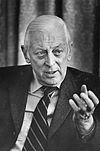
“There have been two Bertrand Russells: one who died during the war; and another who rose out of that one's shroud, an almost mystic communist born out of the ashes of a mathematical logician. Perhaps there was a tender mystic strain in him always; represented at first by a mountain of algebraic formulae; and then finding a distorted expression in a socialism that has the earmarks rather of a religion than of a philosophy. The most characteristic title among his books is Mysticism and Logic: a merciless attack on the illogicality of mysticism, followed by such a glorification of scientific method as makes one think of the mysticism of logic. Russell inherits the English positivist tradition, and is resolved to be tough-minded, because he knows that he cannot...It is remarkable that after writing several volumes of this learned moonshine, Bertrand Russell should suddenly come down upon the surface of this planet, and begin to reason very passionately about war, and government, and socialism, and revolution,– and never once make use of the impeccable formulae piled like Pelion upon Ossa in his Principia Mathematica. Nor has anyone else, observably, made use of them...Freedom is the supreme good; for without it personality is impossible. Freedom of thought and speech would go like a cleansing draught through the neuroses and superstitions of the "modern" mind. For we are not so educated as we think; we are but beginning the great experiment of universal schooling; and it has not had time to affect profoundly our ways of thinking and our public life. We are building the equipment, but we are still primitive in methods and technique; we think of education as the transmission of a certain body of settled knowledge, when it should be rather the development of a scientific habit of mind. The distinctive feature of the unintelligent man is the hastiness and absoluteness of his opinions; the scientist is slow to believe, and never speaks without modification...There is nothing that man might not do if our splendid organization of schools and universities were properly developed and properly manned, and directed intelligently to the reconstruction of human character. This, and not violent revolution, or paper legislation, is the way out of economic greed and international brutality. Man has come to control all other forms of life because he has taken more time in which to grow up; when he takes still more time, and spends that time more wisely, he may learn even to control arid. remake himself. Our schools are the open sesame to Utopia...All in all, a very lovable man: capable of the profoundest metaphysics and the subtlest mathematics, and yet speaking always simply, with the clarity which comes only to those who are sincere; a man addicted to fields of thought that usually dry up the springs of feeling, and yet warmed and illumined with pity, full of an almost mystic tenderness for mankind. Not a courtier, but surely a scholar and a gentleman, and a better Christian than some who mouth the word. Happily, he is still young and vigorous, the flame of life burns brightly in him yet; who knows but this next decade will see him grow out of disillusionment into wisdom, and write his name among the highest in "the serene brotherhood of philosophs"?”
“Bertrand Russell, as all reading America knows, has a right to be proud of his name in respect of his own achievements. He is, I believe, a very great mathematician. But he is also a profound thinker on human affairs, and unlike so many important thinkers, he can write. His thoughts do not have to be dug up for general consumption out of long, badly constructed books full of highly technical terms. They reach us in small, clearly constructed books, and in English that is not only beautifully simple but often poetic…”
“Great spirits have always encountered violent opposition from mediocre minds. The mediocre mind is incapable of understanding the man who refuses to bow blindly to conventional prejudices and chooses instead to express his opinions courageously and honestly.”
“Lieber Bertrand Russell! Ich habe schon lange den Wunsch, Ihnen zu schreiben. Nichts anderes wollte ich dabei, als Ihnen meine hohe Bewunderung ausdrücken. Die Klarheit, Sicherheit und Unparteilichkeit, mit der Sie die logischen, philosophischen und menschlichen Dinge in Ihren Büchern behandelt haben, steht nicht nur in unserer Generation unerreicht da.”Original / Translation (German)“Lieber Bertrand Russell! Ich habe schon lange den Wunsch, Ihnen zu schreiben. Nichts anderes wollte ich dabei, als Ihnen meine hohe Bewunderung ausdrücken. Die Klarheit, Sicherheit und Unparteilichkeit, mit der Sie die logischen, philosophischen und menschlichen Dinge in Ihren Büchern behandelt haben, steht nicht nur in unserer Generation unerreicht da.”English: “Dear Bertrand Russell For a long time I have had the wish to write you. All I wanted to do, was to express my feeling of high admiration of you. The clarity, sureness, and impartiality which you have brought to bear to the logical, philosophical and human problems dealt with in your books are unrivalled not only in our generation.”
“My husband, T.S. Eliot, loved to recount how late one evening he stopped a taxi. As he got in, the driver said: 'You're T.S. Eliot.' When asked how he knew, he replied: 'Ah, I've got an eye for a celebrity. Only '''the other evening I picked up Bertrand Russell, and I said to him: "Well, Lord Russell, what's it all about?" And, do you know, he couldn't tell me.''''”
“What is it about the study of philosophy that tends to make brilliant minds stupid when it comes down to what are known as actual cases? Consider Martin Heidegger, Bertrand Russell, Jean-Paul Sartre, and Ludwig Wittgenstein, the four great names in twentieth-century philosophy: the first was a Nazi, the second died certain that America was responsible for all the world's evil, the third was a Stalinist long after any justification for being so could be adduced, and the fourth lived on the borders of madness most of his life. Contemplation of the lives of philosophers is enough to drive one to the study of sociology.”
“He was always ready to pose the truly awkward dilemmas, and time and again he swam against the stream. ... Few figures in history can match his persistent intellectual courage. ... He became one of the chief glories of our nation and our people and I defy anyone who loves the English language and the English heritage to think of him without a glow of patriotism.”

“There were certain members of the British Mission, however, not entirely inclined to look in open-mouthed wonder at the things about them, with their mental eyes shut. These were not of the labouring element. One of them was Mr. Bertrand Russell. Very politely but decisively he had from the very first refused to be officially chaperoned. He preferred to go about himself. He also showed no elation over the honour of being quartered in a palace and fed on special morsels. Suspicious person, that Russell, the Bolsheviki whispered. But then, what can you expect of a bourgeois?”

“It is difficult to overstate the extent to which Russell's thought dominated twentieth century analytic philosophy: virtually every strand in its development either originated with him or was transformed by being transmitted through him. Analytic philosophy itself owes its existence more to Russell than to any other philosopher.”
“I can remember Bertrand Russell telling me of a horrible dream. He was in the top floor of the University Library, about A.D. 2100. A library assistant was going round the shelves carrying an enormous bucket, taking down books, glancing at them, restoring them to the shelves or dumping them into the bucket. At last he came to three large volumes which Russell could recognize as the last surviving copy of Principia Mathematica. He took down one of the volumes, turned over a few pages, seemed puzzled for a moment by the curious symbolism, closed the volume, balanced it in his hand and hesitated....”
“Russell's prose has been compared by T.S. Eliot to that of David Hume's. I would rank it higher, for it had more color, juice, and humor. But to be lucid, exciting and profound in the main body of one's work is a combination of virtues given to few philosophers. Bertrand Russell has achieved immortality by his philosophical writings.”
“As an admirer and reader of his, one day I could not contain myself and spoke to him. "Mr. Russell," I said, "I know why I eat here. It is because I am poor. But why do you eat here?" "Because," he said, "I am never interrupted."”
“When Bertrand Russell had, by his second wife, a first child, a friend accosted him with, "Congratulations, Bertie! Is it a girl or a boy?" Russell replied, "Yes, of course, what else could it be?"”
“All Bertrand Russell said about [his meeting with Einstein] (apart from how wonderful Einstein looked, and his wonderful eyes) was that Einstein told him a dirty story. I said that Einstein was well known for consummate tact in adapting himself to his company.”

“I felt the theory [of relativity] was about the greatest intellectual advance and illumination that had ever happened. I explained it to Russell, who at that time knew no physics. He was similarly staggered. Suddenly he burst out (to Dora's consternation): ''''To think I have spent my life on absolute muck.''''”
“The mind of Bertrand Russell is the anthropomorphized apex of supreme intelligence.”
“Russell, when asked to give an example of how any statement whatever, say that Russell (a renowned atheist) is the Pope, might follow from the self-contradictory statement 5=2+2, suggested that 3 be subtracted from both sides of this supposed equality; it follows that 2=1, thus two different persons, viz. Bertrand Russell and the Pope, form one person; hence Russell is the Pope.”
“At one time, many philosophers held that faultless "laws of thought" were somehow inherent, a priori, in the very nature of mind. This belief was twice shaken in the past century; first when Russell and his successors showed how the logic men employ can be defective, and later when Freud and Piaget started to reveal the tortuous ways in which our minds actually develop. After Russell observed that the seemingly frivolous "Who shaves the Barber, who shaves everyone who does not shave himself?" was a truly serious obstacle to formalizing common sense logic, he and others tried to develop new formalisms that voided such problems -- by preventing the fatal self-references. But the proposed substitutes were much too complicated to serve for everyday use.”

“Not since Lucretius has there been so much eloquence spent on proving the validity of "unyielding despair" as the foundation of our "safety." But whatever we think of this text, it is easy to derive from it the bitter attitude of Sisyphus who knows the meaninglessness of his task and who performs it nonetheless (instead of choosing suicide) because of the supposed dignity of the gesture. It is equally easy to derive from it the only remaining program for man—other than absurd action, acte gratuit—the esthetic creation by which he creates meaning (beauty) in a universe where none pre-exists him and none will survive him.”

“Mr. Bertrand Russell has noted that each improvement in locomotion has increased the area over which people are compelled to move: so that a person who would have had to spend half an hour to walk to work a century ago must still spend half an hour to reach his destination, because the contrivance that would have enabled him to save time had he remained in his original situation now—by driving him to a more distant residential area—effectually cancels out the gain.”

“Its enduring value was simply a deeper understanding of the central concepts of mathematics and their basic laws and interrelationships. Their total translatability into just elementary logic and a simple familiar two-place predicate, membership, is of itself a philosophical sensation.”
“Mr. Russell is one of the most readable of living writers, and it is very reassuring to know that he exists. So long as he and a few others like him are alive and out of jail, we know that the world is still sane in parts. He has rather an eclectic mind, he is capable of saying shallow things and profoundly interesting things in alternate sentences, and sometimes, even in this book, he is less serious than his subject. But he has an essentially decent intellect, a kind of intellectual chivalry which is far rarer than mere cleverness. Few people during the past thirty years have been so consistently impervious to the fashionable bunk of the moment.”

“As an undergraduate I was a member of the Voltaire Society, and we used to have dinner with Bertrand Russell, and he was 85 years old. And we thought, you know, he is getting on in years, and we put the question to him, we said: "Well, suppose it were all true, that after you pass away you show up at the Pearly Gates, what would you say to Him?" And Russell didn't hesitate a minute, he said: "I would say to Him: you didn't give us enough evidence!"”

“Oh, Bertrand Russell! Oh, Hewlett Johnson! Where, oh where, was your flaming conscience at that time?”

“Russell is the greatest logician since Aristotle, but he is not always quite reasonable or consistent, partly, I think, because he is a socialist who has never discarded an aristocratic outlook.”
“Bertrand Russell won immortality with his contributions to our understanding of logic.”
“He was the most fascinating man I have ever known, the only man I ever loved, the greatest man I shall ever meet, the wittiest, the gayest, the most charming. It was a privilege to know him, and I thank God he was my father.”
“I would have liked to convince my father that I had found what he had been looking for, the ineffable something he had longed for all his life. I would have liked to persuade him that the search for God does not have to be in vain. But it was hopeless. He had known too many blind Christians, bleak moralists who sucked the joy from life and persecuted their opponents; he would never have been able to see the truth they were hiding.”
“Christians were mocked for imagining that man is important in the vast scheme of the universe, even the high point of all creation – and yet my father thought man and his preservation the most important thing in the world, and he lived in hopes of a better life to come. He was by temperament a profoundly religious man, a sort of passionate moralist who would have been a saint in a more believing age. I believe myself that his whole life was a search for God... Somewhere at the back of my father's mind, at the bottom of his heart, in the depths of his soul, there was an empty space that had once been filled by God, and he never found anything else to put it in.”
“Russell is the most gifted Englishman alive.”
“Russell doesn't understand the importance of the past, or of tradition, and—he won't qualify.”
“Russell is a Platonic dialogue in himself.”
“Bertie says that I am muddle headed, but I say that he is simple minded.”
“A gentle, even shy man, Russell was delightful as a conversationalist, companion and friend. He was capable of a pyrotechnical display of wit, erudition and curiosity, and he bubbled with anecdotes about the world's greats.”
“It is impossible to describe Bertrand Russell except by saying that he looks like the Mad Hatter.”
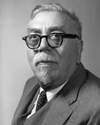
“Russell's books should be bound in two colours, those dealing with mathematical logic in red – and all students of philosophy should read them; those dealing with ethics and politics in blue – and no one should be allowed to read them.”
“This is the great paradox of Russell. All his instincts were on the side of the "rationalists"; his greatest hatred was for those who exalted emotion, or any sort of mystic intuition, at the expense of reason. But because Russell was the greatest rationalist of all, he had to admit that reason cannot prove the mystics wrong. In fact, in some private moods he was a mystic himself.”
“I used generally to have tea with in his [Russell's] rooms in Trinity when I went to Cambridge. A more brilliant intellect I never met, but he was much more approachable than McTaggart had been at first; and he had a peculiar charm of his own. His writings were most pessimistic, but he himself always appeared in the best of spirits—a feature which I had also noticed in pessimists on frontier expeditions. Apparently the way really to enjoy oneself is to be full of dark forebodings and expect the worst; then if the worst actually happens it is only what one had expected, and if anything less than the worst occurs one can be in uproarious good-humour.”
Quotes attributed to Bertrand Russell that are questionable.
“Not enough evidence God! Not enough evidence!”
“One must care about a world one will not see.”
“War does not determine who is right – only who is left.”
“Few people can be happy unless they hate some other person, nation, or creed.”
“In all affairs – love, religion, politics, or business – it's a healthy idea, now and then, to hang a question mark on the things you have long taken for granted.”
“If there were in the world today any large number of people who desired their own happiness more than they desired the unhappiness of others, we could have a paradise in a few years.”
“A new moral outlook is called for in which submission to the powers of nature is replaced by respect for what is best in man. It is where this respect is lacking that scientific technique is dangerous.”
“I believe in using words, not fists... I believe in my outrage knowing people are living in boxes on the street. I believe in honesty. I believe in a good time. I believe in good food. I believe in sex.”
Quotes mistakenly credited to Bertrand Russell.
“Better red than dead.”
“The time you enjoy wasting is not wasted time.”
“None but a coward dares to boast that he has never known fear.”
“The most important thing a father can do for his children is to love their mother.”
“ If forty million people say a foolish thing it does not become a wise one, but the wise man is foolish to give them the lie.”
“If a "religion" is defined to be a system of ideas that contains unprovable statements, then Gödel taught us that mathematics is not only a religion, it is the only religion that can prove itself to be one.”