Bertrand Russell on Socrates
← Back to Bertrand Russell Profile
“Socrates was the chief saint of the Stoics throughout their history; his attitude at the time of his trial, his refusal to escape, his calmness in the face of death, and his contention that the perpetrator of injustice injures himself more than his victim, all fitted in perfectly with Stoic teaching. So did his indifference to heat and cold, his plainness in matters of food and dress, and his complete independence of all bodily comforts.”
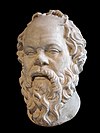
“We are told that Socrates, though indifferent to wine, could, on occasion, drink more than anybody else, without ever becoming intoxicated. It was not drinking that he condemned, but pleasure in drinking. In like manner, the philosopher must not care for the pleasures of love, or for costly raiment, or sandals, or other adornments of the person. He must be entirely concerned with the soul, and not with the body: "He would like, as far as he can, to get away from the body and to turn to the soul."”
“The Platonic Socrates was a pattern to subsequent philosophers for many ages... His merits are obvious. He is indifferent to worldly success, so devoid of fear that he remains calm and urbane and humorous to the last moment, caring more for what he believes to be the truth than for anything else whatever. He has, however, some very grave defects. He is dishonest and sophistical in argument, and in his private thinking he uses intellect to prove conclusions that are to him agreeable, rather than in a disinterested search for knowledge. There is something smug and unctuous about him, which reminds one of a bad type of cleric. His courage in the face of death would have been more remarkable if he had not believed that he was going to enjoy eternal bliss in the company of the gods. Unlike some of his predecessors, he was not scientific in his thinking, but was determined to prove the universe agreeable to his ethical standards. This is treachery to truth, and the worst of philosophic sins. As a man, we may believe him admitted to the communion of saints; but as a philosopher he needs a long residence in a scientific purgatory.”
“Every one is agreed that Socrates was very ugly; he had a snub nose and a considerable paunch; he was "uglier than all the Silenuses in the Satyric drama" ( Xenophon, Symposium). He was always dressed in shabby old clothes, and went barefoot everywhere. His indifference to heat and cold, hunger and thirst, amazed every one. Alcibiades in the Symposium, describing Socrates on military service, says: "His endurance was simply marvellous when, being cut off from our supplies, we were compelled to go without food — on such occasions, which often happen in time of war, he was superior not only to me but to everybody: there was no one to be compared to him. ...His fortitude in enduring cold was also surprising. There was a severe frost, for the winter in that region is really tremendous, and everybody else either remained indoors, or if they went out had on an amazing quantity of clothes, and were well shod, and had their feet swathed in felt and fleeces: in the midst of this, Socrates with his bare feet on the ice and in his ordinary dress marched better than the other soldiers who had shoes, and they looked daggers at him because he seemed to despise them." His mastery over all bodily passions is constantly stressed. He seldom drank wine, but when he did, he could out-drink anybody; no one had ever seen him drunk. In love, even under the strongest temptations, he remained "Platonic," if Plato is speaking the truth. He was the perfect Orphic saint: in the dualism of heavenly soul and earthly body, he had achieved the complete mastery of the soul over the body. His indifference to death at the last is the final proof of this mastery.”