Bertrand Russell on Stoicism
← Back to Bertrand Russell Profile
“What was best in the Cynic doctrine passed over into Stoicism, which was an altogether more complete and rounded philosophy.”
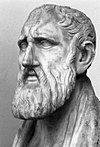
“If virtue is the sole good, there can be no reason against cruelty and injustice, since, as the Stoics are never tired of pointing out, cruelty and injustice afford the sufferer the best opportunities for the exercise of virtue.”
“Stoicism, unlike the earlier purely Greek philosophies, is emotionally narrow, and in a certain sense fanatical; but it also contains religious elements of which the world felt the need, and which the Greeks seemed unable to supply.”
“One cannot accept the attitude of some among the Stoics, who said, "What does it matter to me if my family suffer? I can still be virtuous." The Christian principle, "Love your enemies," is good, but the Stoic principle, "Be indifferent to your friends," is bad.”
“Spinoza does not, like the Stoics, object to all emotions; he objects only to those that are "passions," i.e., those in which we appear to ourselves to be passive in the power of outside forces. …Understanding that all things are necessary helps the mind to acquire power over the emotions.”
“There is, in fact, an element of sour grapes in Stoicism. We can't be happy, but we can be good; let us therefore pretend that, so long as we are good, it doesn't matter being unhappy. This doctrine is heroic, and, in a bad world, useful; but it is neither quite true nor, in a fundamental sense, quite sincere.”
“There are two ways of coping with fear: one is to diminish the external danger, and the other is to cultivate Stoic endurance. The latter can be reinforced, except where immediate action is necessary, by turning our thoughts away from the cause of fear. The conquest of fear is of very great importance. Fear is in itself degrading; it easily becomes an obsession; it produces hate of that which is feared, and it leads headlong to excesses of cruelty. Nothing has so beneficent an effect on human beings as security.”
“Socrates was the chief saint of the Stoics throughout their history; his attitude at the time of his trial, his refusal to escape, his calmness in the face of death, and his contention that the perpetrator of injustice injures himself more than his victim, all fitted in perfectly with Stoic teaching. So did his indifference to heat and cold, his plainness in matters of food and dress, and his complete independence of all bodily comforts. But the Stoics never took over Plato's doctrine of ideas, and most of them rejected his arguments for immortality. Only the later Stoics followed him in regarding the soul as immaterial; the earlier Stoics agreed with Heraclitus in the view that the soul is composed of material fire.”
“Belief in God and a future life makes it possible to go through life with less of stoic courage than is needed by skeptics. A great many young people lose faith in these dogmas at an age at which despair is easy, and thus have to face a much more intense unhappiness than that which falls to the lot of those who have never had a religious upbringing. Christianity offers reasons for not fearing death or the universe, and in so doing it fails to teach adequately the virtue of courage. The craving for religious faith being largely an outcome of fear, the advocates of faith tend to think that certain kinds of fear are not to be deprecated. In this, to my mind, they are gravely mistaken. To allow oneself to entertain pleasant beliefs as a means of avoiding fear is not to live in the best way. In so far as religion makes its appeal to fear, it is lowering to human dignity.”
“To a modern mind, it is difficult to feel enthusiastic about a virtuous life if nothing is going to be achieved by it. We admire a medical man who risks his life in an epidemic of plague, because we think illness is an evil, and we hope to diminish its frequency. But if illness is no evil, the medical man might as well stay comfortably at home. To the Stoic, his virtue is an end in itself, not something that does good. And when we take a longer view, what is the ultimate outcome? A destruction of the present world by fire, and then a repetition of the whole process. Could anything be more devastatingly futile? There may be progress here and there, for a time, but in the long run there is only recurrence. When we see something unbearably painful, we hope that in time such things will cease to happen; but the Stoic assures us that what is happening now will happen over and over again. Providence, which sees the whole, must, one would think, ultimately grow weary through despair.”
“There goes with this a certain coldness in the Stoic conception of virtue. Not only bad passions are condemned, but all passions. The sage does not feel sympathy: when his wife or his children die, he reflects that this event is no obstacle to his own virtue, and therefore he does not suffer deeply. Friendship, so highly prized by Epicurus, is all very well, but it must not be carried to the point where your friend's misfortunes can destroy your holy calm. As for public life, it may be your duty to engage in it, since it gives opportunities for justice, fortitude, and so on; but you must not be actuated by a desire to benefit mankind, since the benefits you can confer — such as peace, or a more adequate supply of food — are no true benefits, and, in any case, nothing matters to you except your own virtue. The Stoic is not virtuous in order to do good, but does good in order to be virtuous. It has not occurred to him to love his neighbour as himself; love, except in a superficial sense, is absent from his conception of virtue.”