Bertrand Russell on Teleology
← Back to Bertrand Russell Profile
“The atomists, unlike Socrates, Plato, and Aristotle, sought to explain the world without introducing the notion of purpose or final cause.”
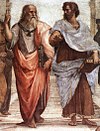
“Bacon not only despised the syllogism, but undervalued mathematics, presumably as insufficiently experimental. He was virulently hostile to Aristotle, but he thought very highly of Democritus, Although he did not deny that the course of nature exemplifies a Divine purpose, he objected to any admixture of teleological explanation in the actual investigation of phenomena; everything, he held, should be explained as following necessarily from efficient causes.”
“The atomists asked the mechanistic question, and gave a mechanistic answer. Their successors, until the Renaissance, were more interested in the teleological question, and thus led science up a blind alley. In regard to both questions alike, there is a limitation which is often ignored, both in popular thought and in philosophy. Neither question can be asked intelligibly about reality, as a whole (including God), but only about parts of it. ...The conception of purpose, therefore, is only applicable within reality, not to reality as a whole.”
“When we ask "why?" concerning an event, we may mean either of two things. We may mean: "What purpose did this event serve?" or we may mean: "What earlier circumstances caused this event?" The answer to the former question is a teleological explanation, or an explanation by final causes; the answer to the latter question is a mechanistic explanation. I do not see how it could have been known in advance which of these two questions science ought to ask, or whether it ought to ask both. But experience has shown that the mechanistic question leads to scientific knowledge, while the teleological question does not.”