Bertrand Russell on Pythagoras
← Back to Bertrand Russell Profile
“Personal religion is derived from ecstasy, theology from mathematics, and both are to be found in Pythagoras.”
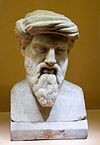
“Pythagoras, as everyone knows, said that "all things are numbers." This statement, interpreted in a modern way, is logical nonsense, but what he meant was not exactly nonsense. He discovered the importance of numbers in music and the connection which he established between music and arithmetic survives in the mathematical terms "harmonic mean" and "harmonic progression." He thought of numbers as shapes, as they appear on dice or playing cards. We still speak of squares or cubes of numbers, which are terms that we owe to him. He also spoke of oblong numbers, triangular numbers, pyramidal numbers, and so on. These were the numbers of pebbles [or calculi] (or as we would more naturally say, shot) required to make the shapes in question.”
“The combination of mathematics and theology, which began with Pythagoras, characterized religious philosophy in Greece, in the Middle Ages, and in modern times down to Kant. Orphism before Pythagoras was analogous to Asiatic mystery religions. But in Plato, Saint Augustine, Thomas Aquinas, Descartes, Spinoza, and Kant there is an intimate blending of religion and reasoning, of moral aspiration with logical admiration of what is timeless, which comes from Pythagoras, and distinguishes the intellectualized theology of Europe from the more straightforward mysticism of Asia. It is only in quite recent times that it has been possible to say clearly that Pythagoras was wrong. I do not know of any other man who has been as influential as he was in the sphere of thought. I say this because what appears as Platonism is, when analyzed, found to be in essence Pythagoreanism. The whole conception of an eternal world, revealed to the intellect but not to the senses, is derived from him. But for him, Christians would not have thought of Christ as the Word; but for him, theologians would not have sought logical proofs of God and immortality.”