Bertrand Russell on Karl Marx
← Back to Bertrand Russell Profile
“Marx's father became a Christian when Marx was a little boy, and some, at least, of the dogmas he must have then accepted seem to have born fruit in his son's psychology.”
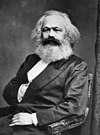
“In yet another aspect he is the last of the great system-builders, the successor of Hegel, a believer, like him, in a rational formula summing up the evolution of mankind.”
“My objections to Marx are of two sorts: one, that he was muddle-headed; and the other, that his thinking was almost entirely inspired by hatred. The doctrine of surplus value, which is supposed to demonstrate the exploitation of wage-earners under capitalism, is arrived at: (a) by surreptitiously accepting Malthus's doctrine of population, which Marx and all his disciples explicitly repudiate; (b) by applying Ricardo's theory of value to wages, but not to the prices of manufactured articles. He is entirely satisfied with the result, not because it is in accordance with the facts or because it is logically coherent, but because it is calculated to rouse fury in wage-earners. Marx's doctrine that all historical events have been motivated by class conflicts is a rash and untrue extension to world history of certain features prominent in England and France a hundred years ago. His belief that there is a cosmic force called Dialectical Materialism which governs human history independently of human volitions, is mere mythology. His theoretical errors, however, would not have mattered so much but for the fact that, like Tertullian and Carlyle, his chief desire was to see his enemies punished, and he cared little what happened to his friends in the process. […] I have always disagreed with Marx… But my objections to modern Communism go deeper than my objections to Marx. It is the abandonment of democracy that I find particularly disastrous.”