Link Copied!
Anicius Manlius Severinus Boethius Quotes (480-524)
Philosopher, Poet, Politician
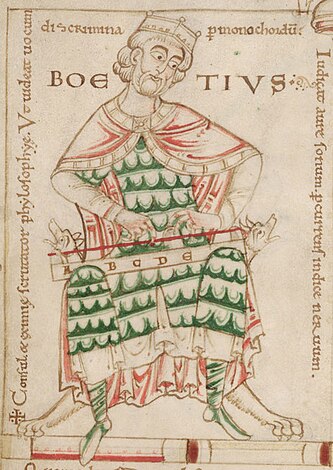
About Anicius Manlius Severinus Boethius
Ancius Manlius Severinus Boethius (c. 480–524 CE) was a Roman Christian philosopher, poet, and politician.
Best Anicius Manlius Severinus Boethius Quotes
Shortest
Earliest
Explore our curated collection of the most famous and impactful Anicius Manlius Severinus Boethius quotes.
“Qui cecidit, stabili non erat ille gradu.”
“Si operam medicantis exspectas, oportet vulnus detegas.”
“Quis legem det amantibus?
Maior lex amor est sibi.”
Maior lex amor est sibi.”
“''Vis aptam meritis uicem referre:
Dilige iure bonos et miseresce malis.”
Dilige iure bonos et miseresce malis.”
“Nam in omni adversitate fortunae infelicissimum est genus infortunii fuisse felicem.”
“Quis enim cohercente in ordinem cuncta deo locus esse ullus temeritati reliquus potest?”
“Sic quae permissis fluitare videtur habenis
Fors patitur frenos ipsaque lege meat.”
Fors patitur frenos ipsaque lege meat.”
“Adeo nihil est miserum nisi cum putes, contraque beata sors omnis est aequanimitate tolerantis.”
“Quis est enim tam compositae felicitatis ut non aliqua ex parte cum status sui qualitate rixetur?”
“Tu quoque falsa tuens bona prius
incipe colla iugo retrahere:
Vera dehinc animum subierint.”
incipe colla iugo retrahere:
Vera dehinc animum subierint.”
“Video, inquam, quae sit vel felicitas vel miseria in ipsis proborum atque improborum meritis constituta.”
“''Unde haud iniuria tuorum quidam familiarium quaesiuit: 'si quidem deus', inquit, 'est, unde mala? Bona uero unde, si non est?'''”
“''Quodsi putatis longius vitam trahi
mortalis aura nominis,
cum sera vobis rapiet hoc etiam dies
iam vos secunda mors manet.”
mortalis aura nominis,
cum sera vobis rapiet hoc etiam dies
iam vos secunda mors manet.”
“''Qui serere ingenuum uolet agrum
liberat arua prius fruticibus,
falce rubos filicemque resecat,
ut noua fruge grauis Ceres eat.”
liberat arua prius fruticibus,
falce rubos filicemque resecat,
ut noua fruge grauis Ceres eat.”
“Videsne igitur quanto in caeno probra volvantur, qua probitas luce resplendeat? In quo perspicuum est numquam bonis praemia, numquam sua sceleribus deesse supplicia.”
“Music is associated not only with speculation but with morality. When rhythms and modes reach an intellect through the ear, they doubtless affect and reshape that mind according to their particular character.”


“O felix hominum genus,
si uestros animos amor
quo caelum regitur regat!
• Alternate translation:
How happy is mankind
if the love that orders the stars above
rules, too, in your hearts.”
si uestros animos amor
quo caelum regitur regat!
• Alternate translation:
How happy is mankind
if the love that orders the stars above
rules, too, in your hearts.”

“Nec speres aliquid nec extimescas,
exarmaueris impotentis iram;
at quisquis trepidus pauet uel optat,
quod non sit stabilis suique iuris,
abiecit clipeum locoque motus
nectit qua ualeat trahi catenam.”
exarmaueris impotentis iram;
at quisquis trepidus pauet uel optat,
quod non sit stabilis suique iuris,
abiecit clipeum locoque motus
nectit qua ualeat trahi catenam.”
“Quae ubi poeticas Musas uidit nostro assistentes toro fletibusque meis uerba dictantes, commota paulisper ac toruis inflammata luminibus: Quis, inquit, has scenicas meretriculas ad hunc aegrum permisit accedere, quae dolores eius non modo nullis remediis fouerent, uerum dulcibus insuper alerent uenenis? Hae sunt enim quae infructuosis affectuum spinis uberem fructibus rationis segetem necant hominumque mentes assuefaciunt morbo, non liberant.”
“Nam si uti corporum languor ita vitiositas quidam est quasi morbus animorum, cum aegros corpore minime dignos odio sed potius miseratione iudicemus, multo magis non insequendi sed miserandi sunt quorum mentes omni languore atrocior urguet improbitas.
• Alternate translation:
For as faintness is a disease of the body, so is vice a sickness of the mind. Wherefore, since we judge those that have corporal infirmities to be rather worthy of compassion than of hatred, much more are they to be pitied, and not abhorred, whose minds are oppressed with wickedness, the greatest malady that may be.”
Quotes About Anicius Manlius Severinus Boethius
Gain deeper perspective through quotes about Anicius Manlius Severinus Boethius from others.
Edward Gibbon on Anicius Manlius Severinus Boethius
“While Boethius, oppressed with fetters, expected each moment the sentence or the stroke of death, he composed, in the tower of Pavia, the Consolation Of Philosophy; a golden volume not unworthy of the leisure of Plato or Tully, but which claims incomparable merit from the barbarism of the times and the situation of the author.”

Dan Jones on Anicius Manlius Severinus Boethius
“Throughout his life Boethius had written on a wide range of subjects: his interests included mathematics, music, philosophy and theology. But he composed his most famous work in jail while awaiting execution for his crimes. The Consolation of Philosophy attempted to place earthly troubles in a divine context. Written in the form of a dialogue between Boethius and Lady Philosophy, it asked its readers to accept that there were higher powers at work behind the vicissitudes of man’s fleeting life. In the course of his musings, he turned to the notion of fortune’s wheel. ‘So now you have committed yourself to the rule of Fortune, you must acquiesce in her ways,’ he wrote. ‘If you are trying to stop her wheel form turning, you are of all men the most obtuse.’”
Bertrand Russell on Anicius Manlius Severinus Boethius
“Boethius is a singular figure. Throughout the Middle Ages he was read and admired, regarded always as a devout Christian and treated almost as if he had been one of the Fathers. Yet his Consolations of Philosophy, written in 524 while he was awaiting execution, is purely Platonic; it does not prove that he was not a Christian, but it does show that pagan philosophy had a much stronger hold on him than Christian theology. Some theological works, especially one on the Trinity, which are attributed to him, are by many authorities considered to be spurious; but it was probably owing to them that the Middle Ages were able to regard him as orthodox, and to imbibe from him much Platonism which would otherwise have been viewed with suspicion. . . . The tone of the book is more like that of Plato than that of Plotinus. There is no trace of the superstition or morbidness of the age, no obsession with sin, no excessive straining after the unattainable. There is perfect philosophic calm—so much that, if the book had been written in prosperity, it might almost have been called smug. Written when it was, in prison under sentence of death, it is as admirable as the last moments of the Platonic Socrates. One does not find a similar outlook until after Newton. . . . [Boethius’s] combination with great learning and zeal for the public good was unique in that age. During the two centuries before his time and the ten centuries after it, I cannot think of any European man of learning so free from superstition and fanaticism. Nor are his merits merely negative; his survey is lofty, disinterested, and sublime. He would have been remarkable in any age; in the age in which he lived, he is utterly amazing.”

John D. Barrow on Anicius Manlius Severinus Boethius
“Ancient belief in a cosmos composed of spheres, producing music as angels guided them through the heavens, was still flourishing in Elizabethan times. …There is a good deal more to Pythagorean musical theory than celestial harmony. Besides the music of the celestial spheres (musica mundana), two other varieties of music were distinguished: the sound of instruments...(musica instrumentalis), and the continuous unheard music that emanated from the human body (musica humana), which arises from a resonance between the body and the soul. ...In the medieval world, the status of music is revealed by its position within the Quadrivium—the fourfold curriculum—alongside arithmetic, geometry, and astronomy. Medieval students... believed all forms of harmony to derive from a common source. Before Boethius' studies in the ninth century, the idea of musical harmony was not considered independently of wider matters of celestial or ethical harmony.”

About Anicius Manlius Severinus Boethius
Ancius Manlius Severinus Boethius (c. 480–524 CE) was a Roman Christian philosopher, poet, and politician.