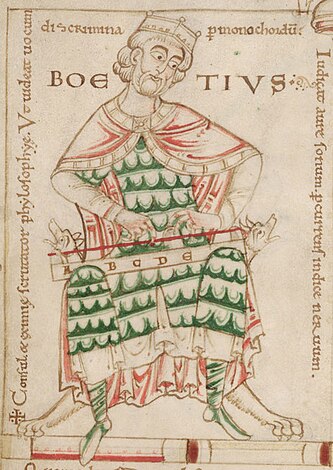
Throughout his life Boethius had written on a wide range of subjects: his interests included mathematics, music, philosophy and theology. But he composed his most famous work in jail while awaiting execution for his crimes. The Consolation of Philosophy attempted to place earthly troubles in a divine context. Written in the form of a dialogue between Boethius and Lady Philosophy, it asked its readers to accept that there were higher powers at work behind the vicissitudes of man’s fleeting life. In the course of his musings, he turned to the notion of fortune’s wheel. ‘So now you have committed yourself to the rule of Fortune, you must acquiesce in her ways,’ he wrote. ‘If you are trying to stop her wheel form turning, you are of all men the most obtuse.’
What It Means
This is a placeholder explanation generated by the low-overhead model. It interprets "Throughout his life Boethius had written on a wide range of subjects: his interests included mathematics, music, philosophy and theology. But he composed his most famous work in jail while awaiting execution for his crimes. The Consolation of Philosophy attempted to place earthly troubles in a divine context. Written in the form of a dialogue between Boethius and Lady Philosophy, it asked its readers to accept that there were higher powers at work behind the vicissitudes of man’s fleeting life. In the course of his musings, he turned to the notion of fortune’s wheel. ‘So now you have committed yourself to the rule of Fortune, you must acquiesce in her ways,’ he wrote. ‘If you are trying to stop her wheel form turning, you are of all men the most obtuse.’" in the context of "Dan Jones, Powers and Thrones: A New History of the Middle Ages (2021), p. 81" to mean that wisdom is timeless.
Tags
About Anicius Manlius Severinus Boethius