Link Copied!
Julian (emperor) Quotes (331-363)
Philosopher, Emperor, Leader
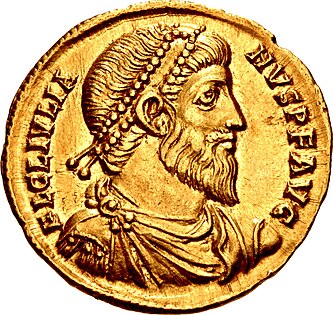
About Julian (emperor)
Flavius Claudius Julianus (c. 331 – 26 June 363) was a Hellenistic philosopher, military leader, Roman emperor, and satirist, often referred to as Julian the Apostate because of his rejection of formal Christian doctrines, and opposition to their spread, and sometimes as Julian II, to distinguish him from Didius Julianus. Sometimes now referred to as Julian the Philosopher, he was the last pagan Augustus of the Roman Empire.
Best Julian (emperor) Quotes
Shortest
Earliest
Explore our curated collection of the most famous and impactful Julian (emperor) quotes.
“Can anyone be proved innocent, if it be enough to have accused him?”

“Nullas infestas hominibus bestias, ut sunt sibi ferales plerique Christianorum expertus.”

“Is it not absurd when a human being tries to find happiness somewhere outside himself, and thinks that wealth and birth and the influence of friends...is of the utmost importance?”

“I think he who knows himself will know accurately, not the opinion of others about him, but what he is in reality… he ought to discover within himself what is right for him to do and not learn it from without…”
“I feel awe of the gods, I love, I revere, I venerate them, and in short have precisely the same feelings towards them as one would have towards kind masters or teachers or fathers or guardians or any beings of that sort.”
“The same things, therefore, does the Sun communicate to things intelligible, over whom he was appointed by the Good to reign and to command: although these were created and began to exist at the same moment with himself.”
“I too am not one to despise myths, and I am far from rejecting those that have the right tendency; indeed I am of the same opinion as you and your admired, or rather the universally admired, Plato. He also often conveyed a serious lesson in his myths.”

“The end and aim of the Cynic philosophy, as indeed of every philosophy, is happiness, but happiness that consists in living according to nature, and not according to the opinions of the multitude.”
“By the gods I do not want the Galileans to be killed or beaten unjustly nor to suffer any other ill. I do, however, state that the god-fearing (theosebeis) should be preferred to them … honour should go to the gods and to the men and cities that worship them.”
“Of all things nothing exists that is not by its substance the offspring of ocean. But why will you have me tell this to the vulgar? Although better to have been shrouded in silence, it nevertheless has been spoken; at all events I declare it, although all men will not readily receive the same.”

“I have observed that even the barbarians across the Rhine sing savage songs composed in language not unlike the croaking of harsh-voiced birds, and that they delight in such songs. For I think it is always the case that inferior musicians, though they annoy their audiences, give very great pleasure to themselves.”
“I lay it down that there is Matter, and also there are Material Species, but unless a Final Cause for them be previously assumed, we shall be, without perceiving it, introducing the doctrine of Epicurus: since if nothing be anterior to two efficient causes, a spontaneous flux and chance must have united the two together.”
“Whither are we fleeing, my most valiant men? Do you not know that flight never leads to safety, but shows the folly of a useless effort? Let us return to our companions, to be at least sharers in their coming glory, if it is without consideration that we are abandoning them as they fight for the Republic.”

“But why do you not cease to call Mary the mother of God, if Isaiah nowhere says that he that is born of the virgin is the "only begotten Son of God" and "the firstborn of all creation"?”
“I am not indeed ignorant that certain over-wise people will call these legends "old wives' fables," and not worth listening to; but I think, for my part, that in such matters it is better to believe the testimony of nations than of those witty individuals, whose little soul is acute indeed, but has a clear insight into no one thing.”

“Know all ye mortals who have entered this contest,
that according to our laws and decrees the victor is
allowed to exult but the vanquished must not complain.
Depart then wherever you please, and in future live
every one of you under the guidance of the gods.
Let every man choose his own guardian and guide.”
that according to our laws and decrees the victor is
allowed to exult but the vanquished must not complain.
Depart then wherever you please, and in future live
every one of you under the guidance of the gods.
Let every man choose his own guardian and guide.”
“The entire heaven, making its parts everywhere harmonize with him, is filled with spirits emanating out of the Sun. For this god is ruler of five orbits in the heavens, and whilst traversing three out of these orbits, he produces in three the Graces, themselves three in number, the remaining circles form the Scales to the Balance of supreme Necessity.”
“Men's works also are naturally perishable and mutable and subject to every kind of alteration. But since God is eternal, it follows that of such sort are his ordinances also. And since they are such, they are either the natures of things or are accordant with the nature of things. For how could nature be at variance with the ordinance of God? How could it fall out of harmony therewith?”

“Let us not admit discourses by Epicureans or Pyrrhonists – though indeed the gods have already in their wisdom destroyed their works, so that most of their books are no longer available. Nevertheless, there is no reason why I should not, by way of example, mention these works too, to show what sort of discourses priests must especially avoid; and if such discourses, then much more must they avoid such thoughts.”
“So long as you are a slave to the opinions of the many you have not yet approached freedom or tasted its nectar...But I do not mean by this that we ought to be shameless before all men and to do what we ought not; but all that we refrain from and all that we do, let us not do or refrain from merely because it seems to the multitude somehow honorable or base, but because it is forbidden by reason and the god within us.”
Julian (emperor) Quotes by Topic
Find exactly what you are looking for by browsing this categorized list of Julian (emperor) quotes by topic.
Julian (emperor) on Intelligibility 2 quotes
“One out of the one Intelligible world; he is stationed in the middle of the Intelligible Powers, according to the strictest sense.”

Julian (emperor) on Reverence
“Set a strong watch upon yourself: reverence us and us alone, and of men him that is like us and none other. You see what tricks self-consciousness and dumb foundering, faint-heartedness have played with yonder idiot.”

Julian (emperor) on Devotion
“To myself grant for the fruit of my devotion to thee — Truth in belief concerning the gods, the attainment of perfection in religious rites, and in all the undertakings which we attempt as regards warlike or military measures....”

Julian (emperor) on Despise
“I shall listen with great pleasure, for I too am not one to despise myths, and I am far from rejecting those that have the right tendency; indeed I am of the same opinion as you and your admired, or rather the universally admired, Plato.”
Julian (emperor) on Jupiter (mythology)
“For the planets round about him (the Sun), as though he were their king, lead on their dance, at appointed distances pursue their orbits at the utmost harmony....If, however, he should have nothing in common with them, except this power of doing good, which communicates unto all, then we ought to acquiesce in the reasoning of the Egyptian priests, who raise altars to the Sun conjointly with Jupiter; nay, rather we should assent to Apollo himself (long before them), who sits on the same throne with Jove, and whose words are, "One Jove, one Pluto, one Sun is Serapis. From which we must conclude that the sovereignty of the Sun and of Jupiter amongst the deities that are objects of intellect is held in common, or rather is one and the same.”

Julian (emperor) on Jupiter
“For the planets round about him (the Sun), as though he were their king, lead on their dance, at appointed distances pursue their orbits at the utmost harmony....If, however, he should have nothing in common with them, except this power of doing good, which communicates unto all, then we ought to acquiesce in the reasoning of the Egyptian priests, who raise altars to the Sun conjointly with Jupiter ; nay, rather we should assent to Apollo himself (long before them), who sits on the same throne with Jove, and whose words are, " One Jove, one Pluto, one Sun is Serapis. From which we must conclude that the sovereignty of the Sun and of Jupiter amongst the deities that are objects of intellect is held in common, or rather is one and the same.”

What Julian (emperor) Said About Others
Discover personal opinions Julian (emperor) shared regarding contemporaries.
Quotes About Julian (emperor)
Gain deeper perspective through quotes about Julian (emperor) from others.
G. W. Bowersock on Julian (emperor) 4 quotes
“Julian is without question one of antiquity's most enigmatic and compelling figures. He attempted the impossible by restoring for a moment the pagan gods to their former primacy, a feat which horrified the Christians and probably perplexed rather than inspired the majority of surviving pagans. Julian was a man of action and at the same time a man whose spiritual life brought him close to many of the most extreme wonder-workers of his age. … Anyone who believes that he can write an authoritative biography of Julian, with everything tidily in place from beginning to end, is deluding himself. The historian can only grope toward the facts about the man and his reign, but the groping is its own reward.”
Robert Browning on Julian (emperor)
“He was a tragic figure, a man of infinite promise, cut off before his prime. An American student once compared him to John F. Kennedy. The comparison will not bear close analysis. But the feeling behind it suggests why Julian became the subject of legend within a few years of his death.”
Constantine P. Cavafy on Julian (emperor) 5 quotes
“Immoral to a degree — and probably more than a degree — they certainly were. But they had the satisfaction that their life was the notorious life of Antioch, delectably sensual, in absolute good taste. To give up all this, indeed, for what?''' His hot air about the false gods, his boring self-advertisement, his childish fear of the theatre, his graceless prudery, his ridiculous beard.”

Anatole France on Julian (emperor)
“The Emperor Julian, who restored to the Empire its old religion, which had been abolished by Constantine the Apostate, is justly regarded as an opponent of the Galilean. And, when perusing the petty treatises of Julian, one is struck with the number of ideas this enemy of the Christians held in common with them. He, like them, is a monotheist; with them, he believes in the merits of abstinence, fasting, and mortification of the flesh; with them, he despises carnal pleasures, and considers he will rise in favour with the gods by avoiding women; finally, he pushes Christian sentiment to the degree of rejoicing over his dirty beard and his black finger-nails. The Emperor Julian's morals were almost those of St. Gregory Nazianzen. There is nothing in this but what is natural and usual. The transformations undergone by morals and ideas are never sudden. The greatest changes in social life are wrought imperceptibly, and are only seen from afar. Christianity did not secure a foothold until such time as the condition of morals accommodated itself to it, and as Christianity itself had become adjusted to the condition of morals. It was unable to substitute itself for paganism until such time as paganism came to resemble it, and itself came to resemble paganism.”

Alice Gardner on Julian (emperor)
“Hating pomp and show, impatient of the petty, hampering rules of Court etiquette, constantly dwelling in thought on the ancient glories of democratic Athens and senatorial Rome, he could hardly view the orientalising and inordinate exaltation of the Imperial dignity in the light of a reform. Yet his almost single-handed efforts to revive the great days of the Roman Senate and of Greek municipal freedom were not productive of very great results, either for good or for evil. … As to the change in spiritual conditions, this was to him not merely an adverse element of the environment in which he had to work; it was the destruction of all that he held dear and believed to be most necessary for the common good. He felt bound to prevent such a destruction at any cost, or to perish in the attempt.”
Edward Gibbon on Julian (emperor) 3 quotes
“While the Romans languished under the ignominious tyranny of eunuchs and bishops, the praises of Julian were repeated with transport in every part of the empire, except in the palace of Constantius. The barbarians of Germany had felt, and still dreaded, the arms of the young Caesar; his soldiers were the companions of his victory; the grateful provincials enjoyed the blessings of his reign; but the favorites, who had opposed his elevation, were offended by his virtues; and they justly considered the friend of the people as the enemy of the court. As long as the fame of Julian was doubtful, the buffoons of the palace, who were skilled in the language of satire, tried the efficacy of those arts which they had so often practised with success.”

Henrik Ibsen on Julian (emperor) 2 quotes
“That power which circumstances placed in my hands, and which is an emanation of divinity, I am conscious of having used to the best of my skill. I have never wittingly wronged any one. For this campaign there were good and sufficient reasons; and if some should think that I have not fulfilled all expectations, they ought in justice to reflect that there is a mysterious power without us, which in a great measure governs the issue of human undertakings.”
Adrian Murdoch on Julian (emperor)
“Of all the emperors, one there was whom I recall from boyhood — bold in war, a lawgiver, far-famed in word and deed; he cared much for his country, but cared not for the true faith, and loved a host of gods. False to the Lord, although true to the world.”
Gedaliahu A. G. Stroumsa on Julian (emperor)
“More than any other Hellenic thinker, Julian insisted on the virtue of paradox and on the importance of the search for religious truth.”
Theodoret on Julian (emperor)
“Julian’s folly was yet more clearly manifested by his death. He crossed the river that separates the Roman Empire from the Persian, brought over his army, and then forthwith burnt his boats, so making his men fight not in willing but in forced obedience. The best generals are wont to fill their troops with enthusiasm, and, if they see them growing discouraged, to cheer them and raise their hopes; but Julian by burning the bridge of retreat cut off all good hope. A further proof of his incompetence was his failure to fulfil the duty of foraging in all directions and providing his troops with supplies. Julian had neither ordered supplies to be brought from Rome, nor did he make any bountiful provision by ravaging the enemy’s country. He left the inhabited world behind him, and persisted in marching through the wilderness. His soldiers had not enough to eat and drink; they were without guides; they were marching astray in a desert land. Thus they saw the folly of their most wise emperor. In the midst of their murmuring and grumbling they suddenly found him who had struggled in mad rage against his Maker wounded to death. Ares who raises the war-din had never come to help him as he promised; Loxias had given lying divination; he who glads him in the thunderbolts had hurled no bolt on the man who dealt the fatal blow; the boasting of his threats was dashed to the ground. The name of the man who dealt that righteous stroke no one knows to this day. Some say that he was wounded by an invisible being, others by one of the Nomads who were called Ishmaelites; others by a trooper who could not endure the pains of famine in the wilderness. But whether it were man or angel who plied the steel, without doubt the doer of the deed was the minister of the will of God. It is related that when Julian had received the wound, he filled his hand with blood, flung it into the air and cried, "Thou hast won, O Galilean." Thus he gave utterance at once to a confession of the victory and to a blasphemy. So infatuated was he.”

Misattributed Quotes
Quotes mistakenly credited to Julian (emperor)
“Vicisti, Galilaee or "νενίκηκας Γαλιλαῖε"”
About Julian (emperor)
Flavius Claudius Julianus (c. 331 – 26 June 363) was a Hellenistic philosopher, military leader, Roman emperor, and satirist, often referred to as Julian the Apostate because of his rejection of formal Christian doctrines, and opposition to their spread, and sometimes as Julian II, to distinguish him from Didius Julianus. Sometimes now referred to as Julian the Philosopher, he was the last pagan Augustus of the Roman Empire.