Charles Darwin Quotes (1809-1882)



-100px.png)







-100px.jpg)









-100px.jpg)
-100px.jpg)





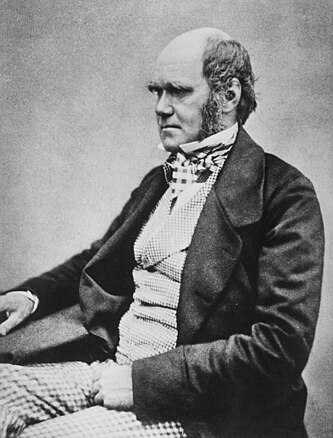
About Charles Darwin
Best Charles Darwin Quotes
Explore our curated collection of the most famous and impactful Charles Darwin quotes.



















Now when naturalists observe a close agreement in numerous small details of habits, tastes and dispositions between two or more domestic races, or between nearly-allied natural forms, they use this fact as an argument that all are descended from a common progenitor who was thus endowed; and consequently that all should be classed under the same species. The same argument may be applied with much force to the races of man.
As it is improbable that the numerous and unimportant points of resemblance between the several races of man in bodily structure and mental faculties (I do not here refer to similar customs) should all have been independently acquired, they must have been inherited from progenitors who were thus characterised.
”


I believe that animals have descended from at most only four or five progenitors, and plants from an equal or lesser number.
Analogy would lead me one step further, namely, to the belief that all animals and plants have descended from some one prototype. But analogy may be a deceitful guide. Nevertheless all living things have much in common, in their chemical composition, their germinal vesicles, their cellular structure, and their laws of growth and reproduction. We see this even in so trifling a circumstance as that the same poison often similarly affects plants and animals; or that the poison secreted by the gall-fly produces monstrous growths on the wild rose or oak-tree. Therefore I should infer from analogy that probably all the organic beings which have ever lived on this earth have descended from some one primordial form, into which life was first breathed by the Creator.
”





The fact that the lower animals are excited by the same emotions as ourselves is so well established, that it will not be necessary to weary the reader by many details. Terror acts in the same manner on them as on us, causing the muscles to tremble, the heart to palpitate, the sphincters to be relaxed, and the hair to stand on end. Suspicion, the offspring of fear, is eminently characteristic of most wild animals. Courage and timidity are extremely variable qualities in the individuals of the same species, as is plainly seen in our dogs. Some dogs and horses are ill-tempered and easily turn sulky; others are good-tempered; and these qualities are certainly inherited.”
But I was very unwilling to give up my belief; I feel sure of this, for I can well remember often and often inventing day-dreams of old letters between distinguished Romans, and manuscripts being discovered at Pompeii or elsewhere, which confirmed in the most striking manner all that was written in the Gospels. But I found it more and more difficult, with free scope given to my imagination, to invent evidence which would suffice to convince me. Thus disbelief crept over me at a very slow rate, but was at last complete. The rate was so slow that I felt no distress.
Although I did not think much about the existence of a personal God until a considerably later period of my life, I will here give the vague conclusions to which I have been driven. The old argument from design in Nature, as given by Paley, which formerly seemed to me so conclusive, fails, now that the law of natural selection has been discovered. We can no longer argue that, for instance, the beautiful hinge of a bivalve shell must have been made by an intelligent being, like the hinge of a door by man. There seems to be no more design in the variability of organic beings, and in the action of natural selection, than in the course which the wind blows. But I have discussed this subject at the end of my book on the Variation of Domesticated Animals and Plants, and the argument there given has never, as far as I can see, been answered.
”


And this is a damnable doctrine.
Although I did not think much about the existence of a personal God until a considerably later period of my life, I will here give the vague conclusions to which I have been driven. The old argument of design in nature, as given by Paley, which formerly seemed to me so conclusive, fails, now that the law of natural selection has been discovered. We can no longer argue that, for instance, the beautiful hinge of a bivalve shell must have been made by an intelligent being, like the hinge of a door by man. There seems to be no more design in the variability of organic beings and in the action of natural selection, than in the course which the wind blows. Everything in nature is the result of fixed laws. But I have discussed this subject at the end of my book on the Variation of Domesticated Animals and Plants, and the argument there given has never, as far as I can see, been answered.”
With savages, the weak in body or mind are soon eliminated; and those that survive commonly exhibit a vigorous state of health. We civilised men, on the other hand, do our utmost to check the process of elimination; we build asylums for the imbecile, the maimed, and the sick; we institute poor-laws; and our medical men exert their utmost skill to save the life of every one to the last moment. There is reason to believe that vaccination has preserved thousands, who from a weak constitution would formerly have succumbed to small-pox. Thus the weak members of civilised societies propagate their kind. No one who has attended to the breeding of domestic animals will doubt that this must be highly injurious to the race of man. It is surprising how soon a want of care, or care wrongly directed, leads to the degeneration of a domestic race; but excepting in the case of man himself, hardly any one is so ignorant as to allow his worst animals to breed.
The aid which we feel impelled to give to the helpless is mainly an incidental result of the instinct of sympathy, which was originally acquired as part of the social instincts, but subsequently rendered, in the manner previously indicated, more tender and more widely diffused. Nor could we check our sympathy, even at the urging of hard reason, without deterioration in the noblest part of our nature. The surgeon may harden himself whilst performing an operation, for he knows that he is acting for the good of his patient; but if we were intentionally to neglect the weak and helpless, it could only be for a contingent benefit, with an overwhelming present evil. We must therefore bear the undoubtedly bad effects of the weak surviving and propagating their kind; but there appears to be at least one check in steady action, namely that the weaker and inferior members of society do not marry so freely as the sound; and this check might be indefinitely increased by the weak in body or mind refraining from marriage, though this is more to be hoped for than expected.
”I have attempted to show that the geological record is extremely imperfect; that only a small portion of the globe has been geologically explored with care; that only certain classes of organic beings have been largely preserved in a fossil state; that the number both of specimens and of species, preserved in our museums, is absolutely as nothing compared with the incalculable number of generations which must have passed away even during a single formation; that, owing to subsidence being necessary for the accumulation of fossiliferous deposits thick enough to resist future degradation, enormous intervals of time have elapsed between the successive formations; that there has probably been more extinction during the periods of subsidence, and more variation during the periods of elevation, and during the latter the record will have been least perfectly kept; that each single formation has not been continuously deposited; that the duration of each formation is, perhaps, short compared with the average duration of specific forms; that migration has played an important part in the first appearance of new forms in any one area and formation; that widely ranging species are those which have varied most, and have oftenest given rise to new species; and that varieties have at first often been local (emphasis not Darwin's). All these causes taken conjointly, must have tended to make the geological record extremely imperfect, and will to a large extent explain why we do not find interminable varieties, connecting together all the extinct and existing forms of life by the finest graduated steps.
He who rejects these views on the nature of the geological record, will rightly reject my whole theory. For he may ask in vain where are the numberless transitional links which must formerly have connected the closely allied or representative species, found in the several stages of the same great formation. He may disbelieve in the enormous intervals of time which have elapsed between our consecutive formations; he may overlook how important a part migration must have played, when the formations of any one great region alone, as that of Europe, are considered; he may urge the apparent, but often falsely apparent, sudden coming in of whole groups of species. He may ask where are the remains of those infinitely numerous organisms which must have existed long before the first bed of the Silurian system was deposited: I can answer this latter question only hypothetically, by saying that as far as we can see, where our oceans now extend they have for an enormous period extended, and where our oscillating continents now stand they have stood ever since the Silurian epoch; but that long before that period, the world may have presented a wholly different aspect; and that the older continents, formed of formations older than any known to us, may now all be in a metamorphosed condition, or may lie buried under the ocean.
”
Charles Darwin Quotes by Topic
Find exactly what you are looking for by browsing this categorized list of Charles Darwin quotes by topic.
Charles Darwin on Insect 4 quotes
Charles Darwin on Science 4 quotes
Charles Darwin on Wild animal suffering 4 quotes
Charles Darwin on Evolution 4 quotes
Charles Darwin on Animals 4 quotes
What Charles Darwin Said About Others
Discover personal opinions Charles Darwin shared regarding contemporaries.
Charles Darwin on Thomas Henry Huxley
Charles Darwin on William Shakespeare

Charles Darwin on Georges Cuvier

Charles Darwin on Hermann von Helmholtz

Charles Darwin on Aristotle
Quotes About Charles Darwin
Gain deeper perspective through quotes about Charles Darwin from others.
Helena Petrovna Blavatsky on Charles Darwin
Sir David Brewster on Charles Darwin
As pointed out by Sir David Brewster on Charles Darwin
William Erasmus Darwin on Charles Darwin
Richard Dawkins on Charles Darwin






Disputed Quotes
Quotes attributed to Charles Darwin that are questionable.
Misattributed Quotes
Quotes mistakenly credited to Charles Darwin