Charles Darwin on Insect suffering
← Back to Charles Darwin Profile
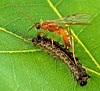
“I cannot persuade myself that a beneficent and omnipotent God would have designedly created the Ichneumonidæ with the express intention of their feeding within the living bodies of Caterpillars, or that a cat should play with mice.”
“Many insects stridulate by rubbing together specially modified parts of their hard integuments. This stridulation generally serves as a sexual charm or call; but it is likewise used to express different emotions [...] anger, terror, jealousy, and love.”
“Mental Qualities.—There is little to be said on this head. We have seen that worms are timid. It may be doubted whether they suffer as much pain when injured, as they seem to express by their contortions. Judging by their eagerness for certain kinds of food, they must enjoy the pleasure of eating. Their sexual passion is strong enough to overcome for a time their dread of light. They perhaps have a trace of social feeling, for they are not disturbed by crawling over each other's bodies, and they sometimes lie in contact. According to Hoffmeister they pass the winter either singly or rolled up with others into a ball at the bottom of their burrows.* Although worms are so remarkably deficient in the several sense-organs, this does not necessarily preclude intelligence, as we know from such cases as those of Laura Bridgman; and we have seen that when their attention is engaged, they neglect impressions to which they would otherwise have attended; and attention indicates the presence of a mind of some kind. They are also much more easily excited at certain times than at others.”
“When a worm is suddenly illuminated and dashes like a rabbit into its burrow—to use the expression employed by a friend—we are at first led to look at the action as a reflex one. The irritation of the cerebral ganglia appears to cause certain muscles to contract in an inevitable manner, independently of the will or consciousness of the animal, as if it were an automaton. But the different effect which a light produced on different occasions, and especially the fact that a worm when in any way employed and in the intervals of such employment, whatever set of muscles and ganglia may then have been brought into play, is often regardless of light, are opposed to the view of the sudden withdrawal being a simple reflex action. With the higher animals, when close attention to some object leads to the disregard of the impressions which other objects must be producing on them, we attribute this to their attention being then absorbed; and attention implies the presence of a mind. Every sportsman knows that he can approach animals whilst they are grazing, fighting or courting, much more easily than at other times. The state, also, of the nervous system of the higher animals differs much at different times, for instance, a horse is much more readily startled at one time than at another. The comparison here implied between the actions of one of the higher animals and of one so low in the scale as an earth-worm, may appear farfetched; for we thus attribute to the worm attention and some mental power, nevertheless I can see no reason to doubt the justice of the comparison.”