Montucla says, speaking of France, that he finds three notions prevalent among cyclometers: 1. That there is a large reward offered for success; 2. That the longitude problem depends on that success; 3. That the solution is the great end and object of geometry. The same three notions are equally prevalent among the same class in England. No reward has ever been offered by the government of either country. The longitude problem hi no way depends upon perfect solution; existing approximations are sufficient to a point of accuracy far beyond what can be wanted. And geometry, content with what exists, has long passed on to other matters. Sometimes a cyclometer persuades a skipper who has made land in the wrong place that the astronomers are at fault, for using a wrong measure of the circle; and the skipper thinks it a very comfortable solution! And this is the utmost that the problem has to do with longitude.
What It Means
This is a placeholder explanation generated by the low-overhead model. It interprets "Montucla says, speaking of France, that he finds three notions prevalent among cyclometers: 1. That there is a large reward offered for success; 2. That the longitude problem depends on that success; 3. That the solution is the great end and object of geometry. The same three notions are equally prevalent among the same class in England. No reward has ever been offered by the government of either country. The longitude problem hi no way depends upon perfect solution; existing approximations are sufficient to a point of accuracy far beyond what can be wanted. And geometry, content with what exists, has long passed on to other matters. Sometimes a cyclometer persuades a skipper who has made land in the wrong place that the astronomers are at fault, for using a wrong measure of the circle; and the skipper thinks it a very comfortable solution! And this is the utmost that the problem has to do with longitude." in the context of "Augustus De Morgan, A Budget of Paradoxes, (London, 1872), p. 96; Cited in: Robert Edouard Moritz. Memorabilia mathematica; or, The philomath's quotation-book, (1914) p. 366" to mean that wisdom is timeless.

Tags
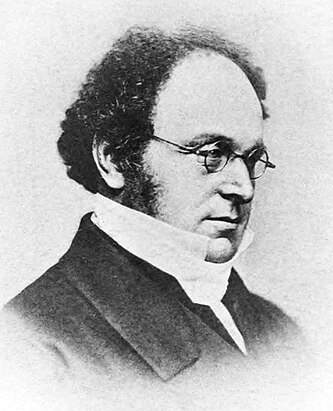
About Augustus De Morgan