Augustus De Morgan, The Differential and Integral Calculus (1836) Advertisement, p.3.
“
I cannot see why it is necessary that every deduction from algebra should be bound to certain conventions incident to an earlier stage of mathematical learning, even supposing them to have been consistently used up to the point in question. I should not care if any one thought this treatise unalgebraical, but should only ask whether the premises were admissible and the conclusions logical.
— Augustus De Morgan on Deductive reasoning
What It Means
This is a placeholder explanation generated by the low-overhead model. It interprets "I cannot see why it is necessary that every deduction from algebra should be bound to certain conventions incident to an earlier stage of mathematical learning, even supposing them to have been consistently used up to the point in question. I should not care if any one thought this treatise unalgebraical, but should only ask whether the premises were admissible and the conclusions logical." in the context of "Augustus De Morgan, The Differential and Integral Calculus (1836) Advertisement, p.3." to mean that wisdom is timeless.
Source: Wikiquote: "Deductive reasoning" (Quotes)
The 'What it means' explanation text was generated by Google Gemini Flash (accessed January 18, 2026). https://gemini.google.com/app
Tags
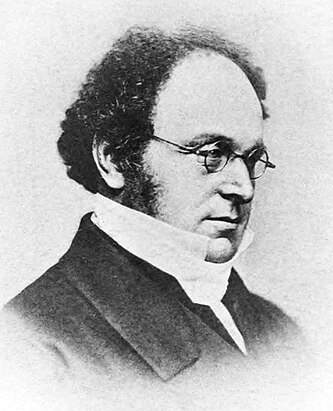
About Augustus De Morgan
Augustus De Morgan (June 27 1806 – March 18 1871) was an Indian-born British mathematician and logician; he was the first professor of mathematics at University College London. He formulated De Morgan's laws and was the first to introduce the term, and make rigorous the idea of mathematical induction. De Morgan crater on the Moon is named after him.
View all quotes →