Link Copied!
El Greco Quotes (1541-1614)
Artist, Painter
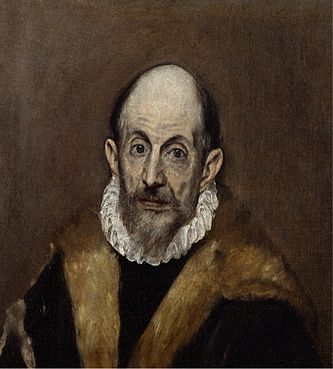
About El Greco
Doménikos Theotokópoulos (Greek language: Δομήνικος Θεοτοκόπουλος, 1541–7 April 1614), most widely known as El Greco (Spanish language for "The Greek"), was a painter, sculptor, and architect of the Spanish Renaissance. The nickname "El Greco" refers both to his Greek origin and Spanish citizenship. The artist normally signed his paintings with his full birth name in Greek alphabet: Δομήνικος Θεοτοκόπουλος (Doménikos Theotokópoulos), often adding the word Κρής (Krēs, "Cretan"). El Greco is regarded as a precursor of both Expressionism and Cubism.
Best El Greco Quotes
Shortest
Earliest
Explore our curated collection of the most famous and impactful El Greco quotes.
“I hold the imitation of colour to be the greatest difficulty of art.”

“Anyway, I would not be happy to see a beautiful, well-proportioned woman, no matter from which point of view, however extravagant, not only lose her beauty in order to, I would say, increase in size according to the law of vision, but no longer appear beautiful, and, in fact, become monstrous.”
“Now, in order to claim some knowledge of painting, Vitruvius speaks of the consideration of the perfect human body and about how good sculptors and painters in order to make it give it a height of ten faces, and I say that according to them they have read and they say that this proportion is based on knowledge of measurement and that it happens that without it it is not possible to have proportion or consideration because those who are not cognizant of this do not count.”

“If Vasari really knew the nature of the Greek style of which he speaks, he would deal with it differently in what he says. He compares it with Giotto, but what Giotto did is simple in comparison, because the Greek style is full of ingenious difficulties [= translation of Greek art historian Nicos Hadjinicolau] / full of deceptive difficulties. [= translation of Spanish art historians Xavier de Salas and Fernando María].”

“[El Greco 'confined to his bed'] ..holding, believing and confessing the Faith of the Holy Church of Rome.. ..in whose Faith I have lived and die, as a faithful and Catholic Christian.. ..because of the gravity of my sickness I was unable to make a will and gives power to Jorge Manuel Teotocopuli my son, and of Doña Jerónima de las Cuevas [his wife he never married], who is a person of honesty and virtue [to make his testament, arrange his burial, and pay his debts, and the] remainder of my possessions to go to Jorge Manuel, as universal heir..”

“It has been necessary to show the Hospital de Tavera as a model, for the building hides the Visagra Gate, and the dome obscures part of the town, and once treated as a model and moved from its place, it seemed better to me to show the main façade.. ..the rest, and its proper relationship to the town can be seen on the plan. Also, in the representation of Our Lady presenting the Chasuble to Saint Ildefonso, in making the figures large, I have applied, in some way, the observation made of celestial bodies that an illuminated body seen at a distance may appear large although it be small.”
Quotes About El Greco
Gain deeper perspective through quotes about El Greco from others.
Julio Clovio on El Greco
“..There has arrived in Rome a young man [El Greco] from Candia [Crete], a disciple of Titian, who in my opinion is a painter of rare talent; among other things he has painted a portrait of himself, which causes wonderment to all the painters in Rome. I should like him to be under the patronage of your Illustrious and Reverend Lordship, without any other contribution towards his living than a room in the Farnese Palace for some little time, until he can find other accommodation. I therefore beg and pray you to have the kindness to write to Count Lodovico, your Majordomo, to provide him with some room near the top in the said Palace; your Illustrious Lordship will be doing a virtuous deed worthy of you, and I shall feel very grateful.. .The most humble servant, Julio Clovio.”
Alonso de Villegas on El Greco
“..foreigners flock to see and admire the painting, and the citizens of Toledo never tire of seeing it, as there is always something new to see, for here is portrayed, very life-like, the notable men of our time.”
Padre Sigüenza on El Greco
“..by a Dominico Greco.. ..who paints excellent things in Toledo, is a painting of Saint Maurice and his soldiers, which he made for the altar of the Saints, and is now in the Chapter House; it did not please His Majesty, but that is not surprising, for it pleased few, although it is said it is of much art and that there are many excellent things by his hand.”
Francisco Pacheco on El Greco 3 quotes
“[El Greco liked] the colors crude and unmixed in great blots as a boastful display of his dexterity.. ..he believed in constant repainting and retouching in order to make the broad masses tell flat as in nature.”
Quote from folio on El Greco
“On 7th April, 1614, died Domenico Greco. He left no will. He received the sacraments, was buried in Santo Domingo el Antiguo; and gave candles.”
Giulio Cesare Mancini on El Greco 2 quotes
“Out of the great esteem he was held in he was called the Greek (il Greco).”
Hortensio Félix Paravicino on El Greco 2 quotes
“Crete gave him life and the painter's craft, Toledo a better homeland, where through Death he began to achieve eternal life.”
Padre Santos on El Greco
“A 'Gloria' by Domineko Greco, among the best which he painted, although still with great want of harmony in the colours, though here there is some excuse, for to paint the Glory of God it is not easy to find suitable colours, for the most vivid cannot attain to the signification of the strength of that supreme Majesty, neither seen nor heard of men.”
Jusepe Martinez on El Greco
“At that time, there came from Italy a painter called Dominico Greco.. .He settled in the famous and ancient city of Toledo, introducing such an extravagant style that to this day nothing has been seen to equal it; attempting to discuss it would cause confusion in the soundest minds; his works being so dissimilar that they do not seem to be by the same hand. He came to this city with a high reputation, so much so that he gave it to be understood that there was nothing superior to his works. In truth, he achieved some works which are worthy of estimation, and which can be put amongst those of famous painters. His nature was extravagant like his painting. It is not known with certainty what he did with his works, as he used to say no price was high enough for them, and so he gave them in pledge to their owners who willingly advanced him what he asked for. He earned many ducats, but spent them in too great pomp and display in his house, to the extent of keeping paid musicians to entertain him at meal-times. His works were many, but the only wealth he left were two hundred unfinished paintings; he reached an advanced age, always enjoying great fame. He was a famous architect, and very eloquent in his speeches. He had few disciples, as none cared to follow his capricious and extravagant style, which was only suitable for himself.”
Albert F. Calvert on El Greco 2 quotes
“Our painter's very name [El Greco] is uncertain. To his contemporaries he was known as the Greco, the difficult Theotocopuli, barbarous to the Spaniards, being disregarded; and up to the end of the eighteenth century no one writes of him except as Dominico Greco. Pacheco, Palomino, Giuseppe Martinez and other native writers, who mention his work, use this name. It is also the name found in the Inventories of the palace, the registers of Toledo, and the indices of public writings.”
Quote of Albert F. Calvert on El Greco
“In his picture of 'St Paul the Apostle' in the sacristy of Toledo cathedral, and also in all the known replicas of the picture, the epistle which the saint holds in his hands bears the inscription in Greek: 'Upos TLTOV TYjS XPlTtoV 'E'xxX.rfiias irpuTOV C7rt O"ypirov yeipoTOveOevra' (translation: Titus ordained the first bishop of the Cretans).”
Quote of Franz Marc on El Greco
“We refer with pleasure and with steadfastness to the case of El Greco, because the glory of this painter is closely tied to the evolution of our new perceptions on art”
About El Greco
Doménikos Theotokópoulos (Greek language: Δομήνικος Θεοτοκόπουλος, 1541–7 April 1614), most widely known as El Greco (Spanish language for "The Greek"), was a painter, sculptor, and architect of the Spanish Renaissance. The nickname "El Greco" refers both to his Greek origin and Spanish citizenship. The artist normally signed his paintings with his full birth name in Greek alphabet: Δομήνικος Θεοτοκόπουλος (Doménikos Theotokópoulos), often adding the word Κρής (Krēs, "Cretan"). El Greco is regarded as a precursor of both Expressionism and Cubism.