Quote from the marginalia, which El Greco inscribed in his copy of Daniele Barbaro's translation of Vitruvius' De architectura; as quoted by Liane Lefaivre and Alexander Tzonis,The Emergence of Modern Architecture: A Documentary History from 1000 to 1810; Routledge, New York, 2004) p. 165
“

Anyway, I would not be happy to see a beautiful, well-proportioned woman, no matter from which point of view, however extravagant, not only lose her beauty in order to, I would say, increase in size according to the law of vision, but no longer appear beautiful, and, in fact, become monstrous.

— El Greco

What It Means

This is a placeholder explanation generated by the low-overhead model. It interprets "Anyway, I would not be happy to see a beautiful, well-proportioned woman, no matter from which point of view, however extravagant, not only lose her beauty in order to, I would say, increase in size according to the law of vision, but no longer appear beautiful, and, in fact, become monstrous." in the context of "Quote from the marginalia, which El Greco inscribed in his copy of Daniele Barbaro's translation of Vitruvius' De architectura; as quoted by Liane Lefaivre and Alexander Tzonis,The Emergence of Modern Architecture: A Documentary History from 1000 to 1810; Routledge, New York, 2004) p. 165" to mean that wisdom is timeless.

Source: Wikiquote: "El Greco" (Quotes of El Greco: sorted chronologically, by date of the quotes of El Greco) The 'What it means' explanation text was generated by Google Gemini Flash (accessed January 18, 2026). https://gemini.google.com/app
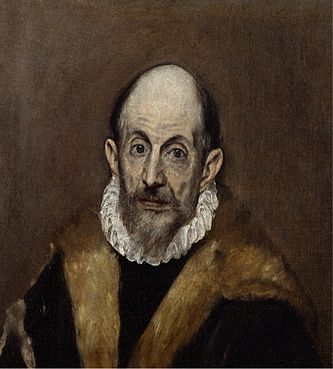
El Greco

About El Greco

Doménikos Theotokópoulos (Greek language: Δομήνικος Θεοτοκόπουλος, 1541–7 April 1614), most widely known as El Greco (Spanish language for "The Greek"), was a painter, sculptor, and architect of the Spanish Renaissance. The nickname "El Greco" refers both to his Greek origin and Spanish citizenship. The artist normally signed his paintings with his full birth name in Greek alphabet: Δομήνικος Θεοτοκόπουλος (Doménikos Theotokópoulos), often adding the word Κρής (Krēs, "Cretan"). El Greco is regarded as a precursor of both Expressionism and Cubism.