Link Copied!
K. M. Panikkar Quotes (1895-1963)
Novelist
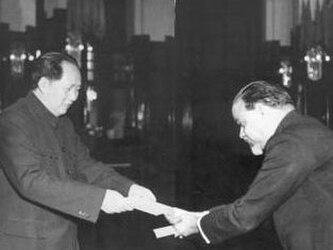

About K. M. Panikkar
Kavalam Madhava Panikkar (3 June 1895 – 10 December 1963), was an Indian novelist, journalist, historian, administrator and diplomat. He was born in Travancore, then a princely state in the British Indian Empire and was educated in Madras and at the University of Oxford.
Best K. M. Panikkar Quotes
Shortest
Earliest
Explore our curated collection of the most famous and impactful K. M. Panikkar quotes.
““With the Portuguese, Christianization was a state enterprise.” (Asia and Western Dominance, London, 1953, p. 380).”

“The captain-general’s ship flew at its mast a flag on which was painted a large cross of Christ and also carried cannon, symbols of the new power entering the East.”
““Sir John Bowring, who negotiated the treaty of 1855, was able to secure the principle of extra-territoriality for British subjects, permission to build churches and exemption of all duty for import of opium.””
““These sisters arranged for the payment of a sum for every child brought to the orphanage, that is, in plain words established a kind of purchase system, encouraging the less scrupulous Chinese middlemen to kidnap children…”
“[The Treaty that followed] “provided for the suspension of official examinations for five years in towns where foreigners had been molested - a device meant to give a chance to the missionary educated young men and Christians to be employed in service…””
“There was considerable missionary sympathy for Karen separatism, and not an insignificant part of the troubles that Burma had to face after her independence may justifiably be attributed to the favouritism with which the Christian elements among the Karens were treated by the West.”

“Legislature protected the right of converts to their share in Hindu joint families, and High Court decisions enabled converts to blackmail their wives to follow them into the fold of their new religion. The Government also encouraged the missionaries to work among the backward tribes.””

“St Xavier had come to the East representing both the Pope ‑ as a Legate ‑ and the King as an inspector of missions. As missionary work was a State enterprise charged to the Crown's revenues in Portugal, this identification of national, interests with religious activity should not be a matter of surprise.”
““The feudal rulers of that part of Japan were anxious at that time to attract Portuguese vessels to the harbours mainly with the object of strengthening themselves against other feudal Lords. They realized instinctively the close connection between the foreign powers across the seas and the missionaries who had come to preach the new religion.””
“In their mediaevalism there was little to choose between the higher Portuguese officials and their Indian contemporaries. The insincerity, dishonesty, selfishness, chicanery and cruelty were about on a par, though perhaps, the cruelty of the Portuguese was the greater, and indeed commercial and political intercourse must have been difficult when no man’s word was to be trusted on either side.”

““The commander of a Spanish galleon which was driven ashore spoke of Spanish power and recounted to the local daimyo who had salvaged the vessel and claimed the cargo the glories and prowess of the Conquistadores in a boastful manner. Hideyoshi’s suspicious mind, already aware of Portuguese action in the East, ordered the arrest of all Spaniards in the country and had them crucified in Nagasaki as spies.””
“Also, it should be remembered that Count Lamsdorff, the Russian Foreign Minister, declared to the British Ambassador in St Petersburg that his government `took no interest in missionaries' and would not therefore associate itself with other Powers in demanding punishment of those who had attacked missionaries. This deserves to be contrasted with the demand persistently made by the Western Powers for the execution of those against whom they preferred the charges of attacking missionaries.”
“Wilhelm II styled himself Admiral of the Atlantic, though that ocean had never been claimed to be an inland waterway. The fleet of gunboats that cruised up and down the Yangtze was a standing temptation for the local representatives of the Great Powers to give point to their often unreasonable demands by a demonstration or the threat of a bombardment. Many instances could be given of this kind of 'gunboat diplomacy' in the interests of missionaries, private debtors and even ordinary Christian converts.”

““In the first place, the missionary brought with him an attitude of moral superiority and a belief in his own exclusive righteousness …… Secondly, from the time of the Portuguese to the end of the Second World War, the association of Christian Missionary work with aggressive imperialism introduced political complications into Christian work…… Inevitably, national sentiment looked upon Missionary activity as inimical to the country’s interests and native Christians as secondary barbarians.””

“With the separation of the Pakistan Provinces, the main sites of what was known as the Indus Valley Civilisation have gone to Pakistan. It is clearly of the utmost importance that archaeological work in connection with this early period of Indian history must be continued in India. A preliminary examination has shown that the centre of the early civilisation was not Sind or the Indus Valley but the desert area in Bikaner and Jaisalmer through which the ancient Saraswati flowed into the Gulf of Kutch at one time.”

“But he was a keen-eyed observer. He noticed that the Portuguese had landed artillery to protect the area in which Christians lived. On a visit to a Portuguese vessel to see Father Coelho he observed that the ship, though small, was heavily armed. He was also well aware of the interest that the western daimyos were manifesting in the arms and equipment of the Portuguese and of their attempts to strengthen themselves by friendship with the foreigners. Hideyoshi acted with firmness and in 1587 the activities of the missionaries were prohibited throughout the length and breadth of Japan.”
““The monarch of Siam assumed the title of the Defender of the Buddhist Faith in imitation of the British King’s title. The conservative but generally enlightened policy followed by the monarchy during the critical period between 1870 and 1920 had the effect of getting Siam through the transition without violent tumult and a disorganization of society, so that in the period following the First [World] War she was enabled to recover her natural independence in full by the gradual abolition, through negotiations, of the rights of extraterritoriality which the foreign nations possessed.””
“A violent propaganda campaign was launched by Carey and his associates against Hinduism in Bengal which seemed to them to be in a state of dissolution. But Hindu orthodoxy reacted vigorously and Lord Minto felt obliged to prohibit such propaganda in Calcutta. Minto's letter to the Court of Directors is worth quoting: `Pray read the miserable stuff addressed specially to the Gentoos (Hindus) in which . . . the pages are filled with hell fire, and hell fire and with still hotter fire, denounced against a whole race of men, for believing in the religion which they were taught by their fathers and mothers. . .”

“In judging of the Portuguese and their actions in India, one has to recollect that they were a century nearer feudal Europe than were any of the other nations that invaded the country — a century further back in civilisation and political organisation. In fact, they had very little of the latter, as practically every Factor had a right to address the Portuguese Crown direct and write home what he thought fit — truth or untruth, praise or slander — of the Viceroy, Governor or other superior authority. Authoritative government is impossible under such conditions, and so the Portuguese officials made it.”
“Unfortunately, before his mission could be completed, Burlinghame died in St Petersburg. His mission was important from two points of view. In the first place he was able to secure assurances both from America and England that they would deal only with the Central Government at Peking, and the danger that existed at one time of the Powers directly negotiating with viceroys and thus securing a dissolution of the central authority on which British mercantile opinion was insistent was avoided. The Shanghai merchants' refrain at this time was `when will the Foreign Office realize that China was a confederation of many States?'”
“Another major aspect of Indian culture is its open attitude to science. India's religious ideas deal only with the relations of god and man, and, consequently, there are no dogmatic views regarding material aspects of the universe. You are no doubt aware of the tremendous shock to the European world of belief when the discovery of Copernicus, that it is the earth which rotates round the sun, was announced. It took many decades before the discovery could be publicly stated. And yet Aryabhatta had made the same discovery more than a thousand years before the time of Copernicus, without causing any flutter in India. This shows the open attitude of Indian Culture to science was not shared generally even by Europe.”
“The Portuguese, we are told, came to India with a Cross in the one hand and a sword in the other. Their own pretensions in the East were based first on the Pull of Nicholas V, dated January 8th 1454, by which Affonso V was given, by virtue of the pontifical and apostolic authority of the Pope, exclusive right to all the countries that might be discovered by the Portuguese in Africa and India. The conversion of the inhabitants of the lands so discovered was to be one of the objects of Portuguese policy. In fact Dom Joao II, who was the real originator of the expedition, had much of this evangelistic spirit in him. To the pious Kings of mediaeval Europe conversion of the heathens seemed to be an imperative duty.”
“It is unnecessary for our pupose to go into the sordid details of the Company's early administration of their Diwani of Bengal. In brief, it may be stated that for a decade the whole power of the organized State was directed to a single purpose ‑ plunder. It was a robber State that had come into existence, and Richard Becher, a servant of the Company, wrote to his masters in London on May 24, 1769, as follows: `It must give pain to an Englishman to have reason to think that since the accession of the Company to the Diwani the condition of the people of this country has been worse than it was before .... This fine country, which flourished under the most despotic and arbitrary government, is verging towards ruin.'...”

“The treaty clauses, in fact, wrote the ultimate doom of Christian activity in China. To have believed that a religion which grew up under the protection of foreign powers, especially under humiliating conditions, following defeat, would be tolerated when the nation recovered its authority, showed extreme shortsightedness. The fact is that the missionaries, like other Europeans, felt convinced in the nineteenth century that their political supremacy was permanent, and they never imagined that China would regain a position when the history of the past might be brought up against them and their converts. `The Church', as Latourette has pointed out, `had become a partner in Western imperialism.' When that imperialism was finally destroyed, the Church could not escape the fate of its patron and ally.”

“More important than these two considerations was the fact that Russia was at no time concerned with the two policies ‑ the forcing of opium on China and the trade in human flesh ‑ which both the people and Government of China resented and which brought her untold humiliation. ... In the `pig trade' ‑ that is, the forcible transportation of Chinese workers to plantations and mines again, in defiance of the orders of Government and of the protests of the people ‑ in this new slave trade, where sometimes forty per cent of those transported died on the way, all Western Powers including America were deeply involved. Russia, for whatever reason, was no party to it. It was these two, the `poison trade' and the `pig trade', that made the iron enter the soul of the Chinese and made them bitterly anti‑foreign.”

K. M. Panikkar Quotes by Topic
Find exactly what you are looking for by browsing this categorized list of K. M. Panikkar quotes by topic.
K. M. Panikkar on Christianity and colonialism 2 quotes
“With the Portuguese, Christianization was a state enterprise.”

K. M. Panikkar on Hinduism and other religions
K. M. Panikkar on Karen conflict
“There was considerable missionary sympathy for Karen separatism, and not an insignificant part of the troubles that Burma had to face after her independence may justifiably be attributed to the favouritism with which the Christian elements among the Karens were treated by the West.”

K. M. Panikkar on Gunboat diplomacy
“Wilhelm II styled himself Admiral of the Atlantic, though that ocean had never been claimed to be an inland waterway. The fleet of gunboats that cruised up and down the Yangtze was a standing temptation for the local representatives of the Great Powers to give point to their often unreasonable demands by a demonstration or the threat of a bombardment. Many instances could be given of this kind of 'gunboat diplomacy' in the interests of missionaries, private debtors and even ordinary Christian converts.”
K. M. Panikkar on Anti-Hindu sentiment
“A violent propaganda campaign was launched by Carey and his associates against Hinduism in Bengal which seemed to them to be in a state of dissolution. But Hindu orthodoxy reacted vigorously and Lord Minto felt obliged to prohibit such propaganda in Calcutta. Minto's letter to the Court of Directors is worth quoting: `Pray read the miserable stuff addressed specially to the Gentoos (Hindus) in which . . . the pages are filled with hell fire, and hell fire and with still hotter fire, denounced against a whole race of men, for believing in the religion which they were taught by their fathers and mothers. . .”

K. M. Panikkar on Summer Palace
“Not satisfied with this, after entering Peking, Lord Elgin ordered the burning of the Summer Palace `whose splendours' the conquerors themselves had `found it difficult to describe'. This action Elgin in his ignorance had imagined would impress the Oriental and leave a lasting fear of the European in the Chinese mind. By a strange process of reasoning, the Europeans have, throughout their relations with Asians, convinced themselves that acts of savagery and inhumanity will increase their prestige in the eyes of Asian people. ... The Elgins have been unfortunate in their historical imagination- — whether it be in respect of Greek marbles or Chinese palaces.”
K. M. Panikkar on Hindu–Islamic relations
“Even in regard to religion the idea that Hinduism was always held in contempt by the early Muslim rulers would not bear examination. In fact we have ample evidence that even under the most bigoted kings like Allauddin Khilji, the Hindu religious leaders received honour and recognition. From Jain sources we know that Allauddin held religious discourses with Acharya Mahasena who had to be brought from the Karnataka country for the purpose. It is also said that the Digambara Jain, Purna Chandra of Delhi, and the Swetambara ascetic Ramachandra Suri were in favour with the same Sultan. Ghiasuddin Tughlaq had two Jain officers who exercised great influence over him, while Firuz held in high honour the poet Ratnasekhara.”

K. M. Panikkar on Christianity in India
“Missionary activities… which became so prominent a feature of European relations with Asia were connected with Western political supremacy in Asia and synchronised with it. ... It may indeed be said that the most serious, persistent and planned effort of European nations in the nineteenth century was their missionary activities in India and China, where a large-scale attempt was made to effect a mental and spiritual conquest at supplementing the political authority already enjoyed by Europe. Though the results were disappointing in the extreme from the missionary point of new, this assault on the spiritual foundations of Asian countries has had far-reaching consequences in the religious and social reorganization of the people...”

K. M. Panikkar on China–Russia relations
“More important than these two considerations was the fact that Russia was at no time concerned with the two policies ‑ the forcing of opium on China and the trade in human flesh ‑ which both the people and Government of China resented and which brought her untold humiliation. ... In the `pig trade' ‑ that is, the forcible transportation of Chinese workers to plantations and mines again, in defiance of the orders of Government and of the protests of the people ‑ in this new slave trade, where sometimes forty per cent of those transported died on the way, all Western Powers including America were deeply involved. Russia, for whatever reason, was no party to it. It was these two, the `poison trade' and the `pig trade', that made the iron enter the soul of the Chinese and made them bitterly anti‑foreign.”

K. M. Panikkar on Slavery in India
“In fact, in the plantation areas conditions amounting to slavery were re‑established by the planters with the acquiescence of the Government.Some idea of the misery to which the population of these areas was reduced by this system of merciless exploitation in the interests of British capital may be gained from the Bengal Indigo Commission's Report and from some of the literature of the period. Nil Darpan or the Mirror of Indigo, a Bengali drama, created a sensation by throwing a little light on this dark corner of Britain's action in India, and the reaction in official circles was so great that a European missionary, Mr Long, who translated and published it in English, was fined and imprisoned. During the whole of this period, in fact till the rise of nationalism after the Great War, conditions in plantations were of a kind which showed the worst features of European relations with Asia.”

K. M. Panikkar on Eurocentrism
“Better understanding of the Asian mind ‑ Indian and Chinese ‑ had one further consequence which needs emphasis. It had been almost a dogma of European thought that everything of value arose in the regions that touched the Aegean Sea. Religion, philosophy, art and even science, it was claimed, originated in this area. In fact, for all civilization a Greek origin was postulated. A persistence in this belief was responsible in the early years of Oriental research for the futile attempts made to date events in Asia, especially Indian history, to periods where they could be conveniently adjusted to developments in Greece. That belief in a monopoly of wisdom for the Greeks had to be reluctantly abandoned, as a result of increased knowledge of Asian civilizations. The liberalization of the European mind consequent upon the recognition of the fact that all nations have contributed towards the growth of human civilization, is a gain of considerable significance.”

What K. M. Panikkar Said About Others
Discover personal opinions K. M. Panikkar shared regarding contemporaries.
K. M. Panikkar on Francis Xavier
“St Xavier had come to the East representing both the Pope ‑ as a Legate ‑ and the King as an inspector of missions. As missionary work was a State enterprise charged to the Crown's revenues in Portugal, this identification of national, interests with religious activity should not be a matter of surprise.”

Quotes About K. M. Panikkar
Gain deeper perspective through quotes about K. M. Panikkar from others.
Sita Ram Goel on K. M. Panikkar 4 quotes
“Panikkar’s study was primarily aimed at providing a survey of Western imperialism in Asia from CE 1498 to 1945. Christian missions came into the picture simply because he found them arrayed always and everywhere alongside Western gunboats, diplomatic pressures, extraterritorial rights and plain gangsterism. Contemporary records consulted by him could not but cut to size the inflated images of Christian heroes such as Francis Xavier and Matteo Ricci. They were found to be not much more than minions employed by European kings and princes scheming to carve out empires in the East. Their methods of trying to convert kings and commoners in Asia, said Panikkar, were force or fraud or conspiracy and morally questionable in every instance. Finding that “missionary activities… which became so prominent a feature of European relations with Asia were connected with Western political supremacy in Asia and synchronised with it” he concluded: “It may indeed be said that the most serious, persistent and planned effort of European nations in the nineteenth century was their missionary activities in India and China, where a large-scale attempt was made to effect a mental and spiritual conquest at supplementing the political authority already enjoyed by Europe. Though the results were disappointing in the extreme from the missionary point of new, this assault on the spiritual foundations of Asian countries has had far-reaching consequences in the religious and social reorganization of the people...”

S.R. Goel on K. M. Panikkar
“A new image of medieval India had also emerged in my mind by reading K.M. Panikkar’s A Survey of Indian History. It was no more the India of Muslim monarchs ruling leisurely over a large empire, building mosques and mazãrs and madrasas and mansions, and patronizing poets and other men of letters. On the contrary, it was the story of the long-drawn-out war which took a decisive turn to the disadvantage of Islamic imperialism with the rise of Shivaji. The war had ended in a victory for the Hindus by the middle of the 18th century.”
Shourie on K. M. Panikkar
“I still remember how much impact the portions on missionaries in Sarkar Panikkar's Asia and Western Dominance made on me.”
About K. M. Panikkar
Kavalam Madhava Panikkar (3 June 1895 – 10 December 1963), was an Indian novelist, journalist, historian, administrator and diplomat. He was born in Travancore, then a princely state in the British Indian Empire and was educated in Madras and at the University of Oxford.