Link Copied!
Galileo Galilei Quotes (1564-1642)
Physicist, Philosopher, Mathematician
-100px.jpg)






-100px.jpg)
About Galileo Galilei
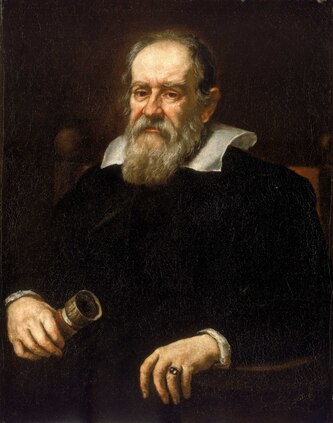
Galileo di Vincenzo Bonaiuti de' Galilei (15 February 1564 – 8 January 1642) was an Italian astronomer, physicist, engineer, philosopher, and mathematician who played a major role in the scientific revolution during the Renaissance.
Best Galileo Galilei Quotes
Shortest
Earliest
Explore our curated collection of the most famous and impactful Galileo Galilei quotes.


“All truths are easy to understand once they are discovered; the point is to discover them.”
“What has philosophy got to do with measuring anything? It's the mathematicians you have to trust, and they measure the skies like we measure a field.”


“My dear Kepler, what would you say of the learned here, who, replete with the pertinacity of the asp, have steadfastly refused to cast a glance through the telescope? What shall we make of this? Shall we laugh, or shall we cry?”
“Surely it is a great thing to increase the numerous host of fixed stars previously visible to the unaided vision, adding countless more which have never before been seen, exposing these plainly to the eye in numbers ten times exceeding the old and familiar stars.”

“Quòd tertio loca à nobis fuit obſeruatum, eſt ipſiuſmet LACTEI Circuli eſſentia, ſeu materies, quam Perſpicilli beneficio adeò ad ſenſum licet intueri, vt & altercationes omnes, quæ per tot ſæcula Philoſophos excrucia runt ab oculata certitudine dirimantur, nosque à verboſis dſputationibus liberemur.”
“Copernicus never discusses matters of religion or faith, nor does he use argument that depend in any way upon the authority of sacred writings which he might have interpreted erroneously. ... He did not ignore the Bible, but he knew very well that if his doctrine were proved, then it could not contradict the Scriptures when they were rightly understood.”
“Names and attributes must be accommodated to the essence of things, and not the essence to the names, since things come first and names afterwards.
• Variant translation: Names and attributes must be accommodated to the essence of things, and not the essence to the names, because things came first, and their names subsequently.”
• Variant translation: Names and attributes must be accommodated to the essence of things, and not the essence to the names, because things came first, and their names subsequently.”
“We seek not what God could have done but what He has done.… God could have caused birds to fly with bones of solid gold, with veins full of quicksilver, with flesh heavier than lead and very small and heavy wings, so as to better show His power … but He wanted to make their bones, flesh and feathers very light … to teach us that He likes simplicity and ease.”
“Alas! Your dear friend and servant Galileo has been for the last month hopelessly blind; so that this heaven, this earth, this universe, which I by my marvelous discoveries and clear demonstrations had enlarged a hundred thousand times beyond the belief of the wise men of bygone ages, henceforward for me is shrunk into such a small space as is filled by my own bodily sensations.”
“I am certainly interested in a tribunal in which, for having used my reason, I was deemed little less than a heretic. Who knows but men will reduce me from the profession of a philosopher to that of historian of the Inquisition! But they behave to me in order that I may become the ignoramus and the fool of Italy...”
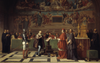
“I have been in my bed for five weeks, oppressed with weakness and other infirmities from which my age, seventy four years, permits me not to hope release. Added to this (proh dolor! [O misery!]) the sight of my right eye — that eye whose labors (dare I say it) have had such glorious results — is for ever lost. That of the left, which was and is imperfect, is rendered null by continual weeping.”
“If I shall have sufficient strength to improve and amplify what was written and published by me up to now about motion by adding some little speculations, and in particular those relating to the force of percussion, in the investigation of which I have consumed hundreds and thousands of hours, and finally reduced this to very easy explanation, so that people can understand it in less than half an hour of time.”
“sì perché l'autorità dell'opinione di mille nelle scienze non val per una scintilla di ragione di un solo, sì perché le presenti osservazioni spogliano d'autorità i decreti de' passati scrittori, i quali se vedute l'avessero, avrebbono diversamente determinato.
• Variant translation: In questions of science the authority of a thousand is not worth the humble reasoning of a single individual.”
• Variant translation: In questions of science the authority of a thousand is not worth the humble reasoning of a single individual.”
“Philosophy is written in this grand book, which stands continually open before our eyes (I say the 'Universe'), but can not be understood without first learning to comprehend the language and know the characters as it is written. It is written in mathematical language, and its characters are triangles, circles and other geometric figures, without which it is impossible to humanly understand a word; without these one is wandering in a dark labyrinth.”
“After the publication of my dialogues, I was summoned to Rome by the Congregation of the holy Office, where, being arrived on the 10th of February 1633, I was subjected to the infinite clemency of that tribunal, and of the Sovereign Pontiff, Urban the Eighth; who, notwithstanding, thought me deserving of his esteem.”
“I would say here something that was heard from an ecclesiastic of the most eminent degree [probably Caesar Baronius]: "The intention of the Holy Ghost is to teach us how one goes to heaven, not how heaven goes."
• Variant translation: I would say here something that was heard from an ecclesiastic of the most eminent degree: "That the intention of the Holy Spirit is to teach us how one goes to heaven, not how the heavens go."”
• Variant translation: I would say here something that was heard from an ecclesiastic of the most eminent degree: "That the intention of the Holy Spirit is to teach us how one goes to heaven, not how the heavens go."”

“To this end they make a shield of their hypocritical zeal for religion. They go about invoking the Bible, which they would have minister to their deceitful purposes. Contrary to the sense of the Bible and the intention of the holy Fathers, if I am not mistaken, they would extend such authorities until even in purely physical matters — where faith is not involved — they would have us altogether abandon reason and the evidence of our senses in favor of some biblical passage, though under the surface meaning of its words this passage may contain a different sense.”
“Whence do you have it that the terrestrial globe is so heavy? For my part, either I do not know what heaviness is, or the terrestrial globe is neither heavy nor light, as likewise all other globes of the universe. Heaviness to me (and I believe to Nature) is that innate tendency by which a body resists being moved from its natural place and by which, when forcibly removed therefrom, it spontaneously returns there. Thus a bucketful of water raised on high and set free, returns to the sea; but who will say that the same water remains heavy in the sea, when being set free there, does not move?”
“I esteem myself happy to have as great an ally as you in my search for truth. I will read your work … all the more willingly because I have for many years been a partisan of the Copernican view because it reveals to me the causes of many natural phenomena that are entirely incomprehensible in the light of the generally accepted hypothesis. To refute the latter I have collected many proofs, but I do not publish them, because I am deterred by the fate of our teacher Copernicus who, although he had won immortal fame with a few, was ridiculed and condemned by countless people (for very great is the number of the stupid).”
“Some years ago, as Your Serene Highness well knows, I discovered in the heavens many things that had not been seen before our own age. The novelty of these things, as well as some consequences which followed from them in contradiction to the physical notions commonly held among academic philosophers, stirred up against me no small number of professors — as if I had placed these things in the sky with my own hands in order to upset nature and overturn the sciences. They seemed to forget that the increase of known truths stimulates the investigation, establishment, and growth of the arts; not their diminution or destruction.”
“Nature … is inexorable and immutable; she never transgresses the laws imposed upon her, or cares a whit whether her abstruse reasons and methods of operation are understandable to men. For that reason it appears that nothing physical which sense-experience sets before our eyes, or which necessary demonstrations prove to us, ought to be called in question (much less condemned) upon the testimony of biblical passages which may have some different meaning beneath their words. For the Bible is not chained in every expression to conditions as strict as those which govern all physical effects; nor is God any less excellently revealed in Nature's actions than in the sacred statements of the Bible.”
“Revealing great, unusual, and remarkable spectacles, opening these to the consideration of every man, and especially of philosophers and astronomers; as observed by Galileo Galilei, Gentleman of Florence, Professor of Mathematics in the University of Padua, with the aid of a spyglass lately invented by him, in the surface of the Moon, in innumerable fixed stars, in nebulae, and above all in four planets swiftly revolving about Jupiter at differing distances and periods, and known to no one before the author recently perceived them and decided they should be named the Medicean Stars”
“The passage of time has revealed to everyone the truths that I previously set forth; and, together with the truth of the facts, there has come to light the great difference in attitude between those who simply and dispassionately refused to admit the discoveries to be true, and those who combined with their incredulity some reckless passion of their own. Men who were well grounded in astronomical and physical science were persuaded as soon as they received my first message. There were others who denied them or remained in doubt only because of their novel and unexpected character, and because they had not yet had the opportunity to see for themselves. These men have by degrees come to be satisfied. But some, besides allegiance to their original error, possess I know not what fanciful interest in remaining hostile not so much toward the things in question as toward their discoverer. No longer being able to deny them, these men now take refuge in obstinate silence, but being more than ever exasperated by that which has pacified and quieted other men, they divert their thoughts to other fancies and seek new ways to damage me.”
“I tell you that if natural bodies have it from Nature to be moved by any movement, this can only be circular motion, nor is it possible that Nature has given to any of its integral bodies a propensity to be moved by straight motion. I have many confirmations of this proposition, but for the present one alone suffices, which is this. I suppose the parts of the universe to be in the best arrangement, so that none is out of its place, which is to say that Nature and God have perfectly arranged their structure. This being so, it is impossible for those parts to have it from Nature to be moved in straight, or in other than circular motion, because what moves straight changes place, and if it changes place naturally, then it was at first in a place preternatural to it, which goes against the supposition. Therefore, if the parts of the world are well ordered, straight motion is superfluous and not natural, and they can only have it when some body is forcibly removed from its natural place, to which it would then return by a straight line, for thus it appears that a part of the earth does [move] when separated from its whole. I said "it appears to us," because I am not against thinking that not even for such an effect does Nature make use of straight line motion.”
“I was obliged to retract, like a good Catholic, this opinion of mine; and as a punishment my dialogue was prohibited; and after five months being dismissed from Rome (at the time that the city of Florence was infected with plague), the habitation which with generous pity was assigned to me, was that of the dearest friend I had in Siena, Monsignor the Archbishop Piccolomini, whose most agreeable conversation I enjoyed with such quite and satisfaction of mind, that having there resumed my studies, I discovered and demonstrated a great number on the mechanical conclusions on the resistance of solids … after about five months, the pestilence having ceased, the confinement of that house was changed by His Holiness for the freedom of the country so agreeable to me, whence I returned to the villa of Bellosguardo, and afterwards to Arcetri, where I still breathe salubrious air near my dear native-country Florence. Stay sane.”
“Persisting in their original resolve to destroy me and everything mine by any means they can think of, these men are aware of my views in astronomy and philosophy. They know that as to the arrangement of the parts of the universe, I hold the sun to be situated motionless in the center of the revolution of the celestial orbs while the earth revolves about the sun. They know also that I support this position not only by refuting the arguments of Ptolemy and Aristotle, but by producing many counter-arguments; in particular, some which relate to physical effects whose causes can perhaps be assigned in no other way. In addition there are astronomical arguments derived from many things in my new celestial discoveries that plainly confute the Ptolemaic system while admirably agreeing with and confirming the contrary hypothesis.
• Variant translation: I hold that the Sun is located at the centre of the revolutions of the heavenly orbs and does not change place, and that the Earth rotates on itself and moves around it. Moreover … I confirm this view not only by refuting Ptolemy's and Aristotle's arguments, but also by producing many for the other side, especially some pertaining to physical effects whose causes perhaps cannot be determined in any other way, and other astronomical discoveries; these discoveries clearly confute the Ptolemaic system, and they agree admirably with this other position and confirm it.”
• Variant translation: I hold that the Sun is located at the centre of the revolutions of the heavenly orbs and does not change place, and that the Earth rotates on itself and moves around it. Moreover … I confirm this view not only by refuting Ptolemy's and Aristotle's arguments, but also by producing many for the other side, especially some pertaining to physical effects whose causes perhaps cannot be determined in any other way, and other astronomical discoveries; these discoveries clearly confute the Ptolemaic system, and they agree admirably with this other position and confirm it.”
“About ten months ago a report reached my ears that a certain Fleming had constructed a spyglass by means of which visible objects, though very distant from the eye of the observer, were distinctly seen as if nearby. Of the truly remarkable effect several experiences were related, to which some persons gave credence while others denied them. A few days later a report was confirmed to me in a letter from a noble Frenchman in Paris, Jacques Badovere, which caused me to apply myself wholeheartedly to inquire into means by which I might arrive at the invention of a similar instrument. This I did shortly afterwards, my basis being the theory of refraction. First I prepared a tube of lead, at the ends I fitted two glass lenses, both plane on one side while on the other side one was spherically convex and the other concave. Then placing my eye near the concave lens I perceived objects satisfactorily large and near, for they appeared three times closer and nine times larger than when seen with the naked eye alone. Next I constructed another one, more accurate, which represented objects as enlarged more than sixty times. Finally, sparing neither labor nor expense, I succeeded in constructing for myself so excellent an instrument that objects seen by means of it appeared nearly one thousand times larger and over thirty times closer than when regarded with our natural vision.”

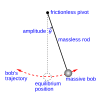
“It now remains that we find the amount of time of descent through the channel. This we shall obtain from the marvelous property of the pendulum, which is that it makes all its vibrations, large or small, in equal times. This requires, once and for all, that two or three or four patient and curious friends, having noted a fixed star that stands against some fixed marker, taking a pendulum of any length, shall go counting its vibrations during the whole time of return of the fixed star to its original point, and this will be the number of vibrations in 24 hours. From the number of these we can find the number of vibrations of any other pendulums, longer or shorter, at will, so that if for example those counted by us in 24 hours were 234,567, then taking another shorter pendulum with which one counts 800 vibrations while another counts 150 of the longer pendulum, we already have, by the golden rule, the number of vibrations for the whole time of 24 hours; and if we want to know the time of descent through the channel, we can easily find not only the minutes, seconds, and sixtieths of seconds, but beyond that as we please. It is true that we can pass a more exact measure by having observed the flow of water through a thin passage, for by collecting this and having weighed what passes in one minute, for example, then by weighing what passes in the time of descent through the channel we can find the most exact measure and quantity of this time, especially by making use of a balance so precise as to weigh one sixtieth of a grain.”
“After an injunction had been judicially intimated to me by this Holy Office, to the effect that I must altogether abandon the false opinion that the sun is the center of the world and immovable, and that the earth is not the center of the world, and moves, and that I must not hold, defend, or teach in any way whatsoever, verbally or in writing, the said false doctrine, and after it had been notified to me that the said doctrine was contrary to Holy Scripture — I wrote and printed a book in which I discuss this new doctrine already condemned, and adduce arguments of great cogency in its favor, without presenting any solution of these, and for this reason I have been pronounced by the Holy Office to be vehemently suspected of heresy, that is to say, of having held and believed that the Sun is the center of the world and immovable, and that the earth is not the center and moves:
Therefore, desiring to remove from the minds of your Eminences, and of all faithful Christians, this vehement suspicion, justly conceived against me, with sincere heart and unfeigned faith I abjure, curse, and detest the aforesaid errors and heresies, and generally every other error, heresy, and sect whatsoever contrary to the said Holy Church, and I swear that in the future I will never again say or assert, verbally or in writing, anything that might furnish occasion for a similar suspicion regarding me; but that should I know any heretic, or person suspected of heresy, I will denounce him to this Holy Office, or to the Inquisitor or Ordinary of the place where I may be. Further, I swear and promise to fulfill and observe in their integrity all penances that have been, or that shall be, imposed upon me by this Holy Office. And, in the event of my contravening, (which God forbid) any of these my promises and oaths, I submit myself to all the pains and penalties imposed and promulgated in the sacred canons and other constitutions, general and particular, against such delinquents. So help me God, and these His Holy Gospels, which I touch with my hands.
I, the said Galileo Galilei, have abjured, sworn, promised, and bound myself as above; and in witness of the truth thereof I have with my own hand subscribed the present document of my abjuration, and recited it word for word at Rome, in the Convent of Minerva, this twenty-second day of June, 1633.”
Therefore, desiring to remove from the minds of your Eminences, and of all faithful Christians, this vehement suspicion, justly conceived against me, with sincere heart and unfeigned faith I abjure, curse, and detest the aforesaid errors and heresies, and generally every other error, heresy, and sect whatsoever contrary to the said Holy Church, and I swear that in the future I will never again say or assert, verbally or in writing, anything that might furnish occasion for a similar suspicion regarding me; but that should I know any heretic, or person suspected of heresy, I will denounce him to this Holy Office, or to the Inquisitor or Ordinary of the place where I may be. Further, I swear and promise to fulfill and observe in their integrity all penances that have been, or that shall be, imposed upon me by this Holy Office. And, in the event of my contravening, (which God forbid) any of these my promises and oaths, I submit myself to all the pains and penalties imposed and promulgated in the sacred canons and other constitutions, general and particular, against such delinquents. So help me God, and these His Holy Gospels, which I touch with my hands.
I, the said Galileo Galilei, have abjured, sworn, promised, and bound myself as above; and in witness of the truth thereof I have with my own hand subscribed the present document of my abjuration, and recited it word for word at Rome, in the Convent of Minerva, this twenty-second day of June, 1633.”
Galileo Galilei Quotes by Topic
Find exactly what you are looking for by browsing this categorized list of Galileo Galilei quotes by topic.
Galileo Galilei on Infinity 7 quotes
“Nature doth, and in it alone is discovered an infinite wisdom, so that Divine Wisdom may be concluded to be infinitely infinite.”

Galileo Galilei on Mathematics 3 quotes
“What has philosophy got to do with measuring anything? It's the mathematicians you have to trust, and they measure the skies like we measure a field.”
Galileo Galilei on Inertia 3 quotes
“I mentally conceive of some moveable [sphere] projected on a horizontal plane, all impediments being put aside. Now it is evident... that equable motion on this plane would be perpetual if the plane were of infinite extent, but if we assume it to be ended, and [situated] on high, the movable, driven to the end of this plane and going on further, adds on to its previous equable and indelible motion, that downward tendency which it has from its heaviness. Thus, there emerges a certain motion, compounded...”
Galileo Galilei on Planet 2 quotes
“The sun, with all those planets revolving around it and dependent on it, can still ripen a bunch of grapes as if it had nothing else in the universe to do.”
Galileo Galilei on Jupiter 2 quotes
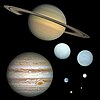
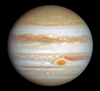
“I therefore concluded, and decided unhesitatingly, that there are three stars in the heavens moving about Jupiter, as Venus and Mercury about the Sun; which at length was established as clear as daylight by numerous other observations. These observations also established that there are not only three, but four, erratic sidereal bodies performing their revolutions round Jupiter.”
What Galileo Galilei Said About Others
Discover personal opinions Galileo Galilei shared regarding contemporaries.
Galileo Galilei on Johannes Kepler 4 quotes
“I thank you because you are the first one, and practically the only one, to have complete faith in my assertions.”

Galileo Galilei on Aristotle 2 quotes
“I do believe for certain, that he [Aristotle] first procured, by the help of the senses, such experiments and observations as he could, to assure him as much as was possible of the conclusion, and that he afterwards sought out the means how to demonstrate it; for this is the usual course in demonstrative sciences. And the reason thereof is, because when the conclusion is true, by the help of the resolutive method, one may hit upon some proposition before demonstrated, or come to some principle known per se; but if the conclusion be false, a man may proceed in infinitum, and never meet with any truth already known.”
Galileo Galilei on Nicolaus Copernicus
“[Copernicus] did not ignore the Bible, but he knew very well that if his doctrine were proved, then it could not contradict the Scriptures when they were rightly understood.”

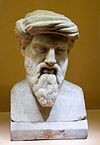
Galileo Galilei on Pythagoras
“Nor need you question but that Pythagoras a long time before he found the demonstration for which he offered the Hecatomb, had been certain, that the square of the side subtending the right angle in a rectangle triangle, was equal to the square of the other two sides: and the certainty of the conclusion conduced not a little to the investigating of the demonstration, understanding me alwayes to mean in demonstrative Sciences.”
Galileo Galilei on Plato
“I would not do so much wrong to Plato, but yet I may truly say with Aristotle, that he too much lost himself in, and too much doted upon that, his Geometry: for that in conclusion these Mathematical subtilties, Salviatus, are true in abstract, but applied to sensible and Physical matter, they hold not good. For the Mathematicians will very well demonstrate for example, that Sphæra tangit planum in puncto [the sphere touches the plane at the point]; a position like to that in dispute, but when one cometh to the matter, things succeed quite another way. And so I may say of these angles of contact, and these proportions; which all evaporate into Air, when they are applied to things material and sensible.”

Quotes About Galileo Galilei
Gain deeper perspective through quotes about Galileo Galilei from others.
Francis Bacon on Galileo Galilei
“[I]t was upon... inequality of motions in point of velocity that Galileo built his theory of flux and reflux of the sea; supposing that the earth revolved faster than the water could follow; and that the water was therefore first gathered in a heap and then fell down, as we see in a basin of water moved quickly. But this he devised upon an assumption which cannot be allowed, viz. that the earth moves; and also without being well informed as to the sexhorary motion of the tide.”

Eric Temple Bell on Galileo Galilei
“Galileo observed as early as 1638 that there are precisely as many squares 1, 4, 9, 16, 25,... as are positive integers all together. This is evident from the sequences1, 2, 3, 4, 5, 6, ... , n, ... 12, 22, 32, 42, 52, 62, ..., n, ... He thus recognized the fundamental distinction between finite and infinite classes that became current in the late nineteenth century. An infinite class is one in which there is a one-to-one correspondence between the whole class and a subclass of the whole. Or, what is equivalent, there are as many things in one part of an infinite class as there are in the whole class. ...A class whose elements can be put in a one-to-one correspondence with the integers 1, 2, 3, ... is said to be denumerable. All the points in any line segment, finite or infinite in length, form a non-denumerable set. A basic course in calculus starts from the theory of point sets. The distinction between denumerable and non-denumerable classes was not started by Galileo; it was observed about 1840 by Bolzano and in 1878 by Cantor. But Galileo's recognition of the cardinal property of all infinite classes makes him one of the genuine anticipators in the history of calculus. The other was Archimedes.”
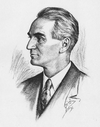
Arthur Berry on Galileo Galilei
“The credit of first using the telescope for astronomical purposes is almost invariably attributed to Galilei, though his first observations were in all probability slightly later in date than those of Harriot and Marius, is to a great extent justified by the persistent way in which he examined object after object, whenever there seemed any reasonable prospect of results following, by the energy and acuteness with which he followed up each clue, by the independence of mind with which he interpreted his observations, and above all by the insight with which he realised their astronomical importance.”
David Brewster on Galileo Galilei 2 quotes
“His brilliant discoveries the man of science regards as his peculiar property; the means by which they were made, and the development of his intellectual character, belong to the logician and to the philosopher; but the triumphs and the reverses of his eventful life must be claimed for our common nature, as a source of more than ordinary instruction.”

Edwin Arthur Burtt on Galileo Galilei
“Others before him had asked why heavy bodies fall; now, the homogeneity of the earth with the heavenly bodies having suggested that terrestrial motion is a proper subject for exact mathematical study, we have the further question raised: how do they fall? with the expectation that the answer will be given in mathematical terms.”







Misattributed Quotes
Quotes mistakenly credited to Galileo Galilei
“Mathematics is the key and door to the sciences.”
“Measure what is measurable, and make measurable what is not so.”
About Galileo Galilei
Galileo di Vincenzo Bonaiuti de' Galilei (15 February 1564 – 8 January 1642) was an Italian astronomer, physicist, engineer, philosopher, and mathematician who played a major role in the scientific revolution during the Renaissance.