About ten months ago a report reached my ears that a certain Fleming had constructed a spyglass by means of which visible objects, though very distant from the eye of the observer, were distinctly seen as if nearby. Of the truly remarkable effect several experiences were related, to which some persons gave credence while others denied them. A few days later a report was confirmed to me in a letter from a noble Frenchman in Paris, Jacques Badovere, which caused me to apply myself wholeheartedly to inquire into means by which I might arrive at the invention of a similar instrument. This I did shortly afterwards, my basis being the theory of refraction. First I prepared a tube of lead, at the ends I fitted two glass lenses, both plane on one side while on the other side one was spherically convex and the other concave. Then placing my eye near the concave lens I perceived objects satisfactorily large and near, for they appeared three times closer and nine times larger than when seen with the naked eye alone. Next I constructed another one, more accurate, which represented objects as enlarged more than sixty times. Finally, sparing neither labor nor expense, I succeeded in constructing for myself so excellent an instrument that objects seen by means of it appeared nearly one thousand times larger and over thirty times closer than when regarded with our natural vision.
What It Means
This is a placeholder explanation generated by the low-overhead model. It interprets "About ten months ago a report reached my ears that a certain Fleming had constructed a spyglass by means of which visible objects, though very distant from the eye of the observer, were distinctly seen as if nearby. Of the truly remarkable effect several experiences were related, to which some persons gave credence while others denied them. A few days later a report was confirmed to me in a letter from a noble Frenchman in Paris, Jacques Badovere, which caused me to apply myself wholeheartedly to inquire into means by which I might arrive at the invention of a similar instrument. This I did shortly afterwards, my basis being the theory of refraction. First I prepared a tube of lead, at the ends I fitted two glass lenses, both plane on one side while on the other side one was spherically convex and the other concave. Then placing my eye near the concave lens I perceived objects satisfactorily large and near, for they appeared three times closer and nine times larger than when seen with the naked eye alone. Next I constructed another one, more accurate, which represented objects as enlarged more than sixty times. Finally, sparing neither labor nor expense, I succeeded in constructing for myself so excellent an instrument that objects seen by means of it appeared nearly one thousand times larger and over thirty times closer than when regarded with our natural vision." in the context of "Translation by Stillman Drake in Discoveries and Opinions of Galileo (1957)" to mean that wisdom is timeless.

Tags
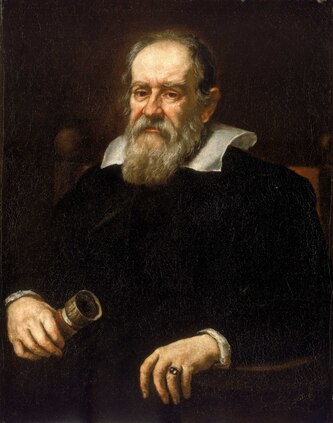
About Galileo Galilei