Link Copied!
Ferdinand Foch Quotes (1851-1929)
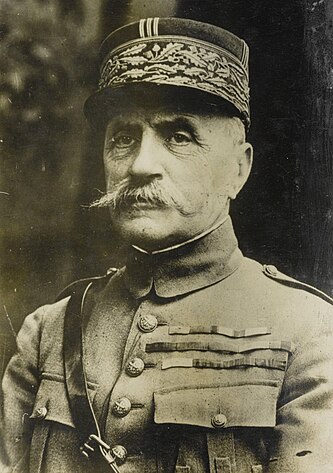


About Ferdinand Foch
Marshal Ferdinand Jean Marie Foch (2 October 1851 – 20 March 1929) was a French general and Marshal of France, Great Britain and Poland, a military theorist and the Allied Supreme Allied Commander during the final year of the First World War.
Best Ferdinand Foch Quotes
Shortest
Earliest
Explore our curated collection of the most famous and impactful Ferdinand Foch quotes.

“The unknown is the governing condition of war.”
“Mon centre cède, ma droite recule, situation excellente, j'attaque.”


“Every manoeuvre must be the development of a scheme; it must aim at a goal.”
“To inform, and, therefore to reconnoitre, this is the first and constant duty of the advanced guard.”
“What you did was the greatest thing accomplished by any private soldier of all of the armies of Europe.”
“An army is to a chief what a sword is to a soldier. It is only worth anything in so far as it receives from him a certain impulsion (direction and vigour).”
“Les avions sont des jouets intéressants mais n'ont aucune utilité militaire
• Variant translation: Airplanes are interesting toys, but have no military utility.”
• Variant translation: Airplanes are interesting toys, but have no military utility.”

“What you must do is to avoid the outbreak of war; do not tempt nations to become your adversaries. The best, indeed, the only means to this end are solid frontiers and an excellent army.”
“The laurels of victory are at the point of the enemy bayonets. They must be plucked there; they must be carried by a hand-to-hand fight if one really means to conquer.”
“Against what should fire be opened? Against the obstacles which may delay the march of infantry.
The first obstacle is the enemy gun. It will be the first objective assigned to artillery masses.”
The first obstacle is the enemy gun. It will be the first objective assigned to artillery masses.”

“In my opinion the treaty [of Versailles] was a bad one, very bad for us. It assured to us neither of the two things to which we were entitled: reparations and security. I said so to anyone who was willing to listen and to many who were not.”
“[O]ur Allies proposed the disarmament of Germany. It cannot be too often asserted that such a step would give us a mere temporary, precarious, illusory security. It is practically impossible to prevent Germany from arming herself in secret.”

“The Prussian Army has no ideals, no true spiritual strength; neither has the whole nation. All they have is gross materialism. ... The German soul has a place for the glorification of brute force, for the notion of war as a colossal looting campaign. That is all it holds. It is not much.”
“Far from being a sum of distinct and partial results, victory is the consequence of efforts, some of which are victorious while others appear to be fruitless, which nevertheless all aim at a common goal, all drive at a common result: namely, at a decision, a conclusion which alone can provide victory.”

“In war there are none but particular cases; everything has there an individual nature; nothing ever repeats itself.
In the first place, the data of a military problem are but seldom certain; they are never final. Everything is in a constant state of change and reshaping.”
In the first place, the data of a military problem are but seldom certain; they are never final. Everything is in a constant state of change and reshaping.”
Ferdinand Foch Quotes by Topic
Find exactly what you are looking for by browsing this categorized list of Ferdinand Foch quotes by topic.
Ferdinand Foch on Treaty of Versailles 4 quotes
“I bluntly remarked to M. Klotz, the Finance Minister: "With the treaty you have just signed, sir, you can expect with certainty to be paid in monkey tricks."”

Ferdinand Foch on Soul
Ferdinand Foch on Fear
“None but a coward dares to boast that he has never known fear.”

Ferdinand Foch on Discipline
“To be disciplined does not mean being silent, abstaining, or doing only what one thinks one may undertake without risk; it is not the art of eluding responsibility; it means acting in compliance with orders received, and therefore finding in one's own mind, by effort and reflection, the possibility to carry out such orders. It also means finding in one's own will the energy to face the risks involved in execution.”
Ferdinand Foch on Weimar Republic
“There you have a country against which the Allies must take well-defined precautions. It is possible that its republican form of government will profoundly modify the German mentality. I devoutly hope so, but we cannot be sure. A well-organized, militarized Republic, however, might be as great a menace to its neighbours as the old Empire—although as yet we have no proof that the Republic can establish itself firmly in Germany.”

What Ferdinand Foch Said About Others
Discover personal opinions Ferdinand Foch shared regarding contemporaries.
Ferdinand Foch on Napoleon
“Sire, sleep in peace; from the tomb itself you labor continually for France. At every danger to the country, our flags quiver at the passage of the Eagle. If our legions have returned victorious through the triumphal arch which you built, it is because the sword of Austerlitz marked out their direction, showing how to unite and lead the army that, won the victory. Your masterly lessons, your determined labors, remain indefeasible examples. In studying them and meditating on them the art of war grows daily greater. It is only in the reverently and thoughtfully gathered rays of your immortal glory that generations of the distant future shall succeed in grasping the science of combat and the management of armies for the sacred cause of the defense of the country.”

Ferdinand Foch on Carl von Clausewitz
“1870 woke us out of that sleep, for it gave us an enemy formed by the teaching of history—by the study of concrete facts. It was in such a fashion that Scharnhorst, Willisen and Clausewitz had, from the beginning of the nineteenth century, formed the Command of the Prussian Army. In order to know and understand war they had not confined themselves to examining the tool which is used in warfare, and taking it to pieces in its component material parts without taking man—who uses it—into account. In the Book of History, carefully analysed, they had found the living Army, troops in movement and action with their human needs, passions, weaknesses, self-denials, capacities of all sorts: "Far from being an exact science, war is a dreadful and impassioned drama."”

Quotes About Ferdinand Foch
Gain deeper perspective through quotes about Ferdinand Foch from others.
George Aston on Ferdinand Foch 2 quotes
“Weygand tells us that many of his visitors, French and foreign, were rather shy at finding themselves in the presence of the Chief who had commanded millions of men, and whose name for eight months had embodied all the trust and all the hopes of the Allied nations, the victor in the greatest battle in history. They left his presence impressed by the greatness of his intellect and of his soul, and fascinated by his simplicity. "They made no mistake; they had been in the presence of true greatness, with which there is always simplicity."”
Winston Churchill on Ferdinand Foch 2 quotes
“On Armistice Day, the German armies had marched homeward in good order. "They fought well," said Marshal Foch, Generalissimo of the Allies, with the laurels bright upon his brow, speaking in soldierly mood: "let them keep their weapons." But he demanded that the French frontier should henceforth be the Rhine. Germany might be disarmed; her military system shivered in fragments; her fortresses dismantled: Germany might be impoverished; she might be loaded with measureless indemnities; she might become a prey to internal feuds: but all this would pass in ten years or in twenty. The indestructible might "of all the German tribes" would rise once more and the unquenched fires of warrior Prussia glow and burn again. But the Rhine, the broad, deep, swift-flowing Rhine, once held and fortified by the French Army, would be a barrier and a shield behind which France could dwell and breathe for generations. Very different were the sentiments and views of the English-speaking world, without whose aid France must have succumbed. The territorial provisions of the Treaty of Versailles left Germany practically intact. She still remained the largest homogeneous racial block in Europe. When Marshal Foch heard of the signing of the Peace Treaty of Versailles he observed with singular accuracy: "This is not Peace. It is an Armistice for twenty years."”

David Lloyd George on Ferdinand Foch 3 quotes
“I met General Foch... He corresponded more with the British idea of what a typical Frenchman is like—vivacious, demonstrative, emphatic and gesticulatory. He talked just as much with his hands and arms as he did with his tongue. But whether he expressed himself with hand or voice he always talked well and to the point. His high broad forehead and his penetrating eye proved him a man of exceptional gifts. I asked him if he had any message for the British Cabinet and he said, "Tell them there will be no more retreats." I asked him whether I could also tell them there would be any more advances. He hesitated and was evidently perplexed by the question. After a perceptible halt he replied: "That depends on the men and material you will be able to throw into the battle line." He said that the Belgians had been obliged to retreat before the German advance, but his advice to them had been, "If you want to keep your country, dig yourselves into it, and hang on to it!"”

Raymond Poincaré on Ferdinand Foch
“He (Clemenceau) broke off to confide in me sadly that General Pétain was contemplating the retreat of the French Army to the south while the British Army retired towards the north. Pétain, added Clemenceau, had given orders on this basis. Foch confirmed this last piece of information and told me of the order to retreat which Pétain had given. "The President of the Council (Clemenceau)," added Foch, "has only just lately begun to take part in military matters; he had accepted Pétain's point of view, but I declined to take any responsibility for it. I sent M. Clemenceau a note to tell him my views. Common sense indicates that when the enemy wishes to begin making a hole, you do not make it wider. You close it, or you try to close it. We have only got to try and to have the will; the rest will be easy. You stick to your ground, you defend it foot by foot. We did that at Ypres, we did it at Verdun." And Foch stuck to his point with the same energy before Clemenceau, the senator and the deputy.”

Misattributed Quotes
Quotes mistakenly credited to Ferdinand Foch
About Ferdinand Foch
Marshal Ferdinand Jean Marie Foch (2 October 1851 – 20 March 1929) was a French general and Marshal of France, Great Britain and Poland, a military theorist and the Allied Supreme Allied Commander during the final year of the First World War.
QuotesCosmos Cross-Civilizational Archive
Explore Related Wisdom Pillars, Worldviews & Canonical Works
Discover how humanity's greatest philosophers, sacred scriptures, and literary masterpieces address the core questions of existence.
30 Wisdom Pillars
22 Worldviews & Traditions
Canonical Books & Scriptures