Link Copied!
Ervin László Quotes (1932-)
Philosopher
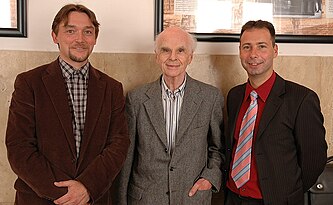
About Ervin László
Ervin László (born May 12, 1932) is a Hungarian philosopher of science, systems theorist, integral theorist, originally a classical pianist. He has published about 75 books and over 400 papers, and is editor of World Futures: The Journal of General Evolution.
Best Ervin László Quotes
Shortest
Earliest
Explore our curated collection of the most famous and impactful Ervin László quotes.

“We are living in a time of dissent, upheaval, revolutions and struggle, frequently aimed at mutual destruction.”

“[ Technology is] the instrumentality for accessing and using free energies in human societies for human and social purposes.”


“Each system has a specific structure made up of certain maintained relationships among its parts, and manifests irreducible characteristics of its own.”
“Underlying the diversified and localized gross layers of ordinary consciousness there is a unified, nonlocalized, and subtle layer: “pure consciousness.””

“Opposed to atomism and behaviorism, the systems view of man links him again with the world he lives in, for he is seen as emerging in that world and reflecting its general character.”

“Yet while they exist, regardless of how long, each system has a specific structure made up of certain maintained relationships among its parts, and manifests irreducible characteristics of its own.”
“The evolution of our individual consciousness paves the way toward the evolution of our collective consciousness. This individual-collective evolution, more than anything else, can and must change this world.”
“A system in one perspective is a subsystem in another. But the systems view always treats systems as integrated wholes of their subsidiary components and never as the mechanistic aggregate of parts in isolable causal relations.”
“The systems view is the emerging contemporary view of organized complexity, one step beyond the Newtonian view of organized simplicity, and two steps beyond the classical world views of divinely ordered or imaginatively envisaged complexity.”
“The worldview of the classical sciences conceptualized nature as a giant machine composed of intricate but replaceable machine-like parts. The new systems sciences look at nature as an organism endowed with irreplaceable elements and an innate but non-deterministic purpose for choice, for flow, for spontaneity.”

“Even the brain, that most delicate and complex of all known organs, is not merely a lot of neurons added together. While a genius must have more of the gray matter than a sparrow, the idiot may have just as much as the genius. The difference between them must be explained in terms of how those substances are organized.”
“Evolution may not “drive” toward humanoid qualities at all, even if it uses them under rather special circumstances. What evolution may be up to could be merely the continuing structuration of the biosphere through increased levels of communication between systems of one level, resulting in more integrated supersystems on the next.”
“In systems such as contemporary society, evolution is always a promise and devolution is always a threat. No system comes with a guarantee of ongoing evolution. The challenge is real. To ignore it is to play dice with all we have. To accept it is not to play God—it is to become an instrument of whatever divine purpose infuses the universe.”
“The new information technologies can be seen to drive societies toward increasingly dynamic high-energy regions further and further from thermodynamical equilibrium, characterized by decreasing specific entropy and increasingly dense free-energy flows, accessed and processed by more and more complex social, economic, and political structures.”
“There is nothing supernatural about the process of self-organization to states of higher entropy; it is a general property of systems, regardless of their materials and origin. It does not violate the Second Law of thermodynamics since the decrease in entropy within an open system is always offset by the increase of entropy in its surroundings.”

“General systems theory is the scientific exploration of "wholes" and "wholeness" which, not so long ago, were considered metaphysical notions transcending the boundaries of science. Hierarchic structure, stability, teleology, differentiation, approach to and maintenance of steady states, goal-directedness — these are a few of such general system properties.”
“The classical worldview was atomistic and individualistic; it viewed objects as separate from their environments and people as separate from each other and from their surroundings. The systems view perceives connections and communications between people, and between people and nature, and emphasizes community and integrity in both the natural and the human world.”
“Systems philosophy first must find out the "nature of the beast" This is the question of what is meant by "system", and how systems are realized in reality in various levels of observation. In Laslo's terms, this is the methodology and theory of natural systems. Secondly, there is epistemology, i.e. the methodology and theory of cognitive systems.”

“We are beginning to see the entire universe as a holographically interlinked network of energy and information, organically whole and self referential at all scales of its existence. We, and all things in the universe, are non-locally connected with each other and with all other things in ways that are unfettered by the hitherto known limitations of space and time.”

“Imagine a universe made up not of things in space and in time, but of patterned flows extending throughout its reaches. What flows is a mysterious, nonindividualized something we call energy. It flows along pathways structured by the metric of integral space-time. It flows smoothly, without crinks or wrinkles, over vast stretches of this cosmic matrix, and it becomes contorted in some regions.”
“In the penultimate decade of the twentieth century science is sufficiently advanced to resolve the puzzles that stymied scientists in the last century and demonstrate, without metaphysical speculation, the consistency of evolution in all realms of experience. It is now possible to advance a general evolution theory based on unitary and mutually consistent concepts derived from the empirical sciences.”
Ervin László Quotes by Topic
Find exactly what you are looking for by browsing this categorized list of Ervin László quotes by topic.
Ervin László on Science 3 quotes
“The worldview of the classical sciences conceptualized nature as a giant machine composed of intricate but replaceable machine-like parts. The new systems sciences look at nature as an organism endowed with irreplaceable elements and an innate but non-deterministic purpose for choice, for flow, for spontaneity.”

Ervin László on World view 3 quotes
“The worldview of the classical sciences conceptualized nature as a giant machine composed of intricate but replaceable machine-like parts. The new systems sciences look at nature as an organism endowed with irreplaceable elements and an innate but non-deterministic purpose for choice, for flow, for spontaneity.”

Ervin László on Information technology 2 quotes
“[ Technology is] the instrumentality for accessing and using free energies in human societies for human and social purposes.”

Ervin László on Meaning 2 quotes
“The search for meaning is not limited to science: it is constant and continuous--all of us engage in it during all our waking hours the search continues even in our dreams. There are many ways of finding meaning, and there are no absolute boundaries separating them.”

Ervin László on Entropy (thermodynamics) 2 quotes
“The new information technologies can be seen to drive societies toward increasingly dynamic high-energy regions further and further from thermodynamical equilibrium, characterized by decreasing specific entropy and increasingly dense free-energy flows, accessed and processed by more and more complex social, economic, and political structures.”

Ervin László on Determinism
“The worldview of the classical sciences conceptualized nature as a giant machine composed of intricate but replaceable machine-like parts. The new systems sciences look at nature as an organism endowed with irreplaceable elements and an innate but non-deterministic purpose for choice, for flow, for spontaneity.”
Ervin László on Systems theory
“General systems theory is the scientific exploration of "wholes" and "wholeness" which, not so long ago, were considered metaphysical notions transcending the boundaries of science. Hierarchic structure, stability, teleology, differentiation, approach to and maintenance of steady states, goal-directedness — these are a few of such general system properties.”
Ervin László on Teleology
“General systems theory is the scientific exploration of "wholes" and "wholeness" which, not so long ago, were considered metaphysical notions transcending the boundaries of science. Hierarchic structure, stability, teleology, differentiation, approach to and maintenance of steady states, goal-directedness — these are a few of such general system properties.”

Ervin László on System
“The notion of "system" has gained central importance in contemporary science, society and life. In many fields of endeavor, the necessity of a "systems approach" or "systems thinking" is emphasized, new professions called "systems engineering," "systems analysis" and the like have come into being, and there can be little doubt that this this concept marks a genuine, necessary, and consequential development in science and world-view.”

Ervin László on Systems thinking
“The notion of "system" has gained central importance in contemporary science, society and life. In many fields of endeavor, the necessity of a "systems approach" or "systems thinking" is emphasized, new professions called "systems engineering," "systems analysis" and the like have come into being, and there can be little doubt that this this concept marks a genuine, necessary, and consequential development in science and world-view.”

Ervin László on Systems engineering
“The notion of "system" has gained central importance in contemporary science, society and life. In many fields of endeavor, the necessity of a "systems approach" or "systems thinking" is emphasized, new professions called "systems engineering," "systems analysis" and the like have come into being, and there can be little doubt that this this concept marks a genuine, necessary, and consequential development in science and world-view.”

Ervin László on Cybernetics
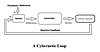
“Now "cybernetics" is the term coined by Wiener to denote "steersmanship" or the science of control. Although current engineering usage restricts it to the study of flows in closed systems, it can be taken in a wider context, as the study of processes interrelating systems with inputs and outputs, and their structural-dynamic structure. It is in this wider sense that "cybernetics" will be used here, to wit, as system-cybernetics, understanding by "system" an ordered whole in relation to its relevant environment (hence one actually or potentially open).”
Ervin László on Invisible hand
“When the classical worldview was applied to social science, the dominant notions turned out to be struggle for survival, the profit of the individual, with at best an assumed automatic coincidence of individual and societal good (through Adam Smith's "invisible hand"). When the systemic vision inspires the theories of social science, the values of competition are mitigated by those of cooperation, and the emphasis on individualistic work ethos is tempered with a tolerance of diversity and of experimentation with institutions and practices that foster man-man and man- nature adaptation and harmony.”

Ervin László on Communication theory
“General evolution theory, based on the integration of the relevant tenets of general system theory, cybernetics, information and communication theory, chaos theory, dynamical systems theory, and nonequilibrium thermodynamics, can convey a sound understanding of the laws and dynamics that govern the evolution of complex systems in the various realms of investigation.... The basic notions of this new discipline can be developed to give an adequate account of the dynamical evolution of human societies as well. Such an account could furnish the basis of a system of knowledge better able to orient human beings and societies in their rapidly changing milieu.”

Quotes About Ervin László
Gain deeper perspective through quotes about Ervin László from others.
Stan Grof on Ervin László
“Where Wilber outlined what an integral theory of everything should look like, Laszlo actually created one.”
About Ervin László
Ervin László (born May 12, 1932) is a Hungarian philosopher of science, systems theorist, integral theorist, originally a classical pianist. He has published about 75 books and over 400 papers, and is editor of World Futures: The Journal of General Evolution.
QuotesCosmos Cross-Civilizational Archive
Explore Related Wisdom Pillars, Worldviews & Canonical Works
Discover how humanity's greatest philosophers, sacred scriptures, and literary masterpieces address the core questions of existence.
30 Wisdom Pillars
22 Worldviews & Traditions
Canonical Books & Scriptures