Link Copied!
Ernst Ludwig Kirchner Quotes (1880-1938)
Artist, Painter

About Ernst Ludwig Kirchner
Ernst Ludwig Kirchner (6 May 1880 – 15 June 1938) was a German expressionist painter and one of the founders of the artists group Die Brücke (The Bridge).
Best Ernst Ludwig Kirchner Quotes
Shortest
Earliest
Explore our curated collection of the most famous and impactful Ernst Ludwig Kirchner quotes.
“It would be nice if you wouldn't call me an expressionist. I'm really not one.”
“..the feeling that pervades a city presented itself in the qualities of lines of force.”
“I begin with movement.. .I believe that all human visual experiences are born from movement..”


“Nowhere does one come to know an artist better than in his prints [and] the woodcut is the most graphic of the print processes.”
“..momentarily, we (Erich Heckel, Max Pechstein, and I) are once again at Moritzburg. There is nothing more delightful than nudes in open air.”
“[that] simple people brought their bodies and shared their scanty bread with the artists. Kirchner learned the course of life again in their houses.”


“Only the artist who has a love and an aptitude for craftsmanship should make prints; only when the artist truly prints himself does the work earn the name original print.”
“I found it very difficult to suddenly depart [from Berlin] since this year I had risen completely in the landscape and life and hardly needed awareness to access this place.”
“The technical procedures doubtless release energies in the artist that remain unused in the much more lightweight processes of drawing or painting [referring to his printmaking].”
“It seems as though the goal of my work has always been to dissolve myself completely into the sensations of the surroundings in order to then integrate this into a coherent painterly form.”
“The beautiful, architectonically constructed, severely formed bodies of these women [his girlfriend in Berlin and life companion, Erna with her sister Gerda] replaced the soft Saxon physique.”
“Completely strange faces pop up as interesting points through the crowd. I am carried along with the current, lacking will. To move becomes an unacceptable effort [describing the crowds in Dresden].”
“Every day I studied the nude, and movement in the streets and in the shops [in Berlin]. Out of the naturalistic surface with all its variations I wanted to derive the pictorially determined surface.”
“Bloated, one [=Kirchner himself] staggers off to work, where all work is in vain and the onslaught of mediocrity flattens everything. Like the cocottes that I painted, that is how one is now. Wiped out, next time gone.”
“to study the nude, the foundation of all pictorial art, in total freedom and naturalness. From.. ..this basis there emerged the feeling, shared by all, of taking creative stimulus from life itself and submitting to the decisive experience.”
“Life is unfixed when one lives in Berlin, where one has to fight for a living. It is painfully base here. I see that a fine, free culture cannot be created under these circumstances and wish to leave as soon as I have overcome this big slump.”
“I painted it in Berlin [self-portrait 'The Drinker'], while screaming military convoys were passing beneath my window day and night.”

“After the war [1918] etching became Kirchner's favorite medium. He attributed this to its responsiveness. 'Etchings', he wrote, 'develop in the first states the most immediate hieroglyphs. Rich in lively handwriting and rich in variety of motifs, the etchings are like a diary of the painter.'”
Ernst Ludwig Kirchner Quotes by Topic
Find exactly what you are looking for by browsing this categorized list of Ernst Ludwig Kirchner quotes by topic.
Ernst Ludwig Kirchner on Die Brücke 5 quotes
“The struggle for existence is very difficult here [Berlin], but the possibilities are also greater. I hope that we can create a fruitful new school and convince many new friends of the value of our efforts.”

Ernst Ludwig Kirchner on Production
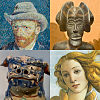
“It is not a question of trying to reproduce objective features, only of good practice for the fingers and for the perceptive faculty, and that too is very useful. You must have read how Van Gogh was always getting his brother to send him drawings to copy. And how Rembrandt used to copy Indian an Italian pictures. Not of course, because they were short of material, but to get 'du corps'. So one should be always drawing... ...Oh, you’d love the Indians. The pure, Aryan Indians, not those one could see in Berlin, whose forms had become rigid and sterile through mingling with the Chinese.”

What Ernst Ludwig Kirchner Said About Others
Discover personal opinions Ernst Ludwig Kirchner shared regarding contemporaries.
Ernst Ludwig Kirchner on Otto Mueller
“[the nicest artist and his works were] always of a high standard and truly free works of art and genuine because they matured freely and purely on the basis of his philosophy of life.”

Ernst Ludwig Kirchner on Karl Schmidt-Rottluff
“The bracing air of the North Sea brought out a monumental impressionism, especially in Schmidt-Rottluff.. ..[a pictorial unity] which actually lives more through the artist's obsession than through the definition of the subject.”

Ernst Ludwig Kirchner on Vincent van Gogh
“..It is not a question of trying to reproduce objective features, only of good practice for the fingers and for the perceptive faculty, and that too is very useful. You must have read how Van Gogh was always getting his brother to send him drawings to copy.. ..to get 'du corps'. So one should be always drawing...”
Quotes About Ernst Ludwig Kirchner
Gain deeper perspective through quotes about Ernst Ludwig Kirchner from others.
Fritz Bleyl on Ernst Ludwig Kirchner 3 quotes
“[Kirchner's studio was] that of a real bohemian, full of paintings lying all over the place, drawings, books and artist's materials — much more like an artist's romantic lodgings than the home of a well-organised architecture student.”

Source on Ernst Ludwig Kirchner
“A colourfully painted curtain concealed a large collection of paintings [in Kirchner's studio in Berlin]. When we began to look at them, he came alive. Together with me, he saw all his experiences drift by on canvas, the small, timid-looking woman set aside what we had seen and brought a bottle of wine. He made short explanatory remarks in a weary voice. Each picture had its own particular colourful character, a great sadness was present in all of them; what I had previously found to be incomprehensible and unfinished now created the same delicate and sensitive impression as his personality. Everywhere a search for style, for psychological understanding of his figures. The most moving was a self-portrait in uniform with his right hand cut off. Then he showed me his travel permit for Switzerland. He wanted to go back to Davos.. ..and implored me to ask father for a medical certificate..”
Grisebach visited Kirchner on Ernst Ludwig Kirchner
“Eberhard Grisebachhttps://de.wikipedia.org/wiki/Eberhard_Grisebach, in a letter March 1917 to Helen Spengler; as quoted by E. W. Kornfield, Stauffer, Christine E. Stauffer (1992). Biography Ernst Ludwig Kirchner, Kirchner Museum Davos. Retrieved March 21, 2016; from Wikipedia: Kirchner”
In a letter of Belgian artist on Ernst Ludwig Kirchner
“'a true victim of the war; the hellish delusion of being sent back into battle had deranged him and flung him helplessly onto the shabby bed of a third-class hotel.. .In Davos I found an emaciated man with a piercing, feverish gaze, who saw imminent death before his eyes.”
Letter from his wife Erna Kirchner on Ernst Ludwig Kirchner
“A tragedy had been quietly enacted here over the last few months. Because of the defamation in Germany [in 1937 a total of 639 works by Kirchner were confiscated by the Nazi-regime: Degenerate Art] and the failure of the November exhibition in Basle.. ..he [=Kirchner] chose a radiantly beautiful day, 15 June, to put an end to his life. I shall spare you the details. He had been suffering grievously until he was able to make this decision.”
de:Gustave Schiefler on Ernst Ludwig Kirchner
“In the days that I spent in Dresden [before 1911].. ..I was together with Kirchner and Heckel a great deal.. .Here they led a singular bohemian life, liberated from any ordering of day-times and mealtimes; when they had the impulse they worked the whole night through and slept through the morning. I was convinced that they not infrequently lived on coffee, cake, and cigarettes.. .When the lamps were lit, we sat on benches and crouched over the batik-ed fabrics that were spread around the low table and looked at the portfolios with hand drawings and printed sheets; all the time strange, grotesque sculptures peered over our shoulders. The two showed me how they etched their lithographs, printed their etchings, and Kirchner drew two.. ..portraits of me with the dry-point needle.”
de:Eberhard Roters on Ernst Ludwig Kirchner
“In spring 1915, the recruit, Ernst Ludwig Kirchner, was furloughed from his field artillery unit because he did not prove adequate to the demand of service. The diagnosis said: "because of affected lungs and feebleness." But the true cause was a profound physical and spiritual crisis, which brought him to a sanatorium in Königstein, Taunus. Artistic efforts at overcoming the trauma are revealed in works such as the 1915 'Self-Portrait as a Soldier'. The artist presents himself in the masquerade of a uniform: his face is a mask of isolation: a bleeding arm stump looms out of the right sleeve; the painter's active hand seems chopped off.”
Deborah Wye on Ernst Ludwig Kirchner
“Kirchner superimposes [in his series Street Scene painting from Berlin], (de:Straßenszenen) a jaded artificiality over its excitement and glamour, situating the garish yet exotic streetwalker in an atmosphere suggesting loneliness and alienation, as well as agitation and danger. Paint is applied in spontaneous, splintered brushstrokes that create jagged forms and express an immediacy and energy that approximate the stimulating yet hectic urban environment.”
Claire Louise Albiez on Ernst Ludwig Kirchner
“More than any of the other artists, Kirchner translated the staccato rhythm of the music into visual means; the legs of dancers become solid entities and almost dashes in his 1910 Hamburger Tänzerinnen (Hamburg Dancers) (Fig. 34). All weight of this image is on the legs, as they are the largest parts of the scene and are rendered fully in black. Moreover, the repeating subject of the three dancers each doing identical leg lifts creates a vibrating back-and-forth. In this quick sketch, Kirchner manages to relay the unified spirit of this performance.”
About Ernst Ludwig Kirchner
Ernst Ludwig Kirchner (6 May 1880 – 15 June 1938) was a German expressionist painter and one of the founders of the artists group Die Brücke (The Bridge).
QuotesCosmos Cross-Civilizational Archive
Explore Related Wisdom Pillars, Worldviews & Canonical Works
Discover how humanity's greatest philosophers, sacred scriptures, and literary masterpieces address the core questions of existence.
30 Wisdom Pillars
22 Worldviews & Traditions
Canonical Books & Scriptures