Link Copied!
Erik von Kuehnelt-Leddihn Quotes (1909-1999)



































About Erik von Kuehnelt-Leddihn
Erik Maria Ritter von Kuehnelt-Leddihn (31 July 1909 – 26 May 1999) was an Austrian Catholic nobleman and socio-political theorist.
Best Erik von Kuehnelt-Leddihn Quotes
Shortest
Earliest
Explore our curated collection of the most famous and impactful Erik von Kuehnelt-Leddihn quotes.
“Ochlocracy is revolution in permanence.”


“Europe's rise is written in the terms of Christianity and Monarchy, Europe's decay in the terms of Republicanism, "Progressivism," and Godlessness.”
“For the average person, all problems date to World War II; for the more informed, to World War I; for the genuine historian, to the French Revolution.”

“There is no such thing as a historical fatality; there is only a historical nemesis which punishes those who have hesitated to act when action was still possible.”
“Generosity is a virtue more frequently found in the small top layers than among the masses. After all, it takes intelligence to suspect that generosity very often pays while egotism does not.”
“The automatic desire for more power is only apparent in children, primitives, people of low character or intellect; for the superior man, power is like a cross, duty a burden, responsibility an obligation.”

“In the last two hundred years the exploitation of envy—its mobilization among the masses—coupled with the denigration of individuals, but more frequently of classes, races, nations, or religious communities, has been the key to political success.”
“The horizontalist is tied down and cannot rise above himself. In his antagonism toward all hierarchy he even finally opposes the idea of God as a superior to himself, as a Supreme Being, and therefore also the conceptual images of Popes, emperors, kings, and fathers.”
“The worship of size and number is an old ochlocratic as well as materialistic trend as opposed to the Christian traditional love for quality. It is "bigger and better" and not "better and bigger" which inspires our democratists with their competitive and recordistic tendencies.”
“In the linguistic usage of the Left, "democratic" denotes much more frequently highly negative values. Everybody is acquainted with the real meaning of such expressions as "making democracy work in the classroom" which just stands for lack of discipline, or "democratizing literature" which means plain trash.”
“E pluribus unum, the constructive principle of federation, In God We Trust, the recognition of God's limitless fatherhood — these two watchwords, together with that of Liberty, should be our creed, not that spurious label democracy which our American forebears despised and execrated.”

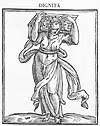
“Dignity is naturally an "aristocratic" virtue, best demonstrated in adverse circumstances, in bearing of suffering, in facing death, childbirth, or the guillotine. Dignity as an attitude is also something personal and not collective. Democratism never liked dignity. Nothing infuriates the howling mob more than dignity.”
“Ninety-five per cent of modern people have no ideas or convictions of their own. Five per cent have views and convictions but again ninety-five per cent of these do not dare to stand up for them. There are five per cent of five per cent who have courage and convictions. These make history for good or evil.”
“If medieval man would have been told that he could "appoint" his kings or superiors, he might have become quite interested in the proposition. Yet on discovering that his vote was scheduled to be drowned in an ocean of millions of other votes his reaction would have been that of a man whose leg had been pulled successfully.”

“America is not a democracy. We are not fighting for democracy. We fight for liberty. America not only fights for its own survival, for its own liberty, but also for liberty abroad. Human dignity can never be preserved without liberty. Liberty is therefore a real good, a precious good worth while to be redeemed by blood.”

“Even 51 per cent of a nation can establish a totalitarian and dictatorial règime, suppress minorities, and still remain democratic; there is, as we have said, little doubt that the American Congress and the French Chambre have a power over their respective nations which would rouse the envy of a Louis XIV or a George III were they alive today.”
“It must furthermore be borne in mind that equality stands for monotony and not for harmony. A harmonious melody can only be established by different unidentical musical tones. These tones must be assembled and have to follow in a certain sequence; otherwise they will result in chaos and not in melody. Human society presupposes such an inequality and unity.”

“We have said before that it is difficult to find the exact reasons for the growing popularity of the word democracy and democratic taken from a dead language which is thoroughly nonunderstandable to 999 out of 1000 Americans. The decline of classical education in favor of progressive "self-realization" has favored the increased use of wrong labels.”
“Who is secure in all his basic needs? Who has work, spiritual care, medical care, housing, food, occasional entertainment, free clothing, free burial, free everything? The answer might be “monks and nuns,” but the standard reply is, “prisoners.” And inevitably this conjures up citizens of the Provider State who have protection from the “cradle to the grave.””

“The ideal dwelling place for the herdist is the city, the megalopolis with its apartment houses, clubs, cinemas, theaters, offices, factories, and restaurants. Here the herdist has ample opportunity to live the life of the masses, to lead an impersonal and lonely existence in a truly dehumanized ant heap, to love and like nobody but himself and perhaps those similar to him.”
“The true herdist [...] is nothing but an egoist who cannot tolerate anybody differing from himself. John Doe, the identitarian, wants a nation, a world, a universe peopled by millions of John Does. He cannot sympathize nor like anybody at variance with John Doe. No wonder that his wishful dream is a humanity of John Does without God or Devil. The herdist is by necessity a humanitarian.”
“Patriotism, not nationalism, should inspire the citizen. The ethnic nationalist who wants a linguistically and culturally uniform nation is akin to the racist who is intolerant toward those who look (and behave) differently. The patriot is a "diversitarian"; he is pleased, indeed proud of the variety within the borders of his country; he looks for loyalty from all citizens. And he looks up and down, not left and right.”
Erik von Kuehnelt-Leddihn Quotes by Topic
Find exactly what you are looking for by browsing this categorized list of Erik von Kuehnelt-Leddihn quotes by topic.
Erik von Kuehnelt-Leddihn on Monarchy 4 quotes
“Monarchy was historically always the best protection against any sort of oligarchical rule and it was the historic role of monarchs to side with the lower classes against the nobility.”

Erik von Kuehnelt-Leddihn on French Revolution 3 quotes
“Did the French Revolution leave anything positive to posterity? Only the metric system.”

Erik von Kuehnelt-Leddihn on Aristocracy 3 quotes
“Education is, after all, something thoroughly "aristocratic" in the intellectual sense.”

Erik von Kuehnelt-Leddihn on Democracy 3 quotes
“In the linguistic usage of the Left, "democratic" denotes much more frequently highly negative values. Everybody is acquainted with the real meaning of such expressions as "making democracy work in the classroom" which just stands for lack of discipline, or "democratizing literature" which means plain trash.”

Erik von Kuehnelt-Leddihn on Equality 3 quotes
“It must furthermore be borne in mind that equality stands for monotony and not for harmony. A harmonious melody can only be established by different unidentical musical tones. These tones must be assembled and have to follow in a certain sequence; otherwise they will result in chaos and not in melody. Human society presupposes such an inequality and unity.”

Erik von Kuehnelt-Leddihn on Ochlocracy 2 quotes
“Ochlocracy (even more so than aristocracy) is based upon change and instability; ochlocracy is revolution in permanence.”
Erik von Kuehnelt-Leddihn on Progressivism 2 quotes
“Europe's rise is written in the terms of Christianity and Monarchy, Europe's decay in the terms of Republicanism, "Progressivism," and Godlessness.”

Erik von Kuehnelt-Leddihn on Cities 2 quotes
“It shall be remembered that the first to be mentioned in the Sacred Scriptures as a builder of cities was at the same time the first murderer — Cain. (Gen. 4:17.)”

Erik von Kuehnelt-Leddihn on Marxism 2 quotes
“Marxism and nationalism coexisted peacefully in the German countries and it was perhaps only a question of time and circumstances when these two ideologies with their fervent admiration for State and Society would merge into one, and National Socialism would arise as a bastard child of Marx and Wagner-Treitschke.”

Erik von Kuehnelt-Leddihn on Herd mentality 2 quotes
“'''The true herdist is nothing but an egoist who cannot tolerate anybody differing from himself. John Doe, the identitarian, wants a nation, a world, a universe peopled by millions of John Does. He cannot sympathize nor like anybody at variance with John Doe. No wonder that his wishful dream is a humanity of John Does without God or Devil. The herdist is by necessity a ''humanitarian.'''''”

Erik von Kuehnelt-Leddihn on Workmanship 2 quotes
“Once Europe could boast of a large class of craftsmen — free people with the opportunity for artistic creation; but now everything is manufactured by mass production and the result is an incredible shrinkage in the variety of forms due to standardization. There is probably a greater variety of goods in Timbuctoo or in the Sooks of Marrakesh than in Frankfort or Los Angeles. The artifacts are thus "democratized." (Mr. Gray and Mr. Green get an identical product for an identical price.)”

Erik von Kuehnelt-Leddihn on Catholic Church 2 quotes
“For the Nationalists the Church was an organization of international conspirators, for the Marxists, opium for the people based on metaphysical superstition, for certain "conservatives," an inimical foreign power ultra montes, for the neo-Liberals an enemy of progress, for the Pravoslavs a materialistic heresy. There were capitalists who considered the Church to be an agent of socialism, thanks to the encyclicals of Leo XIII, and Socialists who visualized her as a protagonist of some sort of capitalist feudalism. One must make the concession that this common hatred against the Church had also a positive aspect; it united the Occident in a common goal and thus it created a focal point which the West had not possessed since the Reformation.”

What Erik von Kuehnelt-Leddihn Said About Others
Discover personal opinions Erik von Kuehnelt-Leddihn shared regarding contemporaries.
Erik von Kuehnelt-Leddihn on Politicians
Erik von Kuehnelt-Leddihn on Saints
“It could be argued that normal life is after all nothing but a chain of clever compromises. The man who understands how to live well, the Lebenskünstler as the Germans call him, is nothing but a virtuoso in compromises. The hero and the saint, on the other hand, are "clumsy," quixotic, and maladroit. They have nothing of the Lebenskünstler and cannot help inflicting upon themselves wound after wound. The virtuoso of life, no less than the bonvivant, is a thoroughly feminine as well as effeminate product.”
Erik von Kuehnelt-Leddihn on Martin Luther
“He was possessed of a more Slavic than Germanic grudge against Latin clarity and legalism; the meticulous adherence to the iron laws of logic, dry and well-weighted argumentation of a gradual and conclusive nature were alien to him. His whole appearance reminds one rather of a Prussian N.C. officer or of a Slovakian butcher, than of a West German intellectual. His bulging eyes and unkempt hair; his fat neck and bellowing voice; his inordinate love for food, drink, and sex; his coarse speech and eruptive nature are characteristic of certain low-class East Europeans. When he says: "I do not admit that my doctrine can be judged by anyone, not by the angels," one could almost imagine hearing Hitler speak.”

Erik von Kuehnelt-Leddihn on Women
“The horror of death so typical of modern man is probably another feminine aspect of our time. "Media vita in morte sumus" is the hymn of a male and hierarchic age. The great thing in the life of the male is death just as love is the keynote of a female life. "Man is the glory of God, but woman is the glory of man," says St. Paul. The man finds his final reunion with God through the gate of death, but the woman gets the foreboding of such a reunion in her love to a man. Men also love women as children of God but, while this remains an indirect approach to Him, death always remains the shortest route to the Father. This is also the reason why there is such a deep metaphysical relation between love and death.”

Erik von Kuehnelt-Leddihn on John Calvin
“Apart from a few poets we see these followers of Calvin contributing very little to the arts and letters. They lacked painters, musicians, architects of originality; hilarity was for them suspect and their humor was limited. In their political activities they displayed strange and disquieting tendencies; in North America they brought the Indians, with the help of bullets, whisky, and infected blankets, almost to a vanishing point. In England they led the first great attack against the institution of monarchy in Christian history, in Ireland they displayed their homicidal talents in the most brutal type of warfare, in South Africa they established republics in which the institution of slavery survived till the threshold of the twentieth century, in Hungary they allied themselves with the pagan Turks and in Japan with the Shintoists against the Catholics.”

Erik von Kuehnelt-Leddihn on Adolf Hitler
“"Progress" is for the convinced ochlocrats a consoling Utopia of madly increased comfort and technicism. This charming but dull vision was always the pseudoreligious consolation of millions of ecstatic believers in ochlocracy and in the relative perfection and wisdom of Mr. and Mrs. Averageman. Utopias in general are surrogates for heaven; they give a meager solace to the individual that his sufferings and endeavors may enable future generations to enter the chiliastic paradise. Communism works in a similar way. Its millennium is almost the same as that of ochlocracy. The Millennium of Lenin, the Millennium of Bellamy, the Millennium as represented in H. G. Wells's, "Of Things to Come," the Millennium of Adolf Hitler and Henry Ford — they are all basically the same; they often differ in their means to attain it but they all agree in the point of technical perfection and the classless or at least totally homogeneous society without grudge or envy.”

Erik von Kuehnelt-Leddihn on Franklin D. Roosevelt
“Mr. Hoover's presidency was drawing to a close and Mr. Franklin Delano Roosevelt, one of the most dynamic grave diggers of the Western world, succeeded on a platform not dissimilar to that of his predecessor. Though Mr. Roosevelt belonged to the Democratic party, his social background indisposed him for a time to leftist policies, both national and international. But his wife (from another branch of the Roosevelt family) was more in tune with leftist ideas, undoubtedly the aftereffect of higher feminine education in the United States. Whereas Mr. Roosevelt played his politics by ear, his wife, who wielded considerable influence, was ideologically far more consistent. Mr. Roosevelt, moreover, had but the scantiest education for his task; he hardly knew Europe, and his knowledge of foreign languages was as modest as his acquaintance with the mentality of other nations. Largely ignorant himself, and profoundly anti-intellectual, he had no way of judging, evaluating, and coordinating expert opinion. Even worse, perhaps, his sense of objective truth was gravely impaired. His handicap was by no means primarily of a physical nature.”

Quotes About Erik von Kuehnelt-Leddihn
Gain deeper perspective through quotes about Erik von Kuehnelt-Leddihn from others.
About Erik von Kuehnelt-Leddihn
Erik Maria Ritter von Kuehnelt-Leddihn (31 July 1909 – 26 May 1999) was an Austrian Catholic nobleman and socio-political theorist.
QuotesCosmos Cross-Civilizational Archive
Explore Related Wisdom Pillars, Worldviews & Canonical Works
Discover how humanity's greatest philosophers, sacred scriptures, and literary masterpieces address the core questions of existence.
30 Wisdom Pillars
22 Worldviews & Traditions
Canonical Books & Scriptures