Link Copied!
Edward Teller Quotes (1908-2003)
Physicist
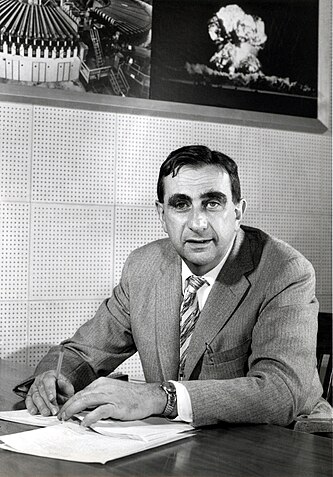

About Edward Teller
Edward Teller (original Hungarian name Teller Ede) (15 January 1908 – 9 September 2003) was an American nuclear physicist, known as "the father of the hydrogen bomb."
Best Edward Teller Quotes
Shortest
Earliest
Explore our curated collection of the most famous and impactful Edward Teller quotes.
“No, I'm the infamous Edward Teller.”
“Two paradoxes are better than one; they may even suggest a solution.”
“There's no system foolproof enough to defeat a sufficiently great fool.”
“When you fight for a desperate cause and have good reasons to fight, you usually win.”
“Secrecy in science does not work. Withholding information does more damage to us than to our competitors.”

“I believe that no endeavor that is worthwhile is simple in prospect; if it is right, it will be simple in retrospect.”
“We must learn to live with contradictions, because they lead to deeper and more effective understanding.”
“I believe in good. It is an ephemeral and elusive quality. It is the center of my beliefs, but it cannot be strengthened by talking about it.”
“I believe in evil. It is the property of all those who are certain of truth. Despair and fanaticism are only differing manifestations of evil.'''”

“I believe in excellence. It is a basic need of every human soul. All of us can be excellent, because, fortunately, we are exceedingly diverse in our ambitions and talents. ”
“A fact is a simple statement that everyone believes. It is innocent, unless found guilty. A hypothesis is a novel suggestion that no one wants to believe. It is guilty, until found effective.”
“My name is not Strangelove. I don't know about Strangelove. I'm not interested in Strangelove. What else can I say?... Look. Say it three times more, and I throw you out of this office.”
“It is not even impossible to imagine that the effects of an atomic war fought with greatly perfected weapons and pushed by the utmost determination will endanger the survival of man.”
“By having simplified what is known, physicists have been led into realms which as yet are anything but simple. That at some time, they, too, will appear as simple consequences of a theory of which no one has yet dreamed is not a statement of fact.
It is a statement of faith.”
It is a statement of faith.”
“I don't want to kill anybody. I am passionately opposed to killing, but I'm even more passionately fond of freedom. The freedom of Dr. Pauling and of myself expressing our opinions freely on any subject, however broad, however far removed of our proper competence, but particularly, to be able to express our opinions in the fields we really know; this would not be possible in Russia.”

“I contributed; Ulam did not. I'm sorry I had to answer it in this abrupt way. Ulam was rightly dissatisfied with an old approach. He came to me with a part of an idea which I already had worked out and difficulty getting people to listen to. He was willing to sign a paper. When it then came to defending that paper and really putting work into it, he refused. He said, "I don't believe in it."”
“Religion was not an issue in my family; indeed, it was never discussed. My only religious training came because the Minta required that all students take classes in their respective religions. My family celebrated one holiday, the Day of Atonement, when we all fasted. Yet my father said prayers for his parents on Saturdays and on all the Jewish holidays. The idea of God that I absorbed was that it would be wonderful if He existed: We needed Him desperately but had not seen Him in many thousands of years.”
“At the end of the war, most people wanted to stop. I didn't. Because here was more knowledge. And in the coming uncertain period, with a dangerous man like Stalin around, and our incomplete knowledge, I felt that more knowledge is necessary. Among the people who knew a great deal about the hydrogen bomb, I was the only advocate of it. And that is, I think, my contribution. Not that I invented it, others would have — and others in the Soviet Union did. But I was the one person who put knowledge, and the availability of knowledge, above everything else.”

“"A stands for atom; it is so small
No one has ever seen it at all.
B stands for bombs; the bombs are much bigger.
So, brother, do not be too fast on the trigger.
F stands for fission; that is what things do
When they get wobbly and big and must split in two.
And just to confound the atomic confusion
What fission has done may be undone by fusion.
H has become a most ominous letter;
It means something bigger, if not something better.
S stands for secret; you can keep it forever —
Provided there's no one abroad who is clever."”
Edward Teller Quotes by Topic
Find exactly what you are looking for by browsing this categorized list of Edward Teller quotes by topic.
Edward Teller on Technology 2 quotes
“Today's science is tomorrow's technology.”

Edward Teller on Science 2 quotes
“Today's science is tomorrow's technology.”
Edward Teller on Global warming 2 quotes
“At present the carbon dioxide in the atmosphere has risen by 2 per cent over normal. By 1970, it will be perhaps 4 per cent, by 1980, 8 per cent, by 1990, 16 per cent [about 360 parts per million, by Teller’s accounting], if we keep on with our exponential rise in the use of purely conventional fuels. By that time, there will be a serious additional impediment for the radiation leaving the earth. Our planet will get a little warmer. It is hard to say whether it will be 2 degrees Fahrenheit or only one or 5. But when the temperature does rise by a few degrees over the whole globe, there is a possibility that the icecaps will start melting and the level of the oceans will begin to rise. Well, I don’t know whether they will cover the Empire State Building or not, but anyone can calculate it by looking at the map and noting that the icecaps over Greenland and over Antarctica are perhaps five thousand feet thick.”

Edward Teller on Truth
Edward Teller on Evil
“I believe in evil. It is the property of all those who are certain of truth. Despair and fanaticism are only differing manifestations of evil.”
Edward Teller on Fanaticism
“I believe in evil. It is the property of all those who are certain of truth. Despair and fanaticism are only differing manifestations of evil.”

Edward Teller on Despair
“I believe in evil. It is the property of all those who are certain of truth. Despair and fanaticism are only differing manifestations of evil.'''”
Edward Teller on Certainty
“I believe in evil. It is the property of all those who are certain of truth. Despair and fanaticism are only differing manifestations of evil.'''”

Edward Teller on Uncertainty principle
“... Heisenberg's main work — his wonderful work — on the uncertainty principle ... Some very important people — like Einstein — did not like this. ... His remark was, "I can believe that God governs the world with any set of laws, but I cannot believe that He is playing at dice. ..." ... Einstein's statement — his remark — was really something to the effect: "I cannot imagine any science without causality ..."”

Edward Teller on Nuclear power
“On May 7, a few weeks after the accident at Three-Mile Island, I was in Washington. I was there to refute some of that propaganda that Ralph Nader, Jane Fonda and their kind are spewing to the news media in their attempt to frighten people away from nuclear power. I am 71 years old, and I was working 20 hours a day. The strain was too much. The next day, I suffered a heart attack. You might say that I was the only one whose health was affected by that reactor near Harrisburg. No, that would be wrong. It was not the reactor. It was Jane Fonda. Reactors are not dangerous.”

Edward Teller on Contradiction
“... I have something of a guess: Bohr liked paradoxes. I wanted to eliminate contradictions. He liked those contradictions. And — what I said so far is true — but what I am now going to say is probably true. And — Bohr liked contradictions with good reason ... The simple, straightforward way how we see the world ... it is not a wavefunction. It is something that I can describe and understand. If I don't start from such ideas then I can't possibly know what I'm talking about. ... You must start from practical theory with all the contradictions that a detailed observation then leads to. Then as a next step you resolve these contradictions.”
What Edward Teller Said About Others
Discover personal opinions Edward Teller shared regarding contemporaries.
Edward Teller on John von Neumann 8 quotes
View all 8 quotes on John von Neumann →Edward Teller on Linus Pauling 2 quotes
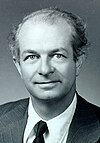
“I don't want to kill anybody. I am passionately opposed to killing, but I'm even more passionately fond of freedom. The freedom of Dr. Pauling and of myself expressing our opinions freely on any subject, however broad, however far removed of our proper competence, but particularly, to be able to express our opinions in the fields we really know; this would not be possible in Russia.”
Edward Teller on George Gamow
“Gamow was fantastic in his ideas. He was right, he was wrong. More often wrong than right. Always interesting; … and when his idea was not wrong it was not only right, it was new.”

Edward Teller on Stanislaw Ulam
“I contributed; Ulam did not. I'm sorry I had to answer it in this abrupt way. Ulam was rightly dissatisfied with an old approach. He came to me with a part of an idea which I already had worked out and difficulty getting people to listen to. He was willing to sign a paper. When it then came to defending that paper and really putting work into it, he refused. He said, "I don't believe in it."”

Edward Teller on Jane Fonda
“On May 7, a few weeks after the accident at Three-Mile Island, I was in Washington. I was there to refute some of that propaganda that Ralph Nader, Jane Fonda and their kind are spewing to the news media in their attempt to frighten people away from nuclear power. I am 71 years old, and I was working 20 hours a day. The strain was too much. The next day, I suffered a heart attack. You might say that I was the only one whose health was affected by that reactor near Harrisburg. No, that would be wrong. It was not the reactor. It was Jane Fonda. Reactors are not dangerous.”

Quotes About Edward Teller
Gain deeper perspective through quotes about Edward Teller from others.
Bad Religion on Edward Teller
“Business institutions universities Both are quite the circus where the killer wants his way I think of Edward Teller and his moribund reprise Then I look to Nevada and I can't believe my eyes It's time for him to die!”
Hans Bethe on Edward Teller
“Dr. Teller has a mind very different from mine. I think one needs both kinds of minds to make a successful project. I think Dr. Teller's mind runs particularly to making brilliant inventions, but what he needs is some control, some other person who is more able to find out just what is the scientific fact about the matter. Some other person who weeds out the bad from the good ideas.”

Freeman Dyson on Edward Teller 3 quotes
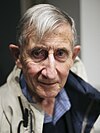
“Teller's mistake was his failure to foresee that a large section of the public would not consider his appearance at the Oppenheimer hearing to be decent behavior. Had Teller not appeared, the outcome of the hearing would almost certainly have been unaffected, and the moral force of Teller's position would not have been tainted.”
Daniel Ellsberg on Edward Teller
“The physicist Edward Teller, known as the “father of the H-bomb,” went further to deny that omnicide—a concept he derided—was remotely feasible. In answer to a question I posed to him as late as 1982, he said emphatically it was “impossible” to kill by any imaginable use of thermonuclear weapons that he had co-invented “more than a quarter of the earth’s population.” At the time, I thought of this assurance, ironically, as his perception of “the glass being three-quarters full.” (Teller was, along with Kahn, Henry Kissinger, and the former Nazi missile designer Wernher von Braun, one of Kubrick’s inspirations for the character of Dr. Strangelove.) And Teller’s estimate was closely in line with what the JCS actually planned to do in 1961, though a better estimate (allowing for the direct effects of fire, which JSC calculations have always omitted) would have been closer to one-third to one-half of total omnicide. But the JCS were mistaken in 1961, and so was Herman Kahn in 1960, and so was Teller in 1982. Nobody’s perfect. Just one year after Teller had made this negative assertion (at a hearing of the California state legislature which we both addressed, on the Bilateral Nuclear Weapons Freeze Initiative), the first papers appeared on the nuclear-winter effects of smoke injected into the stratosphere by firestorms generated by a thousand or more of the fifty thousand existing H-bombs used on cities. Contrary to Kahn and Teller, an American Doomsday Machine already existed in 1961—and had for years—in the form of pre-targeted bombers on alert in the Strategic Air Command (SAC), soon to be joined by Polaris submarine-launched missiles. Although this machine wasn’t likely to kill outright or starve to death literally every last human, its effects, once triggered, would come close enough to that to deserve the name Doomsday.”

Isidor Isaac Rabi on Edward Teller

Gary Stix on Edward Teller
“After he suffered a stroke three years ago, a nurse quizzed him to probe his lucidity. "Are you the famous Edward Teller?" she queried. "No," he snapped. "I'm the infamous Edward Teller."”
About Edward Teller
Edward Teller (original Hungarian name Teller Ede) (15 January 1908 – 9 September 2003) was an American nuclear physicist, known as "the father of the hydrogen bomb."
QuotesCosmos Cross-Civilizational Archive
Explore Related Wisdom Pillars, Worldviews & Canonical Works
Discover how humanity's greatest philosophers, sacred scriptures, and literary masterpieces address the core questions of existence.
30 Wisdom Pillars
22 Worldviews & Traditions
Canonical Books & Scriptures