Link Copied!
Edsger W. Dijkstra Quotes (1930-2002)
Mathematician, Scientist
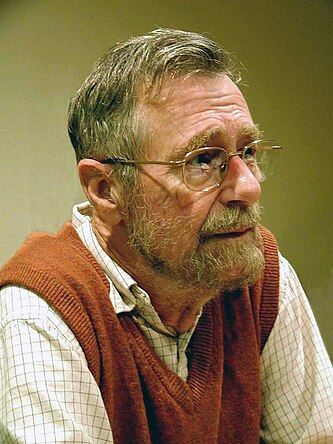

About Edsger W. Dijkstra
Edsger Wybe Dijkstra (11 May 1930 – 6 August 2002) was a Dutch computer scientist, mathematician, programmer, software engineer, and science essayist.
Best Edsger W. Dijkstra Quotes
Shortest
Earliest
Explore our curated collection of the most famous and impactful Edsger W. Dijkstra quotes.
“Simplicity is prerequisite for reliability.”


“We must be very careful when we give advice to younger people: sometimes they follow it!”
“Program testing can be used to show the presence of bugs, but never to show their absence!”
“Several people have told me that my inability to suffer fools gladly is one of my main weaknesses.”

“The use of COBOL cripples the mind; its teaching should, therefore, be regarded as a criminal offense.”
“Using PL/1 must be like flying a plane with 7000 buttons, switches and handles to manipulate in the cockpit.”

“The problems of the real world are primarily those you are left with when you refuse to apply their effective solutions.”
“It is time to unmask the computing community as a Secret Society for the Creation and Preservation of Artificial Complexity.”
“FORTRAN's tragic fate has been its wide acceptance, mentally chaining thousands and thousands of programmers to our past mistakes.”

“The purpose of abstracting is not to be vague, but to create a new semantic level in which one can be absolutely precise.”
“Probably I am very naive, but I also think I prefer to remain so, at least for the time being and perhaps for the rest of my life.”
“Program testing can be a very effective way to show the presence of bugs, but it is hopelessly inadequate for showing their absence.”
“The effective exploitation of his powers of abstraction must be regarded as one of the most vital activities of a competent programmer.”

“Programming is one of the most difficult branches of applied mathematics; the poorer mathematicians had better remain pure mathematicians.”

“Besides a mathematical inclination, an exceptionally good mastery of one's native tongue is the most vital asset of a competent programmer.”

“The art of programming is the art of organizing complexity, of mastering multitude and avoiding its bastard chaos as effectively as possible.”


“Simplicity is a great virtue but it requires hard work to achieve it and education to appreciate it. And to make matters worse: complexity sells better.”
“When FORTRAN has been called an infantile disorder, full PL/1, with its growth characteristics of a dangerous tumor, could turn out to be a fatal disease.”
Edsger W. Dijkstra Quotes by Topic
Find exactly what you are looking for by browsing this categorized list of Edsger W. Dijkstra quotes by topic.
Edsger W. Dijkstra on Programming languages 4 quotes
“The use of COBOL cripples the mind; its teaching should, therefore, be regarded as a criminal offence.”
Edsger W. Dijkstra on Fortran 3 quotes
“FORTRAN's tragic fate has been its wide acceptance, mentally chaining thousands and thousands of programmers to our past mistakes.”

Edsger W. Dijkstra on Debugging 2 quotes
View all 2 quotes on Debugging →Edsger W. Dijkstra on BASIC 2 quotes
“The teaching of BASIC should be rated as a criminal offence: it mutilates the mind beyond recovery.”

Edsger W. Dijkstra on Simplicity
“Simplicity is prerequisite for reliability.”
Edsger W. Dijkstra on Abstraction
“An abstraction is one thing that represents several real things equally well.”
Edsger W. Dijkstra on Advice
“We must be very careful when we give advice to younger people: sometimes they follow it!”

Edsger W. Dijkstra on Youth
“We must be very careful when we give advice to younger people: sometimes they follow it!”

Edsger W. Dijkstra on Axe
“It is impossible to sharpen a pencil with a blunt axe. It is equally vain to try to do it with ten blunt axes instead.”

Edsger W. Dijkstra on Programming
“The effective exploitation of his powers of abstraction must be regarded as one of the most vital activities of a competent programmer.”

Edsger W. Dijkstra on APL
“APL is a mistake, carried through to perfection. It is the language of the future for the programming techniques of the past: it creates a new generation of coding bums.”
Edsger W. Dijkstra on Lisp (programming language)
“Lisp has jokingly been called "the most intelligent way to misuse a computer". I think that description is a great compliment because it transmits the full flavor of liberation: it has assisted a number of our most gifted fellow humans in thinking previously impossible thoughts.”
Edsger W. Dijkstra on World view
“[Though computer science is a fairly new discipline, it is predominantly based on the Cartesian world view. As Edsgar W. Dijkstra has pointed out] A scientific discipline emerges with the - usually rather slow! - discovery of which aspects can be meaningfully 'studied in isolation for the sake of their own consistency.”

Edsger W. Dijkstra on Software engineering
“The required techniques of effective reasoning are pretty formal, but as long as programming is done by people that don't master them, the software crisis will remain with us and will be considered an incurable disease. And you know what incurable diseases do: they invite the quacks and charlatans in, who in this case take the form of Software Engineering gurus.”

Edsger W. Dijkstra on Visualization
“Our intellectual powers are rather geared to master static relations and that our powers to visualize processes evolving in time are relatively poorly developed. For that reason we should do (as wise programmers aware of our limitations) our utmost to shorten the conceptual gap between the static program and the dynamic process, to make the correspondence between the program (spread out in text space) and the process (spread out in time) as trivial as possible.”

What Edsger W. Dijkstra Said About Others
Discover personal opinions Edsger W. Dijkstra shared regarding contemporaries.
Edsger W. Dijkstra on Gerrit Blaauw
“As usual the audience consisted mainly of professors of computing science; this time the speakers were mainly specialists in logic design: for many in the audience the exposure was a shock. At the level of component technology the change over the last fifteen years has been drastic: what used to be expressed in milliseconds is expressed in microseconds now, what used to be expressed in kilobucks is now expressed in dimes and quarters. This change has been so drastic that it is well-known. Much less known is that at the next levels, viz. of circuit design and logic design, the attention of the designers has been so fully usurped by the obligation to adapt to the ever changing technology, that at those levels design methodology has had no chance to mature from craft to scientific discipline. This is in sharp contrast to the developments in programming methodology, where during that period of fifteen years a fairly stable "base" could be enjoyed. Having witnessed that development in programming methodology at close quarters, I was overcome by the feeling of being exposed to the result of fifteen years of intellectual stagnation, and it was during Blaauw's lecture on the first afternoon that I asked my right-hand neighbour "Close your eyes, forget how you came here and guess in which year you are living."; without hesitation he came up with exactly the same year I had in mind: 1962.”
Quotes About Edsger W. Dijkstra
Gain deeper perspective through quotes about Edsger W. Dijkstra from others.
M.D. Mcllroy on Edsger W. Dijkstra
“The precious gift that this Turing Award acknowledges is Dijkstra's style: his approach to programming as a high, intellectual challenge; his eloquent insistence and practical demonstration that programs should be composed correct, not just debugged into correctness; and his illuminating perception of problems at the foundations of program design.”
Donald Knuth on Edsger W. Dijkstra 2 quotes
“A revolution is taking place in the way we write programs and teach programming, because we are beginning to understand the associated mental processes more deeply. It is impossible to read the recent [E. W. Dijkstra, O.-J. Dahl, and C. A. R. Hoare] book Structured Programming, without having it change your life. The reason for this revolution and its future prospects have been aptly described by E.W. Dijkstra in his 1972 Turing Award Lecture, The Humble Programmer.”

David Gries on Edsger W. Dijkstra
“The working vocabulary of programmers everywhere is studded with words originated or forcefully promulgated by E. W. Dijkstra—display, deadly embrace, semaphore, go-to-less programming, structured programming. But his influence on programming is more pervasive than any glossary can possibly indicate.”
Harlan Mills on Edsger W. Dijkstra
“Edsger W. Dijkstra's 1969 "Structured Programming" article precipitated a decade of intense focus on programming techniques that has fundamentally altered human expectations and achievements in software development. Before this decade of intense focus, programming was regarded as a private, puzzle-solving activity of writing computer instructions to work as a program. After this decade, programming could be regarded as a public, mathematics-based activity of restructuring specifications into programs. Before, the challenge was in getting programs to run at all, and then in getting them further debugged to do the right things. After, programs could be expected to both run and do the right things with little or no debugging. Before, it was common wisdom that no sizable program could be error-free. After, many sizable programs have run a year or more with no errors detected. These expectations and achievements are not universal because of the inertia of industrial practices. But they are well-enough established to herald fundamental change in software development.”
Alan Kay on Edsger W. Dijkstra
Alexander Stepanov on Edsger W. Dijkstra
“...I also discovered books of two great computer scientists from whose work I learned the scientific foundation of my trade: Donald Knuth and Edsger Dijkstra. Knuth taught me the answers. Dijkstra taught me the questions. Time and time again I come back to their works for new insights.”

Per Brinch Hansen on Edsger W. Dijkstra
“The first classic is one of the great works in computer programming: E. W. Dijkstra, Cooperating Sequential Processes (1965). Here Dijkstra lays the conceptual foundation for abstract concurrent programming.”
Edsger W. Dijkstra Prize in Distributed Computing (ACM Symposium on Principles of Distributed Computing) on Edsger W. Dijkstra
“The Edsger W. Dijkstra Prize in Distributed Computing is named for Edsger Wybe Dijkstra (1930-2002), a pioneer in the area of distributed computing. His foundational work on concurrency primitives (such as the semaphore), concurrency problems (such as mutual exclusion and deadlock), reasoning about concurrent systems, and self-stabilization comprises one of the most important supports upon which the field of distributed computing is built. No other individual has had a larger influence on research in principles of distributed computing. The prize is given for outstanding papers on the principles of distributed computing, whose significance and impact on the theory and/or practice of distributed computing have been evident for at least a decade.”
Kyle Brown on Edsger W. Dijkstra
“Most experienced IT professionals will agree that developing and adhering to a standard architecture is key to the success of large-scale software development. Computer pioneer Edsger Dijkstra validated this notion when he developed THE operating system in 1968. Since then, layered architectures have proved their viability in technological domains, such as hardware and networking. Layering has proved itself in the operating system domain; however, the same benefits are available when applied to e-commerce or to thin client–oriented applications. Layered architectures have become essential in supporting the iterative development process by promoting reusability, scalability, and maintainability.”
Peter J. Denning on Edsger W. Dijkstra
“Edsger Dijkstra, one of the giants of our field and a passionate believer in the mathematical view of programs and programming (...) Over the previous quarter-century, he had formulated many of the great intellectual challenges of the field as programming—the goto statement, structured programming, concurrent processes, semaphores, deadlocks, recursive programming in Algol, and deriving correct programs.”
Niklaus Wirth on Edsger W. Dijkstra 2 quotes
“Of great influence to Pascal was Structured Programming, put forth by E. W. Dijkstra. This method of proceeding in a design would obliviously be greatly encouraged by the use of a Structured Language, a language with a set of constructs that could freely be combined and nested. The textual structure of a program should directly reflect its flow of control.”
Disputed Quotes
Quotes attributed to Edsger W. Dijkstra that are questionable.
Misattributed Quotes
Quotes mistakenly credited to Edsger W. Dijkstra
“Go To statement considered harmful”
About Edsger W. Dijkstra
Edsger Wybe Dijkstra (11 May 1930 – 6 August 2002) was a Dutch computer scientist, mathematician, programmer, software engineer, and science essayist.
QuotesCosmos Cross-Civilizational Archive
Explore Related Wisdom Pillars, Worldviews & Canonical Works
Discover how humanity's greatest philosophers, sacred scriptures, and literary masterpieces address the core questions of existence.
30 Wisdom Pillars
22 Worldviews & Traditions
Canonical Books & Scriptures