Link Copied!
Charles Sanders Peirce Quotes (1839-1914)
Philosopher, Mathematician

About Charles Sanders Peirce
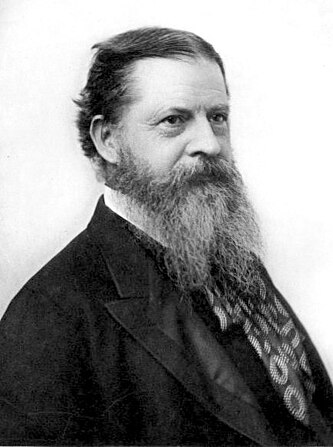
Charles Sanders Peirce pronounced like purse (10 September 1839 – 19 April 1914) was an American philosopher, chemist and polymath, who is now remembered as a pioneer of the field of semiotics and, with the formulation of the pragmatic maxim, the founder of the philosophies of Pragmatism and Pragmaticism. He was the son of the mathematician Benjamin Peirce.
Best Charles Sanders Peirce Quotes
Shortest
Earliest
Explore our curated collection of the most famous and impactful Charles Sanders Peirce quotes.
“Do not block the way of inquiry.”
“By an object, I mean anything that we can think, i.e. anything we can talk about.”
“It is ...easy to be certain. One has only to be sufficiently vague.”
“Let us not pretend to doubt in philosophy what we do not doubt in our hearts.”


“Indeed, even this last moment will be recognized like the rest, at least, be just beginning to be so.”
“Mere imagination would indeed be mere trifling; only no imagination is mere.”


“Let me now try to gather up all these odds and ends of commentary and restate the law of mind, in a unitary way.”

“Understand me well. My appeal is to observation — observation that each of you must make for himself.”

“The definition of definition is at bottom just what the maxim of pragmatism expresses. ”


“Unless man have a natural bent in accordance with nature's, he has no chance of understanding nature at all.”

“You are of all my friends the one who illustrates pragmatism in its most needful forms. You are a jewel of pragmatism.”

“True science is distinctively the study of useless things. For the useful things will get studied without the aid of scientific men.”
“The next simplest feature that is common to all that comes before the mind, and consequently, the second category, is the element of Struggle.”
“What distinct meaning can attach to saying that an idea in the past in any way affects an idea in the future, from which it is completely detached?”
“The Scientific Attitude and Fallibilism in Philosophical Writings of Peirce, selected and edited with an introducton by Justus Buchler. p. 49”
“A finite interval of time generally contains an innumerable series of feelings; and when these become welded together in association the result is a general idea.”
“The development of the human mind has practically extinguished all feelings, except a few sporadic kinds, [like] sound, colors, smells, warmth, etc., which now appear to be disconnected and separate.”
“Wherever ideas come together they tend to weld into general ideas; and whenever they are generally connected, general ideas govern the connection; and these general ideas are living feelings spread out.”

“The word "God," so "capitalised" (as we Americans say), is the definable proper name, signifying Ens necessarium; in my belief Really creator of all three Universes of Experience.”
Charles Sanders Peirce Quotes by Topic
Find exactly what you are looking for by browsing this categorized list of Charles Sanders Peirce quotes by topic.
Charles Sanders Peirce on Semiotics 6 quotes
“The entire universe is perfused with signs, if it is not composed exclusively of signs.”

Charles Sanders Peirce on Sign 3 quotes
“The entire universe is perfused with signs, if it is not composed exclusively of signs.”

Charles Sanders Peirce on Logic 3 quotes
“A certain maxim of Logic which I have called Pragmatism has recommended itself to me for diverse reasons and on sundry considerations.”

Charles Sanders Peirce on Ideas 3 quotes
“The consciousness of a general idea has a certain "unity of the ego" in it, which is identical when it passes from one mind to another. It is, therefore, quite analogous to a person, and indeed, a person is only a particular kind of general idea.”
Charles Sanders Peirce on Pragmatism 2 quotes
“The definition of definition is at bottom just what the maxim of pragmatism expresses.”
Charles Sanders Peirce on God 2 quotes
“The word "God," so "capitalised" (as we Americans say), is the definable proper name, signifying Ens necessarium; in my belief Really creator of all three Universes of Experience.”

Charles Sanders Peirce on Diagram
Charles Sanders Peirce on Chemistry
“It has never been in my power to study anything, — mathematics, ethics, metaphysics, gravitation, thermodynamics, optics, chemistry, comparative anatomy, astronomy, psychology, phonetics, economics, the history of science, whist, men and women, wine, metrology, except as a study of semeiotic.”

Charles Sanders Peirce on Metaphysics
“Find a scientific man who proposes to get along without any metaphysics […] and you have found one whose doctrines are thoroughly vitiated by the crude and uncriticized metaphysics with which they are packed. We must philosophize, said the great naturalist Aristotle — if only to avoid philosophizing.”

Charles Sanders Peirce on Theologians
“It is not my object to pursue the theological question; and having used it as a logical example I drop it, without caring to anticipate the theologian's reply. I only desire to point out how impossible it is that we should have an idea in our minds which relates to anything but conceived sensible effects of things.”

Charles Sanders Peirce on Purpose
“The hypothesis will lead to our thinking of features of each Universe as purposed; and this will stand or fall with the hypothesis. Yet a purpose essentially involves growth, and so cannot be attributed to God. Still it will, according to the hypothesis, be less false to speak so than to represent God as purposeless.”

Charles Sanders Peirce on Suicide
“My duty will be to continue to endeavor to do the work I seem to have been put into the world to do; and when the moment arrives at which there seems to be no rational hope of making my life useful, my duty, as I see it, will be to treat my life just as I would an aching tooth that there was no hope of making useful. I will have it out.”

Charles Sanders Peirce on Observation
“The only possible way of accounting for the laws of nature and for uniformity in general is to suppose them results of evolution. This supposes them not to be absolute, not to be obeyed precisely. It makes an element of indeterminacy, spontaneity, or absolute chance in nature. Just as, when we attempt to verify any physical law, we find our observations cannot be precisely satisfied by it, and rightly attribute the discrepancy to errors of observation, so we must suppose far more minute discrepancies to exist owing to the imperfect cogency of the law itself, to a certain swerving of the facts from any definite formula.”
Charles Sanders Peirce on System
“The ordinary logic has a great deal to say about genera and species, or in our nineteeth century dialect, about classes. Now a class is a set of objects compromising all that stand to one another in a special relation of similarity. But where ordinary logic talks of classes the logic of relatives talks of systems. A system is a set of objects compromising all that stands to one another in a group of connected relations. Induction according to ordinary logic rises from the contemplation of a sample of a class to that of a whole class; but according to the logic of relatives it rises from the comtemplation of a fragment of a system to the envisagement of the complete system.”

Charles Sanders Peirce on Occam's razor
“There never was a sounder logical maxim of scientific procedure than Ockham's razor: Entia non sunt multiplicanda praeter necessitatem. That is to say; before you try a complicated hypothesis, you should make quite sure that no simplification of it will explain the facts equally well. No matter if it takes fifty generations of arduous experimentation to explode the simpler hypothesis, and no matter how incredible it may seem that that simpler hypothesis should suffice, still fifty generations are nothing in the life of science, which has all time before it; and in the long run, say in some thousands of generations, time will be economized by proceeding in an orderly manner, and by making it an invariable rule to try the simpler hypothesis first. Indeed, one can never be sure that the simpler hypothesis is not the true one, after all, until its cause has been fought out to the bitter end. But you will mark the limitation of my approval of Ockham's razor. It is a sound maxim of scientific procedure. If the question be what one ought to believe, the logic of the situation must take other factors into account. Speaking strictly, belief is out of place in pure theoretical science, which has nothing nearer to it than the establishment of doctrines, and only the provisional establishment of them, at that. Compared with living belief it is nothing but a ghost. If the captain of a vessel on a lee shore in a terrific storm finds himself in a critical position in which he must instantly either put his wheel to port acting on one hypothesis, or put his wheel to starboard acting on the contrary hypothesis, and his vessel will infallibly be dashed to pieces if he decides the question wrongly, Ockham's razor is not worth the stout belief of any common seaman. For stout belief may happen to save the ship, while Entia non sunt multiplicanda praeter necessitatem would be only a stupid way of spelling Shipwreck. Now in matters of real practical concern we are all in something like the situation of that sea-captain.”
What Charles Sanders Peirce Said About Others
Discover personal opinions Charles Sanders Peirce shared regarding contemporaries.
Charles Sanders Peirce on William Fleming
“William Fleming (1791-1866) wrote a manual of moral philosophy, a book on political economy, and the Vocabulary.”
Quotes About Charles Sanders Peirce
Gain deeper perspective through quotes about Charles Sanders Peirce from others.
Noam Chomsky on Charles Sanders Peirce
“Peirce, to my knowledge, is original and unique in stressing the problem of studying the rules that limit the class of possible theories. Of course, his concept of abduction, like Lorenz’s biological a priori, has a strongly Kantian flavor, and all derive from the rationalist psychology that concerned itself with the forms, the limits, and the principles that provide “the sinews and connections” for human thought, that underlie “that infinite amount of knowledge of which we are not always conscious,” of which Leibnitz spoke. It is therefore quite natural that we should link these developments to the revival of philosophical grammar, which grew from the same soil as an attempt, quite fruitful and legitimate, to explore one basic facet of human intelligence.”
John Dewey on Charles Sanders Peirce
“Pierce wrote as a logician and James as a humanist.”
Umberto Eco on Charles Sanders Peirce
“The principle of interpretation says that "a sign is something by knowing which we know something more" (Peirce). The Peircean idea of semiosis is the idea of an infinite process of interpretation.”

Horace Standish Thayer on Charles Sanders Peirce
Paul Weiss on Charles Sanders Peirce
"Charles Sanders Peirce" profile in on Charles Sanders Peirce
“Peirce held that the continuity of space, time, ideation, feeling, and perception is an irreducible deliverance of science, and that an adequate conception of the continuous is an extremely important part of all the sciences. This doctrine he called “synechism,” a word deriving from the Greek preposition that means “(together) with.””
Bertrand Russell on Charles Sanders Peirce 2 quotes
“Peirce was a man of tremendous energy, producing a multitude of ideas, good, bad, and indifferent. He reminds on of a volcano spouting vast masses of rock, of which some, on examination, turn out to be nuggets of pure gold. He holds―and I confess that an examination of scientific inference has made me feel the force of this view―that man is adapted, by his congenital constitution, to the apprehension of natural laws which cannot be proved by experience, although experience is in conformity with them.”

Karl Popper on Charles Sanders Peirce
“One of the greatest philosophers of all time.”
Carlo Sini on Charles Sanders Peirce
“Ultimately, the last word is never ours. Peirce said: the meaning of my life is entrusted to others. [...] Which proves that truth is never something definitive; we are always mistaken. On a journey. It is no coincidence that I speak of the “transit of truth.””
John F. Sowa on Charles Sanders Peirce
“Conceptual graphs are system of logic based on the existential graphs of Charles Sanders Peirce and the semantic networks of artificial intelligence. The purpose of the system is to express meaning in a form that is logically precise, humanly readable, and computationally tractable.”
George Bruce Halstead on Charles Sanders Peirce
“Professor Klein then speaks of "that artistic finish that we admire in Euclid's Elements," and mentions Allman's important historical work. I heartily concur in this estimate of Euclid, and desire to contrast it with the error of Charles S. Peirce, in the Nation, where he speaks of "Euclid's proof (Elements Bk. I., props. 16 and 17)" as "really quite fallacious, because it uses no premises not as true in the case of spherics." Our bright American seems to have forgotten Euclid's Postulate 6 (Axiom 12 in Gregory, Axiom 9 in Heiberg), "Two straight lines cannot enclose a space;" that is, two straights having crossed never recur.”
About Charles Sanders Peirce
Charles Sanders Peirce pronounced like purse (10 September 1839 – 19 April 1914) was an American philosopher, chemist and polymath, who is now remembered as a pioneer of the field of semiotics and, with the formulation of the pragmatic maxim, the founder of the philosophies of Pragmatism and Pragmaticism. He was the son of the mathematician Benjamin Peirce.
QuotesCosmos Cross-Civilizational Archive
Explore Related Wisdom Pillars, Worldviews & Canonical Works
Discover how humanity's greatest philosophers, sacred scriptures, and literary masterpieces address the core questions of existence.
30 Wisdom Pillars
22 Worldviews & Traditions
Canonical Books & Scriptures