Link Copied!
Alexandra Kollontai Quotes (0-)
King
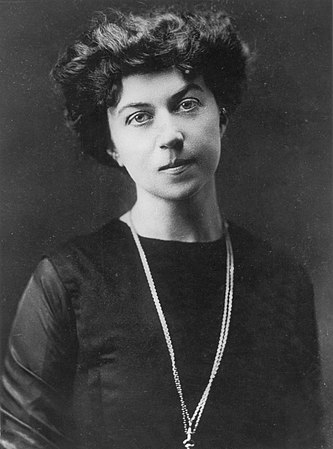


About Alexandra Kollontai
Alexandra Mikhailovna Kollontai (Russian: Алекса́ндра Миха́йловна Коллонта́й — née Domontovich, Домонто́вич; 31 March (O.S. 19 March) 1872 – 9 March 1952) was a Russian Communist revolutionary, first as a member of the Mensheviks, then from 1915 on as a Bolshevik. In 1922, Kollontai was appointed a diplomatic counsellor to the Soviet legation in Norway, being soon promoted to head of the legation, one of the first women to hold such a post.
Best Alexandra Kollontai Quotes
Shortest
Earliest
Explore our curated collection of the most famous and impactful Alexandra Kollontai quotes.

“My life was as crammed with strenuous work and highly interesting experiences alike.”
“I could not lead a happy, peaceful life when the working population was so terribly enslaved.”

“I wanted to be free. I wanted to express desires on my own, to shape my own little life.”


“One must write not only for oneself. But for others. For those far-away, unknown women who will live then. Let them see that we were not heroines or heroes at all. But we believed passionately and ardently.”
“I stood close to the materialist conception of history, since in early womanhood I had inclined towards the realistic school.”
“To me the war was an abomination, a madness, a crime, and from the first moment onwards–more out of impulse than reflection–I inwardly rejected it and could never reconcile myself with it up to this very moment.”

“The work began with great zeal and the most roseate hopes. A splendid summer and an eventful winter marked the year of 1923! The newly resumed trade relations were in full swing: Russian corn and Norwegian herring and fish, Russian wood products and Norwegian paper and cellulose.”
“I have succeeded in structuring my intimate life according to my own standards and I make no secret of my love experiences anymore than does a man. Above all, however, I never let my feelings, the joy or pain of love take the first place in my life inasmuch as creativity, activity, struggle always occupied the foreground.”

“Already as a small child I criticized the injustice of adults and I experienced as a blatant contradiction the fact that everything was offered to me whereas so much was denied to the other children. My criticism sharpened as the years went by and the feeling of revolt against the many proofs of love around me grew apace.”

“Not a single one of the men who were close to me has ever had a direction-giving influence on my inclinations, strivings, or my world-view. On the contrary, most of the time I was the guiding spirit. I acquired my view of life, my political line from life itself, and in uninterrupted study from books.”
“The issue was to wage a struggle against the war, against coalescence with the liberal bourgeoisie, and for the power of the workers' councils, the Soviets.”

“When one recalls the first months of the Workers' Government, months which were so rich in magnificent illusions, plans, ardent initiatives to improve life, to organize the world anew, months of the real romanticism of the Revolution, one would in fact like to write about all else save about one's self.”
“I stand on the threshold of new missions and life is making new demands upon me. No matter what further tasks I shall be carrying out, it is perfectly clear to me that the complete liberation of the working woman and the creation of the foundation of a new sexual morality will always remain the highest aim of my activity, and of my life.”
“It must be admitted that, although I possessed a certain degree of ambition, like every other active human being, I was never animated by the desire to obtain "a post." For me "what I am" was always of less importance than "what I can," that is to say, what I was in a position to accomplish. In this way I, too, had my ambition and it was especially noticeable there where I stood with my whole heart and soul in the struggle, where the issue was the abolition of the slavery of working women.”

“Then came the great days of the October Revolution. Smolny became historic. The sleepless nights, the permanent sessions. And, finally, the stirring declarations. "The Soviets take power!" "The Soviets address an appeal to the peoples of the world to put an end to the war." "The land is socialized and belongs to the peasants!"”

“Looking back one perceives only a massive operation, struggle, and action. In reality there were no heroes or leaders. It was the people, the working people, in soldiers' uniform or in civilian attire, who controlled the situation and who recorded its will indelibly in the history of the country and mankind. It was a sultry summer, a crucial summer of the revolutionary flood-tide in 1917!”

“The Revolution was in full swing. The struggle was becoming increasingly irreconcilable and bloodier, much of what was happening did not fit in with my outlook. But after all there was still the unfinished task, women's liberation. Women, of course, had received all rights but in practice, of course, they still lived under the old yoke: without authority in family life, enslaved by a thousand menial household chores, bearing the whole burden of maternity, even the material cares, because many women now found life alone as a result of the war and other circumstances.”

“Nothing is more difficult than writing an autobiography. What should be emphasized? Just what is of general interest? It is advisable, above all, to write honestly and dispense with any of the conventional introductory protestations of modesty. For if one is called upon to tell about one's life so as to make the events that made it what it became useful to the general public, it can mean only that one must have already wrought something positive in life, accomplished a task that people recognize. Accordingly it is a matter of forgetting that one is writing about oneself, of making an effort to abjure one's ego so as to give an account, as objectively as possible, of one's life in the making and of one's accomplishments.”
“In all the social relations which I had during the three years of my work in Norway, I never once experienced the least trace of aversion or mistrust against woman's capabilities. To be sure, the healthy, democratic spirit of the Norwegian people greatly contributed to this. Thus the fact is to be confirmed that my work as official Russian representative in Norway was never, and in no wise, made difficult for the reason that I belonged "to the weaker sex."”

“When I was appointed as Russian envoy to Oslo, I realized that I had thereby achieved a victory not only for myself, but for women in general and indeed, a victory over their worst enemy, that is to say, over conventional morality and conservative concepts of marriage. ... What is of a wholly special significance here is that a woman, like myself, who has settled scores with the double standard and who has never concealed it, was accepted into a caste which to this very day staunchly upholds tradition and pseudo-morality. Thus the example of my life can also serve to dispel the old goblin of the double standard also from the lives of other women. And this is a most crucial point of my own existence, which has a certain social-psychological worth and contributes to the liberation struggle of working women.”
“There are individuals – a mere handful in the history of mankind – who, while themselves being the product of an imminent catastrophic change, leave their mark upon an entire epoch. Vladimir Ilyich Lenin is one such giant mind, one such giant will...
However mighty such giants of history may be, the universal-general principle that they symbolise and embody dissolves all the narrowly individual. The ordinary measuring rod of the qualities, failings and passions characteristic of the people of that age is not applicable to them. It is not a question of the personal characteristics of Vladimir Ilyich Lenin but what he symbolises... He has gathered to himself like a magnet everything in the revolution that is expressive of will, power, ruthless destruction and constructive persistence. Everyone who values what the workers' revolution brings with it in its cleansing whirlwind cannot but value and cherish its symbol, its embodiment – Vladimir Ilyich Lenin.”
However mighty such giants of history may be, the universal-general principle that they symbolise and embody dissolves all the narrowly individual. The ordinary measuring rod of the qualities, failings and passions characteristic of the people of that age is not applicable to them. It is not a question of the personal characteristics of Vladimir Ilyich Lenin but what he symbolises... He has gathered to himself like a magnet everything in the revolution that is expressive of will, power, ruthless destruction and constructive persistence. Everyone who values what the workers' revolution brings with it in its cleansing whirlwind cannot but value and cherish its symbol, its embodiment – Vladimir Ilyich Lenin.”
Alexandra Kollontai Quotes by Topic
Find exactly what you are looking for by browsing this categorized list of Alexandra Kollontai quotes by topic.
Alexandra Kollontai on Russian Revolution 4 quotes
“The issue was to wage a struggle against the war, against coalescence with the liberal bourgeoisie, and for the power of the workers' councils, the Soviets.”

Alexandra Kollontai on Feminism 3 quotes
“The time has come when all human beings will be equally appraised according to their activity and their general human dignity.”

Alexandra Kollontai on Freedom
“I wanted to be free. I wanted to express desires on my own, to shape my own little life.”

Alexandra Kollontai on Misogyny
“Only the fresh revolutionary storms were strong enough to sweep away hoary prejudices against woman.”

Alexandra Kollontai on Sexism
“Only the fresh revolutionary storms were strong enough to sweep away hoary prejudices against woman.”

Alexandra Kollontai on Marriage of convenience
Alexandra Kollontai on World War I
“To me the war was an abomination, a madness, a crime, and from the first moment onwards–more out of impulse than reflection–I inwardly rejected it and could never reconcile myself with it up to this very moment.”

Alexandra Kollontai on Women's liberation movement
“Only the fresh revolutionary storms were strong enough to sweep away hoary prejudices against woman and only the productive-working people is able to effect the complete equalization and liberation of woman by building a new society.'''”
Alexandra Kollontai on New Woman
“I am still far from being the type of the positively new women who take their experience as females with a relative lightness and, one could say, with an enviable superficiality, whose feelings and mental energies are directed upon all other things in life but sentimental love feelings.”

Alexandra Kollontai on Autobiography
“Nothing is more difficult than writing an autobiography. What should be emphasized? Just what is of general interest? It is advisable, above all, to write honestly and dispense with any of the conventional introductory protestations of modesty. For if one is called upon to tell about one's life so as to make the events that made it what it became useful to the general public, it can mean only that one must have already wrought something positive in life, accomplished a task that people recognize. Accordingly it is a matter of forgetting that one is writing about oneself, of making an effort to abjure one's ego so as to give an account, as objectively as possible, of one's life in the making and of one's accomplishments.”

What Alexandra Kollontai Said About Others
Discover personal opinions Alexandra Kollontai shared regarding contemporaries.
Alexandra Kollontai on Women in the workforce
“It must be admitted that, although I possessed a certain degree of ambition, like every other active human being, I was never animated by the desire to obtain "a post." For me "what I am" was always of less importance than "what I can," that is to say, what I was in a position to accomplish. In this way I, too, had my ambition and it was especially noticeable there where I stood with my whole heart and soul in the struggle, where the issue was the abolition of the slavery of working women.”

Alexandra Kollontai on Vladimir Lenin
“There are individuals – a mere handful in the history of mankind – who, while themselves being the product of an imminent catastrophic change, leave their mark upon an entire epoch. Vladimir Ilyich Lenin is one such giant mind, one such giant will... However mighty such giants of history may be, the universal-general principle that they symbolise and embody dissolves all the narrowly individual. The ordinary measuring rod of the qualities, failings and passions characteristic of the people of that age is not applicable to them. It is not a question of the personal characteristics of Vladimir Ilyich Lenin but what he symbolises... He has gathered to himself like a magnet everything in the revolution that is expressive of will, power, ruthless destruction and constructive persistence. Everyone who values what the workers' revolution brings with it in its cleansing whirlwind cannot but value and cherish its symbol, its embodiment – Vladimir Ilyich Lenin.”

Quotes About Alexandra Kollontai
Gain deeper perspective through quotes about Alexandra Kollontai from others.
Angelica Balabanoff on Alexandra Kollontai
“Within the Russian Party itself, the first organized opposition to the policies of both Lenin and Trotsky was led by a woman-Alexandra Kollontai. Alexandra was not an Old Bolshevik, but she had joined the Bolshevik Party even before Trotsky had done so and much earlier than I. During these first few years of the Revolution she was a frequent source of both personal and political annoyance to the Party leaders. On more than one occasion the Central Committee had wanted me to substitute for her in the leadership of the women's movement, thus facilitating the campaign against her and isolating her from the women of the masses. Fortunately, I understood this intrigue and refused these offers, emphasizing that no one could do this work so well as she, and trying to augment her prestige and create sympathy for her whenever possible. By the Ninth Congress of the Russian Party, the last vestiges of trade-union autonomy and workers' control in industry was swept away to be replaced by the control of the political had become the leader of the "Workers' Opposition," a protest missars over the trade unions and the workers' soviets. Kollantai movement against the bureaucratic suffocation of the labour unions and the democratic rights of the workers. As there was no possibility, even at that time, of publicly criticizing the Central Committee or of placing an unofficial opinion before the Party rank and file, she was courageous enough to have a pamphlet secretly printed for distribution to the delegates at the Party Convention. I have never seen Lenin so angry as when one of these pamphlets was handed to him at the Convention-in spite of the fact that "opposition" within the Party itself was still supposed to be legitimate. Taking the platform, he denounced Kollontai as the Party's worst enemy, a menace to its unity. He went so far in his attack as to make allusions to certain episodes in Kollontai's intimate life that had nothing whatever to do with the issue. It was the kind of polemic which did no credit to Lenin, and it was on this occasion that I realized the lengths to which Lenin would go in the pursuit of his strategic aims, his opposition to a party opponent. I admired Kollontai for the calm and self-control with which she answered Lenin's attack. Among the examples she quoted of the methods which were used by the Central Committee against Party "rebels" was the attempt of the "Central Committee to send Angelica Balabanoff to Turkestan to eat peaches." Like many other rebellious members of the Party, she was sent away soon after on a diplomatic mission. For old revolutionists like Kollontai it was a punishment to be separated from the field of revolutionary activity, but after years in Norway, Mexico, and Sweden as Soviet ambassador, she seemed to become reconciled to her position and to fall completely into line.”

Shirley Fredricks on Alexandra Kollontai
“Kollontai was never a brilliant Marxist scholar or an innovative theoretician as was her friend Rosa Luxemburg, for example. She "discovered" Marx in a copy of Communist Manifesto which she picked up in a bookstore in Germany during the cooling off period forced on her by her parents. It quickly replaced her populism, which had been shallow and emotional, and seemed to pull her previous ideas together in an intellectually satisfying form-a common experience for many Marxist converts.”
Emma Goldman on Alexandra Kollontai
“Alexandra Kollontay and Angelica Balabanoff were within easy reach, as they were living in the National. I sought out the former first. Mme Kollontay looked remarkably young and radiant, considering her fifty years and the severe operation she had recently undergone. A tall and stately woman, every inch the grande dame rather than the fiery revolutionist. Her attire and suite of two rooms bespoke good taste, the roses on her desk rather startling in the Russian greyness. They were the first I had seen since our deportation. [...] She leaned back in her arm-chair and I began speaking of the harrowing things that had come to my knowledge. She listened attentively without interrupting me, but there was not the slightest indication in her cold, handsome face of any perturbation on account of my recital. "We do have some dull grey spots in our vivid revolutionary picture," she said when I had concluded. "They are un-avoidable in a country so backward, with a people so dark and a social experiment of such magnitude, opposed by the entire world as it is. They will disappear when we have liquidated our military fronts and when we shall have raised the mental level of our masses." I could help in that, she continued. I could work among the women; they were ignorant of the simplest principles of life, physical and otherwise, ignorant of their own functions as mothers and citizens. I had done such fine work of that kind in America, and she could assure me of a much more fertile field in Russia. "Why not join me and stop your brooding over a few dull grey spots?" she said in conclusion; "they are nothing more, dear comrade, really nothing more." People raided, imprisoned, and shot for their ideas! The old and the young held as hostages, every protest gagged, iniquity and favouritism rampant, the best human values betrayed, the very spirit of revolution daily crucified-were all these nothing but "grey, dull spots," I wondered! I felt chilled to the marrow of my bones.”

Margaret S Marsh on Alexandra Kollontai 3 quotes
“No American socialist-feminist successfully integrated the anarchist-feminist analysis of domestic oppression into a socialist framework...Nevertheless, a socialist framework existed, in the work of Aleksandra Kollontai. Kollontai, a Russian Marxist revolutionary who participated in the birth of the Bolshevik state, wrote her most extensive analysis of the Woman Question while in exile in Western Europe in the years immediately preceding World War I." Following Bebel and Engels, Kollontai argued that the first requisite for women's emancipation was productive work outside the confines of the domestic circle. However, participation in the work force would not free women unless there were also changes in the industrial system. Ultimately, of course, the workers must overthrow capitalism, Kollontai declared. But, more immediately, socialists should work for shorter hours, less dangerous working conditions, paid maternity leaves, nursery facilities in all factories, and scheduled breaks from work so that mothers could breast feed their babies. Not all socialists agreed with Kollontai on the above issues. Most men and some women refused to countenance the urging of special reforms for women because they believed it undermined the solidarity of the proletariat. But Kollontai further extended her analysis of female oppression to include an attack on the emotional dependence of women upon men.”
Maxine Molyneux Women on Alexandra Kollontai
“Throughout the history of the socialist movement there has, therefore, been a strand of feminist critique from within. Many feminists shared in the vision of a just society, but criticised the ways in which communist parties sought to bring it about. Amongst the Bolsheviks, Inessa Armand and Alexandra Kollontai were early critics of their party's policies and practice, and they, along with anarchist feminists such as Emma Goldman, laid some of the early groundwork in identifying socialism's failures.”
Ella Reeve Bloor on Alexandra Kollontai
“It was a great privilege to work so closely with these wonderful women of our movement...I was very much impressed too with the brilliant and handsome Alexandra Kollontai, who had been active in the woman's movement even in pre-revolutionary days. She had been for a time People's Commissar of Social Welfare. When I first met her, she was one of the leaders of the Workers' Opposition, taking the line that the interests of the trade unions were opposed to those of the Soviet state and the Party. Lenin, to whom she was deeply devoted, convinced her of the fallacy of her position, and she abandoned her oppositionist stand, becoming a loyal supporter of the Party's position. She became Minister Plenipotentiary to Norway, the first woman ambassador in the world, was for a time ambassador to Mexico and is today Soviet Ambassador to Sweden.”

About Alexandra Kollontai
Alexandra Mikhailovna Kollontai (Russian: Алекса́ндра Миха́йловна Коллонта́й — née Domontovich, Домонто́вич; 31 March (O.S. 19 March) 1872 – 9 March 1952) was a Russian Communist revolutionary, first as a member of the Mensheviks, then from 1915 on as a Bolshevik. In 1922, Kollontai was appointed a diplomatic counsellor to the Soviet legation in Norway, being soon promoted to head of the legation, one of the first women to hold such a post.
QuotesCosmos Cross-Civilizational Archive
Explore Related Wisdom Pillars, Worldviews & Canonical Works
Discover how humanity's greatest philosophers, sacred scriptures, and literary masterpieces address the core questions of existence.
30 Wisdom Pillars
22 Worldviews & Traditions
Canonical Books & Scriptures