Link Copied!
Ilf and Petrov Quotes (1897-1937)
Author, Writer
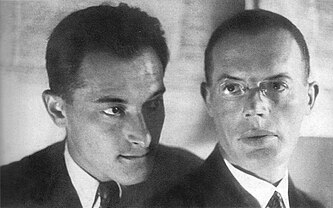

About Ilf and Petrov
Ilya Ilf (Ilya Arnoldovich Feinsilberg, 1897–1937) and Yevgeny Petrov (Yevgeniy Petrovich Katayev, 1902–1942) were two Soviet prose authors of the 1920s and 1930s. They did much of their writing together, and are almost always referred to as "Ilf and Petrov". The duo were arguably the most popular satirical writers in the Soviet period.
Best Ilf and Petrov Quotes
Shortest
Earliest
Explore our curated collection of the most famous and impactful Ilf and Petrov quotes.


“Liar competition. The first prize was given to the person who told the truth.”

“Not a single car has ever been run over by a pedestrian, yet for some reason motorists are unhappy.”

“All talented people write differently, all untalented ones write the same way and even in the same handwriting.”

“There were so many hairdressing establishments and funeral homes in the regional centre of N. that the inhabitants seemed to be born merely in order to have a shave, get their hair cut, freshen up their heads with toilet water and then die.”
“When a woman grows old, many unpleasant things may happen to her: her teeth may fall out, her hair may thin out and turn grey, she may become short-winded, she may unexpectedly develop fat or grow extremely thin, but her voice never changes. It remains just as it was when she was a schoolgirl, a bride, or some young rake's mistress.”

“Every small town [in America] wants to be like New York. There are New Yorks for two thousand people, and there are for one thousand eight hundred. We even came across one baby New York with nine hundred inhabitants. And it was a real city. Its residents walked along their own Broadway with their noses in the air. It is a disputable thing whose Broadway they considered the main thing to be, theirs or New York's one.”
“Just as at the North Station in Moscow the loudspeaker informs summer residents that the nearest train goes non-stop to Mytishchi, and then stops everywhere, here the blacks reported that the elevator goes only to the sixteenth floor, or up to the thirty-second, with the first stop again on the sixteenth floor. Subsequently, we realized this little trick of the administration: on the sixteenth floor there is a restaurant and cafeteria.”
“New York was sleeping, and millions of electric lamps guarded its sleep. People from Scotland, Ireland, Hamburg and Vienna, Kovno and Bialystok, Naples and Madrid, Texas, Dakota and Arizona were sleeping, people from Latin America, Australia, Africa and China were sleeping. Black, white and yellow people were sleeping. Looking at the slightly fluctuating lights, we wanted to quickly find out: how do these people work, how do they have fun, what do they dream about, what do they hope for, what do they eat?”
“An attempt to look at New York from a car failed. We were driving along rather dark and gloomy streets. Sometimes something was buzzing like hell under my feet, sometimes something rumbled overhead. When we stopped at traffic lights, the sides of the cars next to us obscured everything. The driver turned around several times and asked for the address. Apparently, he was worried about our English. Sometimes he looked at us encouragingly, and his face said: “Nothing, you won’t get lost! No one has ever lost in New York.””
“With printing being as well developed as it is in the West, the forgery of Soviet identification papers is nothing. A friend of mine even went as far as forging American dollars. And you know how difficult that is. The paper has those different-coloured little lines on it. It requires great technique. He managed to get rid of them on the Moscow black market, but it turned out later that his grandfather, a notorious currency-dealer, had bought them all in Kiev and gone absolutely broke. The dollars were counterfeit, after all.”
“We thought that we would walk slowly, carefully looking around, so to speak, studying, observing, absorbing and so on. But New York is not the kind of city where people move slowly. People did not walk past us, but ran. And we ran too. From then on we couldn't stop. We lived in New York for a month and all the time we were rushing somewhere as fast as we could. At the same time, we looked so busy and businesslike that John Pierpont Morgan Jr. himself could have envied us. At this rate, he would earn sixty million dollars this month.”
“It's madness to think that you can drive slowly on an American interstate. The desire to be careful is not enough. Hundreds more cars are running next to your car, thousands of them are pressing behind you, and tens of thousands are rushing towards you. And they all drive at full speed, in a satanic impulse, dragging you along with them. All of America is rushing somewhere, and, apparently, there will be no stopping. Steel dogs and birds sparkle on the cars noses. Among millions of cars, we flew from ocean to ocean — a grain of sand, driven by a gasoline storm that has been raging over America for so many years!”
“Long, heavy trains race to all' parts of the country. The way is open at every point. Green lights can be seen everywhere; the track is clear. The polar express goes up to Murmansk. The K-l draws out of Kursk Station, bound for Tiflis, arching its back over the points. The far-eastern courier rounds Lake Baikal and approaches the Pacific at full speed. The Muse of Travel is calling. … People speed all over the country. Some of them are looking for scintillating brides thousands of miles away, while others, in pursuit of treasure, leave their jobs in the post office and rush off like schoolboys to Aldan. Others simply sit at home, tenderly stroking an imminent hernia and reading the works of Count Salias, bought for five kopeks instead of a rouble.”

“"… Now you, for instance. You're distinguished-lookin' and tall, though a bit on the thin side. If you should die, God forbid, they'll say you popped off. But a tradesman, who belonged to the former merchants' guild, would breathe his last. And if it's someone of lower status, say a caretaker, or a peasant, we say he has croaked or gone west. But when the high-ups die, say a railway conductor or someone in administration, they say he has kicked the bucket. They say: 'You know our boss has kicked the bucket, don't you?'"
Shocked by this curious classification of human mortality, Ippolit Matveyevich asked:
"And what will the undertakers say about you when you die?"
"I'm small fry. They'll say, 'Bezenchuk's gone', and nothin' more."”
Shocked by this curious classification of human mortality, Ippolit Matveyevich asked:
"And what will the undertakers say about you when you die?"
"I'm small fry. They'll say, 'Bezenchuk's gone', and nothin' more."”
“Statistics know everything.
It has been calculated with precision how much ploughland there is in the USSR, with subdivision into black earth, loam and loess. All citizens of both sexes have been recorded in those neat, thick registers-so familiar to Ippolit Matveyevich Vorobyaninov-the registry office ledgers. It is known how much of a certain food is consumed yearly by the average citizen in the Republic. It is known how much vodka is imbibed as an average by this average citizen, with a rough indication of the titbits consumed with it. It is known how many hunters, ballerinas, revolving lathes, dogs of all breeds, bicycles, monuments, girls, lighthouses and sewing machines there are in the country. …
But there is one thing that they do not know.
They do not know how many chairs there are in the USSR.”
“When we went to America, we did not take into account one thing, American hospitality. It boundlessly and far leaves behind everything possible of this kind, including Russian, Siberian or Georgian. The first American you know will definitely invite you to his home (or restaurant) to drink a cocktail with him. Ten of your new acquaintance's friends will be at the cocktail party. Each of them will certainly drag you to their place for a cocktail. And each of them will have ten or fifteen friends. In two days you make a hundred new acquaintances, in a week - several thousand. Staying in America for a year is simply dangerous: you can drink yourself to death and become a vagabond. All several thousand of our new friends were filled with one desire: to show us everything we wanted to see, to go with us wherever we wanted, to explain to us everything that we did not understand. Americans are amazing people, it’s nice to be friends with them, and it’s easy to do business with them.”
Ilf and Petrov Quotes by Topic
Find exactly what you are looking for by browsing this categorized list of Ilf and Petrov quotes by topic.
Ilf and Petrov on Duels
“Ippolit Matveyevich entered the room in slightly better spirits. "Unheard-of impudence," he exclaimed angrily. "I could hardly control myself." "Dear, dear," sympathized Ostap. "What has the modern youth come to? Terrible young people! Chase after other people's wives. Spend other people's money. Complete decadence. But tell me, does it really hurt when they hit you on the head? " "I'll challenge him to a duel!" "Fine! I can recommend a good friend of mine. He knows the duelling code by heart and has two brooms quite suitable for a struggle to the death. You can have Ivanopulo and his neighbour on the right as seconds. He's an ex-honorary citizen of the city of Kologriv and still even brags about the title. Or you can have a duel with mincing-machines — it's more elegant. Each wound is definitely fatal. The wounded adversary is automatically turned into a meat ball. How do you like the idea, Marshal?"”
About Ilf and Petrov
Ilya Ilf (Ilya Arnoldovich Feinsilberg, 1897–1937) and Yevgeny Petrov (Yevgeniy Petrovich Katayev, 1902–1942) were two Soviet prose authors of the 1920s and 1930s. They did much of their writing together, and are almost always referred to as "Ilf and Petrov". The duo were arguably the most popular satirical writers in the Soviet period.