Link Copied!
Titian Quotes (1488-1576)
Leader
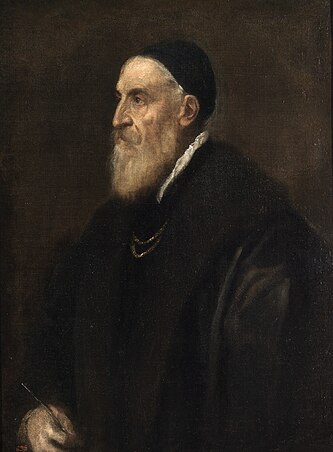
About Titian
Tiziano Vecelli or Vecellio (c. 1488-90 – 27 August 1576), better known as Titian, was the leader of the 16th-century Venetian school of the Italian Renaissance. He was born in Pieve di Cadore, in the Cadore territory, near Belluno (Veneto), in Italy, and died in Venice. Many official letters of Titian were written by Aretino, between 1527-1556. From 1556 it was Verdizotti (one of his pupils) who did many secretarial services for Titian.
Best Titian Quotes
Shortest
Earliest
Explore our curated collection of the most famous and impactful Titian quotes.

“It is not bright colors but good drawing that makes figures beautiful.”

“[I] purposely avoided the styles of Raphael and Michaelangelo because I was ambitious of higher distinction than that of a clever imitator.”
“Illustrious Lord, hearing that your Excellency has gone to the court of his Imperial Majesty [Charles V], I abstain from coming to Mantua, sighing at my bad fortune in not having left Bologna soon enough to meet your Grace. At Venice I shall prepare the copy of the portrait of his Majesty, which I take home with me at your Excellency's bidding.”
“Most serene and Powerful King [Ferdinand], most Clement Lord,.. .The portraits of the serene daughters of your Majesty will be done in two days, and I shall take them to Venice, whence – having finished them with all diligence – I shall send them quickly to your Majesty. As soon as your Majesty has seen them, I am convinced I shall receive much greater favours than those which have been previously done me, and so I recommend myself humbly to your Majesty. – Your Majesty's faithful servant, Titiano.”
“I have been expecting the bull of the benefice of Medole which your Excellency gave me for my son Pomponio last year, and seeing that the matter is delayed beyond measure, and what is worse, that I have not received the income of the benefice — I find myself in a state of great discontent. It would be greatly to my dishonour and infamy, if my boy should be forced to change the priest's dress, which he wears with so much pleasure, after all Venice has been made acquainted with the gift made to him of this benefice by your Excellency.”
“Most high and important Signor, Having recently obtained a 'Queen of Persia' of some quality, which I thought worthy of appearing before your Highness' [= Prince Philip II] exalted presence, I had her sent, pending the time when other works of mine were drying, to take embassies from me to your Highness, and be company to the landscape and [a] St. Margaret, previously sent by Ambassador [Fransesco] Vargas.. ..Most high and potent Signor's servant, who kisses your feet, Titiano Vecellio.”
“Not every painter has a gift for painting, in fact, many painters are disappointed when they meet with difficulties in art. Painting done under pressure by artists without the necessary talent can only give rise to formlessness, as painting is a profession that requires peace of mind. The painter must always seek the essence of things, always represent the essential characteristics and emotions of the person he is painting..
• Variant: They who are compelled to paint by force, without being in the necessary mood, can produce only ungainly works, because this profession requires an unruffled temper.”
• Variant: They who are compelled to paint by force, without being in the necessary mood, can produce only ungainly works, because this profession requires an unruffled temper.”

“I, Titian of Cadore, having studied painting from childhood upwards, and desirous of fame rather than profit, wish to serve the Doge and Signori, rather than his Highness the Pope and other Signori, who in past days, and even now, have urgently asked to employ me: I am therefore anxious, if it should appear feasible, to paint in the Hall of Council, beginning, if it please their sublimity, with the canvas of 'The Battle' on the side towards the Piazza, which is so difficult that no one as yet has had courage to attempt it...”
“Your Excellency, I went without delay to the well of which Y. E. had written, and made a sketch of it, from which Y. E. will see how the matter stands; but I wish that sketch not to go alone, so send another with it of a well after the fashion of this country. Should these drawings appear to have been done in a manner not agreeable to the greatness of your illustrious Signorina, or in accordance with my humble desire to serve Y. E., I hope to be excused; and that Y. E. will ascribe, the cause to an earnest longing that the work should be done rapidly. I am entirely at command should the drawings be considered unsatisfactory, and am ready to furnish others..”
“..I kissed the hand of Don Alvise Davila, who said he was your friend, and begged me to tell you he would soon prove it. I would have done the same by Signor Antonio da Leva, but that there was no time. He came to see the Emperor [Charles V], and only staid half a day, and there were so many visitors that I could not kiss his hand. But should we meet I shall do my duty, and attend to your interests without regard to the consequences. No more on this head. Here nothing is heard but the roll of drums, and everyone is starting for France. I hope soon to be with you, when we shall have much to say to each other. Bas las manos a vuestra merced and also those of Alvise Anichini.”
“..I also send the picture of the 'Trinity' [also called La Gloria] .. ..in my wish to satisfy your C. M. [Caesarean Majesty] I have not spared myself the pains of striking out two or three times the work of many days to bring it to perfection and satisfy myself, whereby more time was wasted than I usually take to do such things.. ..the portrait of Signor Vargas [agent of Charles V, who was paying Titian for his works] introduced into the work [very probably in the 'La Gloria' / 'Trinity'] was done at his request. If it should not please your C.M. any painter can, with a couple of [brush] strokes, convert it into another person.”

“Most Illustrious Lord and My Lord, I received the other day, with due reverence your Lordship's letter, together with the canvas and framing. Having read and noted the contents, I considered them so pretty and ingenious as to require no improvement of any kind; and the more I thought over it the more I became convinced that the greatness of art amongst the ancients was due to the assistance they received from great princes content to leave to the painters the credit and renown derived from their own ingenuity in bespeaking pictures. Can I therefore doubt that, if God enables me to satisfy in any part the wishes of Your Lordship, I shall have all credit for my labour? Yet I shall, after all have done no more than give shape to that which received its spirit — the most essential part — from Your Excellency.”

“Your Ceasarean Majesty, I consigned to senõr Don Diego di Mendoza, the two portraits of the most serene Empress [ Isabella ] , in which I have used all the diligence of which I was capable. I should have liked to take them to your Majesty in person, but that my age and the length of the journey forbade such a course. I beg your Majesty to send me words of the faults or failings which I may have made, and return the pictures that I may correct them. Your Majesty may not permit anyone else to lay hand on them.. ..Your Majesty’s most humble and constant servant, Titiano.”

“Excellent Lord: —Knowing your Excellency's love for painting and your passion for protecting it as shown in the patronage of Ginlio Eomano; —being further desirous of pleasing your Excellency, —I have taken the opportunity of Messer Pietro Aretino's arrival [in Venice] to paint his likeness, and as he comes — a second St. Paul —to preach the virtues of your Excellency, and I likewise know that you are fond of so faithful a servant because of his many virtues, I make you herewith a present of his portrait. But I also bear in remembrance the Signor Girolamo Adorno who adored the Marquis of Mantua, and as he was a qualified gentleman, I send your Excellency a present of him also. These may not be gifts worthy of so great a person as your Excellency.. ..Most devoted servant, Titiano Vecellio.”
“I have an action pending before the Legate [Titian's friend, Giovanni della Casa ] here against the brothers of [the church] San Spirito of whom I hear they mean to tire me out by delays. Their purpose is to obtain a commission or brief, by which my cause shall be transferred to another judge, who is their friend. I beg your Reverend Lordship, in remembrance of my services and in view of the importance of the case to give Monsignor Guiddicioni to understand that he may not pass anything contrary to me, but trust to the goodness and sufficiency of Monsignor the Legate [Titian's friend] so that the brothers shall not have it in their power to ill-use me and create delays contrary to duty and justice; the matter being public at Venice where everyone knows that these brethren are old and certain debtors to me for my works.”
“I should be acting the part of an ungrateful servant, unworthy of the favours which unite my duty to your great kindness, if I were not to say that his Majesty [ Charles V ] forced me to go to him and pays the expenses of my journey, I start discontented because I have not fulfilled your wish and my obligation in presenting myself to my Lord [ Pope Paul III ] and yours, and working in obedience to his intentions [to paint the Pope's portrait].. ..But I promise as a true servant to pay interest on my return with a new picture in addition to the first.. ..So with your license, Padron mio unico, I shall go, whither I am called, and returning with the grace of God, I shall serve you with all the strength of the talents which I got from my cradle..”
“His Majesty [emperor Charles V] , [in his court in Augsburg] sent for me. After the usual courtesies and examination of the pictures which I have brought, he asked for news of you.. ..I replied that at Venice, in Rome and in all Italy the public assumed that his Holiness [the new Pope], was well minded to make you ..[Cardinal] upon which Caesar [= Charles V] showed signs of pleasure in his face, saying he would greatly rejoice at such an event, which could not fail to please you, and so, dear brother [= close friend], I have done for you such service as I owe to a friend of your standing.. ..not a day passes but the Duke of Alva speaks to me of the 'divine Aretini', because he loves you so much..”
“Most Illustrious, &c,— It was not necessary for your Excellency to remind me by letter or the gift of a rich cassock of the pictures, which I have altogether at heart, knowing as I do under what obligation I am for many kindnesses.. ..Many days have passed since I gave one of the pictures to the ambassador to send to your Excellency. Five others are in a fair way, which I shall finish on hearing that the first was satisfactory, or the reverse, regulating my work accordingly. And so I shall proceed by degrees to the end, when I shall hope to have well served your Excellency. In the meantime, it would be a great favour to me if your Excellency would liberate my benefice from the pension payable upon it, which, besides causing me a loss in money which I pay out yearly, creates not a little trouble and disturbance because of the persons with whom I am pestered, out of whose hands your Excellency alone can save me. I beg, I supplicate your Excellency to do this.. ..which alone would suffice to make me your Excellency's perpetual slave.”
Quotes About Titian
Gain deeper perspective through quotes about Titian from others.
In a letter of Jacomo Delli Thebaldi on Titian
“He [Titian] told me he remembered that there were [already] three pictures in the fazata (wall facing the light ?) in Your Excellency's Studio; and that your Excellency had arranged that this one should be hung on the same fazata. He wishes to know whether the new canvas is to be in the middle of the others, or at one side, either towards the chapel or towards the Castello; and he promised to begin work this morning, proceeding without interruption to the close.”
Duke Alfonso de Ferrara on Titian
“We thought, that Titian, the painter, would some day finish our picture; but he seems to take no account of us whatever. We therefore instruct you to tell him instantly, that we are surprised that he should not have finished our picture; that he must finish it under all circumstances or incur our great displeasure; and he may be made to feel that he is doing an ill turn to one who can resent it. We are determined that he shall complete the work he promised : if he does not, we shall see to his doing it, and you are to advise us instantly of his resolution.”
Duke Alfonso on Titian
“Before Christmas, Tebaldi [Titian's agent in Venice] received a letter from the Duke Alfonso, with orders to communicate the contents to Titian. "Let him know," says Alfonso, "that we have thought over the matter of the 'St. Sebastian'.. ..Let him think on the other hand of serving us well in the work which he has on hand for us, as we do not mean to burthen him with more for the present, and we have to remind him of the head which he began at our bidding before he left Ferrara." A canvas and a present of twenty-five scudi preceded the dispatch of this letter, and from a reply subsequently made by Tebaldi, we ascertain that "the head" was a half length on panel which Titian had promised to enlarge so as to include "an elbow and a part of a left hand."”
Quote of Jacomo Thebaldi on Titian
“The body [of St. Sebastian ] is bound with one arm high up, the other low down, to a column ; the whole frame writhes in such a way as to display almost all of the back. In all parts of the person there is evidence of suffering, and all from one arrow that sticks in the middle of the body. I am no judge, because I do not understand drawing, but looking at the limbs and muscles the figure seems to me to be as natural as a corpse.”
In a letter of on Titian 3 quotes
“Most Illustrious and best Lord Uncle, — Having asked Titian, the bearer of these presents, to execute certain work for me, he declared himself unable to serve me at present, because of a promise to do certain things for your Excellency which require time. For this reason I send him to attend your Excellency. But I beg he may be sent back at once to expedite the work I have on hand for him, which will take but a few days. As soon as he shall have done he can return to the service of your Excellency, and in this your Excellency will do me a singular pleasure to whom I stand greatly recommended.”
Marcantonio Michiel on Titian
In a letter of Benedetto Agnello on Titian
“Our master Titian is quite disconsolate at the loss of his wife, who was buried yesterday. He told me that in the troubled time of her sickness he was unable to work at the portrait of the lady Cornelia or at the picture of the 'i Nude' which he is doing for our most illustrious Lord; but he thinks the latter will be a fine thing, and he hopes to finish it before the month is out. Meanwhile he desires to know how his Lordship likes the 'St. Sebastian' lately sent to him, which he admits is but an ordinary performance as compared with the nudes, and one which he only produced as an entertainment in token of the devotion which he feels for his Excellency.”
Sansovino on Titian 2 quotes
“It is a custom of this city [Venice] that the Prince [The Doge] when in office should do three things: procure his own likeness of life size, to be placed in a certain lunette beneath the ceiling of the Hall of Great Council, and for this Titian had a salary..”
Source on Titian
“Titian, now I clearly see in a new guise My beloved idol, opening her eyes.”
Giovanni della Casa on Titian
“Ben vegg' io, Tiziano, in forme nuove L' idolo mio, che i begli occhi apre e gira.”
Pietro Aretino on Titian 2 quotes
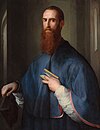
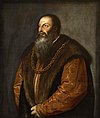
“If I were a painter I should die of despair.. ..but certain it is that Titian's pencil has waited on Titian's old age to perform its miracles.”
In a letter of Bembo Quirini on Titian
“Your Titian, or rather our Titian is here [from Venice to Rome] and he tells me that he is under great obligation to you for having been the main cause of his coming hither.. ..he has already seen so many fine antiques [of Rome] that he is filled with wonder, and glad that he came.”
Michelangelo's on Titian
“..if this man [Titian] had been in any way assisted by art and design, as he is by nature, and above all in counterfeiting the life, no one could do more or work better, for he has a fine spirit and a very beautiful and lively manner.”
Paolo Pino on Titian
“There had been a time, as Vasari truly said, when the master [Titian] finished his works with such care and minuteness that they bore inspection at any distance. At a later period his touches and brush strokes were ill suited for a close inspection, but at the focus they were perfectly effective, and so stupendously clever that the scenes appeared to be real. Three lives has Titian, one natural, one artificial, the third eternal.”
Quote of Michel Angelo Biondo on Titian
Quote on Titian
“Titian is alive and well, and not a little pleased to know that your Majesty was inquiring for him. He took me to see [the painting] the 'Trinity' [also called La Gloria] which he promised to finish towards the end of September. It seems to me to be a fine work. Equally so a 'Christ appearing to the Magdalen' in the garden for the Serenissima Queen Mary. The other painting he says will be a 'Grieving Virgin', companion to the 'Ecce Homo', already in possession of your Majesty, which he has not done because the size was not given, but which he will execute so soon as the particulars are sent to him.”
Quote of Lorenzi on Titian
“On the 3rd of July 1518 Titian was called to the Salt Office [of Venice], and there curtly informed: — "that unless he [Titian] began at once or within a week to work at the canvas in the Hall of Great Council which had been neglected for so many years, and unless he should proceed to labour at it continuously till its completion, 'their magnificences ' would cause it to be painted and finished at Titian's expense". But: Awful as the threat appeared, it failed to move the painter in any way. He had orders for great altar-pieces at Ancona and Brescia, commissions from the Duke of Ferrara, etc..”
Quote of Giovanni Batista Leoni on Titian
Quote of Francesco Scanelli on Titian
“Titian was visited on a certain occasion by a company of German travelers.. ..these gentlemen declared that they only knew of one master capable of finishing as they thought paintings ought to be finished, and that was Dürer.. ..To these observations Titian smilingly replied, that if he had thought extreme finish to be the end and aim of art, he too would have fallen into the excesses of Dürer. But though long experience had taught him to prefer a broad and even track to a narrow and intricate path, yet he would still take occasion to show that the subtlest detail might be compassed without sacrifice of breadth, and so produced the 'Christ of the Tribute Money'.”
Boschini's on Titian
“In every thing Titian's art was similar to nature. Milk feeds his babes; he weaves the stuffs; by him the arms are wrought. He transfers the trees, the hills, and plains to his picture; his animals have but just issued from the ark; and his joy or grief are alike infectious. So long as Nature lives Titian will also live. He was the very mirror of nature, only that the mirror reflects whilst Titian creates.”
Palma Giovine on Titian 2 quotes
“Titian prepared his pictures with a solid stratum of pigment, which served as a bed or fundament upon which to return frequently. Some of these preparations were made with resolute strokes of a brush heavily laden with colour, the half tints struck in with pure red earth, the lights with white, modeled into relief by touches of the same brush dipped into red, black, and yellow. In this way he would give the promise of a figure in four strokes. After laying this [first] foundation he would turn the picture to the wall, and leave it there perhaps for months, turning it round again after a time to look at it carefully, and scan the parts as he would the face of his greatest enemy. If at this time any portion of it should appear to him to have been defective, he would set to work to correct it, applying remedies as a surgeon might apply them, cutting off excrescences here, superabundant flesh there, redressing an arm, adjusting or setting a limb, regardless of the pain which it might cause. In this way he would reduce the whole to a certain symmetry, put it aside, and return again a third or more times, till the first quintessence had been covered over with its padding of flesh.”
Antonio Zanetti on Titian
“Titian was characterized by this, that he painted flesh in which the blood appeared to mantle, whilst the art of the painter was merged in the power of a creator. He imagined forms of grander proportions, of more shiny impast[o], of more harmonious hues than his competitors. With incomparable skill he gave tenderness to flesh by transitions of half tone and broken contrasted colours. He moderated the fire of Giorgione, whose strength lay in resolute action, fanciful movement, and a mysterious artifice in disposing shadows contrasting darkly with hot red lights, blended, strengthened, or blurred so as to produce the semblance of exuberant life.”
Quote of Sir Joshua Reynolds on Titian 2 quotes
“Raphael and Titian are two names which stand the highest in our art, — one for drawing, the other for painting. It is to Titian we must turn our eyes to find excellence with regard to color, and light and shade, in the highest degree. He was both the first and the greatest master of this art. By a few strokes he knew how to mark the general image and character of whatever object he attempted; and produced, by this alone, a truer representation than his master Giovanni Bellini, or any of his predecessors, who finished every hair. His great care was to express the general color, to preserve the masses of light and shade, and to give by opposition the idea of that solidity which is inseparable from natural objects. When those are preserved, though the work should possess no other merit, it will have in a proper place its complete effect; but where any of these are wanting, however minutely labored the picture may be in detail, the whole will have a false' and even an unfinished appearance, at whatever distance, or in whatever light, it can be shown.. ..This manner was then new to the world, but that unshaken truth on which it is founded has fixed it as a model to all succeeding painters; and those who will examine into the artifice will find it to consist in the power of generalizing, and in the shortness and simplicity of the means employed.”
Sir Joshua Reynolds on Titian
“Titian by a few strokes knew how to mark the general image and character of whatever objects he attempted. His great care was to preserve the masses of light and shade, and to give by opposition the idea of that solidity which is inseparable from natural objects.”
William Hazlitt on Titian 2 quotes
“It is the intense personal character which, I think, gives the superiority to Titian's portraits over all others, and stamps them with a living and permanent interest. Of other pictures you tire, if you have them constantly before you; of his, never. For other pictures have either an abstracted look, and you dismiss them, when you have made up your mind on the subject as a matter of criticism; or an heroic look, and you cannot be always straining your enthusiasm; or an insipid look, and you sicken of it. But whenever you turn to look at Titian's portraits, they appear to be looking at you; there seems to be some question pending between you, as though an intimate friend or inveterate foe were in the room with you; they exert a kind of fascinating power; and there is that exact resemblance of individual nature which is always new and always interesting, because you cannot carry away a mental abstraction of it, and you must recur to the object to revive it in its full force and integrity. I would as soon have Raphael's, or most other pictures, hanging up in a collection, that I might pay an occasional visit to them: Titian's are the only ones that I should wish to have hanging in the same room with me for company!”
About Titian
Tiziano Vecelli or Vecellio (c. 1488-90 – 27 August 1576), better known as Titian, was the leader of the 16th-century Venetian school of the Italian Renaissance. He was born in Pieve di Cadore, in the Cadore territory, near Belluno (Veneto), in Italy, and died in Venice. Many official letters of Titian were written by Aretino, between 1527-1556. From 1556 it was Verdizotti (one of his pupils) who did many secretarial services for Titian.