Link Copied!
Thomas Jefferson Quotes (1743-1826)
Philosopher, President, Author









-100px.png)









































-100px.jpg)




-100px.jpg)






















-100px.jpg)







-100px.png)

About Thomas Jefferson
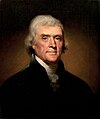
Thomas Jefferson (13 April 1743 – 4 July 1826) was author of the Declaration of Independence (1776) and the Virginia Statute for Religious Freedom (1777), founder of the University of Virginia (1819), the third president of the United States (1801–1809), a political philosopher, editor of Jefferson's Bible (1819), and one of the most influential founders of the United States.
Best Thomas Jefferson Quotes
Shortest
Earliest
Explore our curated collection of the most famous and impactful Thomas Jefferson quotes.
“referencesmark”
“Delay is preferable to error.”
“There is not a sprig of grass that shoots uninteresting to me.”
“Timid men prefer the calm of despotism to the tempestuous sea of liberty.”
“...the more a subject is understood, the more briefly it may be explained.”
“I am an enemy to all banks discounting bills or notes for anything but coin.”
“The whole art of government consists in the art of being honest.”


“No government ought to be without censors; and where the press is free no one ever will.”

“Were we directed from Washington when to sow and when to reap, we should soon want bread.”


“The second office of the government is honorable and easy, the first is but a splendid misery.”
“[I]f ever there was a holy war, it was that which saved our liberties and gave us independence.”

“We are not to expect to be translated from despotism to liberty in a featherbed.”
“Botany is the school for patience, and it’s amateurs learn resignation from daily disappointments.”

“The natural progress of things is for liberty to yield, and government to gain ground.”
“History has informed us that bodies of men, as well as individuals, are susceptible of the spirit of tyranny.”
“Christianity neither is, nor ever was, a part of the common law [this quote is referring to English Common Law].”

“War is an instrument entirely inefficient toward redressing wrong; and multiplies, instead of indemnifying losses.”
“The republican is the only form of government which is not eternally at open or secret war with the rights of mankind.”
“I never consider a difference of opinion in politics, in religion, in philosophy, as cause for withdrawing from a friend.”
“I have ever deemed it more honorable and profitable, too, to set a good example than to follow a bad one.”
“The policy of American government is to leave its citizens free, neither restraining them nor aiding them in their pursuits.”

“My new trade of nail-making is to me in this country what an additional title of nobility or the ensigns of a new order are in Europe”
“I never will, by any word or act, bow to the shrine of intolerance, or admit a right of inquiry into the religious opinions of others.”
“I think myself that we have more machinery of government than is necessary, too many parasites living on the labor of the industrious.”
“A free people [claim] their rights, as derived from the laws of nature, and not as the gift of their chief magistrate.”

“It is not by the consolidation or concentration, of powers, but by their distribution that good government is effected.”
“We have the wolf by the ears, and we can neither hold him nor safely let him go. Justice is in one scale, self-preservation in the other.”
“I would rather be exposed to the inconveniences attending too much liberty, than those attending too small a degree of it.”
“I, however, place economy among the first and most important republican virtues, and public debt as the greatest of the dangers to be feared.”
“If we can but prevent the government from wasting the labors of the people, under the pretense of taking care of them, they must become happy.”
“I read no newspaper now but Ritchie's, and in that chiefly the advertisments, for they contain the only truths to be relied on in a newspaper.”
“Enlighten the people generally, and tyranny and oppressions of body and mind will vanish like evil spirits at the dawn of day.”

“Whensoever hostile aggressions...require a resort to war, we must meet our duty and convince the world that we are just friends and brave enemies.”
“While the art of printing is left to us science can never be retrograde; what is once acquired of real knowlege can never be lost.”

“If a due participation of office is a matter of right, how are vacancies to be obtained? Those by death are few; by resignation, none.”
“Let what will be said or done, preserve your sang-froid immovably, and to every obstacle, oppose patience, perseverance, and soothing language.”
“The mother principle [is] that 'governments are republican only in proportion as they embody the will of their people, and execute it.'".”
“The greatest service which can be rendered any country is to add an useful plant to its culture; especially, a bread grain; next in value to bread is oil.”
“Nothing was or is farther from my intentions, than to enlist myself as the champion of a fixed opinion, where I have only expressed doubt.”
“It is rare that the public sentiment decides immorally or unwisely, and the individual who differs from it ought to distrust and examine well his own opinion.”
“Nearly all of it is now called in by the banks, who have the regulation of the safety-valves of our fortunes, and who condense and explode them at their will.”


“All persons shall have full and free liberty of religious opinion; nor shall any be compelled to frequent or maintain any religious institution.”
“Bigotry is the disease of ignorance, of morbid minds; enthusiasm of the free and buoyant. Education & free discussion are the antidotes of both.”
“The Constitution of the United States asserts that all power is inherent in the people; that they may exercise it by themselves; that it is their right and duty.”
“The two principles on which our conduct towards the Indians should be founded, are justice and fear. After the injuries we have done them, they cannot love us....”

“The majority, oppressing an individual, is guilty of a crime, abuses its strength, and by acting on the law of the strongest breaks up the foundations of society.”
“The States should be urged to concede to the General Government, with a saving of chartered rights, the exclusive power of establishing banks of discount for paper.”
“I have the consolation to reflect that during the period of my administration not a drop of the blood of a single fellow citizen was shed by the sword of war or of the law.”

“I agree with you that it is the duty of every good citizen to use all the opportunities, which occur to him, for preserving documents relating to the history of our country.”
“He who steadily observes the moral precepts in which all religions concur, will never be questioned at the gates of heaven as to the dogmas in which they all differ.”
“Your favor of July 2. came duly to hand. The concern you therein express as to the effect of your pamphlet in America, induces me to trouble you with some observations on that subject.”
“Experience declares that man is the only animal which devours his own kind; for I can apply no milder term to the governments of Europe, and to the general prey of the rich on the poor.”

“It was by the sober sense of our citizens that we were safely and steadily conducted from monarchy to republicanism, and it is by the same agency alone we can be kept from falling back.”
“Lay down true principles and adhere to them inflexibly. Do not be frightened into their surrender by the alarms of the timid, or the croakings of wealth against the ascendency of the people.”
“There are extraordinary situations which require extraordinary interposition. An exasperated people, who feel that they possess power, are not easily restrained within limits strictly regular.”
“Our opinion here is that that place has been so deeply concerned in smuggling, that if it wants it is because it has illegally sent away what it ought to have retained for its own consumption.”
“Here was buried Thomas Jefferson, author of the Declaration of American Independence, of the Statute of Virginia for Religious Freedom, and Father of the University of Virginia.”

“The abolition of the evil is not impossible; it ought never therefore to be despaired of. Every plan should be adopted, every experiment tried, which may do something towards the ultimate object.”

“Whenever the people are well informed, they can be trusted with their own government; that whenever things get so far wrong as to attract their notice, they may be relied on to set them to rights.”
“I hope we shall... crush in it’s birth the aristocracy of our monied corporations which dare already to challenge our government to a trial of strength and bid defiance to the laws of our country”

“As you say of yourself, I too am an Epicurian. I consider the genuine (not the imputed) doctrines of Epicurus as containing everything rational in moral philosophy which Greece and Rome have left us.”
“I am convinced that those societies (as the Indians) which live without government enjoy in their general mass an infinitely greater degree of happiness than those who live under the European governments.”
“[I]f the present Congress errs in too much talking, how can it be otherwise in a body to which the people send 150 lawyers, whose trade it is to question everything, yield nothing, and to talk by the hour?”
“Our laws, language, religion, politics, & manners are so deeply laid in English foundations, that we shall never cease to consider their history as a part of ours, and to study ours in that as it’s origin.”

“The incorporation of a bank and the powers assumed [by legislation doing so] have not, in my opinion, been delegated to the United States by the Constitution. They are not among the powers specially enumerated.”
“Only lay down true principles, and adhere to them inflexibly. Do not be frightened into their surrender by the alarms of the timid, or the croakings of wealth against the ascendency of the people.”
“They have retired into the Judiciary as a stronghold. There the remains of federalism are to be preserved and fed from the Treasury; and from that battery all the works of republicanism are to be beaten down and erased.”

“Happy in the prospect of a restoration of primitive Christianity, I must leave to younger athletes to encounter and lop off the false branches which have been engrafted into it by the mythologists of the middle and modern ages.”

“A lively and lasting sense of filial duty is more effectually impressed on the mind of a son or daughter by reading King Lear, than by all the dry volumes of ethics, and divinity, that ever were written.”
“Religion is a subject on which I have ever been most scrupulously reserved. I have considered it as a matter between every man and his Maker in which no other, and far less the public, had a right to intermeddle.”
“The law books abound with similar instances of the care the judges take of the public integrity, Laws, moreover, abridging the natural right of the citizen, should be restrained by rigorous constructions within their narrowest limits.”
“The acquisition of Canada this year, as far as the neighborhood of Quebec, will be a mere matter of marching, and will give us experience for the attack of Halifax the next, and the final expulsion of England from the American continent.”
“In the middle ages of Christianity opposition to the State opinions was hushed. The consequence was, Christianity became loaded with all the Romish follies. Nothing but free argument, raillery & even ridicule will preserve the purity of religion.”
“History, I believe, furnishes no example of a priest-ridden people maintaining a free civil government. This marks the lowest grade of ignorance of which their civil as well as religious leaders will always avail themselves for their own purposes.”
“Whether the succeeding generation is to be more virtuous than their predecessors, I cannot say; but I am sure they will have more worldly wisdom, and enough, I hope, to know that honesty is the first chapter in the book of wisdom.”

“It is between fifty and sixty years since I read it, and I then considered it merely the ravings of a maniac, no more worthy nor capable of explanation than the incoherences of our own nightly dreams. ... what has no meaning admits no explanation.”
“Sometimes it is said that man can not be trusted with the government of himself. Can he, then, be trusted with the government of others? Or have we found angels in the forms of kings to govern him? Let history answer this question.”
“If there be any among us who would wish to dissolve this Union or to change its republican form, let them stand undisturbed as monuments of the safety with which error of opinion may be tolerated where reason is left free to combat it.”

“I have no fear that the result of our experiment will be that men may be trusted to govern themselves without a master. Could the contrary of this be proved, I should conclude either that there is no god, or that he is a malevolent being.”
“It is an axiom in my mind, that our liberty can never be safe but in the hands of the people themselves, and that too of the people with a certain degree of instruction. This it is the business of the State to effect, and on a general plan.”

“The government of the United States have no idea of paying their debt in a depreciated medium, and... in the final liquidation of the payments which shall have been made, due regard will be had to an equitable allowance for the circumstance of depreciation.”
“We took the liberty to make some enquiries concerning the ground of their pretentions to make war upon nations who had done them no injury, and observed that we considered all mankind as our friends who had done us no wrong, nor had given us any provocation.”
“Our people... will give you all the necessaries of war they produce, if, instead of the bankrupt trash they now are obliged to receive for want of any other, you will give them a paper promise funded on a specific pledge, and of a size for common circulation.”
“The idea of creating a national bank I do not concur in, because it seems now decided that Congress has not that power (although I sincerely wish they had it exclusively), and because I think there is already a vast redundancy rather than a scarcity of paper medium.”
“I sincerely rejoice at the acceptance of our new Constitution by nine States. It is a good canvas, on which some strokes only want retouching. What these are, I think are sufficiently manifested by the general voice from north to south, which calls for a bill of rights.”

“Our particular principles of religion are a subject of accountability to our god alone. I enquire after no man's and trouble none with mine; nor is it given to us in this life to know whether yours or mine, our friend's or our foe's, are exactly the right.”

“I may say Christianity itself divided into its thousands also, who are disputing, anathematizing and where the laws permit burning and torturing one another for abstractions which no one of them understand, and which are indeed beyond the comprehension of the human mind[.]”
“The State legislatures should be immediately urged to relinquish the right of establishing banks of discount. Most of them will comply, on patriotic principles, under the convictions of the moment; and the non-complying may be crowded into concurrence by legitimate devices.”
“Whereas, our tenet ever was, and, indeed, it is almost the only landmark which now divides the federalists from the republicans, that Congress had not unlimited powers to provide for the general welfare, but were restrained to those specifically enumerated;...”
“The spirit of resistance to government is so valuable on certain occasions, that I wish it to be always kept alive. It will often be exercised when wrong, but better so than not to be exercised at all. I like a little rebellion now and then. It is like a storm in the atmosphere.”
“But with respect to future debt; would it not be wise and just for that nation to declare in the constitution they are forming that neither the legislature, nor the nation itself can validly contract more debt, than they may pay within their own age, or within the term of 19 years.”

“The priests have so disfigured the simple religion of Jesus that no one who reads the sophistications they have engrafted on it, from the jargon of Plato, of Aristotle & other mystics, would conceive these could have been fathered on the sublime preacher of the sermon on the mount.”
“I congratulate you, my dear friend, on the law of your state for suspending the importation of slaves, and for the glory you have justly acquired by endeavoring to prevent it forever. This abomination must have an end, and there is a superior bench reserved in heaven for those who hasten it.”
“Compulsion in religion is distinguished peculiarly from compulsion in every other thing. I may grow rich by art I am compelled to follow, I may recover health by medicines I am compelled to take against my own judgment, but I cannot be saved by a worship I disbelieve & abhor.”

“I have often thought that nothing would do more extensive good at small expense than the establishment of a small circulating library in every county, to consist of a few well-chosen books, to be lent to the people of the country under regulations as would secure their safe return in due time.”

“Ridicule is the only weapon which can be used against unintelligible propositions. Ideas must be distinct before reason can act upon them; and no man ever had a distinct idea of the trinity. It is the mere Abracadabra of the mountebanks calling themselves the priests of Jesus.”
“Above all things, lose no occasion of exercising your dispositions to be grateful, to be generous, to be charitable, to be humane, to be true, just, firm, orderly, courageous, &c. Consider every act of this kind, as an exercise which will strengthen your moral faculties and increase your worth.”
“The monopoly of a single bank is certainly an evil. The multiplication of them was intended to cure it; but it multiplied an influence of the same character with the first, and completed the supplanting the precious metals by a paper circulation. Between such parties the less we meddle the better.”
“With respect to modern languages, French, as I have before observed, is indispensible. Next to this the Spanish is most important to an American. Our connection with Spain is already important and will become daily more so. Besides this the antient part of American history is written chiefly in Spanish.”
“Let those flatter who fear; it is not an American art. To give praise which is not due might be well from the venal, but would ill beseem those who are asserting the rights of human nature. They know, and will therefore say, that kings are the servants, not the proprietors of the people.”
“The system of banking we have both equally and ever reprobated. I contemplate it as a blot left in all our constitutions, which, if not covered, will end in their destruction, which is already hit by the gamblers in corruption, and is sweeping away in its progress the fortunes and morals of our citizens.”

“It is said that our paper is as good as silver, because we may have silver for it at the bank where it issues. This is not true. One, two, or three persons might have it; but a general application would soon exhaust their vaults, and leave a ruinous proportion of their paper in its intrinsic worthless form.”
“Our country is now taking so steady a course as to show by what road it will pass to destruction, to wit: by consolidation of power first, and then corruption, its necessary consequence. The engine of consolidation will be the Federal judiciary; the two other branches the corrupting and corrupted instruments.”

“I wish it were possible to obtain a single amendment to our Constitution. I would be willing to depend on that alone for the reduction of the administration of our government to the genuine principles of its Constitution; I mean an additional article, taking from the federal government the power of borrowing.”
“In a democratic republic, where the mass of the people of all parties have the same interest at stake, some respect must be had to the feelings and wishes of the minority, especially when that minority is large and clamorous; otherwise, it will be impossible to avoid discord, and discord weakens the bonds of union.”

“Treasury notes of small as well as high denomination, bottomed on a tax which would redeem them in ten years, would place at our disposal the whole circulating medium of the United States... The public... ought never more to permit its being filched from them by private speculators and disorganizers of the circulation.”

“May it be to the world, what I believe it will be, (to some parts sooner, to others later, but finally to all), the signal of arousing men to burst the chains under which monkish ignorance and superstition had persuaded them to bind themselves, and to assume the blessings and security of self-government.”

“The religion-builders have so distorted and deformed the doctrines of Jesus, so muffled them in mysticisms, fancies and falsehoods, have caricatured them into forms so monstrous and inconceivable, as to shock reasonable thinkers, to revolt them against the whole, and drive them rashly to pronounce its founder an impostor.”
“To constrain the brute force of the people, the European governments deem it necessary to keep them down by hard labor, poverty and ignorance, and to take from them, as from bees, so much of their earnings, as that unremitting labor shall be necessary to obtain a sufficient surplus to sustain a scanty and miserable life.”
“We are firmly convinced, and we act on that conviction, that with nations, as with individuals, our interests, soundly calculated, will ever be found inseparable from our moral duties; and history bears witness to the fact that a just nation is taken on its word, when recourse is had to armaments and wars to bridle others.”
“I am quite at a loss about the nailboys remaining with mr Stewart. they have long been a dead expence instead of profit to me. in truth they require a vigour of discipline to make them do reasonable work, to which he cannot bring himself. on the whole I think it will be best for them also to be removed to mr Lilly’s [control].”
“They might need a preparatory discourse on the text of 'prove all things, hold fast that which is good,' in order to unlearn the lesson that reason is an unlawful guide in religion. They might startle on being first awaked from the dreams of the night, but they would rub their eyes at once, and look the spectres boldly in the face.”

“To the corruptions of Christianity I am indeed opposed; but not to the genuine precepts of Jesus himself. I am a Christian, in the only sense he wished any one to be; sincerely attached to his doctrines, in preference to all others; ascribing to himself every human excellence; & believing he never claimed any other.”
“He who permits himself to tell a lie once, finds it much easier to do it a second and third time, till at length it becomes habitual; he tells lies without attending to it, and truths without the world's believing him. This falsehood of tongue leads to that of the heart, and in time depraves all its good dispositions.”
“I am for freedom of religion, & against all maneuvres to bring about a legal ascendancy of one sect over another, for freedom of the press, and against all violations of the Constitution to silence by force and not by reason the complaints or criticisms, just or unjust, of our citizens against the conduct of their agents.”

“I forgot to ask the favor of you to speak to Lilly as to the treatment of the nailers. it would destroy their value in my estimation to degrade them in their own eyes by the whip. this therefore must not be resorted to but in extremities. as they will again be under my government, I would chuse they should retain the stimulus of character.”
“In fine, I repeat, you must lay aside all prejudice on both sides, and neither believe nor reject anything, because any other persons, or description of persons, have rejected or believed it. Your own reason is the only oracle given you by heaven, and you are answerable, not for the rightness, but uprightness of the decision.”
“Put down all banks, admit none but a metallic circulation that will take its proper level with the like circulation in other countries, and then our manufacturers may work in fair competition with those of other countries, and the import duties which the government may lay for the purposes of revenue will so far place them above equal competition.”

“It is in our lives, and not from our words, that our religion must be read. By the same test the world must judge me. But this does not satisfy the priesthood. They must have a positive, a declared assent to all their interested absurdities. My opinion is that there would never have been an infidel, if there had never been a priest.”
“I repair, then, fellow-citizens, to the post you have assigned me. With experience enough in subordinate offices to have seen the difficulties of this the greatest of all, I have learnt to expect that it will rarely fall to the lot of imperfect man to retire from this station with the reputation and the favor which bring him into it.”
“I know no safe depository of the ultimate powers of the society but the people themselves; and if we think them not enlightened enough to exercise their control with wholesome discretion, the remedy is not to take it from them, but to inform their discretion by education. This is the true corrective of abuses of constitutional power.”
“It is literally true that the toleration of banks of paper discount costs the United States one-half their war taxes; or, in other words, doubles the expenses of every war. Now think but for a moment, what a change of condition that would be, which should save half our war expenses, require but half the taxes, and enthral us in debt but half the time.”
“To take from one, because it is thought his own industry and that of his fathers has acquired too much, in order to spare to others, who, or whose fathers, have not exercised equal industry and skill, is to violate arbitrarily the first principle of association, the guarantee to everyone the free exercise of his industry and the fruits acquired by it.”

“Every difference of opinion is not a difference of principle. We have called by different names brethren of the same principle. We are all Republicans, we are all Federalists.”
“I shall often go wrong through defect of judgment. When right, I shall often be thought wrong by those whose positions will not command a view of the whole ground. I ask your indulgence for my own errors, which will never be intentional, and your support against the errors of others, who may condemn what they would not if seen in all its parts.”
“When the representative body have lost the confidence of their constituents, when they have notoriously made sale of their most valuable rights, when they have assumed to themselves powers which the people never put into their hands, then indeed their continuing in office becomes dangerous to the state, and calls for an exercise of the power of dissolution.”
“Instead of funding issues of paper on the hypothecation of specific redeeming taxes (the only method of anticipating, in a time of war, the resources of times of peace, tested by the experience of nations), we are trusting to tricks of jugglers on the cards, to the illusions of banking schemes for the resources of the war, and for the cure of colic to inflations of more wind.”
“He who made us would have been a pitiful bungler, if he had made the rules of our moral conduct a matter of science. For one man of science, there are thousands who are not. What would have become of them? Man was destined for society. His morality, therefore, was to be formed to this object. He was endowed with a sense of right and wrong, merely relative to this.”

“A child raised every 2. years is of more profit then the crop of the best laboring man. in this, as in all other cases, providence has made our duties and our interests coincide perfectly.... [W]ith respect therefore to our women & their children I must pray you to inculcate upon the overseers that it is not their labor, but their increase which is the first consideration with us.”

“Truth will do well enough if left to shift for herself. She seldom has received much aid from the power of great men to whom she is rarely known & seldom welcome. She has no need of force to procure entrance into the minds of men. Error indeed has often prevailed by the assistance of power or force. Truth is the proper & sufficient antagonist to error.”

“It has always been denied by the republican party in this country, that the Constitution had given the power of incorporation to Congress. On the establishment of the Bank of the United States, this was the great ground on which that establishment was combated; and the party prevailing supported it only on the argument of its being an incident to the power given them for raising money.”

“It has always been denied by the republican party in this country, that the Constitution had given the power of incorporation to Congress. On the establishment of the Bank of the United States, this was the great ground on which that establishment was combated; and the party prevailing supported it only on the argument of its being an incident to the power given them for raising money.”
“If, in my retirement to the humble station of a private citizen, I am accompanied with the esteem and approbation of my fellow citizens, trophies obtained by the blood-stained steel, or the tattered flags of the tented field, will never be envied. The care of human life and happiness, and not their destruction, is the first and only legitimate object of good government.”
“Believing that the happiness of mankind is best promoted by the useful pursuits of peace, that on these alone a stable prosperity can be founded, that the evils of war are great in their endurance, and have a long reckoning for ages to come, I have used my best endeavors to keep our country uncommitted in the troubles which afflict Europe, and which assail us on every side.”

“It should be remembered, as an axiom of eternal truth in politics, that whatever power in any government is independent, is absolute also; in theory only, at first, while the spirit of the people is up, but in practice, as fast as that relaxes. Independence can be trusted nowhere but with the people in mass. They are inherently independent of all but moral law.”
“And even should the cloud of barbarism and despotism again obscure the science and libraries of Europe, this country remains to preserve and restore light and liberty to them. In short, the flames kindled on the fourth of July, 1776, have spread over too much of the globe to be extinguished by the feeble engines of despotism; on the contrary, they will consume these engines and all who work them.”
“As to the species of exercise, I advise the gun. While this gives a moderate exercise to the body, it gives boldness, enterprise, and independence to the mind. Games played with the ball, and others of that nature, are too violent for the body, and stamp no character on the mind. Let your gun therefore be the constant companion of your walks. Never think of taking a book with you.”

“We might as well say that the Newtonian system of philosophy is a part of the common law, as that the Christian religion is. The truth is that Christianity and Newtonianism being reason and verity itself, in the opinion of all but infidels and Cartesians, they are protected under the wings of the common law from the dominion of other sects, but not erected into dominion over them.”
“In our university [of Virginia] you know there is no Professorship of Divinity. A handle has been made of this, to disseminate an idea that this is an institution, not merely of no religion, but against all religion. Occasion was taken at the last meeting of the Visitors, to bring forward an idea that might silence this calumny, which weighed on the minds of some honest friends to the institution.”

“Some are whigs, liberals, democrats, call them what you please. Others are tories, serviles, aristocrats, &c. The latter fear the people, and wish to transfer all power to the higher classes of society; the former consider the people as the safest depository of power in the last resort; they cherish them therefore, and wish to leave in them all the powers to the exercise of which they are competent.”

“The naturalists, you know, distribute the history of nature into three kingdoms or departments: zoology, botany, mineralogy. Ideology, or mind, however, occupies so much space in the field of science, that we might perhaps erect it into a fourth kingdom or department. But inasmuch as it makes a part of the animal construction only, it would be more proper to subdivide zoology into physical and moral.”

“The liberty of the whole earth was depending on the issue of the contest, and was ever such a prize won with so little innocent blood? My own affections have been deeply wounded by some of the martyrs to this cause, but rather than it should have failed, I would have seen half the earth desolated. Were there but an Adam & an Eve left in every country, & left free, it would be better than as it now is.”

“Of liberty I would say that, in the whole plenitude of its extent, it is unobstructed action according to our will. But rightful liberty is unobstructed action according to our will within limits drawn around us by the equal rights of others. I do not add "within the limits of the law" because law is often but the tyrant's will, and always so when it violates the rights of the individual.”

“I know, indeed, that some honest men fear that a republican government can not be strong, that this Government is not strong enough; but would the honest patriot, in the full tide of successful experiment, abandon a government which has so far kept us free and firm on the theoretic and visionary fear that this Government, the world's best hope, may by possibility want energy to preserve itself? I trust not.”
“Life's visions are vanished, it's dreams are no more.
Dear friends of my bosom, why bathed in tears?
I go to my fathers; I welcome the shore,
which crowns all my hopes, or which buries my cares.
Then farewell my dear, my lov'd daughter, Adieu!
The last pang in life is in parting from you.
Two Seraphs await me, long shrouded in death;
I will bear them your love on my last parting breath.”
Dear friends of my bosom, why bathed in tears?
I go to my fathers; I welcome the shore,
which crowns all my hopes, or which buries my cares.
Then farewell my dear, my lov'd daughter, Adieu!
The last pang in life is in parting from you.
Two Seraphs await me, long shrouded in death;
I will bear them your love on my last parting breath.”
“The basis of our government being the opinion of the people, the very first object should be to keep that right; and were it left to me to decide whether we should have a government without newspapers, or newspapers without a government, I should not hesitate a moment to prefer the latter. But I should mean that every man should receive those papers and be capable of reading them.”
“Architecture worth great attention. As we double our numbers every 20 years we must double our houses. Besides we build of such perishable materials that one half of our houses must be rebuilt in every space of 20 years. So that in that term, houses are to be built for three fourths of our inhabitants. It is then among the most important arts: and it is desireable to introduce taste into an art which shews so much.”
“We shall divert through our own Country a branch of commerce which the European States have thought worthy of the most important struggles and sacrifices, and in the event of peace... we shall form to the American union a barrier against the dangerous extension of the British Province of Canada and add to the Empire of liberty an extensive and fertile Country thereby converting dangerous Enemies into valuable friends.”

“No experiment can be more interesting than that we are now trying, and which we trust will end in establishing the fact, that man may be governed by reason and truth. Our first object should therefore be, to leave open to him all the avenues to truth. The most effectual hitherto found, is the freedom of the press. It is, therefore, the first shut up by those who fear the investigation of their actions.”
“The returning good sense of our country threatens abortion to their hopes, & they believe that any portion of power confided to me, will be exerted in opposition to their schemes. And they believe rightly; for I have sworn upon the altar of god eternal hostility against every form of tyranny over the mind of man. But this is all they have to fear from me: and enough, too, in their opinion.”
“The inhabitants of the ceded territory shall be incorporated in the Union of the United States, and admitted as soon as possible, according to the principles of the Federal constitution, to the enjoyment of all the rights, advantages, and immunities, of citizens of the United States; and, in the mean time, they shall be maintained and protected in the free enjoyment of their liberty, property, and the religion which they profess.”

“What a stupendous, what an incomprehensible machine is man! Who can endure toil, famine, stripes, imprisonment and death itself in vindication of his own liberty, and the next moment, be deaf to all those motives whose powers supported him through his trial, and inflict on his fellow men a bondage, one hour of which is fraught with more misery than ages of that which he rose in rebellion to oppose.”
“No one has a natural right to the trade of a money lender, but he who has the money to lend. Let those then among us who have a moneyed capital and who prefer employing it in loans rather than otherwise, set up banks and give cash or national bills for the notes they discount. Perhaps, to encourage them, a larger interest than is legal in the other cases might be allowed them, on the condition of their lending for short periods only.”

“But it will be asked, are we to have no banks? Are merchants and others to be deprived of the resource of short accommodations, found so convenient? I answer, let us have banks; but let them be such as are alone to be found in any country on earth, except Great Britain. There is not a bank of discount on the continent of Europe (at least there was not one when I was there) which offers anything but cash in exchange for discounted bills.”
“If a nation expects to be ignorant and free, in a state of civilization, it expects what never was and never will be. The functionaries of every government have propensities to command at will the liberty and property of their constituents. There is no safe deposit for these but with the people themselves; nor can they be safe with them without information. Where the press is free, and every man able to read, all is safe.”
“[...] Congress itself can punish Alexandria, by repealing the law which made it a town, by discontinuing it as a port of entry or clearance, and perhaps by suppressing it’s banks. But I expect all will go off with impunity. If our government ever fails, it will be from this weakness. No government can be maintained without the principle of fear as well as of duty. Good men will obey the last, but bad ones the former only.”
“Necessity, as well as patriotism and confidence, will make us all eager to receive treasury notes, if founded on specific taxes. Congress may borrow of the public, and without interest, all the money they may want, to the amount of a competent circulation, by merely issuing their own promissory notes, of proper denominations for the larger purposes of circulation, but not for the small. Leave that door open for the entrance of metallic money.”
“I am conscious that an equal division of property is impracticable. But the consequences of this enormous inequality producing so much misery to the bulk of mankind, legislators cannot invent too many devices for subdividing property..[a] means of silently lessening the inequality of property is to exempt all from taxation below a certain point, and to tax the higher portions of property in geometrical progression as they rise.”

“A man has a right to use a saw, an axe, a plane, separately; may he not combine their uses on the same piece of wood? He has a right to use his knife to cut his meat, a fork to hold it; may a patentee take from him the right to combine their use on the same subject? Such a law, instead of enlarging our conveniences, as was intended, would most fearfully abridge them, and crowd us by monopolies out of the use of the things we have.”
“We were laboring under a dropsical fulness of circulating medium. Nearly all of it is now called in by the banks, who have the regulation of the safety-valves of our fortunes, and who condense and explode them at their will. Lands in this State cannot now be sold for a year’s rent; and unless our Legislature have wisdom enough to effect a remedy by a gradual diminution only of the medium, there will be a general revolution of property in this state.”

“I say, the earth belongs to each of these generations during its course, fully and in its own right. The second generation receives it clear of the debts and incumbrances of the first, the third of the second, and so on. For if the first could charge it with a debt, then the earth would belong to the dead and not to the living generation. Then, no generation can contract debts greater than may be paid during the course of its own existence.”

“Considering the general tendency to multiply offices and dependencies and to increase expense to the ultimate term of burden which the citizen can bear, it behooves us to avail ourselves of every occasion which presents itself for taking off the surcharge; that it never may be seen here that, after leaving to labor the smallest portion of its earnings on which it can subsist, Government shall itself consume the whole residue of what it was instituted to guard.”
“The priests of the different religious sects, who dread the advance of science as witches do the approach of day-light; and scowl on it the fatal harbinger announcing the subversion of the duperies on which they live. In this the Presbyterian clergy take the lead. the tocsin is sounded in all their pulpits, and the first alarm denounced is against the particular creed of Doctr. Cooper; and as impudently denounced as if they really knew what it is.”
“The true foundation of republican government is the equal right of every citizen, in his person and property, and in their management. Try by this, as a tally, every provision of our constitution, and see if it hangs directly on the will of the people. Reduce your legislature to a convenient number for full, but orderly discussion. Let every man who fights or pays, exercise his just and equal right in their election.”
“I shall within a few days divest myself of the anxieties and the labors with which I have been oppressed, and retire with inexpressible delight to my family, my friends, my farms, and books. There I may indulge at length in that tranquillity and those pursuits from which I have been divorced by the character of the times in which I have lived, and which have forced me into the line of political life under a sense of duty and against a great and constant aversion to it.”
“I see too many proofs of the imperfection of human reason, to entertain wonder or intolerance at any difference of opinion on any subject; and acquiesce in that difference as easily as on a difference of feature or form; experience having long taught me the reasonableness of mutual sacrifices of opinion among those who are to act together for any common object, and the expediency of doing what good we can, when we cannot do all we would wish.”

“All, too, will bear in mind this sacred principle, that though the will of the majority is in all cases to prevail, that will to be rightful must be reasonable; that the minority possess their equal rights, which equal law must protect, and to violate would be oppression. Let us, then, fellow-citizens, unite with one heart and one mind. Let us restore to social intercourse that harmony and affection without which liberty and even life itself are but dreary things.”

“With all these blessings, what more is necessary to make us a happy and prosperous people? Still one thing more, fellow-citizens,—A wise and frugal Government, which shall restrain men from injuring one another, shall leave them otherwise free to regulate their own pursuits of industry and improvement, and shall not take from the mouth of labor the bread it has earned. This is the sum of good government, and this is necessary to close the circle of our felicities.”
“Where the preamble declares, that coercion is a departure from the plan of the holy author of our religion, an amendment was proposed by inserting "Jesus Christ," so that it would read "A departure from the plan of Jesus Christ, the holy author of our religion;" the insertion was rejected by the great majority, in proof that they meant to comprehend, within the mantle of its protection, the Jew and the Gentile, the Christian and Mohammedan, the Hindoo and Infidel of every denomination.”
“An hereditary chief, strictly limited, the right of war vested in the legislative body, a rigid economy of the public contributions, and absolute interdiction of all useless expenses, will go far towards keeping the government honest and unoppressive. But the only security of all is in a free press. The force of public opinion cannot be resisted, when permitted freely to be expressed. The agitation it produces must be submitted to. It is necessary, to keep the waters pure.”
“Tried myself in the school of affliction, by the loss of every form of connection which can rive the human heart, I know well, and feel what you have lost, what you have suffered, are suffering, and have yet to endure. The same trials have taught me that for ills so immeasurable, time and silence are the only medicines. I will not, therefore, by useless condolences, open afresh the sluices of your grief, nor, although mingling sincerely my tears with yours, will I say a word more where words are vain.”
“All eyes are opened, or opening, to the rights of man. The general spread of the light of science has already laid open to every view the palpable truth, that the mass of mankind has not been born with saddles on their backs, nor a favored few booted and spurred, ready to ride them legitimately, by the grace of God. These are grounds of hope for others. For ourselves, let the annual return of this day forever refresh our recollections of these rights, and an undiminished devotion to them.”
“In order to be able to meet a general combination of the banks against us in a critical emergency, could we not make a beginning towards an independent use of our own money, towards holding our own bank in all the deposits where it is received, and letting the treasurer give his draft or note for payment at any particular place, which, in a well-conducted government, ought to have as much credit as any private draft or bank note or bill, and would give us the same facilities which we derive from the banks?”
“Everything predicted by the enemies of banks, in the beginning, is now coming to pass. We are to be ruined now by the deluge of bank paper. It is cruel that such revolutions in private fortunes should be at the mercy of avaricious adventurers, who, instead of employing their capital, if any they have, in manufactures, commerce, and other useful pursuits, make it an instrument to burden all the interchanges of property with their swindling profits, profits which are the price of no useful industry of theirs.”
“England was, until we copied her, the only country on earth which ever, by a general law, gave a legal right to the exclusive use of an idea. In some other countries it is sometimes done, in a great case, and by a special and personal act, but, generally speaking, other nations have thought that these monopolies produce more embarrassment than advantage to society; and it may be observed that the nations which refuse monopolies of invention, are as fruitful as England in new and useful devices.”

“From the nature and purpose of civil institutions, all the lands within the limits which any particular society has circumscribed around itself are assumed by that society, and subject to their allotment only. This may be done by themselves, assembled collectively, or by their legislature, to whom they may have delegated sovereign authority; and if they are alloted in neither of these ways, each individual of the society may appropriate to himself such lands as he finds vacant, and occupancy will give him title.”

“Cultivators of the earth are the most valuable citizens. They are the most vigorous, the most independent, the most virtuous, and they are tied to their country and wedded to its liberty and interests by the most lasting bands. As long therefore as they can find employment in this line, I would not convert them into mariners, artisans, or any thing else. But our citizens will find employment in this line till their numbers, and of course their productions, become too great for the demand both internal and foreign.”

“The equal rights of man, and the happiness of every individual, are now acknowledged to be the only legitimate objects of government. Modern times have the signal advantage, too, of having discovered the only device by which these rights can be secured, to wit: government by the people, acting not in person, but by representatives chosen by themselves, that is to say; by every man of ripe years and sane mind, who either contributes by his purse or person to the support of his country.”
“Of the various executive abilities, no one excited more anxious concern than that of placing the interests of our fellow-citizens in the hands of honest men, with understanding sufficient for their stations. No duty is at the same time more difficult to fulfil. The knowledge of character possessed by a single individual is of necessity limited. To seek out the best through the whole Union, we must resort to the information which from the best of men, acting disinterestedly and with the purest motives, is sometimes incorrect.”
“When speaking of the new testament that you should read all the histories of Christ, as well of those whom a council of ecclesiastics have decided for us to be Pseudo-evangelists, as those they named Evangelists. Because these Pseudo-evangelists pretended to inspiration as much as the others, and you are to judge their pretensions by your own reason, & not by the reason of those ecclesiastics. Most of these are lost. There are some however still extant, collected by Fabricius which I will endeavor to get & send you.”
“Believing with you that religion is a matter which lies solely between man and his God, that he owes account to none other for his faith or his worship, that the legislative powers of government reach actions only, and not opinions, I contemplate with sovereign reverence that act of the whole American people which declared that their legislature should "make no law respecting an establishment of religion, or prohibiting the free exercise thereof," thus building a wall of separation between church and State.”
“I agree ... that a professorship of Theology should have no place in our institution. But we cannot always do what is absolutely best. Those with whom we act, entertaining different views, have the power and the right of carrying them into practice. Truth advances, and error recedes step by step only; and to do to our fellow men the most good in our power, we must lead where we can, follow where we cannot, and still go with them, watching always the favorable moment for helping them to another step.”
“Self-interest, or rather self-love, or egoism, has been more plausibly substituted as the basis of morality. But I consider our relations with others as constituting the boundaries of morality. With ourselves, we stand on the ground of identity, not of relation, which last, requiring two subjects, excludes self-love confined to a single one. To ourselves, in strict language, we can owe no duties, obligation requiring also two parties. Self-love, therefore, is no part of morality. Indeed, it is exactly its counterpart.”

“The Presbyterian clergy are loudest, the most intolerant of all sects, the most tyrannical, and ambitious; ready at the word of the lawgiver, if such a word could be now obtained, to put the torch to the pile, and to rekindle in this virgin hemisphere, the flames in which their oracle Calvin consumed the poor Servetus, because he could not find in his Euclid the proposition which has demonstrated that three are one, and one is three, nor subscribe to that of Calvin that magistrates have a right to exterminate all heretics to Calvinistic creed.”
“A little patience, and we shall see the reign of witches pass over, their spells dissolve, and the people, recovering their true sight, restore their government to its true principles. It is true that in the meantime we are suffering deeply in spirit, and incurring the horrors of a war and long oppressions of enormous public debt. If the game runs sometimes against us at home we must have patience till luck turns, and then we shall have an opportunity of winning back the principles we have lost, for this is a game where principles are at stake.”
“The new Census shews our increase to be in the geometrical ratio of 3 1/6 pr. cent annually which gives a duplication in 22 y— 3 m equal to the most sanguine of our calculations. We are already about the 7th. of the Christian nations in population, but holding a higher place in substantial abilities. If we can keep at peace for our time the next generation will have nothing to fear but from their own want of moderation in the use of their strength.”
“The Constitution has made no provision for our holding foreign territory, still less for incorporating foreign nations into our Union. The Executive, in seizing the fugitive occurrence which so much advances the good of their country, have done an act beyond the Constitution. The Legislature, in casting behind them metaphysical subtleties and risking themselves like faithful servants, must ratify and pay for it, and throw themselves on their country for doing for them unauthorized what we know they would have done for themselves had they been in a situation to do it.”
“If by religion, we are understand sectarian dogmas, in which no two of them agree, then your exclamation on that hypothesis is just, "that this would be the best of all possible worlds, if there were no religion in it." But if the moral precepts, innate in man, and made a part of his physical constitution, as necessary for a social being, if the sublime doctrines of philanthropism and deism taught us by Jesus of Nazareth, in which all agree, constitute true religion, then, without it, this would be, as you again say, "something not fit to be named, even indeed, a hell."”
“The whole history of these books is so defective and doubtful that it seems vain to attempt minute enquiry into it: and such tricks have been played with their text, and with the texts of other books relating to them, that we have a right, from that cause, to entertain much doubt what parts of them are genuine. In the New Testament there is internal evidence that parts of it have proceeded from an extraordinary man; and that other parts are of the fabric of very inferior minds. It is as easy to separate those parts, as to pick out diamonds from dunghills.”
“The Pennsylvania legislature, who, on a proposition to make the belief in God a necessary qualification for office, rejected it by a great majority, although assuredly there was not a single atheist in their body. And you remember to have heard, that when the act for religious freedom was before the Virginia Assembly, a motion to insert the name of Jesus Christ before the phrase, "the author of our holy religion," which stood in the bill, was rejected, although that was the creed of a great majority of them.”
“The principle of rotation... in the body of [bank] directors... breaks in upon the esprit de corps so apt to prevail in permanent bodies; it gives a chance for the public eye penetrating into the sanctuary of those proceedings and practices, which the avarice of the directors may introduce for their personal emolument, and which the resentments of excluded directors, or the honesty of those duly admitted, might betray to the public; and it gives an opportunity at the end of the year, or at other periods, of correcting a choice, which on trial, proves to have been unfortunate.”
“I learn with great satisfaction that you are about committing to the press the valuable historical and State papers you have been so long collecting. Time and accident are committing daily havoc on the originals deposited in our public offices. The late war has done the work of centuries in this business. The last cannot be recovered, but let us save what remains; not by vaults and locks which fence them from the public eye and use in consigning them to the waste of time, but by such a multiplication of copies, as shall place them beyond the reach of accident.”
“Nothing is more certainly written in the book of fate than that these people are to be free. Nor is it less certain that the two races, equally free, cannot live in the same government. Nature, habit, opinion has drawn indelible lines of distinction between them. It is still in our power to direct the process of emancipation and deportation peaceably and in such slow degree as that the evil will wear off insensibly, and their place be pari passu filled up by free white laborers. If on the contrary it is left to force itself on, human nature must shudder at the prospect held up.”

“No body wishes more than I do to see such proofs as you exhibit, that nature has given to our black brethren, talents equal to those of the other colors of men, and that the appearance of a want of them is owing merely to the degraded condition of their existence, both in Africa & America. I can add with truth, that no body wishes more ardently to see a good system commenced for raising the condition both of their body & mind to what it ought to be, as fast as the imbecility of their present existence, and other circumstances which cannot be neglected, will admit.”

“It is a palpable falsehood to say we can have specie for our paper whenever demanded. Instead, then, of yielding to the cries of scarcity of medium set up by speculators, projectors and commercial gamblers, no endeavors should be spared to begin the work of reducing it by such gradual means as may give time to private fortunes to preserve their poise, and settle down with the subsiding medium; and that, for this purpose, the States should be urged to concede to the General Government, with a saving of chartered rights, the exclusive power of establishing banks of discount for paper.”
“Yours of July 27 is received. It confirms the accounts we receive from others that the infractions of the embargo in Maine and Massachusetts are open. I have removed Pope, of New Bedford, for worse than negligence. The collector of Sullivan is on the totter. The Tories of Boston openly threaten insurrection if their importation of flour is stopped. The next post will stop it. I fear your Governor [Sullivan] is not up to the tone of these parricides, and I hope on the first symptom of an open opposition of the law by force you will fly to the scene, and aid in suppressing any commotion.”
“Some men look at constitutions with sanctimonious reverence and deem them like the ark of the covenant, too sacred to be touched. They ascribe to the men of the preceding age a wisdom more than human and suppose what they did to be beyond amendment. I knew that age well; I belonged to it and labored with it. It deserved well of its country. It was very like the present but without the experience of the present; and forty years of experience in government is worth a century of book-reading; and this they would say themselves were they to rise from the dead.”
“But inequality of representation in both Houses of our legislature, is not the only republican heresy in this first essay of our revolutionary patriots at forming a constitution. For let it be agreed that a government is republican in proportion as every member composing it has his equal voice in the direction of its concerns (not indeed in person, which would be impracticable beyond the limits of a city, or small township, but) by representatives chosen by himself, and responsible to him at short periods, and let us bring to the test of this canon every branch of our constitution.”
“The dead? But the dead have no rights. They are nothing; and nothing cannot own something. Where there is no substance, there can be no accident. This corporeal globe, and everything upon it, belong to its present corporeal inhabitants, during their generation. They alone have a right to direct what is the concern of themselves alone, and to declare the law of that direction; and this declaration can only be made by their majority. That majority, then, has a right to depute representatives to a convention, and to make the constitution what they think will be the best for themselves.”
“I had for a long time ceased to read newspapers, or pay any attention to public affairs, confident they were in good hands, and content to be a passenger in our bark to the shore from which I am not distant. But this momentous question, like a firebell in the night, awakened and filled me with terror. I considered it at once as the knell of the Union. I regret that I am now to die in the belief that the useless sacrifice of themselves by the generation of 1776 to acquire self-government and happiness to their country is to be thrown away, and my only consolation is to be that I live not to weep over it.”
“You ask if I mean to publish anything on the subject of a letter of mine to my friend Charles Thompson? Certainly not. I write nothing for publication, and last of all things should it be on the subject of religion. On the dogmas of religion as distinguished from moral principles, all mankind, from the beginning of the world to this day, have been quarrelling, fighting, burning and torturing one another, for abstractions unintelligible to themselves and to all others, and absolutely beyond the comprehension of the human mind. Were I to enter on that arena, I should only add an unit to the number of Bedlamites.”
“The Christian priesthood, finding the doctrines of Christ levelled to every understanding, and too plain to need explanation, saw in the mysticism of Plato, materials with which they might build up an artificial system, which might, from its indistinctness, admit everlasting controversy, give employment for their order, and introduce it to profit, power and pre-eminence. The doctrines which flowed from the lips of Jesus himself are within the comprehension of a child ; but thousands of volumes have not yet explained the Platonisms engrafted on them; and for this obvious reason, that nonsense can never be explained.”
“I like well your idea of issuing treasury notes bearing interest, because I am persuaded they would soon be withdrawn from circulation and locked up in vaults & private hoards. It would put it in the power of every man to lend his 100. or 1000 d. tho’ not able to go forward on the great scale, and be the most advantageous way of obtaining a loan. The other idea of creating a National bank, I do not concur in, because it seems now decided that Congress has not that power, (altho’ I sincerely wish they had it exclusively) and because I think there is already a vast redundancy, rather than a scarcity of paper medium.”
“Do not be frightened from this inquiry by any fear of its consequences. If it ends in a belief that there is no god, you will find incitements to virtue in the comfort and pleasantness you feel in its exercise, and the love of others which it will procure you. If you find reason to believe there is a God, a consciousness that you are acting under his eye, and that he approves you, will be a vast additional incitement; if that there be a future state, the hope of a happy existence in that increases the appetite to deserve it; if that Jesus was also a god, you will be comforted by a belief of his aid and love.”
“I deplore with you the putrid state into which our newspapers have passed, and the malignity, the vulgarity, & mendacious spirit of those who write for them: and I enclose you a recent sample, the production of a New England judge, as a proof of the abyss of degradation into which we are fallen. These ordures are rapidly depraving the public taste and lessening its relish for sound food. As vehicles of information and a curb on our functionaries, they have rendered themselves useless by forfeiting all title to belief. That this has in a great degree been produced by the violence and malignity of party spirit I agree with you...”
“That we are overdone with banking institutions which have banished the precious metals and substituted a more fluctuating and unsafe medium, that these have withdrawn capital from useful improvements and employments to nourish idleness, that the wars of the world have swollen our commerce beyond the wholesome limits of exchanging our own productions for our own wants, and that, for the emolument of a small proportion of our society who prefer these demoralizing pursuits to labors useful to the whole, the peace of the whole is endangered and all our present difficulties produced, are evils more easily to be deplored than remedied.”
“That we are overdone with banking institutions which have banished the precious metals and substituted a more fluctuating and unsafe medium, that these have withdrawn capital from useful improvements and employments to nourish idleness, that the wars of the world have swollen our commerce beyond the wholesome limits of exchanging our own productions for our own wants, and that, for the emolument of a small proportion of our society who prefer these demoralizing pursuits to labors useful to the whole, the peace of the whole is endangered and all our present difficulties produced, are evils more easily to be deplored than remedied.”
“The bank mania is one of the most threatening of these imitations. It is raising up a moneyed aristocracy in our country which has already set the government at defiance, and although forced at length to yield a little on this first essay of their strength, their principles are unyielded and unyielding. These have taken deep root in the hearts of that class from which our legislators are drawn, and the sop to Cerberus from fable has become history. Their principles lay hold of the good, their pelf of the bad, and thus those whom the Constitution had placed as guards to its portals, are sophisticated or suborned from their duties.”
“I consider the foundation of the Constitution as laid on this ground: That "all powers not delegated to the United States, by the Constitution, nor prohibited by it to the States, are reserved to the States or to the people." To take a single step beyond the boundaries thus specially drawn around the powers of Congress, is to take possession of a boundless field of power, no longer susceptible of any definition.
The incorporation of a bank, and the powers assumed by this bill, have not, in my opinion, been delegated to the United States, by the Constitution... They are not among the powers specially enumerated...”
The incorporation of a bank, and the powers assumed by this bill, have not, in my opinion, been delegated to the United States, by the Constitution... They are not among the powers specially enumerated...”
“In the North they are
cool
sober
laborious
persevering
independent
jealous of their own liberties, and just to those of others
interested
chicaning
superstitious and hypocritical in their religion
In the South they are
fiery
voluptuary
indolent
unsteady
independent
zealous for their own liberties, but trampling on those of others.
generous
candid
without attachment or pretensions to any religion but that of the heart.”
cool
sober
laborious
persevering
independent
jealous of their own liberties, and just to those of others
interested
chicaning
superstitious and hypocritical in their religion
In the South they are
fiery
voluptuary
indolent
unsteady
independent
zealous for their own liberties, but trampling on those of others.
generous
candid
without attachment or pretensions to any religion but that of the heart.”
“The moral sense, or conscience, is as much a part of man as his leg or arm. It is given to all human beings in a stronger or weaker degree, as force of members is given them in a greater or less degree. It may be strengthened by exercise, as may any particular limb of the body. This sense is submitted, indeed, in some degree, to the guidance of reason; but it is a small stock which is required for this: even a less one than what we call common sense. State a moral case to a ploughman and a professor. The former will decide it as well, and often better than the latter, because he has not been led astray by artificial rules.”
“Your reason is now mature enough to examine this object [religion]. In the first place divest yourself of all bias in favour of novelty & singularity of opinion. Indulge them in any other subject rather than that of religion. It is too important, & the consequences of error may be too serious. On the other hand shake off all the fears & servile prejudices under which weak minds are servilely crouched. Fix reason firmly in her seat, and call to her tribunal every fact, every opinion. Question with boldness even the existence of a god; because, if there be one, he must more approve the homage of reason, than that of blindfolded fear.”
“You will next read the new testament. It is the history of a personage called Jesus. Keep in your eye the opposite pretensions 1. of those who say he was begotten by God, born of a virgin, suspended & reversed the laws of nature at will, & ascended bodily into heaven: and 2. of those who say he was a man of illegitimate birth, of a benevolent heart, enthusiastic mind, who set out without pretensions to divinity, ended in believing them, & was Punished capitally for sedition by being gibbeted according to the Roman law which punished the first commission of that offence by whipping, & the second by exile or death in furcâ.”
“I congratulate you, fellow citizens, on the approach of the period at which you may interpose your authority constitutionally to withdraw the citizens of the United States from all further participation in those violations of human rights which have been so long continued on the un-offending inhabitants of Africa, and which the morality, the reputation, and the best of our country have long been eager to proscribe. Although no law you may pass can take prohibitory effect until the first day of the year 1808, yet the intervening period is not too long to prevent by timely notice expeditions which can not be completed before that day.”
“I can never join Calvin in addressing his god. He was indeed an Atheist, which I can never be; or rather his religion was Daemonism. If ever man worshipped a false god, he did. The being described in his 5 points is not the God whom you and I acknowledge and adore, the Creator and benevolent governor of the world; but a daemon of malignant spirit. It would be more pardonable to believe in no god at all, than to blaspheme him by the atrocious attributes of Calvin. Indeed I think that every Christian sect gives a great handle to Atheism by their general dogma that, without a revelation, there would not be sufficient proof of the being of a god.”
“Th. Jefferson returns his thanks to Dr. De La Motta for the eloquent discourse on the Consecration of the Synagogue of Savannah, which he has been so kind as to send him. It excites in him the gratifying reflection that his country has been the first to prove to the world two truths, the most salutary to human society, that man can govern himself, and that religious freedom is the most effectual anodyne against religious dissension: the maxim of civil government being reversed in that of religion, where its true form is "divided we stand, united, we fall."”

“"A Decalogue of Canons for Observation in Practical Life"
1. Never put off till tomorrow what you can do to-day.
2. Never trouble another for what you can do yourself.
3. Never spend your money before you have it.
4. Never buy what you do not want, because it is cheap; it will be dear to you.
5. Pride costs us more than hunger, thirst and cold.
6. We never repent of having eaten too little.
7. Nothing is troublesome that we do willingly.
8. How much pain have cost us the evils which have never happened.
9. Take things always by their smooth handle.
10. When angry, count ten before you speak; if very angry, an hundred.”
1. Never put off till tomorrow what you can do to-day.
2. Never trouble another for what you can do yourself.
3. Never spend your money before you have it.
4. Never buy what you do not want, because it is cheap; it will be dear to you.
5. Pride costs us more than hunger, thirst and cold.
6. We never repent of having eaten too little.
7. Nothing is troublesome that we do willingly.
8. How much pain have cost us the evils which have never happened.
9. Take things always by their smooth handle.
10. When angry, count ten before you speak; if very angry, an hundred.”
“The habit of using ardent spirit, by men in public office, has occasioned more injury to the public service, and more trouble to me, than any other circumstance which has occurred in the internal concerns of the country, during my administration. And were I to commence my administration again, with the knowledge which from experience I have acquired, the first question which I would ask, with regard to every candidate for public office, should be, "Is he addicted to the use of ardent spirit?"
• Later variant: Were I to commence my administration again,... the first question I would ask respecting a candidate would be, "Does he use ardent spirits?"”
• Later variant: Were I to commence my administration again,... the first question I would ask respecting a candidate would be, "Does he use ardent spirits?"”
“I agree with you that there is a natural aristocracy among men. The grounds of this are virtue and talents... The natural aristocracy I consider as the most precious gift of nature, for the instruction, the trusts, and government of society... Every one, by his property, or by his satisfactory situation, is interested in the support of law and order. And such men may safely and advantageously reserve to themselves a wholesome control over their public affairs, and a degree of freedom, which, in the hands of the canaille [the masses] of the cities of Europe, would be instantly perverted to the demolition and destruction of everything public and private.”

“The system of banking we have both equally and ever reprobated. I contemplate it as a blot left in all our Constitutions, which, if not covered, will end in their destruction, which is already hit by the gamblers in corruption, and is sweeping away in its progress the fortunes and morals of our citizens. Funding I consider as limited, rightfully, to a redemption of the debt within the lives of a majority of the generation contracting it; every generation coming equally, by the laws of the Creator of the world, to the free possession of the earth he made for their subsistence, unincumbered by their predecessors, who, like them, were but tenants for life.”
“We took the liberty to make some enquiries concerning the ground of their pretensions to make war upon nations who had done them no injury, and observed that we considered all mankind as our friends who had done us no wrong, nor had given us any provocation. The Ambassador [of Tripoli] answered us that it was founded on the Laws of their Prophet, that it was written in their Koran, that all nations who should not have acknowledged their authority were sinners, that it was their right and duty to make war upon them wherever they could be found, and to make slaves of all they could take as Prisoners, and that every Musselman who should be slain in battle was sure to go to Paradise.”

“The object of walking is to relax the mind. You should therefore not permit yourself even to think while you walk; but divert your attention by the objects surrounding you. Walking is the best possible exercise. Habituate yourself to walk very far. The Europeans value themselves on having subdued the horse to the uses of man; but I doubt whether we have not lost more than we have gained, by the use of this animal. No one has occasioned so much, the degeneracy of the human body. An Indian goes on foot nearly as far in a day, for a long journey, as an enfeebled white does on his horse; and he will tire the best horses. There is no habit you will value so much as that of walking far without fatigue.”

“You say that I have been dished up to you as an antifederalist, and ask me if it be just. My opinion was never worthy enough of notice to merit citing; but since you ask it I will tell it you. I am not a Federalist, because I never submitted the whole system of my opinions to the creed of any party of men whatever in religion, in philosophy, in politics, or in anything else where I was capable of thinking for myself. Such an addiction is the last degradation of a free and moral agent. If I could not go to heaven but with a party, I would not go there at all. Therefore I protest to you I am not of the party of federalists. But I am much farther from that than of the Antifederalists.”
“There is an error into which most of the speculators on government have fallen, and which the well-known state of society of our Indians ought, before now, to have corrected. In their hypothesis of the origin of government, they suppose it to have commenced in the patriarchal or monarchical form. Our Indians are evidently in that state of nature which has passed the association of a single family... The Cherokees, the only tribe I know to be contemplating the establishment of regular laws, magistrates, and government, propose a government of representatives, elected from every town. But of all things, they least think of subjecting themselves to the will of one man.”
“I regret that I am now to die in the belief, that the useless sacrifice of themselves by the generation of 1776, to acquire self- government and happiness to their country, is to be thrown away by the unwise and unworthy passions of their sons, and that my only consolation is to be, that I live not to weep over it. If they would but dispassionately weigh the blessings they will throw away, against an abstract principle more likely to be effected by union than by scission, they would pause before they would perpetrate this act of suicide on themselves, and of treason against the hopes of the world. To yourself, as the faithful advocate of the Union, I tender the offering of my high esteem and respect.”
“From the nature of things, every society must at all times possess within itself the sovereign powers of legislation. The feelings of human nature revolt against the supposition of a state so situated as that it may not in any emergency provide against dangers which perhaps threaten immediate ruin. While those bodies are in existence to whom the people have delegated the powers of legislation, they alone possess and may exercise those powers; but when they are dissolved by the lopping off one or more of their branches, the power reverts to the people, who may exercise it to unlimited extent, either assembling together in person, sending deputies, or in any other way they may think proper.”
“The truth is, that the greatest enemies of the doctrine of Jesus are those, calling themselves the expositors of them, who have perverted them to the structure of a system of fancy absolutely incomprehensible, and without any foundation in his genuine words. And the day will come when the mystical generation of Jesus, by the supreme being as his father in the womb of a virgin will be classed with the fable of the generation of Minerva in the brain of Jupiter ... But may we hope that the dawn of reason and freedom of thought in these United States will do away with this artificial scaffolding, and restore to us the primitive and genuine doctrines of this most venerated reformer of human errors.”
“[The] Bank of the United States... is one of the most deadly hostility existing, against the principles and form of our Constitution... An institution like this, penetrating by its branches every part of the Union, acting by command and in phalanx, may, in a critical moment, upset the government. I deem no government safe which is under the vassalage of any self-constituted authorities, or any other authority than that of the nation, or its regular functionaries. What an obstruction could not this bank of the United States, with all its branch banks, be in time of war! It might dictate to us the peace we should accept, or withdraw its aids. Ought we then to give further growth to an institution so powerful, so hostile?”
“Merchants have no country. The mere spot they stand on does not constitute so strong an attachment as that from which they draw their gains. In every country and in every age, the priest has been hostile to liberty. He is always in alliance with the despot, abetting his abuses in return for protection to his own. It is easier to acquire them, and to effect this, they have perverted the best religion ever preached to man into mystery and jargon, unintelligible to all mankind, and therefore the safer engine for their purposes. With the lawyers it is a new thing. They have, in the mother country, been generally the primest supporters of the free principles of their constitution. But there, too, they have changed.”
“Put down the banks, and if this country could not be carried through the longest war against her most powerful enemy without ever knowing the want of a dollar, without dependence on the traitorous classes of her citizens, without bearing hard on the resources of the people, or loading the public with an indefinite burden of debt, I know nothing of my countrymen. Not by any novel project, not by any charlatanerie, but by ordinary and well-experienced means; by the total prohibition of all private paper at all times, by reasonable taxes in war aided by the necessary emissions of public paper of circulating size, this bottomed on special taxes, redeemable annually as this special tax comes in, and finally within a moderate period.”
“Certainly no nation ever before abandoned to the avarice and jugglings of private individuals to regulate according to their own interests, the quantum of circulating medium for the nation — to inflate, by deluges of paper, the nominal prices of property, and then to buy up that property at 1s. in the pound, having first withdrawn the floating medium which might endanger a competition in purchase. Yet this is what has been done, and will be done, unless stayed by the protecting hand of the legislature. The evil has been produced by the error of their sanction of this ruinous machinery of banks; and justice, wisdom, duty, all require that they should interpose and arrest it before the schemes of plunder and spoliation desolate the country.”
“Among the sayings and discourses imputed to him [Jesus] by his biographers, I find many passages of fine imagination, correct morality, and of the most lovely benevolence; and others again of so much ignorance, so much absurdity, so much untruth, charlatanism, and imposture, as to pronounce it impossible that such contradictions should have proceeded from the same being. I separate, therefore, the gold from the dross; restore to Him the former, and leave the latter to the stupidity of some, and roguery of others of His disciples. Of this band of dupes and impostors, Paul was the great Coryphaeus, and first corruptor of the doctrines of Jesus. These palpable interpolations and falsifications of His doctrines, led me to try to sift them apart.”
“One of our fan-coloring biographers, who paints small men as very great, inquired of me lately with real affection too, whether he might consider as authentic, the change of my religion much spoken of in some circles. Now this supposed that they knew what had been my religion before, taking for it the word of their priests, whom I certainly never made the confidants of my creed. My answer was "say nothing of my religion. It is known to my God and myself alone. Its evidence before the world is to be sought in my life; if that has been honest and dutiful to society, the religion which has regulated it cannot be a bad one."”
“We may say with truth and meaning that governments are more or less republican, as they have more or less of the element of popular election and control in their composition; and believing, as I do, that the mass of the citizens is the safest depository of their own rights, and especially, that the evils flowing from the duperies of the people are less injurious than those from the egoism of their agents, I am a friend to that composition of government which has in it the most of this ingredient. And I sincerely believe, with you, that banking establishments are more dangerous than standing armies; and that the principle of spending money to be paid by posterity, under the name of funding, is but swindling futurity on a large scale.”
“The question Whether one generation of men has a right to bind another, seems never to have been started either on this or our side of the water. Yet it is a question of such consequences as not only to merit decision, but place also, among the fundamental principles of every government. The course of reflection in which we are immersed here on the elementary principles of society has presented this question to my mind; & that no such obligation can be so transmitted I think very capable of proof. I set out on this ground, which I suppose to be self-evident, ‘that the earth belongs in usufruct to the living’: that the dead have neither powers nor rights over it. The portion occupied by any individual ceases to be his when himself ceases to be, & reverts to the society.”

“You seem to consider the federal judges as the ultimate arbiters of all constitutional questions, a very dangerous doctrine, indeed, and one which would place us under the despotism of an oligarchy. Our judges are as honest as other men, and not more so. They have with others the same passions for the party, for power and the privilege of the corps. Their power is the more dangerous, as they are in office for life and not responsible, as the other functionaries are, to the elective control. The Constitution has erected no such single tribunal, knowing that to whatever hands confided, with the corruptions of time and party, its members would become despots. It has more wisely made all departments co-equal and co-sovereign within themselves.”

“For the most trifling reasons, and sometimes for no conceivable reason at all, his majesty has rejected laws of the most salutary tendency. The abolition of domestic slavery is the great object of desire in those colonies where it was unhappily introduced in their infant state. But previous to the infranchisement of the slaves we have, it is necessary to exclude all further importations from Africa. Yet our repeated attempts to effect this by prohibitions, and by imposing duties which might amount to a prohibition, have been hitherto defeated by his majesty’s negative: thus preferring the immediate advantages of a few British corsairs to the lasting interests of the American states, and to the rights of human nature deeply wounded by this infamous practice.”
“Of all the systems of morality, ancient or modern, which have come under my observation, none appear to me so pure as that of Jesus. He who follows this steadily need not, I think, be uneasy, although he cannot comprehend the subtleties and mysteries erected on his doctrines by those who, calling themselves his special followers and favorites, would make him come into the world to lay snares for all understandings but theirs. These metaphysical heads, usurping the judgment seat of God, denounce as his enemies all who cannot perceive the Geometrical logic of Euclid in the demonstrations of St. Athanasius, that three are one, and one is three; and yet that the one is not three nor the three one.”
“With respect to the new Government, nine or ten States will probably have accepted by the end of this month. The others may oppose it. Virginia, I think, will be of this number. Besides other objections of less moment, she [Virginia] will insist on annexing a bill of rights to the new Constitution, i.e. a bill wherein the Government shall declare that, 1. Religion shall be free; 2. Printing presses free; 3. Trials by jury preserved in all cases; 4. No monopolies in commerce; 5. No standing army. Upon receiving this bill of rights, she will probably depart from her other objections; and this bill is so much to the interest of all the States, that I presume they will offer it, and thus our Constitution be amended, and our Union closed by the end of the present year.”
“we have heard as yet only the proceedings of the 1st. day of Burr’s trial, which from the favor of the Marshal & judge promises him all which can depend on them. a grand jury of 2. federalists, 4 [Tertium] Quids & 10. republicans does not seem to be a fair representation of the state of Virginia. but all this will shew the original error of establishing a judiciary independant of the nation, and which, from the citadel of the law can turn it’s guns on those they were meant to defend, & controul and fashion their proceedings to it’s own will. I have always entertained a high opinion of the Marshal’s integrity & political correctness. but, in a state where there are not more than 8. Quids, how 5. of them should have been summoned on one jury is difficult to explain from accident.”
“To the existence of banks of discount for cash... there can be no objection, because there can be no danger of abuse, and they are a convenience both to merchants and individuals. I think they should even be encouraged, by allowing them a larger than legal interest on short discounts, and tapering thence, in proportion as the term of discount is lengthened, down to legal interest on those of a year or more. Even banks of deposit, where cash should be lodged, and a paper acknowledgment taken out as its representative, entitled to a return of the cash on demand, would be convenient for remittances, travelling persons, etc. But, liable as its cash would be to be pilfered and robbed, and its paper to be fraudulently re-issued, or issued without deposit, it would require skilful and strict regulation.”

“The Ambassador answered us that it was founded on the laws of their Prophet; that it was written in their Koran; that all nations who should not have acknowledged their authority were sinners; that it was their right and duty to make war upon them wherever they could be found, and to make slaves of all they could take as prisoners; and that every Mussulman who was slain in battle was sure to go to Paradise. He said, also, that the man who was the first to board a vessel had one slave over and above his share, and that when they sprang to the deck of an enemy's ship, every sailor held a dagger in each hand and a third in his mouth; which usually struck such terror into the foe that they cried out for quarter at once. That it was a law that the first who boarded an Enemy’s Vessell should have one slave.”
“For if experience has ever taught a truth, it is that a plurality in the supreme Executive will forever split into discordant factions, distract the nation, annihilate its energies, and force the nation to rally under a single head, generally an usurper. We have, I think, fallen on the happiest of all modes of constituting the Executive, that of easing and aiding our President, by permitting him to choose Secretaries of State, of Finance, of War, and of the Navy, with whom he may advise, either separately or all together, and remedy their divisions by adopting or controlling their opinions at his discretion; this saves the nation from the evils of a divided will, and secures to it a steady march in the systematic course which the President may have adopted for that of his administration.”

“I thank you, Sir, for the copy you were so kind as to send me of the revd. Mr. Bancroft's Unitarian sermons. I have read them with great satisfaction, and always rejoice in efforts to restore us to primitive Christianity, in all the simplicity in which it came from the lips of Jesus. Had it never been sophisticated by the subtleties of Commentators, nor paraphrased into meanings totally foreign to its character, it would at this day have been the religion of the whole civilized world. But the metaphysical abstractions of Athanasius, and the maniac ravings of Calvin, tinctured plentifully with the foggy dreams of Plato, have so loaded it with absurdities and incomprehensibilities, as to drive into infidelity men who had not time, patience, or opportunity to strip it of its meretricious trappings[.]”
“The question will be asked and ought to be looked at, what is to be the resource if loans cannot be obtained? There is but one, "Carthago delenda est." Bank paper must be suppressed, and the circulating medium must be restored to the nation to whom it belongs. It is the only fund on which they can rely for loans; it is the only resource which can never fail them, and it is an abundant one for every necessary purpose. Treasury bills, bottomed on taxes, bearing or not bearing interest, as may be found necessary, thrown into circulation will take the place of so much gold and silver, which last, when crowded, will find an efflux into other countries, and thus keep the quantum of medium at its salutary level. Let banks continue if they please, but let them discount for cash alone or for treasury notes.”
“To preserve the freedom of the human mind then and freedom of the press, every spirit should be ready to devote itself to martyrdom; for as long as we may think as we will, and speak as we think, the condition of man will proceed in improvement. The generation which is going off the stage has deserved well of mankind for the struggles it has made, and for having arrested the course of despotism which had overwhelmed the world for thousands and thousands of years. If there seems to be danger that the ground they have gained will be lost again, that danger comes from the generation your contemporary. But that the enthusiasm which characterizes youth should lift its parricide hands against freedom and science would be such a monstrous phenomenon as I cannot place among possible things in this age and country.”
“To begin an affair of that kind now, and carry it on so long a time in form, is by no means a proper plan ... whatever assurances I may give her in private of my esteem for her, or whatever assurances I may ask in return from her, depend on it — they must be kept in private. Necessity will oblige me to proceed in a method which is not generally thought fair; that of treating with a ward before obtaining the approbation of her guardian. I say necessity will oblige me to it, because I never can bear to remain in suspense so long a time. If I am to succeed, the sooner I know it, the less uneasiness I shall have to go through.''' If I am to meet with a disappointment, the sooner I know it, the more of life I shall have to wear it off: and if I do meet with one, I hope in God, and verily believe; it will be the last.”
“Our legislators are not sufficiently apprized of the rightful limits of their power; that their true office is to declare and enforce only our natural rights and duties, and to take none of them from us. No man has a natural right to commit aggression on the equal rights of another; and this is all from which the laws ought to restrain him; every man is under the natural duty of contributing to the necessities of the society; and this is all the laws should enforce on him; and, no man having a natural right to be the judge between himself and another, it is his natural duty to submit to the umpirage of an impartial third. When the laws have declared and enforced all this, they have fulfilled their functions, and the idea is quite unfounded, that on entering into society we give up any natural right.”
“God forbid we should ever be twenty years without such a rebellion. The people cannot be all, and always, well informed. The part which is wrong will be discontented, in proportion to the importance of the facts they misconceive. If they remain quiet under such misconceptions, it is lethargy, the forerunner of death to the public liberty. [...] What country before ever existed a century and half without a rebellion? And what country can preserve its liberties if their rulers are not warned from time to time that their people preserve the spirit of resistance? Let them take arms. The remedy is to set them right as to facts, pardon and pacify them. What signify a few lives lost in a century or two? The tree of liberty must be refreshed from time to time with the blood of patriots and tyrants. It is its natural manure.”

“Whenever there is in any country, uncultivated lands and unemployed poor, it is clear that the laws of property have been so far extended as to violate natural right. The earth is given as a common stock for man to labour and live on. If, for the encouragement of industry we allow it to be appropriated, we must take care that other employment be furnished to those excluded from the appropriation. If we do not the fundamental right to labour the earth returns to the unemployed. It is too soon yet in our country to say that every man who cannot find employment but who can find uncultivated land, shall be at liberty to cultivate it, paying a moderate rent. But it is not too soon to provide by every possible means that as few as possible shall be without a little portion of land. The small landholders are the most precious part of a state.”
“At the establishment of our constitutions, the judiciary bodies were supposed to be the most helpless and harmless members of the government. Experience, however, soon showed in what way they were to become the most dangerous; that the insufficiency of the means provided for their removal gave them a freehold and irresponsibility in office; that their decisions, seeming to concern individual suitors only, pass silent and unheeded by the public at large; that these decisions, nevertheless, become law by precedent, sapping, by little and little, the foundations of the constitution, and working its change by construction, before any one has perceived that that invisible and helpless worm has been busily employed in consuming its substance. In truth, man is not made to be trusted for life, if secured against all liability to account.”
“I, too, have made a wee-little book from the same materials, which I call the Philosophy of Jesus; it is a paradigma of his doctrines, made by cutting the texts out of the book, and arranging them on the pages of a blank book, in a certain order of time or subject. A more beautiful or precious morsel of ethics I have never seen; it is a document in proof that I am a real Christian, that is to say, a disciple of the doctrines of Jesus, very different from the Platonists, who call me infidel and themselves Christians and preachers of the gospel, while they draw all their characteristic dogmas from what its author never said nor saw. They have compounded from the heathen mysteries a system beyond the comprehension of man, of which the great reformer of the vicious ethics and deism of the Jews, were he to return on earth, would not recognize one feature.”

“Some have made the love of God the foundation of morality. This, too, is but a branch of our moral duties, which are generally divided into duties to God and duties to man. If we did a good act merely from the love of God and a belief that it is pleasing to Him, whence arises the morality of the Atheist? It is idle to say, as some do, that no such being exists. We have the same evidence of the fact as of most of those we act on, to-wit: their own affirmations, and their reasonings in support of them. I have observed, indeed, generally, that while in protestant countries the defections from the Platonic Christianity of the priests is to Deism, in catholic countries they are to Atheism. Diderot, D'Alembert, D'Holbach, Condorcet, are known to have been among the most virtuous of men. Their virtue, then, must have had some other foundation than the love of God.”
“Men by their constitutions are naturally divided into two parties: 1. Those who fear and distrust the people, and wish to draw all powers from them into the hands of the higher classes. 2. Those who identify themselves with the people, have confidence in them, cherish and consider them as the most honest and safe, although not the most wise depositary of the public interests. In every country these two parties exist, and in every one where they are free to think, speak, and write, they will declare themselves. Call them, therefore, liberals and serviles, Jacobins and Ultras, whigs and tories, republicans and federalists, aristocrats and democrats, or by whatever name you please, they are the same parties still and pursue the same object. The last appellation of aristocrats and democrats is the true one expressing the essence of all.”
“Our different States have differently modified their several judiciaries as to the tenure of office. Some appoint their judges for a given term of time; some continue them during good behavior, and that to be determined on by the concurring vote of two-thirds of each legislative House. In England they are removable by a majority only of each House. The last is a practicable remedy; the second is not. The combination of the friends and associates of the accused, the action of personal and party passions, and the sympathies of the human heart, will forever find means of influencing one-third of either the one or the other House, will thus secure their impunity, and establish them in fact for life. The first remedy is the best, that of appointing for a term of years only, with a capacity of reappointment if their conduct has been approved.”

“I am convinced our own happiness requires that we should continue to mix with the world, and to keep pace with it as it goes; and that every person who retires from free communication with it is severely punished afterwards by the state of mind into which he gets, and which can only be prevented by feeding our sociable principles. I can speak from experience on this subject. From 1793 to 1797 I remained closely at home, saw none but those who came there, and at length became very sensible of the ill effect it had on my own mind, and of its direct and irresistible tendency to render me unfit for society and uneasy when necessarily engaged in it. I felt enough of the effect of withdrawing from the world then to see that it led to an anti-social and misanthropic state of mind, which severely punishes him who gives in to it; and it will be a lesson I never shall forget as to myself.”
“Northward of the Chesapeak you may find here and there an opponent to your doctrine as you may find here and there a robber and a murderer, but in no greater number. In that part of America, there being but few slaves, they can easily disencumber themselves of them, and emancipation is put into such a train that in a few years there will be no slaves Northward of Maryland. In Maryland I do not find such a disposition to begin the redress of this enormity as in Virginia. This is the next state to which we may turn our eyes for the interesting spectacle of justice in conflict with avarice and oppression: a conflict wherein the sacred side is gaining daily recruits from the influx into office of young men grown and growing up. These have sucked in the principles of liberty as it were with their mother’s milk, and it is to them I look with anxiety to turn the fate of this question.”
“I am really mortified to be told that, in the United States of America, a fact like this can become a subject of inquiry, and of criminal inquiry too, as an offence against religion; that a question about the sale of a book can be carried before the civil magistrate. Is this then our freedom of religion? and are we to have a censor whose imprimatur shall say what books may be sold, and what we may buy? And who is thus to dogmatize religious opinions for our citizens? Whose foot is to be the measure to which ours are all to be cut or stretched? Is a priest to be our inquisitor, or shall a layman, simple as ourselves, set up his reason as the rule for what we are to read, and what we must believe? It is an insult to our citizens to question whether they are rational beings or not, and blasphemy against religion to suppose it cannot stand the test of truth and reason.”
“I thought Congress had taken their ground firmly for continuing their embargo till June, and then war. But a sudden and unaccountable revolution of opinion took place the last week, chiefly among the New England and New York members, and in a kind of panic they voted the 4th of March for removing the embargo, and by such a majority as gave all reason to believe they would not agree either to war or non-intercourse. This, too, was after we had become satisfied that the Essex Junto had found their expectation desperate, of inducing the people there either to separation or forcible opposition. The majority of Congress, however, has now rallied to the removing the embargo on the 4th March, non-intercourse with France and Great Britain, trade everywhere else, and continuing war preparations. The further details are not yet settled, but I believe it is perfectly certain that the embargo will be taken off the 4th of March.”
“On similar ground it may be proved that no society can make a perpetual constitution, or even a perpetual law. The earth belongs always to the living generation. They may manage it then, & what proceeds from it, as they please, during their usufruct. They are masters too of their own persons, & consequently may govern them as they please. But persons & property make the sum of the objects of government. The constitution and the laws of their predecessors extinguished then in their natural course, with those who gave them being. This could preserve that being till it ceased to be itself, & no longer. Every constitution then, & every law, naturally expires at the end of 19 years. If it be enforced longer, it is an act of force, & not of right. It may be said that the succeeding generation exercising in fact the power of repeal, this leaves them as free as if the constitution or law had been expressly limited to 19 years only.”
“I now return you the memoir ... I am much gratified by its communication, because, as the plan appeared in the newspapers soon after the new Secretary of War came into office, we had given him the credit of it. Every line of it is replete with wisdom; and we might lament that our tardy enlistments prevented its execution, were we not to reflect that these proceeded from the happiness of our people at home. It is more a subject of joy that we have so few of the desperate characters which compose modern regular armies. But it proves more forcibly the necessity of obliging every citizen to be a soldier; this was the case with the Greeks and Romans, and must be that of every free State. Where there is no oppression there will be no pauper hirelings. We must train and classify the whole of our male citizens, and make military instruction a regular part of collegiate education. We can never be safe till this is done.”

“Our cause is just. Our union is perfect. Our internal resources are great, and, if necessary, foreign assistance is undoubtedly attainable. — We gratefully acknowledge, as signal instances of the Divine favour towards us, that his Providence would not permit us to be called into this severe controversy, until we were grown up to our present strength, had been previously exercised in warlike operation, and possessed of the means of defending ourselves. With hearts fortified with these animating reflections, we most solemnly, before God and the world, declare that, exerting the utmost energy of those powers, which our beneficent Creator hath graciously bestowed upon us, the arms we have been compelled by our enemies to assume, we will, in defiance of every hazard, with unabating firmness and perseverence, employ for the preservation of our liberties; being with one mind resolved to die freemen rather than to live slaves.”
“I am not a friend to a very energetic government. It is always oppressive. It places the governors indeed more at their ease at the expense of the people. The late rebellion in Massachusetts has given much more alarm than I think it should have done. Calculate that one rebellion in thirteen States in the course of eleven years is but one for each State in a century and a half. No country should be so long without one. Nor will any degree of power in the hands of the government prevent insurrections. In England, where the hand of power is heavier than with us, there are seldom half a dozen years without an insurrection. In France, where it is still heavier but less despotic, as Montesquieu supposes, than in some other countries and where there are always two or three hundred thousand men ready to crush insurrections, there have been three in the course of the three years I have been here, in every one of which greater numbers were engaged than in Massachusetts.”
“If the debt which the banking companies owe be a blessing to anybody, it is to themselves alone, who are realizing a solid interest of eight or ten per cent on it. As to the public, these companies have banished all our gold and silver medium, which, before their institution, we had without interest, which never could have perished in our hands, and would have been our salvation now in the hour of war; instead of which they have given us two hundred million of froth and bubble, on which we are to pay them heavy interest, until it shall vanish into air... We are warranted, then, in affirming that this parody on the principle of 'a public debt being a public blessing,' and its mutation into the blessing of private instead of public debts, is as ridiculous as the original principle itself. In both cases, the truth is, that capital may be produced by industry, and accumulated by economy; but jugglers only will propose to create it by legerdemain tricks with paper.”
“[T]hat to be independant for the comforts of life we must fabricate them ourselves. We must now place the manufacturer by the side of the agriculturist. The former question is suppressed; or rather assumes a new form: shall we make our own comforts, or go without them, at the will of a foreign nation? He therefore who is now against domestic manufacture must be for reducing us either to dependance on that foreign nation, or to be clothed in skins, & to live like wild beasts in dens & caverns. I am not one of these. Experience has taught me that manufactures are now as necessary to our independance as to our comfort: and if those who quote me as of a different opinion will keep pace with me in purchasing nothing foreign where an equivalent of domestic fabric can be obtained, without regard to difference of price, it will not be our fault if we do not soon have a supply at home equal to our demand, and wrest that weapon of distress from the hand which has wielded it.”
“Yours is one of the few lives precious to mankind, and for the continuance of which every thinking man is solicitous. Bigots may be an exception. What an effort, my dear sir, of bigotry in politics and religion have we gone through! The barbarians really flattered themselves they should be able to bring back the times of Vandalism, when ignorance put everything into the hands of power and priestcraft. All advances in science were proscribed as innovations. They pretended to praise and encourage education, but it was to be the education of our ancestors. We were to look backwards, not forwards, for improvement ... This was the real ground of all the attacks on you. Those who live by mystery & charlatanerie, fearing you would render them useless by simplifying the Christian philosophy — the most sublime and benevolent, but most perverted system that ever shone on man — endeavored to crush your well-earned & well-deserved fame.”

“When the clergy addressed General Washington on his departure from the government, it was observed in their consultation that he had never on any occasion said a word to the public which showed a belief in the Christian religion and they thought they should so pen their address as to force him at length to declare publicly whether he was a Christian or not. They did so. However [Dr. Rush] observed the old fox was too cunning for them. He answered every article of their address particularly except that, which he passed over without notice. Rush observes he never did say a word on the subject in any of his public papers except in his valedictory letter to the Governors of the states when he resigned his commission in the army, wherein he speaks of the benign influence of the Christian religion. I know that Gouverneur Morris, who pretended to be in his secrets & believed himself to be so, has often told me that General Washington believed no more of that system than he himself did.”
“If treasury bills are emitted on a tax appropriated for their redemption in fifteen years, and (to insure preference in the first moments of competition) bearing an interest of six per cent, there is no one who would not take them in preference to the bank paper now afloat, on a principle of patriotism as well as interest; and they would be withdrawn from circulation into private hoards to a considerable amount. Their credit once established, others might be emitted, bottomed also on a tax, but not bearing interest; and if ever their credit faltered, open public loans, on which these bills alone should be received as specie. These, operating as a sinking fund, would reduce the quantity in circulation, so as to maintain that in an equilibrium with specie. It is not easy to estimate the obstacles which, in the beginning, we should encounter in ousting the banks from their possession of the circulation; but a steady and judicious alternation of emissions and loans would reduce them in time.”
“It is really to be lamented that after a public servant has passed a life in important and faithful services, after having given the most plenary satisfaction in every station, it should yet be in the power of every individual to disturb his quiet, by arraigning him in a gazette and by obliging him to act as if he needed a defence, an obligation imposed on him by unthinking minds which never give themselves the trouble of seeking a reflection unless it be presented to them. However it is a part of the price we pay for our liberty, which cannot be guarded but by the freedom of the press, nor that be limited without danger of losing it. To the loss of time, of labour, of money, then, must be added that of quiet, to which those must offer themselves who are capable of serving the public, and all this is better than European bondage. Your quiet may have suffered for a moment on this occasion, but you have the strongest of all supports that of the public esteem.”
“Agreeably to the request of the House of Representatives, communicated in their resolution of the 16th instant, I proceed to state under the reserve therein expressed, information received touching an illegal combination of private individuals against the peace and safety of the Union, and a military expedition planned by them against the territories of a power in amity with the United States, with the measures I have pursued for suppressing the same....
But by information received yesterday I learn that on the 22d of December, Mr. Burr descended the Cumberland with two boats merely of accommodation, carrying with him from that State no quota toward his unlawful enterprise. Whether after the arrival of the proclamation, of the orders, or of our agent, any exertion which could be made by that State, or the orders of the governor of Kentucky for calling out the militia at the mouth of Cumberland, would be in time to arrest these boats, and those from the falls of the Ohio, is still doubtful.”
But by information received yesterday I learn that on the 22d of December, Mr. Burr descended the Cumberland with two boats merely of accommodation, carrying with him from that State no quota toward his unlawful enterprise. Whether after the arrival of the proclamation, of the orders, or of our agent, any exertion which could be made by that State, or the orders of the governor of Kentucky for calling out the militia at the mouth of Cumberland, would be in time to arrest these boats, and those from the falls of the Ohio, is still doubtful.”
“You seem to think it devolved on the judges to decide on the validity of the sedition law. but nothing in the constitution has given them a right to decide for the executive, more than to the Executive to decide for them. Both magistracies are equally independant in the sphere of action assigned to them. The judges, believing the law constitutional, had a right to pass a sentence of fine and imprisonment; because that power was placed in their hands by the constitution. But the Executive, believing the law to be unconstitutional, was bound to remit the execution of it; because that power has been confided to him by the constitution That instrument(The Constitution) meant that its coordinate branches should be checks on each other. But the opinion which gives to the judges the right to decide what laws are constitutional and what not, not only for themselves in their own sphere of action but for the Legislature and Executive also in their spheres, would make the Judiciary a despotic branch.”
“To your request of my opinion of the manner in which a newspaper should be conducted, so as to be most useful, I should answer, "by restraining it to true facts & sound principles only." Yet I fear such a paper would find few subscribers. It is a melancholy truth, that a suppression of the press could not more completely deprive the nation of its benefits, than is done by its abandoned prostitution to falsehood. Nothing can now be believed which is seen in a newspaper. Truth itself becomes suspicious by being put into that polluted vehicle. The real extent of this state of misinformation is known only to those who are in situations to confront facts within their knowledge with the lies of the day. . . . I will add, that the man who never looks into a newspaper is better informed than he who reads them; inasmuch as he who knows nothing is nearer to truth than he whose mind is filled with falsehoods & errors. He who reads nothing will still learn the great facts, and the details are all false.”
“Every man should be protected in his lawful acts, and be certain that no ex post facto law shall punish or endamage him for them. ...The sentiment that ex post facto laws are against natural right, is so strong in the United States, that few, if any, of the State constitutions have failed to proscribe them. The federal constitution indeed interdicts them in criminal cases only; but they are equally unjust in civil as in criminal cases, and the omission of a caution which would have been right, does not justify the doing what is wrong. Nor ought it to be presumed that the legislature meant to use a phrase in an unjustifiable sense, if by rules of construction it can be ever strained to what is just.”
“After long and fruitless endeavors to effect the purposes of their mission and to obtain arrangements within the limits of their instructions, they concluded to sign such as could be obtained and to send them for consideration, candidly declaring to the other negotiators at the same time that they were acting against their instructions, and that their Government, therefore, could not be pledged for ratification....
Whether a regular army is to be raised, and to what extent, must depend on the information so shortly expected. In the mean time I have called on the States for quotas of militia, to be in readiness for present defense, and have, moreover, encouraged the acceptance of volunteers; and I am happy to inform you that these have offered themselves with great alacrity in every part of the Union. They are ordered to be organized and ready at a moment's warning to proceed on any service to which they may be called, and every preparation within the Executive powers has been made to insure us the benefit of early exertions.”
Whether a regular army is to be raised, and to what extent, must depend on the information so shortly expected. In the mean time I have called on the States for quotas of militia, to be in readiness for present defense, and have, moreover, encouraged the acceptance of volunteers; and I am happy to inform you that these have offered themselves with great alacrity in every part of the Union. They are ordered to be organized and ready at a moment's warning to proceed on any service to which they may be called, and every preparation within the Executive powers has been made to insure us the benefit of early exertions.”
“You will recollect that before the Revolution, Coke Littleton was the universal elementary book of law students, and a sounder Whig never wrote, nor of profounder learning in the orthodox doctrines of the British constitution, or in what were called English liberties. You remember also that our lawyers were then all Whigs. But when his black-letter text, and uncouth, but cunning learning got out of fashion, and the honeyed Mansfieldism of Blackstone became the students' hornbook, from that moment, that profession (the nursery of our Congress) began to slide into toryism, and nearly all the young brood of lawyers now are of that hue. They suppose themselves, indeed, to be Whigs, because they no longer know what Whigism or republicanism means.”

“I do not believe that in the four administrations which have taken place, there has been a single instance of departure from good faith towards other nations. We may sometimes have mistaken our rights, or made an erroneous estimate of the actions of others, but no voluntary wrong can be imputed to us. In this respect England exhibits the most remarkable phaenomenon in the universe in the contrast between the profligacy of it’s government and the probity of it’s citizens. And accordingly it is now exhibiting an example of the truth of the maxim that virtue & interest are inseparable. It ends, as might have been expected, in the ruin of it’s people, but this ruin will fall heaviest, as it ought to fall on that hereditary aristocracy which has for generations been preparing the catastrophe. I hope we shall take warning from the example and crush in it’s birth the aristocracy of our monied corporations which dare already to challenge our government to a trial of strength and bid defiance to the laws of our country.”
“And, first, we have no Paupers. the old and crippled among us, who possess nothing and have no families to take care of them, being too few to merit notice as a separate section of society, or to affect a general estimate. the great mass of our population is of laborers; our rich, who can live without labor, either manual or professional, being few, and of moderate wealth. most of the laboring class possess property, cultivate their own lands, have families, and from the demand for their labor are enabled to exact from the rich and the competent such prices as enable them to be fed abundantly, clothed above meer decency, to labor moderately and raise their families. they are not driven to the ultimate resources of dexterity and skill, because their wares will sell, altho’ not quite so nice as those of England. the wealthy, on the other hand, and those at their ease, know nothing of what the Europeans call Luxury. they have only somewhat more of the comforts & decencies of life than those who furnish them. can any condition of society be more desirable than this?”
“I observe an idea of establishing a branch bank of the United States in New Orleans. This institution is one of the most deadly hostility existing against the principles and form of our Constitution. The nation is at this time so strong and united in its sentiments that it cannot be shaken at this moment. But suppose a series of untoward events should occur sufficient to bring into doubt the competency of a republican government to meet a crisis of great danger, or to unhinge the confidence of the people in the public functionaries; an institution like this, penetrating by its branches every part of the union, acting by command and in phalanx may, in a critical moment, upset the government. I deem no government safe which is under the vassalage of any self-constituted authorities, or any other authority than that of the nation or its regular functionaries. What an obstruction could not this Bank of the United States, with al its branch banks, be in time of war! It might dictate to us the peace we should accept, or withdraw its aids. Ought we then to give further growth to an institution so powerful, so hostile?”
“No historical fact is better established, than that the doctrine of one God, pure and uncompounded, was that of the early ages of Christianity ... Nor was the unity of the Supreme Being ousted from the Christian creed by the force of reason, but by the sword of civil government, wielded at the will of the fanatic Athanasius. The hocus-pocus phantasm of a God like another Cerberus, with one body and three heads, had its birth and growth in the blood of thousands of martyrs ... The Athanasian paradox that one is three, and three but one, is so incomprehensible to the human mind, that no candid man can say he has any idea of it, and how can he believe what presents no idea? He who thinks he does, only deceives himself. He proves, also, that man, once surrendering his reason, has no remaining guard against absurdities the most monstrous, and like a ship without rudder, is the sport of every wind. With such person, gullibility which they call faith, takes the helm from the hand of reason, and the mind becomes a wreck.”
“These contributions [federal taxes on consumption of foreign goods] enable us to support the current expenses of the Government, to fulfill contracts with foreign nations, to extinguish the native right of soil within our limits, to extend those limits, and to apply such a surplus to our public debts as places at a short day their final redemption, and that redemption [of debt] once effected," he said, "the revenue thereby liberated may, by a just repartition among the States and a corresponding amendment of the Constitution, be applied, in time of peace, to rivers, canals, roads, arts, manufactures, education, and other great objects within each State. In time of war,—if injustice, by ourselves or others, must sometimes produce war,— increased as the same revenue will be increased by population and consumption, and aided by other resources reserved for that crisis, it may meet within the year all the expenses of the year without encroaching on the rights of future generations by burdening them with the debts of the past. War will then be but a suspension of useful works, and a return to a state of peace a return to the progress of improvement.”
“An opinion prevails that there is no longer any distinction, that the republicans & Federalists are completely amalgamated but it is not so. The amalgamation is of name only, not of principle. All indeed call themselves by the name of Republicans, because that of Federalists was extinguished in the battle of New Orleans. But the truth is that finding that monarchy is a desperate wish in this country, they rally to the point which they think next best, a consolidated government. Their aim is now therefore to break down the rights reserved by the constitution to the states as a bulwark against that consolidation, the fear of which produced the whole of the opposition to the constitution at its birth. Hence new Republicans in Congress, preaching the doctrines of the old Federalists, and the new nick-names of Ultras and Radicals. But I trust they will fail under the new, as the old name, and that the friends of the real constitution and union will prevail against consolidation, as they have done against monarchism. I scarcely know myself which is most to be deprecated, a consolidation, or dissolution of the states. The horrors of both are beyond the reach of human foresight.”
“I can not omit recommending a revisal of the laws on the subject of naturalization. Considering the ordinary chances of human life, a denial of citizenship under a residence of 14 years is a denial to a great proportion of those who ask it, and controls a policy pursued from their 1st settlement by many of these States, and still believed of consequence to their prosperity; and shall we refuse to the unhappy fugitives from distress that hospitality which the savages of the wilderness extended to our fathers arriving in this land? Shall oppressed humanity find no asylum on this globe? The Constitution indeed has wisely provided that for admission to certain offices of important trust a residence shall be required sufficient to develop character and design. But might not the general character and capabilities of a citizen be safely communicated to everyone manifesting a bona fide purpose of embarking his life and fortunes permanently with us, with restrictions, perhaps, to guard against the fraudulent usurpation of our flag, an abuse which brings so much embarrassment and loss on the genuine citizen and so much danger to the nation of being involved in war that no endeavor should be spared to detect and suppress it?”
“Like a dropsical man calling out for water, water, our deluded citizens are clamoring for more banks, more banks. The American mind is now in that state of fever which the world has so often seen in the history of other nations. We are under the bank bubble, as England was under the South Sea bubble, France under the Mississippi bubble, and as every nation is liable to be, under whatever bubble, design, or delusion may puff up in moments when off their guard. We are now taught to believe that legerdemain tricks upon paper can produce as solid wealth as hard labor in the earth. It is vain for common sense to urge that nothing can produce nothing; that it is an idle dream to believe in a philosopher’s stone which is to turn everything into gold, and to redeem man from the original sentence of his Maker, “in the sweat of his brow shall he eat his bread.””

“The most fortunate of us, in our journey through life, frequently meet with calamities and misfortunes which may greatly afflict us; and, to fortify our minds against the attacks of these calamities and misfortunes, should be one of the principal studies and endeavours of our lives. The only method of doing this is to assume a perfect resignation to the Divine will, to consider that whatever does happen, must happen; and that by our uneasiness, we cannot prevent the blow before it does fall, but we may add to its force after it has fallen. These considerations, and others such as these, may enable us in some measure to surmount the difficulties thrown in our way; to bear up with a tolerable degree of patience under this burthen of life; and to proceed with a pious and unshaken resignation, till we arrive at our journey’s end, when we may deliver up our trust into the hands of him who gave it, and receive such reward as to him shall seem proportioned to our merit. Such, dear Page, will be the language of the man who considers his situation in this life, and such should be the language of every man who would wish to render that situation as easy as the nature of it will admit. Few things will disturb him at all: nothing will disturb him much.”
“It is agreed by those who have seriously considered the subject, that no individual has, of natural right, a separate property in an acre of land, for instance. By an universal law, indeed, whatever, whether fixed or movable, belongs to all men equally and in common, is the property for the moment of him who occupies it, but when he relinquishes the occupation, the property goes with it. Stable ownership is the gift of social law, and is given late in the progress of society. It would be curious then, if an idea, the fugitive fermentation of an individual brain, could, of natural right, be claimed in exclusive and stable property. If nature has made any one thing less susceptible than all others of exclusive property, it is the action of the thinking power called an idea, which an individual may exclusively possess as long as he keeps it to himself; but the moment it is divulged, it forces itself into the possession of every one, and the receiver cannot dispossess himself of it. Its peculiar character, too, is that no one possesses the less, because every other possesses the whole of it. He who receives an idea from me, receives instruction himself without lessening mine; as he who lights his taper at mine, receives light without darkening me.”
“The greatest of all the reformers of the depraved religion of his own country, was Jesus of Nazareth. Abstracting what is really his from the rubbish in which it is buried, easily distinguished by its lustre from the dross of his biographers, and as separable from that as the diamond from the dunghill. ... The establishment of the innocent and genuine character of this benevolent moralist, and the rescuing it from the imputation of imposture, which has resulted from artificial systems, [footnote: e.g. The immaculate conception of Jesus, his deification, the creation of the world by him, his miraculous powers, his resurrection and visible ascension, his corporeal presence in the Eucharist, the Trinity; original sin, atonement, regeneration, election, orders of Hierarchy, etc. —T.J.] invented by ultra-Christian sects, unauthorized by a single word ever uttered by him, is a most desirable object, and one to which Priestley has successfully devoted his labors and learning. It would in time, it is to be hoped, effect a quiet euthanasia of the heresies of bigotry and fanaticism which have so long triumphed over human reason, and so generally and deeply afflicted mankind; but this work is to be begun by winnowing the grain from the chaff of the historians of his life.”
“But, whatever be the constitution, great care must be taken to provide a mode of amendment, when experience or change of circumstances shall have manifested that any part of it is unadapted to the good of the nation. In some of our States it requires a new authority from the whole people, acting by their representatives, chosen for this express purpose, and assembled in convention. This is found ' too difficult for remedying the imperfections which experience develops from time to time in an organization of the first impression. A greater facility of amendment is certainly requisite to maintain it in a course of action accommodated to the times and changes through which we are ever passing. In England the constitution may be altered by a single act of the legislature, which amounts to the having no constitution at all. In some of our States, an act passed by two different legislatures, chosen by the people, at different and successive elections, is sufficient to make a change in the constitution. As this mode may be rendered more or less easy, by requiring the approbation of fewer or more successive legislatures, according to the degree of difficulty thought sufficient, and yet safe, it is evidently the best principle which can be adopted for constitutional amendments.”
“I will therefore make up the deficiency by adding a few words on the Constitution proposed by our Convention. I like much the general idea of framing a government which should go on of itself peaceably, without needing continual recurrence to the state legislatures. I like the organization of the government into Legislative, Judiciary and Executive. I like the power given the Legislature to levy taxes; and for that reason solely approve of the greater house being chosen by the people directly. For tho’ I think a house chosen by them will be very illy qualified to legislate for the Union, for foreign nations &c. yet this evil does not weigh against the good of preserving inviolate the fundamental principle that the people are not to be taxed but by representatives chosen immediately by themselves. I am captivated by the compromise of the opposite claims of the great and little states, of the latter to equal, and the former to proportional influence. I am much pleased too with the substitution of the method of voting by persons, instead of that of voting by states: and I like the negative given to the Executive with a third of either house, though I should have liked it better had the Judiciary been associated for that purpose, or invested with a similar and separate power.”
“The small and imperfect mixture of representative government in England, impeded as it is by other branches, aristocratical and hereditary, shows yet the power of the representative principle towards improving the condition of man. With us, all the branches of the government are elective by the people themselves, except the judiciary, of whose science and qualifications they are not competent judges. Yet, even in that department, we call in a jury of the people to decide all controverted matters of fact, because to that investigation they are entirely competent, leaving thus as little as possible, merely the law of the case, to the decision of the judges. And true it is that the people, especially when moderately instructed, are the only safe, because the only honest, depositories of the public rights, and should therefore be introduced into the administration of them in every function to which they are sufficient; they will err sometimes and accidentally, but never designedly, and with a systematic and persevering purpose of overthrowing the free principles of the government. Hereditary bodies, on the contrary, always existing, always on the watch for their own aggrandizement, profit of every opportunity of advancing the privileges of their order, and encroaching on the rights of the people.”
“The art and mystery of banks... is established on the principle that 'private debts are a public blessing.' That the evidences of those private debts, called bank notes, become active capital, and aliment the whole commerce, manufactures, and agriculture of the United States. Here are a set of people, for instance, who have bestowed on us the great blessing of running in our debt about two hundred millions of dollars, without our knowing who they are, where they are, or what property they have to pay this debt when called on; nay, who have made us so sensible of the blessings of letting them run in our debt, that we have exempted them by law from the repayment of these debts beyond a give proportion (generally estimated at one-third). And to fill up the measure of blessing, instead of paying, they receive an interest on what they owe from those to whom they owe; for all the notes, or evidences of what they owe, which we see in circulation, have been lent to somebody on an interest which is levied again on us through the medium of commerce. And they are so ready still to deal out their liberalities to us, that they are now willing to let themselves run in our debt ninety millions more, on our paying them the same premium of six or eight per cent interest, and on the same legal exemption from the repayment of more than thirty millions of the debt, when it shall be called for.”
“Locke denies toleration to those who entertain opinions contrary to those moral rules necessary for the preservation of society; as for instance, that faith is not to be kept with those of another persuasion, ... that dominion is founded in grace, or who will not own & teach the duty of tolerating all men in matters of religion, or who deny the existence of a god (it was a great thing to go so far—as he himself says of the parliament who framed the act of toleration ... He says 'neither Pagan nor Mahomedan nor Jew ought to be excluded from the civil rights of the Commonwealth because of his religion.' Shall we suffer a Pagan to deal with us and not suffer him to pray to his god? Why have Christians been distinguished above all people who have ever lived, for persecutions? Is it because it is the genius of their religion? No, its genius is the reverse. It is the refusing toleration to those of a different opinion which has produced all the bustles and wars on account of religion. It was the misfortune of mankind that during the darker centuries the Christian priests following their ambition and avarice combining with the magistrate to divide the spoils of the people, could establish the notion that schismatics might be ousted of their possessions & destroyed. This notion we have not yet cleared ourselves from.”
“The extent of our country was so great, and its former division into distinct States so established, that we thought it better to confederate as to foreign affairs only. Every State retained its self-government in domestic matters, as better qualified to direct them to the good and satisfaction of their citizens, than a general government so distant from its remoter citizens, and so little familiar with the local peculiarities of the different parts. [...] There are now twenty-four of these distinct States, none smaller perhaps than your Morea, several larger than all Greece. Each of these has a constitution framed by itself and for itself, but militating in nothing with the powers of the General Government in its appropriate department of war and foreign affairs. These constitutions being in print and in every hand, I shall only make brief observations on them, and on those provisions particularly which have not fulfilled expectations, or which, being varied in different States, leave a choice to be made of that which is best. You will find much good in all of them, and no one which would be approved in all its parts. Such indeed are the different circumstances, prejudices, and habits of different nations, that the constitution of no one would be reconcilable to any other in every point. A judicious selection of the parts of each suitable to any other, is all which prudence should attempt [...].”

“I am certainly not an advocate for frequent and untried changes in laws and constitutions. I think moderate imperfections had better be borne with; because, when once known, we accommodate ourselves to them, and find practical means of correcting their ill effects. But I know also, that laws and institutions must go hand in hand with the progress of the human mind. As that becomes more developed, more enlightened, as new discoveries are made, new truths disclosed, and manners and opinions change with the change of circumstances, institutions must advance also, and keep pace with the times. We might as well require a man to wear still the coat which fitted him when a boy, as civilized society to remain ever under the regimen of their barbarous ancestors. It is this preposterous idea which has lately deluged Europe in blood. Their monarchs, instead of wisely yielding to the gradual change of circumstances, of favoring progressive accommodation to progressive improvement, have clung to old abuses, entrenched themselves behind steady habits, and obliged their subjects to seek through blood and violence rash and ruinous innovations, which, had they been referred to the peaceful deliberations and collected wisdom of the nation, would have been put into acceptable and salutary forms. Let us follow no such examples, nor weakly believe that one generation is not as capable as another of taking care of itself, and of ordering its own affairs.”

“I have received the favor of your letter of August 17th, and with it the volume you were so kind as to send me on the Literature of Negroes. Be assured that no person living wishes more sincerely than I do, to see a complete refutation of the doubts I have myself entertained and expressed on the grade of understanding allotted to them by nature, and to find that in this respect they are on a par with ourselves. My doubts were the result of personal observation on the limited sphere of my own State, where the opportunities for the development of their genius were not favorable, and those of exercising it still less so. I expressed them therefore with great hesitation; but whatever be their degree of talent it is no measure of their rights. Because Sir Isaac Newton was superior to others in understanding, he was not therefore lord of the person or property of others. On this subject they are gaining daily in the opinions of nations, and hopeful advances are making towards their reestablishment on an equal footing with the other colors of the human family. I pray you therefore to accept my thanks for the many instances you have enabled me to observe of respectable intelligence in that race of men, which cannot fail to have effect in hastening the day of their relief; [...].”

“The question therefore now comes forward, To what other objects shall these surpluses be appropriated, and the whole surplus of impost, after the entire discharge of the public debt, and during those intervals when the purposes of war shall not call for them? Shall we suppress the impost and give that advantage to foreign over domestic manufactures? On a few articles of more general and necessary use the suppression in due season will doubtless be right, but the great mass of the articles on which impost is paid are foreign luxuries, purchased by those only who are rich enough to afford themselves the use of them.
Their patriotism would certainly prefer its continuance and application to the great purposes of the public education, roads, rivers, canals, and such other objects of public improvement as it may be thought proper to add to the constitutional enumeration of Federal powers. By these operations new channels of communications will be opened between the States, the lines of separation will disappear, their interests will be identified, and their union cemented by new and indissoluble ties. Education is here placed among the articles of public care, not that it would be proposed to take its ordinary branches out of the hands of private enterprise, which manages so much better all the concerns to which it is equal, but a public institution can alone supply those sciences which though rarely called for are yet necessary to complete the circle, all the parts of which contribute to the improvement of the country and some of them to its preservation.”
Their patriotism would certainly prefer its continuance and application to the great purposes of the public education, roads, rivers, canals, and such other objects of public improvement as it may be thought proper to add to the constitutional enumeration of Federal powers. By these operations new channels of communications will be opened between the States, the lines of separation will disappear, their interests will be identified, and their union cemented by new and indissoluble ties. Education is here placed among the articles of public care, not that it would be proposed to take its ordinary branches out of the hands of private enterprise, which manages so much better all the concerns to which it is equal, but a public institution can alone supply those sciences which though rarely called for are yet necessary to complete the circle, all the parts of which contribute to the improvement of the country and some of them to its preservation.”
“The judiciary of the United States is the subtle corps of sappers and miners constantly working under ground to undermine the foundations of our confederated fabric. They are construing our constitution from a co-ordination of a general and special government to a general and supreme one alone. This will lay all things at their feet, and they are too well versed in English law to forget the maxim, boni judicis est ampliare juris-dictionem. We shall see if they are bold enough to take the daring stride their five lawyers have lately taken. If they do, then, with the editor of our book, in his address to the public, I will say, that "against this every man should raise his voice," and more, should uplift his arm. Who wrote this admirable address? Sound, luminous, strong, not a word too much, nor one which can be changed but for the worse. That pen should go on, lay bare these wounds of our constitution, expose the decisions seriatim, and arouse, as it is able, the attention of the nation to these bold speculators on its patience. Having found, from experience, that impeachment is an impracticable thing, a mere scare-crow, they consider themselves secure for life; they sculk from responsibility to public opinion, the only remaining hold on them, under a practice first introduced into England by Lord Mansfield. An opinion is huddled up in conclave, perhaps by a majority of one, delivered as if unanimous, and with the silent acquiescence of lazy or timid associates, by a crafty chief judge, who sophisticates the law to his mind, by the turn of his own reasoning”
“Your sect by its sufferings has furnished a remarkable proof of the universal spirit of religious intolerance inherent in every sect, disclaimed by all while feeble, and practiced by all when in power. Our laws have applied the only antidote to this vice, protecting our religious, as they do our civil rights, by putting all on an equal footing. But more remains to be done, for although we are free by the law, we are not so in practice. Public opinion erects itself into an inquisition, and exercises its office with as much fanaticism as fans the flames of an Auto-da-fé. The prejudice still scowling on your section of our religion altho' the elder one, cannot be unfelt by ourselves. It is to be hoped that individual dispositions will at length mould themselves to the model of the law, and consider the moral basis, on which all our religions rest, as the rallying point which unites them in a common interest; while the peculiar dogmas branching from it are the exclusive concern of the respective sects embracing them, and no rightful subject of notice to any other. Public opinion needs reformation on that point, which would have the further happy effect of doing away the hypocritical maxim of "intus et lubet, foris ut moris". Nothing, I think, would be so likely to effect this, as to your sect particularly, as the more careful attention to education, which you recommend, and which, placing its members on the equal and commanding benches of science, will exhibit them as equal objects of respect and favor.”

“I have stated that the constitutions of our several States vary more or less in some particulars. But there are certain principles in which all agree, and which all cherish as vitally essential to the protection of the life, liberty, property, and safety of the citizen:
1. Freedom of religion, restricted only from acts of trespass on that of others.
2. Freedom of person, securing every one from imprisonment, or other bodily restraint, but by the laws of the land. This is effected by the well-known law of habeas corpus.
3. Trial by jury, the best of all safeguards for the person, the property, and the fame of every individual.
4. The exclusive right of legislation and taxation in the representatives of the people.
5. Freedom of the press, subject only to liability for personal injuries. This formidable censor of the public functionaries, by arraigning them at the tribunal of public opinion, produces reform peaceably, which must otherwise be done by revolution. It is also the best instrument for enlightening the mind of man, and improving him as a rational, moral, and social being.”
1. Freedom of religion, restricted only from acts of trespass on that of others.
2. Freedom of person, securing every one from imprisonment, or other bodily restraint, but by the laws of the land. This is effected by the well-known law of habeas corpus.
3. Trial by jury, the best of all safeguards for the person, the property, and the fame of every individual.
4. The exclusive right of legislation and taxation in the representatives of the people.
5. Freedom of the press, subject only to liability for personal injuries. This formidable censor of the public functionaries, by arraigning them at the tribunal of public opinion, produces reform peaceably, which must otherwise be done by revolution. It is also the best instrument for enlightening the mind of man, and improving him as a rational, moral, and social being.”
“To say that the human soul, angels, god, are immaterial, is to say they are nothings, or that there is no god, no angels, no soul. I cannot reason otherwise: but I believe I am supported in my creed of materialism by Locke, Tracy, and Stewart. At what age of the Christian church this heresy of immaterialism, this masked atheism, crept in, I do not know. But a heresy it certainly is. Jesus taught nothing of it. He told us indeed that `God is a spirit,' but he has not defined what a spirit is, nor said that it is not matter. And the antient fathers generally, if not universally, held it to be matter: light and thin indeed, an etherial gas; but still matter. Origen says `Deus reapse corporalis est; sed graviorum tantum corporum ratione, incorporeus.' Tertullian `quid enim deus nisi corpus?' and again `quis negabit deumesse corpus? Etsi deus spiritus, spiritus etiam corpus est, sui generis, in sua effigie.' St. Justin Martyr `{to Theion phamen einai asomaton oyk oti asomaton -- epeide de to me krateisthai ypo tinos, toy krateisthai timioteron esti, dia toyto kaloymen ayton asomaton.}' And St. Macarius, speaking of angels says `quamvis enim subtilia sint, tamen in substantia, forma et figura, secundum tenuitatem naturae eorum, corpora sunt tenuia.' And St. Austin, St. Basil, Lactantius, Tatian, Athenagoras and others, with whose writings I pretend not a familiarity, are said by those who are, to deliver the same doctrine. [...] I am satisfied, and sufficiently occupied with the things which are, without tormenting or troubling myself about those which may indeed be, but of which I have no evidence.”
“There are other good things of less moment. I will now add what I do not like. First the omission of a bill of rights providing clearly and without the aid of sophisms for freedom of religion, freedom of the press, protection against standing armies, restriction against monopolies, the eternal and unremitting force of the habeas corpus laws, and trials by jury in all matters of fact triable by the laws of the land and not by the law of Nations. To say, as Mr. Wilson does that a bill of rights was not necessary because all is reserved in the case of the general government which is not given, while in the particular ones all is given which is not reserved might do for the Audience to whom it was addressed, but is surely gratis dictum, opposed by strong inferences from the body of the instrument, as well as from the omission of the clause of our present confederation which had declared that in express terms. It was a hard conclusion to say because there has been no uniformity among the states as to the cases triable by jury, because some have been so incautious as to abandon this mode of trial, therefore the more prudent states shall be reduced to the same level of calamity. It would have been much more just and wise to have concluded the other way that as most of the states had judiciously preserved this palladium, those who had wandered should be brought back to it, and to have established general right instead of general wrong. Let me add that a bill of rights is what the people are entitled to against every government on earth, general or particular, and what no just government should refuse, or rest on inference.”
“We think in America that it is necessary to introduce the people into every department of government as far as they are capable of exercising it; and that this is the only way to ensure a long-continued and honest administration of it's powers. 1. They are not qualified to exercise themselves the EXECUTIVE department: but they are qualified to name the person who shall exercise it. With us therefore they chuse this officer every 4. years. 2. They are not qualified to LEGISLATE. With us therefore they only chuse the legislators. 3. They are not qualified to JUDGE questions of law; but they are very capable of judging questions of fact. In the form of JURIES therefore they determine all matters of fact, leaving to the permanent judges to decide the law resulting from those facts. Butwe all know that permanent judges acquire an esprit de corps; that, being known, they are liable to be tempted by bribery; that they are misled by favor, by relationship, by a spirit of party, by a devotion to the executive or legislative; that it is better to leave a cause to the decision of cross and pile than to that of a judge biased to one side; and that the opinion of twelve honest jurymen gives still a better hope of right than cross and pile does. It is left therefore, to the juries, if they think the permanent judges are under any bias whatever in any cause, to take on themselves to judge the law as well as the fact. They never exercise this power but when they suspect partiality in the judges; and by the exercise of this power they have been the firmest bulwarks of English liberty.”
“You will naturally examine first, the religion of your own country. Read the Bible, then as you would read Livy or Tacitus. The facts which are within the ordinary course of nature, you will believe on the authority of the writer, as you do those of the same kind in Livy and Tacitus. The testimony of the writer weighs in their favor, in one scale, and their not being against the laws of nature, does not weigh against them. But those facts in the Bible which contradict the laws of nature, must be examined with more care, and under a variety of faces. Here you must recur to the pretensions of the writer to inspiration from God. Examine upon what evidence his pretensions are founded, and whether that evidence is so strong, as that its falsehood would be more improbable than a change in the laws of nature, in the case he relates. For example in the book of Joshua we are told the sun stood still several hours. Were we to read that fact in Livy or Tacitus we should class it with their showers of blood, speaking of statues, beasts, etc. But it is said that the writer of that book was inspired. Examine therefore candidly what evidence there is of his having been inspired. The pretension is entitled to your inquiry, because millions believe it. On the other hand you are astronomer enough to know how contrary it is to the law of nature that a body revolving on its axis as the earth does, should have stopped, should not by that sudden stoppage have prostrated animals, trees, buildings, and should after a certain time have resumed its revolution, & that without a second general prostration. Is this arrest of the earth's motion, or the evidence which affirms it, most within the law of probabilities?”
“We concur in considering the government of England as totally without morality, insolent beyond bearing, inflated with vanity and ambition, aiming at the exclusive dominion of the sea, lost in corruption, of deep-rooted hatred towards us, hostile to liberty wherever it endeavors to show its head, and the eternal disturber of the peace of the world. In our estimate of Bonaparte, I suspect we differ. [...] Our form of government is odious to him, as a standing contrast between republican and despotic rule; and as much from that hatred, as from ignorance in political economy, he had excluded intercourse between us and his people, by prohibiting the only articles they wanted from us, that is, cotton and tobacco. Whether the war we have had with England, and the achievements of that war, and the hope that we may become his instruments and partisans against that enemy, may induce him, in future, to tolerate our commercial intercourse with his people, is still to be seen. For my part, I wish that all nations may recover and retain their independence; that those which are overgrown may not advance beyond safe measures of power, that a salutary balance may be ever maintained among nations, and that our peace, commerce, and friendship, may be sought and cultivated by all. It is our business to manufacture for ourselves whatever we can, to keep our markets open for what we can spare or want; and the less we have to do with the amities or enmities of Europe, the better. Not in our day, but at no distant one, we may shake a rod over the heads of all, which may make the stoutest of them tremble. But I hope our wisdom will grow with our power, and teach us, that the less we use our power, the greater it will be.”
“The second feature I dislike, and greatly dislike, is the abandonment in every instance of the necessity of rotation in office, and most particularly in the case of the President. Experience concurs with reason in concluding that the first magistrate will always be re-elected if the constitution permits it. He is then an officer for life. This once observed it becomes of so much consequence to certain nations to have a friend or a foe at the head of our affairs that they will interfere with money and with arms. A Galloman or an Angloman will be supported by the nation he befriends. If once elected, and at a second or third election outvoted by one or two votes, he will pretend false votes, foul play, hold possession of the reins of government, be supported by the states voting for him, especially if they are the central ones lying in a compact body themselves and separating their opponents: and they will be aided by one nation of Europe, while the majority are aided by another. The election of a President of America some years hence will be much more interesting to certain nations of Europe than ever the election of a king of Poland was. Reflect on all the instances in history antient and modern, of elective monarchies, and say if they do not give foundation for my fears, the Roman emperors, the popes, while they were of any importance, the German emperors till they became hereditary in practice, the kings of Poland, the Deys of the Ottoman dependancies. It may be said that if elections are to be attended with these disorders, the seldomer they are renewed the better. But experience shews that the only way to prevent disorder is to render them uninteresting by frequent changes. An incapacity to be elected a second time would have been the only effectual preventative. The power of removing him every fourth year by the vote of the people is a power which will not be exercised. The king of Poland is removeable every day by the Diet, yet he is never removed.”

“In England, where judges were named and removable at the will of an hereditary executive, from which branch most misrule was feared, and has flowed, it was a great point gained, by fixing them for life, to make them independent of that executive. But in a government founded on the public will, this principle operates in an opposite direction, and against that will. There, too, they were still removable on a concurrence of the executive and legislative branches. But we have made them independent of the nation itself. They are irremovable, but by their own body, for any depravities of conduct, and even by their own body for the imbecilities of dotage. The justices of the inferior courts are self- chosen, are for life, and perpetuate their own body in succession forever, so that a faction once possessing themselves of the bench of a county, can never be broken up, but hold their county in chains, forever indissoluble. Yet these justices are the real executive as well as judiciary, in all our minor and most ordinary concerns. They tax us at will; fill the office of sheriff, the most important of all the executive officers of the county; name nearly all our military leaders, which leaders, once named, are removable but by themselves. The juries, our judges of all fact, and of law when they choose it, are not selected by the people, nor amenable to them. They are chosen by an officer named by the court and executive. Chosen, did I say? Picked up by the sheriff from the loungings of the court yard, after everything respectable has retired from it. Where then is our republicanism to be found? Not in our constitution certainly, but merely in the spirit of our people. That would oblige even a despot to govern us republicanly. Owing to this spirit, and to nothing in the form of our constitution, all things have gone well. But this fact, so triumphantly misquoted by the enemies of reformation, is not the fruit of our constitution, but has prevailed in spite of it. Our functionaries have done well, because generally honest men. If any were not so, they feared to show it.”
“I am not among those who fear the people. They, and not the rich, are our dependence for continued freedom. And to preserve their independence, we must not let our rulers load us with perpetual debt. We must make our election between economy and liberty, or profusion and servitude. If we run into such debts, as that we must be taxed in our meat and in our drink, in our necessaries and our comforts, in our labors and our amusements, for our callings and our creeds, as the people of England are, our people, like them, must come to labor sixteen hours in the twenty-four, give the earnings of fifteen of these to the government for their debts and daily expenses; and the sixteenth being insufficient to afford us bread, we must live, as they now do, on oatmeal and potatoes; have no time to think, no means of calling the mismanagers to account; but be glad to obtain subsistence by hiring ourselves to rivet their chains on the necks of our fellow-sufferers. Our landholders, too, like theirs, retaining indeed the title and stewardship of estates called theirs, but held really in trust for the treasury, must wander, like theirs, in foreign countries, and be contented with penury, obscurity, exile, and the glory of the nation. This example reads to us the salutary lesson, that private fortunes are destroyed by public as well as by private extravagance. And this is the tendency of all human governments. A departure from principle in one instance becomes a precedent for a second; that second for a third; and so on, till the bulk of the society is reduced to be mere automatons of misery, and to have no sensibilities left but for sinning and suffering. Then begins, indeed, the bellum omnium in omnia, which some philosophers observing to be so general in this world, have mistaken it for the natural, instead of the abusive state of man. And the fore horse of this frightful team is public debt. Taxation follows that, and in its train wretchedness and oppression.”
“The doctrines of Jesus are simple, and tend all to the happiness of man.
1. That there is one only God, and he all perfect.
2. That there is a future state of rewards and punishments.
3. That to love God with all thy heart and thy neighbor as thyself, is the sum of religion.
These are the great points on which he endeavored to reform the religion of the Jews. But compare with these the demoralizing dogmas of Calvin.
1. That there are three Gods.
2. That good works, or the love of our neighbor, are nothing.
3. That faith is every thing, and the more incomprehensible the proposition, the more merit in its faith.
4. That reason in religion is of unlawful use.
5. That God, from the beginning, elected certain individuals to be saved, and certain others to be damned; and that no crimes of the former can damn them; no virtues of the latter save.
Now, which of these is the true and charitable Christian? He who believes and acts on the simple doctrines of Jesus? Or the impious dogmatists, as Athanasius and Calvin? Verily I say these are the false shepherds foretold as to enter not by the door into the sheepfold, but to climb up some other way. They are mere usurpers of the Christian name, teaching a counter-religion made up of the deliria of crazy imaginations, as foreign from Christianity as is that of Mahomet. Their blasphemies have driven thinking men into infidelity, who have too hastily rejected the supposed author himself, with the horrors so falsely imputed to him. Had the doctrines of Jesus been preached always as pure as they came from his lips, the whole civilized world would now have been Christian. I rejoice that in this blessed country of free inquiry and belief, which has surrendered its creed and conscience to neither kings nor priests, the genuine doctrine of one only God is reviving, and I trust that there is not a young man now living in the United States who will not die an Unitarian. '''”
1. That there is one only God, and he all perfect.
2. That there is a future state of rewards and punishments.
3. That to love God with all thy heart and thy neighbor as thyself, is the sum of religion.
These are the great points on which he endeavored to reform the religion of the Jews. But compare with these the demoralizing dogmas of Calvin.
1. That there are three Gods.
2. That good works, or the love of our neighbor, are nothing.
3. That faith is every thing, and the more incomprehensible the proposition, the more merit in its faith.
4. That reason in religion is of unlawful use.
5. That God, from the beginning, elected certain individuals to be saved, and certain others to be damned; and that no crimes of the former can damn them; no virtues of the latter save.
Now, which of these is the true and charitable Christian? He who believes and acts on the simple doctrines of Jesus? Or the impious dogmatists, as Athanasius and Calvin? Verily I say these are the false shepherds foretold as to enter not by the door into the sheepfold, but to climb up some other way. They are mere usurpers of the Christian name, teaching a counter-religion made up of the deliria of crazy imaginations, as foreign from Christianity as is that of Mahomet. Their blasphemies have driven thinking men into infidelity, who have too hastily rejected the supposed author himself, with the horrors so falsely imputed to him. Had the doctrines of Jesus been preached always as pure as they came from his lips, the whole civilized world would now have been Christian. I rejoice that in this blessed country of free inquiry and belief, which has surrendered its creed and conscience to neither kings nor priests, the genuine doctrine of one only God is reviving, and I trust that there is not a young man now living in the United States who will not die an Unitarian. '''”
“About to enter, fellow-citizens, on the exercise of duties which comprehend everything dear and valuable to you, it is proper you should understand what I deem the essential principles of our Government, and consequently those which ought to shape its Administration. I will compress them within the narrowest compass they will bear, stating the general principle, but not all its limitations. Equal and exact justice to all men, of whatever state or persuasion, religious or political; peace, commerce, and honest friendship with all nations, entangling alliances with none; the support of the State governments in all their rights, as the most competent administrations for our domestic concerns and the surest bulwarks against antirepublican tendencies; the preservation of the General Government in its whole constitutional vigor, as the sheet anchor of our peace at home and safety abroad; a jealous care of the right of election by the people -- a mild and safe corrective of abuses which are lopped by the sword of revolution where peaceable remedies are unprovided; absolute acquiescence in the decisions of the majority, the vital principle of republics, from which is no appeal but to force, the vital principle and immediate parent of despotism; a well-disciplined militia, our best reliance in peace and for the first moments of war till regulars may relieve them; the supremacy of the civil over the military authority; economy in the public expense, that labor may be lightly burthened; the honest payment of our debts and sacred preservation of the public faith; encouragement of agriculture, and of commerce as its handmaid; the diffusion of information and arraignment of all abuses at the bar of the public reason; freedom of religion; freedom of the press, and freedom of person under the protection of the habeas corpus, and trial by juries impartially selected. These principles form the bright constellation which has gone before us and guided our steps through an age of revolution and reformation. The wisdom of our sages and blood of our heroes have been devoted to their attainment. They should be the creed of our political faith, the text of civic instruction, the touchstone by which to try the services of those we trust; and should we wander from them in moments of error or of alarm, let us hasten to retrace our steps and to regain the road which alone leads to peace, liberty, and safety.”

“I am sorry the person recommended has not been agreeable to all the republicans, but I am more concerned to see in this disapprobation a germ of division which, if not smothered, will continue you under that rule from which union is relieving our fellow citizens in other states. It is disheartening to see, on the approaching crisis of election, a division of that description of Republicans, which has certainly no strength to spare. But, my dear friend, if we do not learn to sacrifice small differences of opinion, we can never act together. Every man cannot have his way in all things. If his own opinion prevails at some times, he should acquiesce on seeing that of others preponderate at others. Without this mutual disposition we are disjointed individuals, but not a society. My position is painful enough between federalists who cry out on the first touch of their monopoly, and republicans who clamor for universal removal. A subdivision of the latter will increase the perplexity. I am proceeding with deliberation and inquiry to do what I think just to both descriptions and conciliatory to both. The greatest good we can do our country is to heal it’s party divisions & make them one people. I do not speak of their leaders who are incurable, but of the honest and well-intentioned body of the people. I consider the pure federalist as a republican who would prefer a somewhat stronger executive; and the republican as one more willing to trust the legislature as a broader representation of the people, and a safer deposit of power for many reasons. But both sects are republican, entitled to the confidence of their fellow citizens. Not so their quondam leaders, covering under the mask of federalism hearts devoted to monarchy. The Hamiltonians, the Essex-men, the revolutionary tories &c. They have a right to tolerance, but neither to confidence nor power. It is very important that the pure federalist and republican should see in the opinion of each other but a shade of his own, which by a union of action will be lessened by one-half: that they should see & fear the monarchist as their common enemy, on whom they should keep their eyes, but keep off their hands.”
“Well aware that the opinions and belief of men depend not on their own will, but follow involuntarily the evidence proposed to their minds; that Almighty God hath created the mind free, and manifested his supreme will that free it shall remain by making it altogether insusceptible of restraint; that all attempts to influence it by temporal punishments, or burthens, or by civil incapacitations, tend only to beget habits of hypocrisy and meanness, and are a departure from the plan of the holy author of our religion, who being lord both of body and mind, yet choose not to propagate it by coercions on either, as was in his Almighty power to do, but to exalt it by its influence on reason alone; that the impious presumption of legislature and ruler, civil as well as ecclesiastical, who, being themselves but fallible and uninspired men, have assumed dominion over the faith of others, setting up their own opinions and modes of thinking as the only true and infallible, and as such endeavoring to impose them on others, hath established and maintained false religions over the greatest part of the world and through all time: That to compel a man to furnish contributions of money for the propagation of opinions which he disbelieves and abhors, is sinful and tyrannical; ... that our civil rights have no dependence on our religious opinions, any more than our opinions in physics or geometry; and therefore the proscribing any citizen as unworthy the public confidence by laying upon him an incapacity of being called to offices of trust or emolument, unless he profess or renounce this or that religions opinion, is depriving him injudiciously of those privileges and advantages to which, in common with his fellow-citizens, he has a natural right; that it tends also to corrupt the principles of that very religion it is meant to encourage, by bribing with a monopoly of worldly honours and emolumerits, those who will externally profess and conform to it; that though indeed these are criminals who do not withstand such temptation, yet neither are those innocent who lay the bait in their way; that the opinions of men are not the object of civil government, nor under its jurisdiction; that to suffer the civil magistrate to intrude his powers into the field of opinion and to restrain the profession or propagation of principles on supposition of their ill tendency is a dangerous fallacy, which at once destroys all religious liberty, ... and finally, that truth is great and will prevail if left to herself; that she is the proper and sufficient antagonist to error, and has nothing to fear from the conflict unless by human interposition disarmed of her natural weapons, free argument and debate ; errors ceasing to be dangerous when it is permitted freely to contradict them.”

“His parentage was obscure; his condition poor; his education null; his natural endowments great; his life correct and innocent: he was meek, benevolent, patient, firm, disinterested, & of the sublimest eloquence.
The disadvantages under which his doctrines appear are remarkable.
1. Like Socrates & Epictetus, he wrote nothing himself.
2. But he had not, like them, a Xenophon or an Arrian to write for him. On the contrary, all the learned of his country, entrenched in its power and riches, were opposed to him, lest his labors should undermine their advantages; and the committing to writing his life & doctrines fell on the most unlettered & ignorant men; who wrote, too, from memory, & not till long after the transactions had passed.
3. According to the ordinary fate of those who attempt to enlighten and reform mankind, he fell an early victim to the jealousy & combination of the altar and the throne, at about 33. years of age, his reason having not yet attained the maximum of its energy, nor the course of his preaching, which was but of 3. years at most, presented occasions for developing a complete system of morals.
4. Hence the doctrines which he really delivered were defective as a whole, and fragments only of what he did deliver have come to us mutilated, misstated, & often unintelligible.
5. They have been still more disfigured by the corruptions of schismatising followers, who have found an interest in sophisticating & perverting the simple doctrines he taught by engrafting on them the mysticisms of a Grecian sophist, frittering them into subtleties, & obscuring them with jargon, until they have caused good men to reject the whole in disgust, & to view Jesus himself as an impostor.
Notwithstanding these disadvantages, a system of morals is presented to us, which, if filled up in the true style and spirit of the rich fragments he left us, would be the most perfect and sublime that has ever been taught by man.
The question of his being a member of the Godhead, or in direct communication with it, claimed for him by some of his followers, and denied by others, is foreign to the present view, which is merely an estimate of the intrinsic merit of his doctrines.
1. He corrected the Deism of the Jews, confirming them in their belief of one only God, and giving them juster notions of his attributes and government.
2. His moral doctrines, relating to kindred & friends, were more pure & perfect than those of the most correct of the philosophers, and greatly more so than those of the Jews; and they went far beyond both in inculcating universal philanthropy, not only to kindred and friends, to neighbors and countrymen, but to all mankind, gathering all into one family, under the bonds of love, charity, peace, common wants and common aids. A development of this head will evince the peculiar superiority of the system of Jesus over all others.
3. The precepts of philosophy, & of the Hebrew code, laid hold of actions only. He pushed his scrutinies into the heart of man; erected his tribunal in the region of his thoughts, and purified the waters at the fountain head.
4. He taught, emphatically, the doctrines of a future state, which was either doubted, or disbelieved by the Jews; and wielded it with efficacy, as an important incentive, supplementary to the other motives to moral conduct.”
The disadvantages under which his doctrines appear are remarkable.
1. Like Socrates & Epictetus, he wrote nothing himself.
2. But he had not, like them, a Xenophon or an Arrian to write for him. On the contrary, all the learned of his country, entrenched in its power and riches, were opposed to him, lest his labors should undermine their advantages; and the committing to writing his life & doctrines fell on the most unlettered & ignorant men; who wrote, too, from memory, & not till long after the transactions had passed.
3. According to the ordinary fate of those who attempt to enlighten and reform mankind, he fell an early victim to the jealousy & combination of the altar and the throne, at about 33. years of age, his reason having not yet attained the maximum of its energy, nor the course of his preaching, which was but of 3. years at most, presented occasions for developing a complete system of morals.
4. Hence the doctrines which he really delivered were defective as a whole, and fragments only of what he did deliver have come to us mutilated, misstated, & often unintelligible.
5. They have been still more disfigured by the corruptions of schismatising followers, who have found an interest in sophisticating & perverting the simple doctrines he taught by engrafting on them the mysticisms of a Grecian sophist, frittering them into subtleties, & obscuring them with jargon, until they have caused good men to reject the whole in disgust, & to view Jesus himself as an impostor.
Notwithstanding these disadvantages, a system of morals is presented to us, which, if filled up in the true style and spirit of the rich fragments he left us, would be the most perfect and sublime that has ever been taught by man.
The question of his being a member of the Godhead, or in direct communication with it, claimed for him by some of his followers, and denied by others, is foreign to the present view, which is merely an estimate of the intrinsic merit of his doctrines.
1. He corrected the Deism of the Jews, confirming them in their belief of one only God, and giving them juster notions of his attributes and government.
2. His moral doctrines, relating to kindred & friends, were more pure & perfect than those of the most correct of the philosophers, and greatly more so than those of the Jews; and they went far beyond both in inculcating universal philanthropy, not only to kindred and friends, to neighbors and countrymen, but to all mankind, gathering all into one family, under the bonds of love, charity, peace, common wants and common aids. A development of this head will evince the peculiar superiority of the system of Jesus over all others.
3. The precepts of philosophy, & of the Hebrew code, laid hold of actions only. He pushed his scrutinies into the heart of man; erected his tribunal in the region of his thoughts, and purified the waters at the fountain head.
4. He taught, emphatically, the doctrines of a future state, which was either doubted, or disbelieved by the Jews; and wielded it with efficacy, as an important incentive, supplementary to the other motives to moral conduct.”

“This commonwealth is determined, as it doubts not its co-states are, to submit to undelegated and consequently unlimited powers in no man, or body of men, on earth; that, if the acts before specified should stand, these conclusions would flow from them — that the general government may place any act they think proper on the list of crimes, and punish it themselves, whether enumerated or not enumerated by the Constitution as cognizable by them; that they may transfer its cognizance to the President, or any other person, who may himself be the accuser, counsel, judge, and jury, whose suspicions may be the evidence, his order the sentence, his officer the executioner, and his breast the sole record of the transaction; that a very numerous and valuable description of the inhabitants of these states, being, by this precedent, reduced, as outlaws, to absolute dominion of one man, and the barriers of the Constitution thus swept from us all, no rampart now remains against the passions and the power of a majority of Congress, to protect from a like exportation, or other grievous punishment, the minority of the same body, the legislatures, judges, governors, and counsellors of the states, nor their other peaceable inhabitants, who may venture to reclaim the constitutional rights and liberties of the states and people, or who for other causes, good or bad, may be obnoxious to the view, or marked by the suspicions, of the President, or be thought dangerous to his or their elections, or other interests, public or personal; that the friendless alien has been selected as the safest subject of a first experiment; but the citizen will soon follow, or rather has already followed; for already has a Sedition Act marked him as a prey: That these and successive acts of the same character, unless arrested on the threshold, may tend to drive these states into revolution and blood, and will furnish new calumnies against republican governments, and new pretexts for those who wish it to be believed that man cannot be governed but by a rod of iron; that it would be a dangerous delusion were a confidence in the men of our choice to silence our fears for the safety of our rights; that confidence is every where the parent of despotism; free government is founded in jealousy, and not in confidence; it is jealousy, and not confidence, which prescribes limited constitutions to bind down those whom we are obliged to trust with power; that our Constitution has accordingly fixed the limits to which, and no farther, our confidence may go; and let the honest advocate of confidence read the Alien and Sedition Acts, and say if the Constitution has not been wise in fixing limits to the government it created, and whether we should be wise in destroying those limits; let him say what the government is, if it be not a tyranny, which the men of our choice have conferred on the President, and the President of our choice has assented to and accepted, over the friendly strangers, to whom the mild spirit of our country and its laws had pledged hospitality and protection; that the men of our choice have more respected the bare suspicions of the President than the solid rights of innocence, the claims of justification, the sacred force of truth, and the forms and substance of law and justice.
In questions of power, then, let no more be said of confidence in man, but bind him down from mischief by the chains of the Constitution.”
In questions of power, then, let no more be said of confidence in man, but bind him down from mischief by the chains of the Constitution.”
“My aim in that was, to justify the character of Jesus against the fictions of his pseudo-followers, which have exposed him to the inference of being an impostor. For if we could believe that he really countenanced the follies, the falsehoods and the charlatanisms which his biographers father on him, and admit the misconstructions, interpolations and theorizations of the fathers of the early, and fanatics of the latter ages, the conclusion would be irresistible by every sound mind, that he was an impostor. I give no credit to their falsifications of his actions and doctrines, and to rescue his character, the postulate in my letter asked only what is granted in reading every other historian. ... I say, that this free exercise of reason is all I ask for the vindication of the character of Jesus. We find in the writings of his biographers matter of two distinct descriptions. First, a groundwork of vulgar ignorance, of things impossible, of superstitions, fanaticisms and fabrications. Intermixed with these, again, are sublime ideas of the Supreme Being, aphorisms and precepts of the purest morality and benevolence, sanctioned by a life of humility, innocence and simplicity of manners, neglect of riches, absence of worldly ambition and honors, with an eloquence and persuasiveness which have not been surpassed. These could not be inventions of the groveling authors who relate them. They are far beyond the powers of their feeble minds. They shew that there was a character, the subject of their history, whose splendid conceptions were above all suspicion of being interpolations from their hands. Can we be at a loss in separating such materials, and ascribing each to its genuine author? The difference is obvious to the eye and to the understanding, and we may read as we run to each his part; and I will venture to affirm, that he who, as I have done, will undertake to winnow this grain from its chaff, will find it not to require a moment's consideration. The parts fall asunder of themselves, as would those of an image of metal and clay. ... There are, I acknowledge, passages not free from objection, which we may, with probability, ascribe to Jesus himself; but claiming indulgence from the circumstances under which he acted. His object was the reformation of some articles in the religion of the Jews, as taught by Moses. That sect had presented for the object of their worship, a being of terrific character, cruel, vindictive, capricious and unjust. Jesus, taking for his type the best qualities of the human head and heart, wisdom, justice, goodness, and adding to them power, ascribed all of these, but in infinite perfection, to the Supreme Being, and formed him really worthy of their adoration. Moses had either not believed in a future state of existence, or had not thought it essential to be explicitly taught to his people. Jesus inculcated that doctrine with emphasis and precision. Moses had bound the Jews to many idle ceremonies, mummeries and observances, of no effect towards producing the social utilities which constitute the essence of virtue; Jesus exposed their futility and insignificance. The one instilled into his people the most anti-social spirit towards other nations; the other preached philanthropy and universal charity and benevolence. The office of reformer of the superstitions of a nation, is ever dangerous. Jesus had to walk on the perilous confines of reason and religion: and a step to right or left might place him within the gripe of the priests of the superstition, a blood thirsty race, as cruel and remorseless as the being whom they represented as the family God of Abraham, of Isaac and of Jacob, and the local God of Israel. They were constantly laying snares, too, to entangle him in the web of the law. He was justifiable, therefore, in avoiding these by evasions, by sophisms, by misconstructions and misapplications of scraps of the prophets, and in defending himself with these their own weapons, as sufficient, ad homines, at least. That Jesus did not mean to impose himself on mankind as the son of God, physically speaking, I have been convinced by the writings of men more learned than myself in that lore. But that he might conscientiously believe himself inspired from above, is very possible.”
Thomas Jefferson Quotes by Topic
Find exactly what you are looking for by browsing this categorized list of Thomas Jefferson quotes by topic.
Thomas Jefferson on Christianity 21 quotes
“Christianity neither is, nor ever was, a part of the common law.”
Thomas Jefferson on Government 10 quotes
“The whole art of government consists in the art of being honest.”
Thomas Jefferson on American Revolution 10 quotes
“[N]o man shall be compelled to frequent or support and religious worship, place, or ministry... nor shall otherwise suffer on account of his religious opinions or belief, but that all men shall be free to profess, and by argument to maintain, their opinion on matters of religion.”

Thomas Jefferson on Liberty 9 quotes
“The natural progress of things is for liberty to yield and government to gain ground. As yet our spirits are free.”
Thomas Jefferson on Freedom of the press 8 quotes
“Our liberty depends on the freedom of the press, and that cannot be limited without being lost.”

What Thomas Jefferson Said About Others
Discover personal opinions Thomas Jefferson shared regarding contemporaries.
Thomas Jefferson on Jesus 12 quotes
“I doubt whether the people of this country would suffer an execution for heresy, or a three years imprisonment for not comprehending the mysteries of the trinity.”
Thomas Jefferson on George Washington 4 quotes
“His mind was great and powerful, without being of the very first order; his penetration strong, though, not so acute as that of a Newton, Bacon, or Locke; and as far as he saw, no judgment was ever sounder. It was slow in operation, being little aided by invention or imagination, but sure in conclusion.”

Thomas Jefferson on Alexander Hamilton 3 quotes
“Hamilton is really a colossus to the antirepublican party. Without numbers, he is an host within himself.”

Thomas Jefferson on George III of the United Kingdom 3 quotes
“We I hope shall be left free to avail ourselves of the advantages of neutrality: and yet much I fear the English, or rather their stupid king, will force us out of it. (...) Common sense dictates therefore that they should let us remain neuter: ergo they will not let us remain neuter. I never yet found any other general rule for foretelling what they will do, but that of examining what they ought not to do.”

Thomas Jefferson on Adam Weishaupt 2 quotes
“Wishaupt seems to be an enthusiastic Philanthropist. He is among those (as you know the excellent [Richard] Price and Priestley also are) who believe in the indefinite perfectibility of man. He thinks he may in time be rendered so perfect that he will be able to govern himself in every circumstance so as to injure none, to do all the good he can, to leave government no occasion to exercise their powers over him, & of course to render political government useless.”

Quotes About Thomas Jefferson
Gain deeper perspective through quotes about Thomas Jefferson from others.
Source on Thomas Jefferson 3 quotes
“When, in the Course of human events, it becomes necessary for one people to dissolve the political bands which have connected them with another, and to assume among the powers of the earth, the separate and equal station to which the Laws of Nature and of Nature's God entitle them, a decent respect to the opinions of mankind requires that they should declare the causes which impel them to the separation.”
Known as the "anti-slavery clause", this section drafted by Thomas Jefferson was removed from the on Thomas Jefferson
“he has waged cruel war against human nature itself, violating it's most sacred rights of life & liberty in the persons of a distant people who never offended him, captivating & carrying them into slavery in another hemisphere, or to incur miserable death in their transportation thither. this piratical warfare, the opprobrium of infidel powers; is the warfare of the Christian king of Great Britain. determined to keep open a market where MEN should be bought & sold he has prostituted his negative for suppressing every legislative attempt to prohibit or to restrain this execrable commerce: and that this assemblage of horrors might want no fact of distinguished die, he is now exciting those very people to rise in arms among us, and to purchase that liberty of which he has deprived them, by murdering the people upon whom he ''also obtruded them: thus paying off former crimes committed against the liberties of one people, with crimes which he urges them to commit against the lives of another.”
Article No. 20 on Thomas Jefferson
“Murdering the people upon whom he also obtruded them, thus paying off former crimes committed against the liberties of one people, with crimes which he urges them to commit against the lives of another. In every stage of these repressions, we have petitioned for redress in the most humble terms, our repreated petitions have been answered only by repreated injury.”
Lord Acton on Thomas Jefferson
“How development of nations keeps the reality a little behind the wish and the will. That is, the people live under a rule made by others. Each generation is governed, necessarily, by a former generation. Jefferson's great idea: Let it be governed by its own ideas.”
Henry Adams on Thomas Jefferson
“Almost every other American statesman might be described in a parenthesis. A few broad strokes of the brush would paint the portraits of all the early Presidents with this exception, and a few more strokes would answer for any member of their many cabinets; but Jefferson could be painted only touch by touch, with a fine pencil, and the perfection of the likeness depended upon the shifting and uncertain flicker of its semi-transparent shadows.”











Disputed Quotes
Quotes attributed to Thomas Jefferson that are questionable.
“I have recently been examining all the known superstitions of the world, and do not find in our particular superstition one redeeming feature. They are all alike founded on fables and mythology.”
Misattributed Quotes
Quotes mistakenly credited to Thomas Jefferson
“When governments fear the people, there is liberty. When the people fear the government, there is tyranny.
• Variant: Where the people fear the government you have tyranny. Where the government fears the people you have liberty.”
• Variant: Where the people fear the government you have tyranny. Where the government fears the people you have liberty.”
“The price of freedom is eternal vigilance.
• Variant: "Eternal vigilance is the price of liberty; power is ever stealing from the many to the few" (from a speech by Wendell Phillips at the Massachusetts Anti-Slavery Society on January 28, 1852; quoted by John Morley, ed., The Fortnightly, Volume VIII, Chapman and Hall, 1870, p. 67).”
• Variant: "Eternal vigilance is the price of liberty; power is ever stealing from the many to the few" (from a speech by Wendell Phillips at the Massachusetts Anti-Slavery Society on January 28, 1852; quoted by John Morley, ed., The Fortnightly, Volume VIII, Chapman and Hall, 1870, p. 67).”
“There is no justification for taking away individuals' freedom in the guise of public safety.”
“Resistance to tyranny is obedience to God.”
“Dissent is the highest form of patriotism.”
“Government big enough to supply everything you need is big enough to take everything you have ... The course of history shows that as a government grows, liberty decreases.”
“The best government is that which governs least.
• Variant: "That government is best which governs least"; reported in Paul F. Boller, Jr., and John George, They Never Said It: A Book of Fake Quotes, Misquotes, & Misleading Attributions (1989), p. 56”
• Variant: "That government is best which governs least"; reported in Paul F. Boller, Jr., and John George, They Never Said It: A Book of Fake Quotes, Misquotes, & Misleading Attributions (1989), p. 56”
“The Christian god can easily be pictured as virtually the same god as the many ancient gods of past civilizations. The Christian god is a three headed monster; cruel, vengeful and capricious. If one wishes to know more of this raging, three headed beast-like god, one only needs to look at the caliber of people who say they serve him. They are always of two classes: fools and hypocrites.”
“The strongest reason for the people to retain the right to keep and bear arms is, as a last resort, to protect themselves against tyranny in government.”
“If the American people ever allow private banks to control the issue of their currency, first by inflation, then by deflation, the banks and the corporations which grow up around them will deprive the people of all property until their children wake up homeless on the continent their fathers conquered.”
“I sincerely believe that banking institutions are more dangerous to our liberties than standing armies. Already they have raised up a money aristocracy that has set the government at defiance. The issuing power should be taken from the banks and restored to the people to whom it properly belongs.”
“Equal rights for all, special privileges for none.”
“Almighty God, Who has given us this good land for our heritage; We humbly beseech Thee that we may always prove ourselves a people mindful of Thy favor and glad to do Thy will. Bless our land with honorable ministry, sound learning, and pure manners. Save us from violence, discord, and confusion, from pride and arrogance, and from every evil way. Defend our liberties, and fashion into one united people, the multitude brought hither out of many kindreds and tongues. Endow with Thy spirit of wisdom those whom in Thy name we entrust the authority of government, that there may be justice and peace at home, and that through obedience to Thy law, we may show forth Thy praise among the nations of the earth. In time of prosperity fill our hearts with thankfulness, and in the day of trouble, suffer not our trust in Thee to fail; all of which we ask through Jesus Christ our Lord. Amen.”
“The two enemies of the people are criminals and government, so let us tie the second down with the chains of the Constitution so the second will not become the legalized version of the first.”
“The issue today is the same as it has been throughout all history, whether man shall be allowed to govern himself or be ruled by a small elite.”
“The first consideration in immigration is the welfare of the receiving nation. In a new government based on principles unfamiliar to the rest of the world and resting on the sentiments of the people themselves, the influx of a large number of new immigrants unaccustomed to the government of a free society could be detrimental to that society. Immigration, therefore, must be approached carefully and cautiously.”
“Widespread poverty and concentrated wealth cannot long endure side by side in a democracy”
“Tyranny is defined as that which is legal for the government but illegal for the citizenry.”
About Thomas Jefferson
Thomas Jefferson (13 April 1743 – 4 July 1826) was author of the Declaration of Independence (1776) and the Virginia Statute for Religious Freedom (1777), founder of the University of Virginia (1819), the third president of the United States (1801–1809), a political philosopher, editor of Jefferson's Bible (1819), and one of the most influential founders of the United States.