Link Copied!
Maimonides Quotes (1135-1204)
Philosopher











About Maimonides
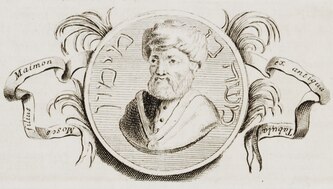
Moshe ben Maimon (Hebrew: רבי משה בן מיימון; Arabic: موسى بن ميمون بن عبد الله القرطبي الإسرائيلي / Mussa bin Maimun ibn Abdallah al-Kurtubi al-Israili; 1135 or 1138 – 12 December 1204), commonly known as Moses Maimonides, was a Jewish rabbi, physician, and philosopher. He was born in Spain, but spent most of his life in Egypt. His works ranged from a commentary on the Mishnah to his Code of Law (summarising the whole of Jewish law) and the philosophical work, the Guide for the Perplexed.
Best Maimonides Quotes
Shortest
Earliest
Explore our curated collection of the most famous and impactful Maimonides quotes.

“God cannot be compared to anything. Note this.”

“Far from it be the notion that the Supreme Being is corporeal, having a material form.”
“For that which is without a beginning, a final cause need not be sought.”

“An artisan busies himself with his work for three hours each day and spends nine hours in study.”
“It is man's duty to love and to fear God, even without hope of reward or fear of punishment.”

“It is better and more satisfactory to acquit a thousand guilty persons than to put a single innocent one to death.”

“It is forbidden to dwell in the vicinity of any of those with an evil tongue, and all the more to sit with them and listen to their words.”
“A sensible man should not demand of me, or hope that when we mention a subject, we shall make a complete exposition of it.”
“Man's shortcomings and sins are all due to the substance of the body and not to its form; while all his merits are exclusively due to his form.”
“Those who believe that... detailed rules originate in a certain cause, are as far from the truth as those who assume that the whole law is useless.”
“Management [ Providence ], knowledge, and intention are not the same when ascribed to us and when ascribed to God.”

“ועל זה נאמר והחזקת בו גר ותושב וחי עמך כלומר החזק בו עד שלא
:יפול ויצטרך (translation needed)”
:יפול ויצטרך (translation needed)”

“It is the function of the intellect to discriminate between the true and the false—a distinction which is applicable to all objects of intellectual perception.”

“We suffer from the evils which we, by our own free will, inflict on ourselves and ascribe them to God, who is far from being connected with them!”
“There shall always be much silence in a man's conduct. He shall speak only about a matter concerned with wisdom or matters that are necessary to keep his body alive.”
“The first kind of evil is that which is caused to man by the circumstance that he is subject to genesis and destruction, or that he possesses a body.”

Maimonides Quotes by Topic
Find exactly what you are looking for by browsing this categorized list of Maimonides quotes by topic.
Maimonides on Truth 4 quotes
“Accept the truth from whatever source it comes.”

Maimonides on Torah study 3 quotes
View all 3 quotes on Torah study →Maimonides on Intention 3 quotes
“That which is produced with intention has passed over from non-existence to existence.”

Maimonides on Idolatry 3 quotes
“It is distinctly said in the Law that everything which idolaters consider as service to their gods, and a means of approaching them, is rejected and despised by God... Thus all precepts cautioning against idolatry, or against that which is connected therewith, leads to it, or is related to it, are evidently useful.”
Maimonides on History of science 3 quotes
“[T]he principal part in the human body, namely, the heart, is in constant motion, and is the source of every motion noticed in the body; it rules over the other members, and communicates to them through its own pulsations the force required for their functions. The outermost sphere by its motion rules in a similar way over all other parts of the universe, and supplies all things with their special properties. Every motion in the universe has thus its origin in the motion of that sphere; and the soul of every animated being derives its origin from the soul of that same sphere.”

Maimonides on Middle Ages 3 quotes
“[T]he principal part in the human body, namely, the heart, is in constant motion, and is the source of every motion noticed in the body; it rules over the other members, and communicates to them through its own pulsations the force required for their functions. The outermost sphere by its motion rules in a similar way over all other parts of the universe, and supplies all things with their special properties. Every motion in the universe has thus its origin in the motion of that sphere; and the soul of every animated being derives its origin from the soul of that same sphere.”
Maimonides on Evil speaking 2 quotes
“Evil speech kills three people—the one who says it, the one who accepts it, and the one about whom it is said.”
Maimonides on Law 2 quotes
“The chief object of the Law, as has been shown by us, is the teaching of truths; to which the truth of the creatio ex nihilo belongs. It is known that the object of the law of Sabbath is to confirm and to establish this principle, as we have shown in this treatise (Part II. chap. xxxi.) In addition to the teaching of truths the Law aims at the removal of injustice from mankind. We have thus proved that the first laws do not refer to burnt-offering and sacrifice, which are of secondary importance.”

Maimonides on Essence 2 quotes
“My opinion is this: the cause of the error of all these schools is their belief that God's knowledge is like ours; each school points to something withheld from our knowledge, and either assumes that the same must be the case in God's knowledge, or at least finds some difficulty how to explain it. ...they likewise demonstrated... that our intellect and our knowledge are insufficient to comprehend the true idea of His essence. ...they came to the absurd conclusion that that which is required for our knowledge is also required for God's knowledge.”
Maimonides on Existence of God 2 quotes
“You are no doubt aware that the Almighty, desiring to lead us to perfection and to improve our state of society, has revealed to us laws which are to regulate our actions. These laws, however, presuppose an advanced state of intellectual culture. We must first form a conception of the Existence of the Creator according to our capabilities; that is, we must have a knowledge of Metaphysics. But this discipline can only be approached after the study of Physics: for the science of Physics borders on Metaphysics, and must even precede it in the course of our studies, as is clear to all who are familiar with these questions.”

Maimonides on Business
“An artisan busies himself with his work for three hours each day and spends nine hours in study.”

Maimonides on Capital punishment
“It is better and more satisfactory to acquit a thousand guilty persons than to put a single innocent one to death.”

What Maimonides Said About Others
Discover personal opinions Maimonides shared regarding contemporaries.
Maimonides on Abraham
“After a long time the great and awful Name was forgotten and the people, men, women and children, only recognized an image of wood or stone and the temple of wood or stone which they had been brought up from infancy to serve by bowing down. ... Abraham ... knew that all were mistaken and that what caused them to err was worship of the images which drove the Truth out of their minds.”
Maimonides on Galen
“Galen, in the third section of his book, "The Use of the Limbs," says correctly that it would be in vain to expect to see living beings formed of the blood of menstruous women and the semen virile, who will not die, will never feel pain, or will move perpetually, or shine like the sun. This dictum of Galen is part of the following more general proposition:—Whatever is formed of matter receives the most perfect form possible in that species of matter; in each individual case the defects are in accordance with that individual matter.”
Maimonides on Aristotle
“Aristotle sees no difference between the falling of a leaf or a stone and the death of the good and noble people in the ship; nor does he distinguish between the destruction of a multitude of ants by an ox depositing on them his excrement and the death of worshippers killed by the fall of the house when its foundations give way. In short, the opinion of Aristotle is this: Everything is the result of management which is constant, which does not come to an end and does not change any of its properties, as e.g., the heavenly beings, and everything which continues according to a certain rule... But that which is not constant, and does not follow a certain rule... is due to chance and not to management; it is in no relation to Divine Providence. Aristotle holds that it is even impossible to ascribe to Providence that management of these things. ...It is the belief of those who turned away from our Law and said: "God hath forsaken the earth." (Ezek. ix. 9)”

Maimonides on Muhammad
“After him arose the Madman who emulated his precursor since he paved the way for him. But he added the further objective of procuring rule and submission, and he invented his well known religion. All of these men purposed to place their teachings on the same level with our divine religion. But only a simpleton who lacks knowledge of both would liken divine institutions to human practices. Our religion differs as much from other religions for which there are alleged resemblances as a living man endowed with the faculty of reason is unlike a statue which is ever so well carved out of marble, wood, bronze or silver. When a person ignorant of divine wisdom or of God's works sees the statue that superficially resembles a man in its contours, form, features, and color, he believes that the structure of the parts of a statue is like the constitution of a man, because he is deficient in understanding concerning the inner organization of both. But the informed person who knows the interior of both, is cognizant of the fact that the internal structure of the statue betrays no skillful workmanship at all, whereas the inward parts of man are truly marvelously made, a testimony to the wisdom of the Creator, such as the prolongation of the nerves in the muscles and their ramifications, the branching out of the sinews and their intersections and the network of their ligaments and their manner of growth, the articulations of the bones and the joints, the pulsating and non-pulsating blood vessels and their ramifications, the setting of the limbs into one another, the uncovered and covered parts, every one of these in proportion, in form and proper place. ... This event was predicted in the divinely inspired prophecy of Daniel, according to which, in some future time a person would appear with a religion similar to the true one, with a book of Scriptures and oral communications, who will arrogantly pretend that God had vouchsafed him a revelation, and that he held converse with Him, besides making other extravagant claims. Thus Daniel in his description of the rise of the Arabic kingdom after the fall of the Roman Empire, alluded to the appearance of the Madman and his victories over the Roman, Persian, and Byzantine Empires in the vision concerning a horn which grew, became long and strong. This is clearly indicated in a verse that can be understood by the masses as well as by the select few. Since this interpretation is borne out by the facts of history, no other meaning can be given to the following verse: "I considered the horns, and, behold, there came among them another horn, a little one, before which three of the first horns were plucked up by the roots; and, behold, in this horn were eyes like the eyes of a man, and a mouth speaking great things." (Danield 7:8).”

Quotes About Maimonides
Gain deeper perspective through quotes about Maimonides from others.
H. P. Blavatsky on Maimonides
“Maimonides, the great Jewish theologian and historian, who at one time was almost deified by his countrymen and afterward treated as a heretic, remarks, that the more absurd and void of sense the Talmud seems the more sublime is the secret meaning. This learned man has successfully demonstrated that the Chaldean Magic, the science of Moses and other learned thaumaturgists was wholly based on an extensive knowledge of the various and now forgotten branches of natural science. Thoroughly acquainted with all the resources of the vegetable, animal, and mineral kingdoms, experts in occult chemistry and physics, psychologists as well as physiologists, why wonder that the graduates or adepts instructed in the mysterious sanctuaries of the temples, could perform wonders, which even in our days of enlightenment would appear supernatural? It is an insult to human nature to brand magic and the occult science with the name of imposture. To believe that for so many thousands of years, one-half of mankind practiced deception and fraud on the other half, is equivalent to saying that the human race was composed only of knaves and incurable idiots. Where is the country in which magic was not practised? At what age was it wholly forgotten? p. 19”
Jewish saying on Maimonides
“From Moses to Moses there was none like Moses.”
Leo Strauss on Maimonides 2 quotes
“Maimonides states that the intention of his work is to explain the meaning of Biblical words of various kinds, as well as of Biblical parables. Such an explanation is necessary, because the external meaning of both lends itself to grave misunderstanding. Since the internal meaning, being hidden, is a secret, the explanation of each such word or parable is the revelation of a secret.”

Misattributed Quotes
Quotes mistakenly credited to Maimonides
About Maimonides
Moshe ben Maimon (Hebrew: רבי משה בן מיימון; Arabic: موسى بن ميمون بن عبد الله القرطبي الإسرائيلي / Mussa bin Maimun ibn Abdallah al-Kurtubi al-Israili; 1135 or 1138 – 12 December 1204), commonly known as Moses Maimonides, was a Jewish rabbi, physician, and philosopher. He was born in Spain, but spent most of his life in Egypt. His works ranged from a commentary on the Mishnah to his Code of Law (summarising the whole of Jewish law) and the philosophical work, the Guide for the Perplexed.