Link Copied!
Lucian Quotes (125-190)
Philosopher
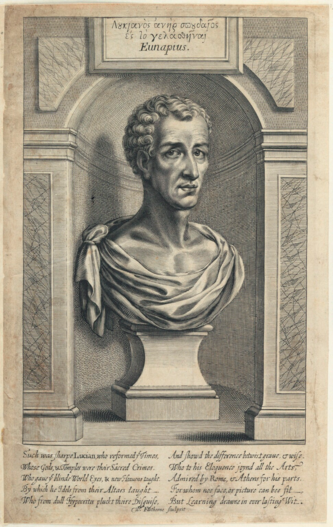
About Lucian
Lucian of Samosata (c. 125 – c. 190) was a satirist and philosopher, born at Samosata in the Syrian province of the Roman Empire (now in Turkey), but in later life resident in Athens. His works are written in the Attic dialect of Greek.
Best Lucian Quotes
Shortest
Earliest
Explore our curated collection of the most famous and impactful Lucian quotes.
“If the brave should fly, he who pursues must be braver.”


“These men seem not to know that poetry has its particular rules and precepts; and that history is governed by others directly opposite.”
“Everything has a beauty peculiar to itself; but if you put one instead of another, the most beautiful becomes ugly, because it is not in its proper place.”
“History, when she adds pleasure to utility, may attract more admirers; though as long as she is possessed of that greatest of perfections, truth, she need not be anxious concerning beauty.”
“The truth is hidden from us. Even if a mere piece of luck brings us straight to it, we shall have no grounded conviction of our success; there are so many similar objects, all claiming to be the real thing.”
“I say, therefore, that he who would write history well must be possessed of these two principal qualifications, a fine understanding and a good style: one is the gift of nature, and cannot be taught; the other may be acquired by frequent exercise, perpetual labour and an emulation of the ancients.”

“I now make the only true statement you are to expect – that I am a liar. This confession is, I consider, a full defence against all imputations. My subject is, then, what I have neither seen, experienced, nor been told, what neither exists nor could conceivably do so. I humbly solicit my readers' incredulity.”
“For history, I say again, has this and this only for its own: if a man will start upon it, he must sacrifice to no God but Truth; he must neglect all else; his sole rule and unerring guide is this – to think not of those who are listening to him now, but of the yet unborn who shall seek his converse.”
“First, then, I went to the Indians, the mightiest nation upon earth. I had little trouble in persuading them to descend from their elephants and follow me. The Brahmins, who dwell between Oxydracae and the country of the Nechrei, are mine to a man: they live according to my laws, and are respected by all their neighbours; and the manner of their death is truly wonderful.”
“He is unpardonable, therefore, who cannot distinguish one from the other; but lays on history the paint of poetry, its flattery, fable, and hyperbole: it is just as ridiculous as it would be to clothe one of our robust wrestlers, who is as hard as an oak, in fine purple, or some such meretricious garb, and put paint on his cheeks; how would such ornaments debase and degrade him!”
“The good historian, then, must be thus described: he must be fearless, uncorrupted, free, the friend of truth and of liberty; one who, to use the words of the comic poet, calls a fig a fig, and a skiff a skiff, neither giving nor withholding from any, from favour or from enmity, not influenced by pity, by shame, or by remorse; a just judge, so far benevolent to all as never to give more than is due to any in his work; a stranger to all, of no country, bound only by his own laws, acknowledging no sovereign, never considering what this or that man may say of him, but relating faithfully everything as it happened.”

Lucian Quotes by Topic
Find exactly what you are looking for by browsing this categorized list of Lucian quotes by topic.
Lucian on Twelve-tone technique 2 quotes
“Alas, this industrialized twelve-tone horse, dull on the outside and empty inside, constantly being perfected and dragged to a new Troy in shadow of an ideological war long since fought and won by responsible minds like Schoenberg, with neither systems nor scholarship for armor!”
Lucian on Serialism 2 quotes
“Alas, this industrialized twelve-tone horse, dull on the outside and empty inside, constantly being perfected and dragged to a new Troy in shadow of an ideological war long since fought and won by responsible minds like Schoenberg, with neither systems nor scholarship for armor!”
Lucian on Leadership 2 quotes
“Character is what you are. Reputation is what others think you are. The reason that some fail to climb the ladder of success, or of leadership if you want to call it that, is that there is a difference between reputation and character. The two do not always coincide. A man may be considered to have sterling character. Opportunity might come to that man; but if he has the reputation for something he is not, he may fail that opportunity. I think character is the foundation of successful leadership.”

Lucian on Angels
Lucian on Deity
“A boy of five years old serene and gay, Unpitying Hades hurried me away.Mbr”
Lucian on Hydroxychloroquine
“Hydroxychloroquine has been studied as a possible antiviral therapy for many decades. Despite showing evidence of activity against several viruses in the laboratory, it never showed success in randomized clinical trials.”

Lucian on Antisemitism in the UK Labour Party
“There can be no hypocrisy or double-standards when it comes to Jewish people in the Labour Party. We demand equal treatment, freedom from hatred and a concerted effort from the party's leadership to stamp out antisemitism.”

Lucian on Recognition
“...awareness of the plurality of functions of his own tools forms the basis for his responsibility just as, in everyday life, every man's responsibility begins with recognition of the multiplicity of human races, conditions, needs, and ideals.”

Lucian on Obituary
“Luciano Pavarotti, who has died aged 71 of pancreatic cancer, grew up in the 1940s listening to the previous golden generation of tenor stars on record and radio... His family were enthusiastically musical and, aged four, he was apparently standing on the kitchen table singing the Duke of Mantua's La donna é mobile from Rigoletto as a party trick. He modelled himself on what he heard, and used recordings to take account of the competition, dead or alive, throughout his career. Nature equipped him with one of the most individual, unmistakable and beautiful voices there has been.”
Lucian on Speaking out
“The historian should be fearless and incorruptible; a man of independence, loving frankness and truth; one who, as the poet says, calls a fig a fig and a spade a spade. He should yield to neither hatred nor affection, but should be unsparing and unpitying. He should be neither shy nor deprecating, but an impartial judge, giving each side all it deserves but no more. He should know in his writings no country and no city; he should bow to no authority and acknowledge no king. He should never consider what this or that man will think, but should state the facts as they really occurred.”
What Lucian Said About Others
Discover personal opinions Lucian shared regarding contemporaries.
Lucian on Luciano Lama 2 quotes
“Luciano Lama had a great mentor in Di Vittorio: accompanying him on his numerous trips, he got to know the reality of southern Italy and understood the importance of direct contact with the masses.”

Lucian on Ernst von Glasersfeld
“Ernst von Glasersfeld, who founded radical constructivism (RC) in the 1970s, is clearly on Kuhn's side”

Lucian on Giuseppe Di Vittorio
“Luciano Lama had a great mentor in Di Vittorio: accompanying him on his numerous trips, he got to know the reality of southern Italy and understood the importance of direct contact with the masses.”

Lucian on Claude Lévi-Strauss
“I would go as far as to say (as my anger comes back) that any attempt to codify musical reality into a kind of imitation grammar (I refer mainly to the efforts associated with the Twelve-Tone System) is a brand of fetishism which shares with Fascism and racism the tendency to reduce live processes to immobile, labeled objects, the tendency to deal with formalities rather than substance. Claude Lévi-Strauss describes (though to illustrate a different point) a captain at sea, his ship reduced to a frail raft without sails, who, by enforcing a meticulous protocol on his crew, is able to distract them from nostalgia for a safe harbor and from the desire for a destination.”

About Lucian
Lucian of Samosata (c. 125 – c. 190) was a satirist and philosopher, born at Samosata in the Syrian province of the Roman Empire (now in Turkey), but in later life resident in Athens. His works are written in the Attic dialect of Greek.