Link Copied!
Jorge Luis Borges Quotes (1899-1986)
Author, Writer, Poet
























About Jorge Luis Borges
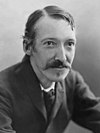
Jorge Luis Borges (24 August 1899 – 14 June 1986) was an Argentine writer who is considered one of the foremost literary figures of the 20th century. Most famous in the English speaking world for his short stories and fictive essays, Borges was also a poet, critic, translator and man of letters.
Best Jorge Luis Borges Quotes
Shortest
Earliest
Explore our curated collection of the most famous and impactful Jorge Luis Borges quotes.

“The central problem of novel-writing is causality.”

“Censorship is the mother of metaphor.”
“Ser conservador es una forma de ser escéptico.”
“La duda es uno de los nombres de la inteligencia.”
“Fame is a form—perhaps the worst form—of incomprehension.”
“My advanced age has taught me the resignation of being Borges.”


“In a riddle whose answer is chess, what is the only prohibited word?”
“Art always opts for the individual, the concrete; art is not Platonic.”
“Your unforgivable sins do not allow you to see my splendor.”
“To die for a religion is easier than to live it absolutely.”


“The vast ineptitude of his pretense would be a convincing proof that this was no fraud.”

“I will pause to consider this eternity from which the subsequent ones derive.”

“I owe the discovery of Uqbar to the conjunction of a mirror and an encyclopedia.”

“Time forks perpetually toward innumerable futures. In one of them I am your enemy.”
“The future is inevitable and precise, but it may not occur. God lurks in the gaps.”

“El infierno y el paraíso me parecen desproporcionados. Los actos de los hombres no merecen tanto.”
“Like all those possessing a library, Aurelian was aware that he was guilty of not knowing his in its entirety.”

“Reading … is an activity subsequent to writing: more resigned, more civil, more intellectual.”

“Imprecision is tolerable and verisimilar in literature, because we always tend towards it in life.”

“My undertaking is not difficult, essentially... I should only have to be immortal to carry it out.”
“The flattery of posterity is not worth much more than contemporary flattery, which is worth nothing.”

“Mir Bahadur Ali is, as we have seen, incapable of evading the most vulgar of art's temptations: that of being a genius.”
“That one individual should awaken in another memories that belong to still a third is an obvious paradox.”
“He transforms all concepts into incommunicable, solidified objects. To refute him is to become contaminated with unreality.”
“His many years had reduced and polished him the way water smooths and polishes a stone or generations of men polish a proverb.”
“The earth we inhabit is an error, an incompetent parody. Mirrors and paternity are abominable because they multiply and affirm it.”
“"Maybe this crime belongs to the history of Jewish superstitions," murmmured Lönnrot.
"Like Christianity," the editor put in.”
"Like Christianity," the editor put in.”

“That history should have imitated history was already sufficiently marvellous; that history should imitate literature is inconceivable....”

“I have known that thing the Greeks knew not – uncertainty.
• Variant: I have known uncertainty: a state unknown to the Greeks.”
• Variant: I have known uncertainty: a state unknown to the Greeks.”


“Hay un concepto que es el corruptor y el desatinador de los otros. No hablo del mal cuyo limitado imperio es la ética; hablo del infinito.”
“Yo, que me figuraba el Paraíso / Bajo la especie de una biblioteca. I have always imagined Paradise as a kind of library.”
“¿De qué otra forma se puede amenazar que no sea de muerte? Lo interesante, lo original, sería que alguien lo amenace a uno con la inmortalidad.”

“Besides, time, which despoils castles, enriches verses . . . Time broadens the scope of verses and I know of some which, like music, are everything for all men.”

“Dictatorships foster oppression, dictatorships foster servitude, dictatorships foster cruelty; more abominable is the fact that they foster idiocy.”

“Films are even stranger, for what we are seeing are not disguised people but photographs of disguised people, and yet we believe them while the film is being shown.”
“I cannot walk through the suburbs in the solitude of the night without thinking that the night pleases us because it suppresses idle details, just as our memory does.”

“I thought of a labyrinth of labyrinths, of one sinuous spreading labyrinth that would encompass the past and the future and in some way involve the stars.”
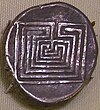
“The geometry of Tlön comprises two somewhat different disciplines: the visual and the tactile. The latter corresponds to our own geometry and is subordinated to the first.”

“In the order of literature, as in others, there is no act that is not the coronation of an infinite series of causes and the source of an infinite series of effects.”
“Para uno de esos gnosticos, el visible universo era una ilusion o (mas precisamente) un sofisma. Los espejos y la paternidad son abominables porque lo multiplican y lo divulgan.”
“Myth is at the beginning of literature, and also at its end.
• Variant: In the beginning of literature there is myth, as there is also in the end of it.”
• Variant: In the beginning of literature there is myth, as there is also in the end of it.”
“The universe (which others call the Library) is composed of an indefinite and perhaps infinite number of hexagonal galleries, with vast air shafts between, surrounded by very low railings.”

“El hecho ocurrió en el mes de febrero de 1969, al norte de Boston, en Cambridge. No lo escribí inmediatamente porque mi primer propósito fue olvidarlo, para no perder la razón.”

“Villari took no notice of them because the idea of a coincidence between art and reality was alien to him. Unlike people who read novels, he never saw himself as a character in a work of art.”
“Reality is not always probable, or likely. But if you're writing a story, you have to make it as plausible as you can, because if not, the reader's imagination will reject it.”
“The execution was set for the 29th of March, at nine in the morning. This delay was due to a desire on the part of the authorities to act slowly and impersonally, in the manner of planets or vegetables.”
“This was the first time Remington rifles were used in the Argentine, and it tickles my fancy to think that the firm that shaves me every morning bears the same name as the one that killed my grandfather.”
“There is a flavor that our time (perhaps surfeited by the clumsy imitations of professional patriots) does not usually perceive without some suspicion: the fundamental flavor of the heroic.”

“Of course, like all young men, I tried to be as unhappy as I could — a kind of Hamlet and Raskolnikov rolled into one.”
“It is clear that there is no classification of the Universe that is not arbitrary and full of conjectures. The reason for this is very simple: we do not know what kind of thing the universe is.”

“There are no moral or intellectual merits. Homer composed the Odyssey; if we postulate an infinite period of time, with infinite circumstances and changes, the impossible thing is not to compose the Odyssey, at least once.”
“The man who acquires an encyclopedia does not thereby acquire every line, every paragraph, every page, and every illustration; he acquires the possibility of becoming familiar with one and another of those things.”
“In the course of a life devoted less to living than to reading, I have verified many times that literary intentions and theories are nothing more than stimuli and that the final work usually ignores or even contradicts them.”
“The exercise of letters is sometimes linked to the ambition to construct an absolute book, a book of books that includes the others like a Platonic archetype, an object whose virtues are not diminished by the passage of time.”
“"Wakefield" prefigures Franz Kafka, but the latter modifies, and sharpens, the reading of "Wakefield." The debt is mutual; a great writer creates his or her precursors. He or she creates them and in some fashion justifies them.”
“In adultery, there is usually tenderness and self-sacrifice; in murder, courage; in profanation and blasphemy, a certain satanic splendour. Judas elected those offences unvisited by any virtues: abuse of confidence and informing.”
“Wilde was not a great poet nor a consummate prose writer. He was a very astute Irishman who encompassed in epigrams an esthetic credo which others before him scattered in the space of long pages. He was an enfant terrible.”
“Years of solitude had taught him that, in one's memory, all days tend to be the same, but that there is not a day, not even in jail or in the hospital, which does not bring surprises, which is not a translucent network of minimal surprises.”
“I know of one semibarbarous zone whose librarians repudiate the "vain and superstitious habit" of trying to find sense in books, equating such a quest with attempting to find meaning in dreams or in the chaotic lines on the palms of one's hand.”
“Ts'ui Pe must have said once: I am withdrawing to write a book. And another time: I am withdrawing to construct a labyrinth. Every one imagined two works; to no one did it occur that the book and the maze were one and the same thing.”
“He sospechado alguna vez que la única cosa sin misterio es la felicidad, porque se justifica por sí sola.
• Variant: I have thought from time to time that the only thing without mystery is happiness, since it justifies itself.”
• Variant: I have thought from time to time that the only thing without mystery is happiness, since it justifies itself.”
“What one man does is something done, in some measure, by all men. For that reason a disobedience committed in a garden contaminates the human race; for that reason it is not unjust that the crucifixion of a single Jew suffices to save it.”
“I would define the baroque as that style that deliberately exhausts (or tries to exhaust) its own possibilities, and that borders on self-caricature. [...] The baroque is the final stage in all art, when art flaunts and squanders its resources.”

“It seemed incredible to me that day without premonitions or symbols should be the one of my inexorable death.
• Variant translation: It seemed incredible that this day, a day without warnings or omens, might be that of my implacable death.”
• Variant translation: It seemed incredible that this day, a day without warnings or omens, might be that of my implacable death.”
“In the work of Ts'ui Pên, all possible outcomes occur; each one is the point of departure for other forkings. Sometimes, the paths of this labyrinth converge: for example, you arrive at this house, but in one of the possible pasts you are my enemy, in another, my friend.”
“Writing long books is a laborious and impoverishing act of foolishness: expanding in five hundred pages an idea that could be perfectly explained in a few minutes. A better procedure is to pretend that those books already exist and to offer a summary, a commentary.”
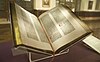
“If the pages of this book contain some successful verse, the reader must excuse me the discourtesy of having usurped it first. Our nothingness differs little; it is a trivial and chance circumstance that you should be the reader of these exercises and I their author.”
“We all think that fate has dealt us a wretched sort of lot in life, and that others must be better. [...] I presume that in the heaven of the Blessèd there are those who believe that the advantages of that locale are much exaggerated by theologists, who have never been there themselves.”
“It is no exaggeration to state that the classic culture of Tlön comprises only one discipline: psychology. All others are subordinated to it. I have said that the men of this planet conceive the universe as a series of mental processes which do not develop in space but successively in time.”
“No one is anyone, one single immortal man is all men. Like Cornelius Agrippa, I am god, I am hero, I am philosopher, I am demon and I am world, which is a tedious way of saying that I do not exist.”
“Arrasado el jardín, profanados los cálices y las aras, entraron a caballo los hunos en la biblioteca monástica y rompieron los libros incomprensibles y los vituperaron y los quemaron, acaso temerosos de que las letras encubrieran blasfemias contra su dios, que era una cimitarra de hierro.”
“"Well, [Lorca had] a gift for gab. For example, he makes striking metaphors, but I think he makes striking metaphors for him, because I think that his world was mostly verbal. I think that he was fond of playing words against each other, the contrast of words, but I wonder if he knew what he was doing."”
“We (the indivisible divinity that works in us) have dreamed the world. We have dreamed it resistant, mysterious, visible, ubiquitous in space and firm in time, but we have allowed slight, and eternal, bits of the irrational to form part of its architecture so as to know that it is false.”
“One of the heresiarchs of Uqbar had stated that mirrors and copulation are abominable, since they both multiply the numbers of man.
• Variant translation: Mirrors and copulation are obscene, for they increase the numbers of mankind.”
• Variant translation: Mirrors and copulation are obscene, for they increase the numbers of mankind.”
“The aesthetic event is something as evident, as immediate, as indefinable as love, the taste of fruit, of water. We feel poetry as we feel the closeness of a woman, or as we feel a mountain or a bay. If we feel it immediately, why dilute it with other words, which no doubt will be weaker than our feelings?”
“A book is more than a verbal structure or series of verbal structures; it is the dialogue it establishes with its reader and the intonation it imposes upon his voice and the changing and durable images it leaves in his memory. A book is not an isolated being: it is a relationship, an axis of innumerable relationships.”
“Truly fine poetry must be read aloud. A good poem does not allow itself to be read in a low voice or silently. If we can read it silently, it is not a valid poem: a poem demands pronunciation. Poetry always remembers that it was an oral art before it was a written art. It remembers that it was first song.”
“It is venturesome to think that a coordination of words (philosophies are nothing more than that) can resemble the universe very much. It is also venturesome to think that of all these illustrious coordinations, one of them — at least in an infinitesimal way — does not resemble the universe a bit more than the others.”
“Any life, however long and complicated it may be, actually consists of a single moment — the moment when a man knows forever more who he is.
• Variant: Any life, no matter how long and complex it may be, is made up of a single moment — the moment in which a man finds out, once and for all, who he is.”
• Variant: Any life, no matter how long and complex it may be, is made up of a single moment — the moment in which a man finds out, once and for all, who he is.”

“I have suspected that history, real history, is more modest and that its essential dates may be, for a long time, secret. A Chinese prose writer has observed that the unicorn, because of its own anomaly, will pass unnoticed. Our eyes see what they are accustomed to seeing. Tacitus did not perceive the Crucifixion, although his book recorded it.”
“Like every writer, he measured the virtues of other writers by their performance, and asked that they measure him by what he conjectured or planned.
• "The Secret Miracle"; Variant: Like all writers, he measured the achievements of others by what they had accomplished, asking of them that they measure him by what he envisaged or planned.”
• "The Secret Miracle"; Variant: Like all writers, he measured the achievements of others by what they had accomplished, asking of them that they measure him by what he envisaged or planned.”
“En mi juventud probé la mescalina y la cocaína pero enseguida me pasé a los pastillas de menta que me parecieron más estimulantes. Si las drogas producen el mismo efecto que el alcohol, no me interesan. Un borracho es evidentemente ridículo. He estado borracho algunas veces y lo recuerdo como una experiencia muy desagradable para los demás y para mí.”
“There is no exercise of the intellect which is not, in the final analysis, useless. A philosophical doctrine begins as a plausible description of the universe; with the passage of the years it becomes a mere chapter — if not a paragraph or a name — in the history of philosophy.
• Variant: There is no intellectual exercise which is not ultimately useless.”
• Variant: There is no intellectual exercise which is not ultimately useless.”

“There is no combination of characters one can make — dhcmrlchtdj, for example — that the divine Library has not foreseen and that in one or more of its secret tongues does not hide a terrible significance. There is no syllable one can speak that is not filled with tenderness and terror, that is not, in one of those languages, the mighty name of a god.”

“Time carries him as the river carries
A leaf in the downstream water.
No matter. The enchanted one insists
And shapes God with delicate geometry.
Since his illness, since his birth,
He goes on constructing God with the word.
The mightiest love was granted him
Love that does not expect to be loved.”
A leaf in the downstream water.
No matter. The enchanted one insists
And shapes God with delicate geometry.
Since his illness, since his birth,
He goes on constructing God with the word.
The mightiest love was granted him
Love that does not expect to be loved.”

“Any time something is written against me, I not only share the sentiment but feel I could do the job far better myself. Perhaps I should advise would-be enemies to send me their grievances beforehand, with full assurance that they will receive my every aid and support. I have even secretly longed to write, under a pen name, a merciless tirade against myself.”
“A writer — and, I believe, generally all persons — must think that whatever happens to him or her is a resource. All things have been given to us for a purpose, and an artist must feel this more intensely. All that happens to us, including our humiliations, our misfortunes, our embarrassments, all is given to us as raw material, as clay, so that we may shape our art.”
“I found America the friendliest, most forgiving, and most generous nation I had ever visited. We South Americans tend to think of things in terms of convenience, whereas people in the United States approach things ethically. This — amateur Protestant that I am — I admired above all. It even helped me overlook skyscrapers, paper bags, television, plastics, and the unholy jungle of gadgets.”
“The metaphysicians of Tlön do not seek for the truth or even for verisimilitude, but rather for the astounding. They judge that metaphysics is a branch of fantastic literature. They know that a system is nothing more than the subordination of all aspects of the universe to any one such aspect. Even the phrase "all aspects" is rejectable, for it supposes the impossible addition of the present and of all past moments.”
“There is nothing very remarkable about being immortal; with the exception of mankind, all creatures are immortal, for they know nothing of death. What is divine, terrible, and incomprehensible is to know oneself immortal.
• Variant: To be immortal is commonplace; except for man, all creatures are immortal, for they are ignorant of death; what is divine, terrible, incomprehensible, is to know that one is immortal.”
• Variant: To be immortal is commonplace; except for man, all creatures are immortal, for they are ignorant of death; what is divine, terrible, incomprehensible, is to know that one is immortal.”
“"It's possible, but not interesting," Lonnrot answered. "You will reply that reality hasn't the slightest need to be of interest. And I'll answer you that reality may avoid the obligation to be interesting, but that hypotheses may not. In the hypothesis you have postulated, chance intervenes largely. Here lies a dead rabbi; I should prefer a purely rabbinical explanation; not the imaginary mischances of an imaginary robber."”
“It is known that Whistler when asked how long it took him to paint one of his "nocturnes" answered: "All of my life." With the same rigor he could have said that all of the centuries that preceded the moment when he painted were necessary. From that correct application of the law of causality it follows that the slightest event presupposes the inconceivable universe and, conversely, that the universe needs even the slightest of events.”
“As I think of the many myths, there is one that is very harmful, and that is the myth of countries. I mean, why should I think of myself as being an Argentine, and not a Chilean, and not an Uruguayan. I don't know really. All of those myths that we impose on ourselves — and they make for hatred, for war, for enmity — are very harmful. Well, I suppose in the long run, governments and countries will die out and we'll be just, well, cosmopolitans.”
“Toward dawn, he dreamed that he was in hiding, in one of the naves of the Clementine Library. What are you looking for? a librarian wearing dark glasses asked him. I'm looking for God, Hladik replied. God, the librarian said, is in one of the letters on one of the pages of one of the four hundred thousand volumes in the Clementine. My parents and my parents' parents searched for that letter; I myself have gone blind searching for it.”
“No estoy seguro de que yo exista, en realidad. Soy todos los autores que he leído, toda la gente que he conocido, todas las mujeres que he amado. Todas las ciudades que he visitado, todos mis antepasados...
• Source: El Pais, 1981; translation: The Guardian, 2008”
• Source: El Pais, 1981; translation: The Guardian, 2008”
“In the critic's vocabulary, the word "precursor" is indispensable, but it should be cleansed of all connotations of polemic or rivalry. The fact is that every writer creates his own precursors. His work modifies our conception of the past, as it will modify the future.
• Variant translation: The fact is that all writers create their precursors. Their work modifies our conception of the past, just as it is bound to modify the future.”
• Variant translation: The fact is that all writers create their precursors. Their work modifies our conception of the past, just as it is bound to modify the future.”
“Thinking, meditating, imagining are not anomalous acts – they are the normal respiration of the intelligence. To glorify the occasional exercise of that function, to treasure beyond price ancient and foreign thoughts, to recall with incredulous awe what some doctor universalis thought, is to confess our own languor, or our own barbarie. Every man should be capable of all ideas, and I believe that in the future he shall be.”

“And yet, and yet … Negar la sucesión temporal, negar el yo, negar el universo astronómico, son desesperaciones aparentes y consuelos secretos. Nuestro destino no es espantoso por irreal: es espantoso porque es irreversible y de hierro. El tiempo es la sustancia de que estoy hecho. El tiempo es un río que me arrebata, pero yo soy el río; es un tigre que me destroza, pero yo soy el tigre; es un fuego que me consume, pero yo soy el fuego. El mundo desgraciadamente es real; yo, desgraciadamente, soy Borges.”
“On the floor, and hanging on to the bar, squatted an old man, immobile as an object. His years had reduced and polished him as water does a stone or the generations of men do a sentence. He was dark, dried up, diminutive, and seemed outside time, situated in eternity.
• Variant: On the floor, curled against the bar, lay an old man, as motionless as an object. The many years had worn him away and polished him, as a stone is worn smooth by running water or a saying is polished by generations of mankind.”
• Variant: On the floor, curled against the bar, lay an old man, as motionless as an object. The many years had worn him away and polished him, as a stone is worn smooth by running water or a saying is polished by generations of mankind.”
“The impossibility of penetrating the divine pattern of the universe cannot stop us from planning human patterns, even though we are conscious they are not definitive. The analytic language of Wilkins is not the least admirable of such patterns.
• Variant: The impossibility of penetrating the divine scheme of the universe does not, however, dissuade us from planning human schemes, even though we know they must be provisional. The Analytic Language of Wilkins is not the least admirable of these schemes.”
• Variant: The impossibility of penetrating the divine scheme of the universe does not, however, dissuade us from planning human schemes, even though we know they must be provisional. The Analytic Language of Wilkins is not the least admirable of these schemes.”

“If Dahlmann was without hope, he was also without fear. As he crossed the threshold, he felt that to die in a knife fight, under the open sky, and going forward to the attack, would have been a liberation, a joy, and a festive occasion, on the first night in the sanitarium, when they stuck him with the needle. He felt that if he had been able to choose, then, or to dream his death, this would have been the death he would have chosen or dreamt. Firmly clutching his knife, which he perhaps would not know how to wield, Dahlmann went out into the plain.”

“Cabe ir más lejos; cabe sospechar que no hay universo en el sentido orgánico, unificador, que tiene esa ambiciosa palabra. Si lo hay, falta conjeturar su propósito; falta conjeturar las palabras, las definiciones, las etimologías, las sinonimias, del secreto diccionario de Dios.
• Variant: We can go further; we suspect that there is no universe in the organic, unifying sense of that ambitious word. If there is, we must conjecture its purpose; we must conjecture the words, the definitions, the etymologies, the synonyms, from the secret dictionary of God.”
• Variant: We can go further; we suspect that there is no universe in the organic, unifying sense of that ambitious word. If there is, we must conjecture its purpose; we must conjecture the words, the definitions, the etymologies, the synonyms, from the secret dictionary of God.”
“One thinker no less brilliant than the heresiarch himself, but in the orthodox tradition, advanced a most daring hypothesis. This felicitous supposition declared that there is only one Individual, and that this indivisible Individual is every one of the separate beings in the universe, and that these beings are the instruments and masks of divinity itself.
• Variant: This happy conjecture affirmed that there is only one subject, that this indivisible subject is every being in the universe and that these beings are the organs and masks of the divinity.”
• Variant: This happy conjecture affirmed that there is only one subject, that this indivisible subject is every being in the universe and that these beings are the organs and masks of the divinity.”
“Hume noted for all time that Berkeley's arguments did not admit the slightest refutation nor did they cause the slightest conviction. This dictum is entirely correct in its application to the earth, but entirely false in Tlön. The nations of this planet are congenitally idealist. Their language and the derivations of their language — religion, letters, metaphysics — all presuppose idealism. The world for them is not a concourse of objects in space; it is a heterogeneous series of independent acts. It is successive and temporal, not spatial.”

“It is worth remembering that every writer begins with a naively physical notion of what art is. A book for him or her is not an expression or a series of expressions, but literally a volume, a prism with six rectangular sides made of thin sheets of papers which should include a cover, an inside cover, an epigraph in italics, a preface, nine or ten parts with some verses at the beginning, a table of contents, an ex libris with an hourglass and a Latin phrase, a brief list of errata, some blank pages, a colophon and a publication notice: objects that are known to constitute the art of writing.”
“Music, states of happiness, mythology, faces belabored by time, certain twilights and certain places try to tell us something, or have said something we should not have missed, or are about to say something; this imminence of a revelation which does not occur is, perhaps, the aesthetic phenomenon.
• Variant translation: Music, feelings of happiness, mythology, faces worn by time, certain twilights and certain places, want to tell us something, or they told us something that we should not have missed, or they are about to tell us something; this imminence of a revelation that is not produced is, perhaps, the esthetic event.”
• Variant translation: Music, feelings of happiness, mythology, faces worn by time, certain twilights and certain places, want to tell us something, or they told us something that we should not have missed, or they are about to tell us something; this imminence of a revelation that is not produced is, perhaps, the esthetic event.”
“I foresee that man will resign himself each day to more atrocious undertakings; soon there will be no one but warriors and brigands; I give them this counsel: The author of an atrocious undertaking ought to imagine that he has already accomplished it, ought to impose upon himself a future as irrevocable as the past.
• Variant translation: I foresee that man will resign himself each day to new abominations, and soon that only bandits and soldiers will be left... Whosoever would undertake some atrocious enterprise should act as if it were already accomplished, should impose upon himself a future as irrevocable as the past.”
• Variant translation: I foresee that man will resign himself each day to new abominations, and soon that only bandits and soldiers will be left... Whosoever would undertake some atrocious enterprise should act as if it were already accomplished, should impose upon himself a future as irrevocable as the past.”
“Coleridge observes that all men are born Aristotelians or Platonists. The latter feel that classes, orders, and genres are realities; the former, that they are generalizations. For the latter, language is nothing but an approximative set of symbols; for the former, it is the map of the universe. The Platonist knows that the universe is somehow a cosmos, an order; that order, for the Aristotelian, can be an error or a fiction of our partial knowledge. Across the latitudes and the epochs, the two immortal antagonists change their name and language: one is Parmenides, Plato, Spinoza, Kant, Francis Bradley; the other, Heraclitus, Aristotle, Locke, Hume, William James.”
“On September 20, 1792, Johann Wolfgang von Goethe (who had accompanied the Duke of Weimar on a military expedition to Paris) saw the finest army of Europe inexplicably repulsed at Valmy by some French militiamen, and said to his disconcerted friends: "In this place and on this day, a new epoch in the history of the world is beginning, and we shall be able to say that we have been present at its origin." Since that time historic days have been numerous, and one of the tasks of governments (especially in Italy, Germany, and Russia) has been to fabricate them or to simulate them with an abundance of preconditioning propaganda followed by relentless publicity.”
“These ambiguities, redundances, and deficiences recall those attributed by Dr. Franz Kuhn to a certain Chinese encyclopedia entitled Celestial Emporium of Benevolent Knowledge. On those remote pages it is written that animals are divided into (a) those that belong to the Emperor, (b) embalmed ones, (c) those that are trained, (d) suckling pigs, (e) mermaids, (f) fabulous ones, (g) stray dogs, (h) those that are included in this classification, (i) those that tremble as if they were mad, (j) innumerable ones, (k) those drawn with a very fine camel's hair brush, (l) others, (m) those that have just broken a flower vase, (n) those that resemble flies from a distance.”
“Nowadays, one of the churches of Tlön maintains platonically that such and such a pain, such and such a greenish-yellow colour, such and such a temperature, such and such a sound, etc., make up the only reality there is. All men, in the climactic instant of coitus, are the same man. All men who repeat one line of Shakespeare are William Shakespeare.
• Variant: Today, one of the churches of Tlön Platonically maintains that a certain pain, a certain greenish tint of yellow, a certain temperature, a certain sound, are the only reality. All men, in the vertiginous moment of coitus, are the same man. All men who repeat a line from Shakespeare are William Shakespeare.”
• Variant: Today, one of the churches of Tlön Platonically maintains that a certain pain, a certain greenish tint of yellow, a certain temperature, a certain sound, are the only reality. All men, in the vertiginous moment of coitus, are the same man. All men who repeat a line from Shakespeare are William Shakespeare.”
“Un hombre se propone la tarea de dibujar el mundo. A lo largo de los años puebla un espacio con imágenes de provincias, de reinos, de montañas, de bahías, de naves, de islas, de peces, de habitaciones, de instrumentos, de astros, de caballos y de personas. Poco antes de morir, descubre que ese paciente laberinto de líneas traza la imagen de su cara.
• Variant translation: A man sets himself the task of portraying the world. Through the years he peoples a space with images of provinces, kingdoms, mountains, bays, ships, islands, fishes, rooms, instruments, stars, horses, and people. Shortly before his death, he discovers that that patient labyrinth of lines traces the image of his face.”
• Variant translation: A man sets himself the task of portraying the world. Through the years he peoples a space with images of provinces, kingdoms, mountains, bays, ships, islands, fishes, rooms, instruments, stars, horses, and people. Shortly before his death, he discovers that that patient labyrinth of lines traces the image of his face.”

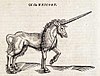
“It is universally held that the unicorn is a supernatural being and of auspicious omen; so say the odes, the annals, the biographies of worthies, and other texts whose authority is unimpeachable. Even village women and children know that the unicorn is a lucky sign. But this animal does not figure among the barnyard animals, it is not always easy to come across, it does not lend itself to zoological classification. Nor is it like the horse or bull, the wolf or deer. In such circumstances we may be face to face with a unicorn and not know for sure that we are. We know that a certain animal with a mane is a horse and that a certain animal with horns is a bull. We do not know what the unicorn looks like.”
“Literature is not exhaustible, for the sufficient and simple reason that a single book is not. A book is not an isolated entity: it is a narration, an axis of innumerable narrations. One literature differs from another, either before or after it, not so much because of the text as for the manner in which it is read.
• Variant translation: A book is not an autonomous entity: it is a relation, an axis of innumerable relations. One literature differs from another, be it earlier or later, not because of the texts but because of the way they are read: if I could read any page from the present time — this one, for instance — as it will be read in the year 2000, I would know what the literature of the year 2000 would be like.”
• Variant translation: A book is not an autonomous entity: it is a relation, an axis of innumerable relations. One literature differs from another, be it earlier or later, not because of the texts but because of the way they are read: if I could read any page from the present time — this one, for instance — as it will be read in the year 2000, I would know what the literature of the year 2000 would be like.”
“From these two incontrovertible premises he deduced that the Library is total and that its shelves register all the possible combinations of the twenty-odd orthographical symbols (a number which, though extremely vast, is not infinite). Everything: the minutely detailed history of the future, the archangels' autobiographies, the faithful catalogues of the Library, thousands and thousands of false catalogues, the demonstration of the fallacy of those catalogues, the demonstration of the fallacy of the true catalogue, the Gnostic gospel of Basilides, the commentary on that gospel, the commentary on the commentary on that gospel, the true story of your death, the translation of every book in all languages, the interpolations of every book in all books.”

“The Garden of Forking Paths is an incomplete, but not false, image of the universe as Ts'ui Pên conceived it. In contrast to Newton and Schopenhauer, your ancestor did not believe in a uniform, absolute time. He believed in an infinite series of times, in a growing, dizzying net of divergent, convergent and parallel times. This network of times which approached one another, forked, broke off, or were unaware of one another for centuries, embraces all possibilities of time. We do not exist in the majority of these times; in some you exist, and not I; in others I, and not you; in others, both of us.
• Variant translation: This web of time — the strands of which approach one another, bifurcate, intersect or ignore each other through the centuries — embrace every possibility.”
• Variant translation: This web of time — the strands of which approach one another, bifurcate, intersect or ignore each other through the centuries — embrace every possibility.”

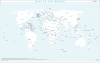
“In that Empire, the Art of Cartography attained such Perfection that the map of a single Province occupied the entirety of a City, and the map of the Empire, the entirety of a Province. In time, those Unconscionable Maps no longer satisfied, and the Cartographers Guilds struck a Map of the Empire whose size was that of the Empire, and which coincided point for point with it. The following Generations, who were not so fond of the Study of Cartography as their Forebears had been, saw that that vast Map was Useless, and not without some Pitilessness was it, that they delivered it up to the Inclemencies of Sun and Winters. In the Deserts of the West, still today, there are Tattered Ruins of that Map, inhabited by Animals and Beggars; in all the Land there is no other Relic of the Disciplines of Geography.”

“One of the schools of Tlön goes so far as to negate time; it reasons that the present is indefinite, that the future has no reality other than as a present hope, that the past has no reality other than as a present memory. Another school declares that all time has already transpired and that our life is only the crepuscular and no doubt falsified an mutilated memory or reflection of an irrecoverable process. Another, that the history of the universe — and in it our lives and the most tenuous detail of our lives — is the scripture produced by a subordinate god in order to communicate with a demon. Another, that the universe is comparable to those cryptographs in which not all the symbols are valid and that only what happens every three hundred nights is true. Another, that while we sleep here, we are awake elsewhere and that in this way every man is two men.”

“The possibilities of the art of combination are not infinite, but they tend to be frightful. The Greeks engendered the chimera, a monster with heads of the lion, the dragon and the goat; the theologians of the second century, the Trinity, in which the Father, the Son and the Holy Ghost are inextricably tied; the Chinese zoologists, the ti-yiang, a vermilion supernatural bird, endowed with six feet and four wings, but without a face or eyes; the geometers of the nineteenth century, the hypercube, a figure with four dimensions, which encloses an infinite number of cubes and has as its faces eight cubes and twenty-four squares. Hollywood has just enriched this vain museum of horrors: by means of an artistic malignity called dubbing, it proposes monsters that combine the illustrious features of Greta Garbo with the voice of Aldonza Lorenzo.”
“Only one thing is more admirable than the admirable reply of the Saxon king: that an Icelander, a man of the lineage of the vanquished, has perpetuated the reply. It is as if a Carthaginian had bequeathed to us the memory of the exploit of Regulus. Saxo Grammaticus wrote with justification in his Gesta Danorum: "The men of Thule [Iceland] are very fond of learning and of recording the history of all peoples and they are equally pleased to reveal the excellences of others or of themselves."
Not the day when the Saxon said the words, but the day when an enemy perpetuated them, was the historic date. A date that is a prophecy of something still in the future: the day when races and nations will be cast into oblivion, and the solidarity of all mankind will be established.”
Not the day when the Saxon said the words, but the day when an enemy perpetuated them, was the historic date. A date that is a prophecy of something still in the future: the day when races and nations will be cast into oblivion, and the solidarity of all mankind will be established.”
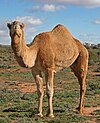
“Some days past I have found a curious confirmation of the fact that what is truly native can and often does dispense with local color; I found this confirmation in Gibbon's Decline and Fall of the Roman Empire. Gibbon observes that in the Arabian book par excellence, in the Koran, there are no camels; I believe if there were any doubt as to the authenticity of the Koran, this absence of camels would be sufficient to prove it is an Arabian work. It was written by Mohammed, and Mohammed, as an Arab, had no reason to know that camels were especially Arabian; for him they were part of reality, he had no reason to emphasize them; on the other hand, the first thing a falsifier, a tourist, an Arab nationalist would do is have a surfeit of camels, caravans of camels, on every page; but Mohammed, as an Arab, was unconcerned: he knew he could be an Arab without camels. I think we Argentines can emulate Mohammed, can believe in the possibility of being Argentine without abounding in local color.”
“Who are the inventors of Tlön? The plural is inevitable, because the hypothesis of a lone inventor — an infinite Leibniz laboring away darkly and modestly — has been unanimously discounted. It is conjectured that this brave new world is the work of a secret society of astronomers, biologists, engineers, metaphysicians, poets, chemists, algebraists, moralists, painters, geometers... directed by an obscure man of genius. Individuals mastering these diverse disciplines are abundant, but not so those capable of inventiveness and less so those capable of subordinating that inventiveness to a rigorous and systematic plan. This plan is so vast that each writer's contribution is infinitesimal. At first it was believed that Tlön was a mere chaos, and irresponsible license of the imagination; now it is known that it is a cosmos and that the intimate laws which govern it have been formulated, at least provisionally. Let it suffice for me to recall that the apparent contradictions of the Eleventh Volume are the fundamental basis for the proof that the other volumes exist, so lucid and exact is the order observed in it.”
“I turn to the most promising example: the bird. The habit of flocking; smallness; similarity of traits; their ancient connection with the two twilights, the beginnings of days, and the endings; the fact of being more often heard than seen — all of this moves us to acknowledge the primacy of the species and the almost perfect nullity of individuals. Keats, entirely a stranger to error, could believe that the nightingale enchanting him was the same one Ruth heard amid the alien corn of Bethlehem in Judah; Stevenson posits a single bird that consumes the centuries: "the nightingale that devours time." Schopenhauer — impassioned, lucid Schopenhauer — provides a reason: the pure corporeal immediacy in which animals live, oblivious to death and memory. He then adds, not without a smile: Whoever hears me assert that the grey cat playing just now in the yard is the same one that did jumps and tricks there five hundred years ago will think whatever he likes of me, but it is a stranger form of madness to imagine that the present-day cat is fundamentally an entirely different one.”
“Everything would be in its blind volumes. Everything: the detailed history of the future, Aeschylus' The Egyptians, the exact number of times that the waters of the Ganges have reflected the flight of a falcon, the secret and true nature of Rome, the encyclopedia Novalis would have constructed, my dreams and half-dreams at dawn on August 14, 1934, the proof of Pierre Fermat's theorem, the unwritten chapters of Edwin Drood, those same chapters translated into the language spoken by the Garamantes, the paradoxes Berkeley invented concerning Time but didn't publish, Urizen's books of iron, the premature epiphanies of Stephen Dedalus, which would be meaningless before a cycle of a thousand years, the Gnostic Gospel of Basilides, the song the sirens sang, the complete catalog of the Library, the proof of the inaccuracy of that catalog. Everything: but for every sensible line or accurate fact there would be millions of meaningless cacophonies, verbal farragoes, and babblings. Everything: but all the generations of mankind could pass before the dizzying shelves—shelves that obliterate the day and on which chaos lies—ever reward them with a tolerable page.”
“"I suppose he had the good luck to be executed, no? I had an hour's chat with him in Buenos Aires. He struck me as a kind of play actor, no? Living up to a certain role. I mean, being a professional Andalusian... But in the case of Lorca, it was very strange because I lived in Andalusia and the Andalusians aren't a bit like that. His were stage Andalusians. Maybe he thought that in Buenos Aires he had to live up to that character, but in Andalusia, people are not like that. In fact, if you are in Andalusia, if you are talking to a man of letters and you speak to him about bullfights, he'll say, 'Oh well, that sort of this pleases people, I suppose, but really the torero works in no danger whatsoever. Because they are bored by these things, because every writer is bored by the local color in his own country. Well, when I met Lorca, he was being a professional Andalusian... Besides, Lorca wanted to astonish us. He said to me that he was very troubled about a very important figure in the contemporary world. A character in whom he could see all the tragedy of American life. And then he went on in this way until I asked him who was this character and it turned out this character was Mickey Mouse. I suppose he was trying to be clever. And I thought, 'That's the kind of thing you say when you are very, very young and you want to astonish somebody.' But after all, he was a grown man, he had no need, he could have talked in a different way. But when he started in about Mickey Mouse being a symbol of America, there was a friend of mine there and he looked at me and I looked at him and we both walked away because we were too old for that kind of game, no? Even at that time."”
“"Well, he wrote a book -- well, maybe here I'm being political -- he wrote a book about the tyrants of South America, and then he had several stanzas against the United States. Now he knows that that's rubbish. And he had not a word against Perón. Because he had a law suit in Buenos Aires, that was explained to me afterwards, and he didn't care to risk anything. And so, when he was supposed to be writing at the top of his voice, full of noble indignation, he had not a word to say against Perón. And he was married to an Argentine lady, he knew that many of his friends had been sent to jail. He knew all about the state of our country, but not a word against him. At the same time, he was speaking against the United States, knowing the whole thing was a lie, no? But, of course, that doesn't mean anything against his poetry. Neruda is a very fine poet, a great poet in fact. And when they gave Miguel de Asturias the Nobel Prize, I said that it should have been given to Neruda! Now when I was in Chile, and we were on different political sides, I think he did the best thing to do. He went on a holiday during the three or four days I was there so there was no occasion for our meeting. But I think he was acting politely, no? Because he knew that people would be playing him up against me, no? I mean, I was an Argentine, poet, he was a Chilean poet, he's on the side of the Communists, I'm against them. So I felt he was behaving very wisely in avoiding a meeting that would have been quite uncomfortable for both of us."”
Jorge Luis Borges Quotes by Topic
Find exactly what you are looking for by browsing this categorized list of Jorge Luis Borges quotes by topic.
Jorge Luis Borges on Absurdism 8 quotes
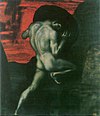
“I will pause to consider this eternity from which the subsequent ones derive.”
Jorge Luis Borges on Labyrinth 6 quotes
View all 6 quotes on Labyrinth →Jorge Luis Borges on Time 3 quotes
“Time forks perpetually toward innumerable futures.”

Jorge Luis Borges on Mirror 3 quotes
“I owe the discovery of Uqbar to the conjunction of a mirror and an encyclopedia.”

Jorge Luis Borges on Libraries 3 quotes
“The universe (which others call the Library) is composed of an indefinite and perhaps infinite number of hexagonal galleries, with vast air shafts between, surrounded by very low railings.”

What Jorge Luis Borges Said About Others
Discover personal opinions Jorge Luis Borges shared regarding contemporaries.
Jorge Luis Borges on Baruch Spinoza 3 quotes
“Time carries him as the river carries A leaf in the downstream water. No matter. The enchanted one insists And shapes God with delicate geometry. Since his illness, since his birth, He goes on constructing God with the word. The mightiest love was granted him Love that does not expect to be loved.”

Jorge Luis Borges on George Bernard Shaw 2 quotes
“The writers of our century delight in the weaknesses of the human condition; the only one capable of inventing heroes was Bernard Shaw.”

Jorge Luis Borges on Fyodor Dostoyevsky
“In the preface to an anthology of Russian literature, Vladimir Nabokov stated that he had not found a single page of Dostoevsky worthy of inclusion. This ought to mean that Dostoevsky should not be judged by each page but rather by the total of all the pages that comprise the book.”

Jorge Luis Borges on María Luisa Bombal
“Today, in Santiago, Chile, or Buenos Aires, in Caracas or Lima, when they name the best names, María Luisa Bombal is never missing from the list. This fact is even more notable when one considers the brevity of her work-which does not correspond to any determined "school" and which fortunately is devoid of any regionalism.”
Jorge Luis Borges on William Shakespeare
“History adds that before or after dying he found himself in the presence of God and told Him: "I who have been so many men in vain want to be one and myself." The voice of the Lord answered from a whirlwind: "Neither am I anyone; I have dreamt the world as you dreamt your work, my Shakespeare, and among the forms in my dream are you, who like myself are many and no one."”

Quotes About Jorge Luis Borges
Gain deeper perspective through quotes about Jorge Luis Borges from others.
Marjorie Agosín "Reflections on the Fantastic" Translated from the Spanish by Celeste Kostopulos-Cooperman. In on Jorge Luis Borges
“Both Italo Calvino and Jorge Luis Borges have contributed greatly to our understanding of the fantastic...For Borges, on the other hand, the key to the fantastic resides within the articulation of a new language. His allegories, fictions, poems and essays make a distinction between what language represents and what it wants to represent. Within the border of that which is spoken and that which is not, arises the space that we would call the fantastic, where the unusual does and does not astonish and where magic is also reality.”
Isabel Allende on Jorge Luis Borges
“I belong to the first generation of Latin American writers brought up reading other Latin American writers. Before my time the work of Latin American writers was not well distributed, even on our continent. In Chile it was very hard to read other writers from Latin America. My greatest influences have been all the great writers of the Latin American Boom in literature: García Márquez, Vargas Llosa, Cortázar, Borges, Paz, Rulfo, Amado, etc.”

Mariana Enriquez interview quoted on Jorge Luis Borges
“Ficciones by Jorge Luis Borges is no longer my favorite short story book. I could name dozens I love more and held more dear—but when I read it, at age 12 I think, maybe younger, it blew my mind in a way that taught me that fiction was a territory of freedom unlike any other, where if I’d venture, I’d have immense powers. The possibilities that these stories offer, the sheer power of the imagination displayed here, is unforgettable. And for me to read it in Spanish, to read this kind of wizardry in my language, was just a joy.”
Angélica Gorodischer on Jorge Luis Borges

James Irby on Jorge Luis Borges
“Extremes of fantastic hope and skepticism paradoxically coexist in Borges' thought. In "Pascal's Sphere" he examines an image which is not only paradoxical in itself — the universe as an infinite sphere, in other words, a boundless form perfectly circumscribed — but which has also served to express diametrically opposite emotions: Bruno's elation and Pascal's anguish. But the other basic symmetry to note here is Borges' history of the metaphor. Not only paradoxes are found throughout this collection, but also various listings of ideas or themes or images which though diverse in origin and detail are essentially the same. In "The Flower of Coleridge" the coincidence of Valéry's, Emerson's, and Shelley's conceptions of all literature as the product of one Author seems itself to bear out that conception. At the beginning of the essay on Hawthorne, Borges again briefly traces the history of a metaphor — the likening of our dreams to a theatrical performance — and adds that true metaphors cannot be invented, since they have always existed. Such "avatars" point beyond the flux and diversity of history to a realm of eternal archetypes, which, though limited in number, "can be all things for all people, like the Apostle." While the paradox upsets our common notions of reality and suggests that irreducible elements are actually one, recurrence negates history and the separateness of individuals. Of course, this too is a paradox, as "New Refutation of Time" shows: time must exist in order to provide the successive identities with which it is to be "refuted." The two symmetries noted above, if we pursue their implications far enough, finally coalesce, with something of the same dizzying sense, so frequent in Borges' stories, of infinite permutations lurking at every turn. Both are uses of what he calls a pantheist extension of the principle of identity — God is all things: a suitably heterogeneous selection of these may allude to Totality — which has, as he notes in the essay on Whitman, unlimited rhetorical possibilities.”



About Jorge Luis Borges
Jorge Luis Borges (24 August 1899 – 14 June 1986) was an Argentine writer who is considered one of the foremost literary figures of the 20th century. Most famous in the English speaking world for his short stories and fictive essays, Borges was also a poet, critic, translator and man of letters.