



































“Of Space”
— Immanuel Kant, Kant's Inaugural Dissertation

Explore our curated collection of the most famous and impactful Immanuel Kant quotes.
“Of Space”
“Scholium”
“Corollary”
“The deceiver is really the fool.”
“Human reason is by nature architectonic.”
“Wikisource: Critique of Pure Reason Preface”

“All our knowledge falls with the bounds of experience.”

“The woman wants to dominate, the man wants to be dominated[.]”
“Thus our duties to animals are indirectly duties to humanity.”

“It is precisely in knowing its limits that philosophy consists.”

“The concept of space is not abstracted from external sensations.”
“Out of the crooked timber of humanity, no straight thing was ever made.”
“This problem is the most difficult and the last to be solved by mankind.”

“I have no knowledge of myself as I am, but merely as I appear to myself.”

“Natural science is throughout either a pure or an applied doctrine of motion.”
“A spurious axiom of the first class is: Whatever is, is somewhere and sometime.”
“Only the descent into the hell of self-knowledge can pave the way to godliness.”Original / Translation (German)“[N]ur die Höllenfahrt des Selbsterkenntnisses bahnt den Weg zur Vergötterung ...”English: “Only the descent into the hell of self-knowledge can pave the way to godliness.”
“Wer sich aber zum Wurm macht, kann nachher nicht klagen, dass er mit Füßen getreten wird.”Original / Translation (German)“Wer sich aber zum Wurm macht, kann nachher nicht klagen, dass er mit Füßen getreten wird.”English: “However, he who makes himself a worm cannot complain afterwards that he gets stepped on.”
“All natural capacities of a creature are destined to evolve completely to their natural end.”
“...happiness is not an ideal of reason but of imagination, resting solely on empirical grounds.”
“... happiness is not an ideal of reason, but of imagination, resting on merely empirical grounds,”
“Is it reasonable to assume a purposiveness in all the parts of nature and to deny it to the whole?”
“Metaphysics has as the proper object of its enquiries three ideas only: God, freedom, and immortality.”

Find exactly what you are looking for by browsing this categorized list of Immanuel Kant quotes by topic.
“Sapere aude! Have the courage to use your own understanding.”

“Morality is thus the relation of actions to the autonomy of the will, that is, to a possible giving of universal law through its maxims.”
“It is so easy to be immature. If I have a book to serve as my understanding, a pastor to serve as my conscience, a physician to determine my diet for me, and so on, I need not exert myself at all. I need not think, if only I can pay: others will readily undertake the irksome work for me. The guardians who have so benevolently taken over the supervision of men have carefully seen to it that the far greatest part of them (including the entire fair sex) regard taking the step to maturity as very dangerous, not to mention difficult. Having first made their domestic livestock dumb, and having carefully made sure that these docile creatures will not take a single step without the go-cart to which they are harnessed, these guardians then show them the danger that threatens them, should they attempt to walk alone. Now this danger is not actually so great, for after falling a few times they would in the end certainly learn to walk; but an example of this kind makes men timid and usually frightens them out of all further attempts.”
“Thus our duties to animals are indirectly duties to humanity.”

“A person who already displays ... cruelty to animals is also no less hardened towards men. We can already know the human heart, even in regard to animals.”
“The more we devote ourselves to observing animals and their behaviour, the more we love them, on seeing how gready they care for their young; in such a context, we cannot even contemplate cruelty to a wolf. Leibnitz put the grub he had been observing back on the tree with its leaf, lest he should be guilty of doing any harm to it. It upsets a man to destroy such a creature for no reason, and this tenderness is subsequendy transferred to man.”
“Even philosophers will praise war as ennobling mankind, forgetting the Greek who said: War is bad in that it begets more evil than it kills.”

“By virtue of their mutual interest does nature unite people against violence and war…the spirit of trade cannot coexist with war, and sooner or later this spirit dominates every people. For among all those powers…that belong to a nation, financial power may be the most reliable in forcing nations to pursue the noble cause of peace…and wherever in the world war threatens to break out, they will try to head it off through mediation, just as if they were permanently leagued for this purpose.”
“All wars are accordingly so many attempts (not in the intention of man, but in the intention of Nature) to establish new relations among states, and through the destruction or at least the dismemberment of all of them to create new political bodies, which, again, either internally or externally, cannot maintain themselves and which must thus suffer like revolutions; until finally, through the best possible civic constitution and common agreement and legislation in external affairs, a state is created which, like a civic commonwealth, can maintain itself automatically.”
“The science of mathematics presents the most brilliant example of how pure reason may successfully enlarge its domain without the aid of experience.”
“Those who thought they could distinguish philosophy from mathematics by saying that the former was concerned with quality only, the latter with quantity only, mistook effect for cause. It is owing to the form of mathematical knowledge that it can refer to quanta only, because it is only the concept of quantities that admits of construction, that is, of a priori representation in intuition, while qualities cannot be represented in any but empirical intuition.”
“I maintain that in every special natural doctrine only so much science proper is to be met with as mathematics; for... science proper, especially of nature, requires a pure portion, lying at the foundation of the empirical, and based upon à priori knowledge of natural things. ...the conception should be constructed. But the cognition of the reason through construction of conceptions is mathematical. A pure philosophy of nature in general, namely, one that only investigates what constitutes a nature in general, may thus be possible without mathematics; but a pure doctrine of nature respecting determinate natural things (corporeal doctrine and mental doctrine), is only possible by means of mathematics; and as in every natural doctrine only so much science proper is to be met with therein as there is cognition à priori, a doctrine of nature can only contain so much science proper as there is in it of applied mathematics.”
“Moral Teleology supplies the deficiency in physical Teleology, and first establishes a Theology; because the latter, if it did not borrow from the former without being observed, but were to proceed consistently, could only found a Demonology, which is incapable of any definite concept.”
“Teleology,... as science, belongs to no Doctrine, but only to Criticism; and to the criticism of a special cognitive faculty, viz. Judgement. But so far as it contains principles a priori, it can and must furnish the method by which nature must be judged according to the principle of final causes.”
“The privilege of aiming at a merely mechanical method of explanation of all natural products is in itself quite unlimited; but the faculty of attaining thereto is by the constitution of our Understanding, so far as it has to do with things as natural purposes, not only very much limited but also clearly bounded. For, according to a principle of the Judgement, by this process alone nothing can be accomplished towards an explanation of these things; and consequently the judgement upon such products must always be at the same time subordinated by us to a teleological principle.”
Discover personal opinions Immanuel Kant shared regarding contemporaries.
“Let us suppose there was a teacher of whom an historical record (or, at least, a widespread belief which is not basically disputable) reports that he was the first to expound publicly a pure and searching religion, comprehensible to the whole world. … Suppose that all he did was done even in the face of a dominant ecclesiastical faith which was onerous and not conducive to moral ends (a faith whose perfunctory worship can serve as a type of all the other faiths, at bottom merely statutory, which were current in the world at the time). Suppose, further, we find that he had made this universal religion of reason the highest and indispensable condition of every religious faith whatsoever … and this without further adding to this faith burdensome new ordinances or wishing to transform acts which he had initiated into peculiar holy practices, required in themselves as being constituent elements of religion. After this description one will not fail to recognize the person who can be referenced, not indeed as the founder of the religion which, free from every dogma, is engraved in all men’s hearts (for it does not have its origin in an arbitrary will), but as the founder of the first true church.”
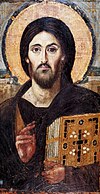
“[Jesus] claims that not the observance of outer civil or statutory churchly duties but the pure moral disposition of the heart alone can make man well-pleasing to God (Matthew V, 20-48); … that injury done one’s neighbor can be repaired only through satisfaction rendered to the neighbor himself, not through acts of divine worship (V, 24). Thus, he says, does he intend to do full justice to the Jewish law (V, 17); whence it is obvious that not scriptural scholarship but the pure religion of reason must be the law’s interpreter, for taken according to the letter, it allowed the very opposite of all this. Furthermore, he does not leave unnoticed, in his designations of the strait gate and the narrow way, the misconstruction of the law which men allow themselves in order to evade their true moral duty, holding themselves immune through having fulfilled their churchly duty (VII, 13). He further requires of these pure dispositions that they manifest themselves also in works (VII, 16) and, on the other hand, denies the insidious hope of those who imagine that, through invocation and praise of the Supreme Lawgiver in the person of His envoy, they will make up for their lack of good works and ingratiate themselves into favor (VII, 21). Regarding these works he declares that they ought to be performed publicly, as an example for imitation (V, 16), and in a cheerful mood, not as actions extorted from slaves (VI, 16); and that thus, from a small beginning in the sharing and spreading of such dispositions, religion, like a grain of seed in good soil, or a ferment of goodness, would gradually, through its inner power, grow into a kingdom of God (XIII, 31-33).”
“I freely admit that the remembrance of David Hume was the very thing that many years ago first interrupted my dogmatic slumber and gave a completely different direction to my researches in the field of speculative philosophy.”

“A light was kindled amongst the investigators of nature when Galilei let balls of a definite weight roll down the inclined plane. For they saw that they only understand what is produced according to a predetermined plan or hypothesis... for otherwise planless observations made according to no ideas could never be brought into the form of a law which reason demands and seeks. ...Thus physics was brought into the position of a certain science after groping about blindly for so many hundred years.”

“The light dove cleaving in free flight the thin air, whose resistance it feels, might imagine that her movements would be far more free and rapid in airless space. Just in the same way did Plato, abandoning the world of sense because of the narrow limits it sets to the understanding, venture upon the wings of ideas beyond it, into the void space of pure intellect. He did not reflect that he made no real progress by all his efforts; for he met with no resistance which might serve him for a support, as it were, whereon to rest, and on which he might apply his powers, in order to let the intellect acquire momentum for its progress. It is, indeed, the common fate of human reason in speculation, to finish the imposing edifice of thought as rapidly as possible, and then, for the first time to begin to examine whether the foundation is a solid one or no.”

Gain deeper perspective through quotes about Immanuel Kant from others.
“The slow progress towards juster international relations may be traced to the distinguished jurist of the Netherlands, Grotius; to the great German, Immanuel Kant, who lifted the subject of “Eternal Peace’ high above controversy; to Count Tolstoy of Russia, who so trenchantly set it forth in our own day, and so on throughout the nations.”

“If ... the ability to tell right from wrong should turn out to have anything to do with the ability to think, then we must be able to "demand" its exercise from every sane person, no matter how erudite or ignorant, intelligent or stupid, he may happen to be. Kant—in this respect almost alone among the philosophers—was much bothered by the common opinion that philosophy is only for the few, precisely because of its moral implications.”

“The innocent sounding First Thesis, taken seriously, forces us to move our attention away from the individual toward humanity. Since there are no limits to the application of reason, and reason does not work instinctively, but requires "trial, practice, and instruction in order to gradually progress from one level of insight to another," individual human beings do not live long enough to learn the full use of reason. However, we find nature setting a short period for individual lives, but producing a series of generations in which each passes its own accomplishments onto its successor. The only way to make the capability of reasoning consistent with the First Thesis is to assume that rationality is to be fully developed only in the race, not in the individual.”
“The new philosophy of science will prove to be a critical philosophy more subtle and more synthetic than was Kantian philosophy in respect to Newtonian science. Relativistic criticism does not limit itself to a revolution of means of explanation. It is more profoundly revolutionary. It is more génial.”
“For it is only in the Critique that all the various strands of Kant's thought are woven together into the pattern of his practical philosophy. This pattern, in turn, can be understood only in the entire fabric of the critical philosophy, and that rich design can be clear only to those who have understood each of its three principal parts, which are the three Critiques and not shorter and more popular works like the Prolegomena and the Foundations.”

Quotes attributed to Immanuel Kant that are questionable.
“Experience without theory is blind, but theory without experience is mere intellectual play.”
Quotes mistakenly credited to Immanuel Kant.
“To be is to do.”