Link Copied!
Florian Cajori Quotes (1859-1930)











About Florian Cajori
Florian Cajori (1859 – 1930) was a Swiss-American professor of mathematics and physics. He was one of the most celebrated historians of mathematics in his day. Cajori's A History of Mathematics (1894) was the first popular presentation of the history of mathematics in the United States and his 1928 –1929 History of Mathematical Notations has been described as "unsurpassed."
Best Florian Cajori Quotes
Shortest
Earliest
Explore our curated collection of the most famous and impactful Florian Cajori quotes.
“The miraculous powers of modern calculation are due to three inventions : the Arabic Notation, Decimal Fractions and Logarithms.”
“Comparatively few of the propositions and proofs in the Elements are his [Euclid's] own discoveries. In fact, the proof of the "Theorem of Pythagoras" is the only one directly ascribed to him.”
“It is a remarkable fact in the history of geometry, that the Elements of Euclid, written two thousand years ago, are still regarded by many as the best introduction to the mathematical sciences.”

“In 1735 the solving of an astronomical problem, proposed by the Academy, for which several eminent mathematicians had demanded several months' time, was achieved in three days by Euler with aid of improved methods of his own... With still superior methods this same problem was solved by the illustrious Gauss in one hour.”

“My quotations from Newton suggest the motive which induced him to take a stand against the use of hypotheses, namely, the danger of becoming involved in disagreeable controversies. ...Newton could no more dispense with hypotheses in his own cogitations than an eagle can dispense with flight. Nor did Newton succeed in avoiding controversy.”
“Professor Sylvester's first high class at the new university Johns Hopkins consisted of only one student, G. B. Halsted, who had persisted in urging Sylvester to lecture on the modern algebra. The attempt to lecture on this subject led him into new investigations in quantics.”
“The Elements has been considered as offering models of scrupulously rigorous demonstrations. It is certainly true that in point of rigour it compares favourably with its modern rivals; but when examined in the light of strict mathematical logic, it has been pronounced by C.S. Peirce to be "riddled with fallacies." The results are correct only because the writer's experience keeps him on his guard.”
“Most of his [Euler's] memoirs are contained in the transactions of the Academy of Sciences at St. Petersburg, and in those of the Academy at Berlin. From 1728 to 1783 a large portion of the Petropolitan transactions were filled by his writings. He had engaged to furnish the Petersburg Academy with memoirs in sufficient number to enrich its acts for twenty years a promise more than fulfilled, for down to 1818 [Euler died in 1793] the volumes usually contained one or more papers of his. It has been said that an edition of Euler's complete works would fill 16,000 quarto pages.”
“Fermat died with the belief that he had found a long-sought-for law of prime numbers in the formula a prime, but he admitted that he was unable to prove it rigorously. The law is not true, as was pointed out by Euler in the example 4,294,967,297 = 6,700,417 times 641. The American lightning calculator Zerah Colburn, when a boy, readily found the factors but was unable to explain the method by which he made his marvellous mental computation.”
“J. J. Sylvester was an enthusiastic supporter of reform [in the teaching of geometry]. The difference in attitude on this question between the two foremost British mathematicians, J. J. Sylvester, the algebraist, and Arthur Cayley, the algebraist and geometer, was grotesque. Sylvester wished to bury Euclid "deeper than e'er plummet sounded" out of the schoolboy's reach; Cayley, an ardent admirer of Euclid, desired the retention of Simson's Euclid. When reminded that this treatise was a mixture of Euclid and Simson, Cayley suggested striking out Simson's additions and keeping strictly to the original treatise.”

“The opinion is widely prevalent that even if the subjects are totally forgotten, a valuable mental discipline is acquired by the efforts made to master them. While the Conference admits that, considered in itself this discipline has a certain value, it feels that such a discipline is greatly inferior to that which may be gained by a different class of exercises, and bears the same relation to a really improving discipline that lifting exercises in an ill-ventilated room bear to games in the open air. The movements of a race horse afford a better model of improving exercise than those of the ox in a tread-mill.”
“The history of mathematics may be instructive as well as agreeable ; it may not only remind us of what we have, but may also teach us to increase our store. Says De Morgan, "The early history of the mind of men with regards to mathematics leads us to point out our own errors; and in this respect it is well to pay attention to the history of mathematics." It warns us against hasty conclusions; it points out the importance of a good notation upon the progress of the science; it discourages excessive specialization on the part of the investigator, by showing how apparently distinct branches have been found to possess unexpected connecting links; it saves the student from wasting time and energy upon problems which were, perhaps, solved long since; it discourages him from attacking an unsolved problem by the same method which has led other mathematicians to failure; it teaches that fortifications can be taken by other ways than by direct attack, that when repulsed from a direct assault it is well to reconnoitre and occupy the surrounding ground and to discover the secret paths by which the apparently unconquerable position can be taken.”
“Our so-called "Arabic" notation owes its excellence to the application of the principle of local value and the use of a symbol for zero. It is now conclusively established that the principle of local value was used by the Babylonians much earlier than by the Hindus and that the Maya of Central America used the principle and symbols for zero in a well-developed numeral system of their own. The notation of Babylonia used the scale of 60, that of the Maya, the scale 20 (except in one step). It follows, therefore, that the present controversy on the origin of our numerals does not involve the question of the first use of local value and symbols for zero; it concerns itself only with the time and place of the first application of local value to the decimal scale and with the origin of the forms or shapes of our ten numerals. ... Hurt by the alleged arrogance of certain Greek scholars, Sebokht praises the science of the Hindus and speaks of "their valuable methods of computation. . . . I wish only to say that this computation is done by means of nine signs." Unfortunately, he leaves it to us to guess whether or not he used the zero. The passage, written about 662 A.D., is the earliest reference that has been found outside of India to our numerals. ...The form of the symbols with the zero, used in India, differed so widely from the old forms without the zero used there, that the former seem to have had an independent origin and to have been imported into India.
...The following are outstanding facts:
1. The earliest reliable record of the use of our numerals with zero is an inscription of 867 A.D. in India.
2. The validity of the testimony of early Arabic writers ascribing to India the numerals with zero is shaken, but not destroyed.
3. There is not a scintilla of evidence in the form of old manuscripts or numeral inscriptions to support the Greek origin of our numerals.
4. At present the hypothesis of the Hindu origin of our numerals stands without serious rival. But this hypothesis is by no means firmly established.”
Florian Cajori Quotes by Topic
Find exactly what you are looking for by browsing this categorized list of Florian Cajori quotes by topic.
Florian Cajori on Geometry 8 quotes
“When Ptolemy once asked Euclid if geometry could not be mastered by an easier process than by studying the Elements, Euclid returned the answer, "There is no royal road to geometry."”
Florian Cajori on History of mathematics 7 quotes
“The history of mathematics may be instructive as well as agreeable; it may not only remind us of what we have, but may also teach us to increase our store.”

Florian Cajori on Euclid’s Elements 3 quotes
“Comparatively few of the propositions and proofs in the Elements are his [Euclid's] own discoveries. In fact, the proof of the "Theorem of Pythagoras" is the only one directly ascribed to him.”
Florian Cajori on Arithmetic 3 quotes
“The chemist smiles at the childish efforts of alchemists but the mathematician finds the geometry of the Greeks and the arithmetic of the Hindoos as useful and admirable as any research of today.”

Florian Cajori on Gravity 3 quotes
“Laplace made the assumption that the transmission of gravity is not instantaneous, and he found that in order to produce the known effects in the secular acceleration of the moon, gravity must travel seven million times faster than the speed of light. ...Laplace's calculation has been found to be incomplete, and his velocity of gravity illusory.”

Florian Cajori on History of calculus 3 quotes
“Methods of drawing tangents were invented by Roberval and Fermat... Descartes gave a third method. Of all the problems which he solved by his geometry, none gave him as great pleasure as his mode of constructing tangents. It is profound but operose, and, on that account, inferior to Fermat's. His solution rests on the method of Indeterminate Coefficients, of which he bears the honour of invention. Indeterminate coefficients were employed by him also in solving bi-quadratic equations.”

Florian Cajori on Ancient Greek mathematics 2 quotes
“Comparatively few of the propositions and proofs in the Elements are his [Euclid's] own discoveries. In fact, the proof of the "Theorem of Pythagoras" is the only one directly ascribed to him.”

Florian Cajori on Mathematical analysis 2 quotes
“The analytic method is not conclusive, unless all operations involved in it are known to be reversible. To remove all doubt, the Greeks, as a rule added to the analytic process a synthetic one, consisting of a reversion of all operations occurring in the analysis. Thus the aim of analysis was to aid in the discovery of synthetic proofs or solutions.”

Florian Cajori on Mathematical induction 2 quotes
“One who extended the theory of equations somewhat further than Vieta was Albert Girard... Like Vieta this ingenious author applied algebra to geometry, and was the first who understood the use of negative roots in the solution of geometric problems. He spoke of imaginary quantities; inferred by induction that every equation has as many roots as there are units in the number expressing its degree; and first showed how to express the sums of their powers in terms of the coefficients.”

Florian Cajori on Differential calculus 2 quotes
“An untold amount of intellectual energy has been expended on the quadrature of the circle, yet no conquest has been made by direct assault. The circle-squarers have existed in crowds ever since the period of Archimedes. After innumerable failures to solve the problem at a time, even when investigators possessed that most powerful tool, the differential calculus, persons versed in mathematics dropped the subject, while those who still persisted were completely ignorant of its history and generally misunderstood the conditions of the problem. ...But progress was made on this problem by approaching it from a different direction and by newly discovered paths. Lambert proved in 1761 that the ratio of the circumference of a circle to its diameter is incommensurable. Some years ago, Lindemann demonstrated that this ratio is also transcendental and that the quadrature of the circle, by means of the ruler and compass only, is impossible. He thus showed by actual proof that which keen minded mathematicians had long suspected; namely, that the great army of circle-squarers have, for two thousand years, been assaulting a fortification which is as indestructible as the firmament of heaven.”

Florian Cajori on Decoration
“Amber—a mineralized yellowish resin—was used in antiquity for decoration. In common with the bright shining silver-gold alloys, and gold itself, it was called "electron"; hence the word "electricity".”
Florian Cajori on Differential equation
“The problem of three bodies has been treated in various ways since the time of Lagrange, but no decided advance towards a more complete algebraic solution has been made, and the problem stands substantially where it was left by him. He had made a reduction in the differential equations to the seventh order. This was elegantly accomplished in a different way by Jacobi in 1843.”

What Florian Cajori Said About Others
Discover personal opinions Florian Cajori shared regarding contemporaries.
Florian Cajori on Carl Gustav Jacob Jacobi 7 quotes
“Among standard works on mechanics are Jacobi's Vorlesungen über Dynamik, edited by Clebsch, 1866.”
Florian Cajori on Girard Desargues 6 quotes
“Pascal greatly admired Desargues' results... Pascal's and Desargues writings contained some of the fundamental ideas of modern synthetic geometry.”

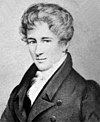
Florian Cajori on Niels Henrik Abel 6 quotes
“Abel's theorem was pronounced by Jacobi the greatest discovery of our century on the integral calculus. The aged Legendre, who greatly admired Abel's genius, called it "monumentum aere perennius." During the few years of work allotted to the young Norwegian, he penetrated new fields of research, the development of which has kept mathematicians busy for over half a century.”
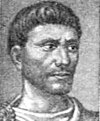
Florian Cajori on Diophantus 4 quotes
“In this work [Arithmetica] is introduced the idea of an algebraic equation expressed in algebraic symbols. His treatment is purely analytical and completely divorced from geometrical methods.”
Florian Cajori on Simon Stevin 3 quotes
“One of the greatest curiosities of the history of science that Napier constructed logarithms before exponents were used. To be sure, Stifel and Stevin made some attempts to denote powers by indices, but this notation was not generally known,—not even to T. Harriot, whose algebra appeared long after Napier's death. That logarithms flow naturally from the exponential symbol was not observed until much later. ...While F. Vieta represented A^3 by "A cubus" and Stevin x^3 by a figure 3 within a small circle [around it], Descartes wrote a^3.”

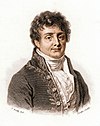
Florian Cajori on Joseph Fourier 3 quotes
“Fourier took a prominent part at his home in promoting the Revolution. Under the French Revolution the arts and sciences seemed for a time to flourish. ...The Normal School was created in 1795, of which Fourier became at first pupil, then lecturer. His brilliant success secured him a chair in the Polytechnic School, the duties of which he afterwards quitted, along with Monge and Berthollet, to accompany Napoleon on his campaign to Egypt. Napoleon founded the Institute of Egypt, of which Fourier became secretary. In Egypt he engaged not only in scientific work, but discharged important political functions. ...In 1827 Fourier succeeded Laplace as president of the council of the Polytechnic School.”
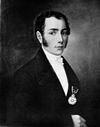
Florian Cajori on Joseph von Fraunhofer 2 quotes
“He was the first to observe spectra due to gratings, and with them he made the earliest determination of wave-lengths.”
Florian Cajori on Euclid 2 quotes
“The term 'axiom' was used by Proclus, but not by Euclid. He speaks, instead, of 'common notions'—common either to all men or to all sciences.”
Florian Cajori on John Napier 2 quotes
“Let our judgment not be too harsh. The period under consideration is too near the Middle Ages to admit of complete emancipation from mysticism even among scientists. Scholars like Kepler, Napier, Albrecht Duerer, while in the van of progress and planting one foot upon the firm ground of truly scientific inquiry, were still resting with the other foot upon the scholastic ideas of preceding ages.”

Florian Cajori on Galileo Galilei 2 quotes
“Galileo is the founder of the science of dynamics. Among his contemporaries it was chiefly the novelties he detected in the sky that made him celebrated, but Lagrange claims that his astronomical discoveries required only a telescope and perseverance, while it took an extraordinary genius to discover laws from phenomena, which we see constantly and of which the true explanation escaped all earlier philosophers. The first contributor to the science of mechanics after Galileo was Descartes.”

Florian Cajori on Pierre de Fermat 2 quotes
“Since Fermat introduced the conception of infinitely small differences between consecutive values of a function and arrived at the principle for finding the maxima and minima, it was maintained by Lagrange, Laplace, and Fourier, that Fermat may be regarded as the first inventor of the differential calculus. This point is not well taken, as will be seen from the words of Poisson, himself a Frenchman, who rightly says that the differential calculus "consists in a system of rules proper for finding the differentials of all functions, rather than in the use which may be made of these infinitely small variations in the solution of one or two isolated problems."”

Florian Cajori on Gottfried Leibniz
“In the interval of 200 years between Kepler and Gauss there arose no great mathematician in Germany excepting Leibniz.”

Quotes About Florian Cajori
Gain deeper perspective through quotes about Florian Cajori from others.
The Tiger on Florian Cajori 3 quotes
“What is perhaps the greatest blow that has ever come to the student body of Colorado College came last Friday when it was announced that Dean Florian Cajori, for about thirty years the best-known and best-liked professor in the College, had resigned and will not be back with us next year. It was not only on account of the value of his service as an instructor that the students felt such a sense of loss at the announcement, but more on account of the friendship and intimate relationship which he has shown to us. "Caj"… has been closer to this student body than any other one man. It was usually "Caj" who made the speech at the Barbecue, it was "Caj" who talked upcoming events in chapel, it was "Caj" who was always out there at the picnic or the Festival or the ball game. No form of student activity has seemed entirely complete unless our "Caj" has been there or has had something to do with it.”
R. T. Crawford on Florian Cajori
“Professor Florian Cajori died August 14, 1934. In May of the following year I was invited by the University of California Press to edit this work. ...this is a revision of Motte's translation of the Principia. From many conversations with Professor Cajori, I know that he had long cherished the idea of revising Newton's immortal work by rendering certain parts into modern phraseology (e.g., to change the reading of "reciprocally in the subduplicate ratio of " to "inversely as the square root of") and to append historical and critical notes which would provide instruction to some readers and interest to all. This is his last work; one of the most fitting to crown a life devoted to investigation and to the history of the sciences in his chosen field.”
About Florian Cajori
Florian Cajori (1859 – 1930) was a Swiss-American professor of mathematics and physics. He was one of the most celebrated historians of mathematics in his day. Cajori's A History of Mathematics (1894) was the first popular presentation of the history of mathematics in the United States and his 1928 –1929 History of Mathematical Notations has been described as "unsurpassed."