Florian Cajori on Niels Henrik Abel
← Back to Florian Cajori Profile
“Abel's theorem was pronounced by Jacobi the greatest discovery of our century on the integral calculus. The aged Legendre, who greatly admired Abel's genius, called it "monumentum aere perennius." During the few years of work allotted to the young Norwegian, he penetrated new fields of research, the development of which has kept mathematicians busy for over half a century.”
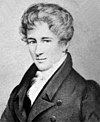
“Like Jacobi and many other young men who became eminent mathematicians, Abel found the first exercise of his talent in the attempt to solve by algebra the general equation of the fifth degree. ...His extraordinary success in mathematical study led to the offer of a stipend by the government, that he might continue his studies in Germany and France. ...Encouraged by Abel and Steiner, Crelle started his journal in 1826.”
“Abel had sent to Gauss his proof of 1824 of the impossibility of solving equations of the fifth degree, to which Gauss never paid any attention. This slight, and a haughtiness of spirit which he associated with Gauss, prevented the genial Abel from going to Göttingen. A similar feeling was entertained by him later against Cauchy. ...He met... Dirichlet, Legendre, Cauchy, and others; but was little appreciated. He had already published several important memoirs in Crelle's Journal, but by the French this new periodical was as yet hardly known to exist, and Abel was too modest to speak of his own work. Pecuniary embarrassments induced him to return home...”
“Great as were the achievements of Abel in elliptic functions, they were eclipsed by his researches on what are now called Abelian functions. Abel's theorem on these functions was given by him in several forms, the most general of these being that in his Mémoire sur une propriété générale d'une classe trés-étendue de fonctions transcendentes (1826). ...A few months after his arrival in Paris [July, 1826], Abel submitted it to the French Academy. Cauchy and Legendre were appointed to examine it; but said nothing about it until after Abel's death. ...The memoir remained in Cauchy's hands. It was not published until 1841. By a singular mishap, the manuscript was lost before the proof-sheets were read.”
“In its form, the contents of the memoir [Mémoire sur une propriété générale... (1826)] belongs to the integral calculus. Abelian integrals depend upon an irrational function y which is connected with x by an algebraic equation F((x,y))=0. Abel's theorem asserts that a sum of such integrals can be expressed by a definite number p of similar integrals, where p depends merely on the properties of the equation F((x,y))=0. It was shown later that p is the deficiency of the curve F((x,y))=0. The addition theorems of elliptic integrals are deducible from Abel's theorem. The hyperelliptic integrals introduced by Abel, and proved by him to possess multiple periodicity, are special cases of Abelian integrals whenever p = or > 3. The reduction of Abelian to elliptic integrals has been studied mainly by Jacobi, Hermite, Königsberger, Brioschi, Goursat, E. Picard and O. Bolza...”
“At nearly the same time with Abel, Jacobi published articles on elliptic functions. Legendre's favourite subject, so long neglected, was at last to be enriched by some extraordinary discoveries. The advantage to be derived by inverting the elliptic integral of the first kind and treating it as a function of its amplitude (now called elliptic function) was recognised by Abel, and a few months later also by Jacobi. A second fruitful idea, also arrived at independently by both, is the introduction of imaginaries leading to the observation that the new functions simulated at once trigonometric and exponential functions. For it was shown that while trigonometric functions had only a real period, and exponential only an imaginary, elliptic functions had both sorts of periods. These two discoveries were the foundations upon which Abel and Jacobi, each in his own way, erected beautiful new structures. Abel developed the curious expressions representing elliptic functions by infinite series or quotients of infinite products.”