Eric Temple Bell on Unification in science and mathematics
← Back to Eric Temple Bell Profile
“Whatever its source, mathematics has come down to the present by the two main streams of number and form. The first carried along arithmetic and algebra, the second, geometry. In the seventeenth century these two united, forming the ever-broadening river of mathematical analysis.”
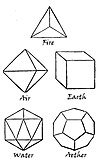
“If the early Greeks were cognizant of Babylonian algebra, they made no attempt to develop or even to use it, and thereby they stand convicted of the supreme stupidity in the history of mathematics. ...The ancient Babylonians had a rare capacity for numerical calculation; the majority of Greeks were either mystical or obtuse in their first approach to number. What the Greeks lacked in number, the Babylonians lacked in logic and geometry, and where the Babylonians fell short, the Greeks excelled. Only in the modern mind of the seventeenth and succeeding centuries were number and form first clearly perceived as different aspects of one mathematics.”
“At first the mathematical disciplines were not sharply defined. As knowledge increased, individual subjects split off from the parent mass and became autonomous. Later, some were overtaken and reabsorbed in vaster generalizations of the mass from which they sprang. Thus trigonometry issued from surveying, astronomy, and geometry only to be absorbed, centuries later, in the analysis which had generalized geometry. This recurrent escape and recapture has inspired some to dream of a final, unified mathematics which shall embrace all. Early in the twentieth century it was believed by some for a time that the desired unification had been achieved in mathematical logic. But mathematics, too irrepressibly creative to be restrained by any formalism, escaped.”
QuotesCosmos Cross-Civilizational Archive
Explore Related Wisdom Pillars, Worldviews & Canonical Works
Discover how humanity's greatest philosophers, sacred scriptures, and literary masterpieces address the core questions of existence.
30 Wisdom Pillars
22 Worldviews & Traditions
Canonical Books & Scriptures