Link Copied!
Enriqueta Vasquez Quotes (1930-)
Writer
About Enriqueta Vasquez
Enriqueta Vasquez (Born 1930) is a writer who has been a part of the Chicana Movement. She wrote for El Grito del Norte from 1968 to 1973 and has published two books.
Best Enriqueta Vasquez Quotes
Shortest
Earliest
Explore our curated collection of the most famous and impactful Enriqueta Vasquez quotes.
“I didn’t want my kids to go through what I went through.”
“How can one guarantee complete non-violence when one lives in a completely VIOLENT country?”
“There are not a few people with too much and others with too little; instead, everyone has enough. (1969, about Cuba)”



“A woman who has no way of expressing herself and realizing herself as a full human has nothing else to turn to but the owning of material things.”
“When we speak of Gringo, we do not particularly hate all white people, but we refer to their social system as ‘Gringo.’ That is what we don’t like.”
“I had heard that the revolution lives everyday and that it must continue to change and live everyday if it is to be truly of and for the people. (1969, about Cuba)”

“El Grito Del Norte, a Chicano newspaper based in Espanola, New Mexico, was born from the revolutionary flames that engulfed the Southwest in the late 1960s and the early 1970s.”

“Both, men and women faced the white, male-dominated world and its blatant racism; women in the workplace and servicemen in the war where they returned to tell stories of Raza and Blacks far outnumbering Anglos in the front lines.”


“When the article, "The Woman of La Raza" came out as a result of the 1969 Chicano Conference, I experienced repercussions because I wrote about The Woman. Instead of being intimidated, I felt it necessary to write a whole book on La Mujer.”
“Let's start thinking in terms of feeding ourselves instead of feeding the grocery stores. Cooperatives are certainly a big answer for the people. Let's go back to being more self-sufficient. Why do we have to support Mr. Safeway, whoever or wherever he may be?”

“And now, today, as we hear the call of the Raza, and as the dormant, "docile" Mexican American comes to life, we see the stirring of the people. With that call, the Chicana also stirs and I am sure that she will leave her mark upon the Mexican-American movement in the Southwest”
“I learned to listen, not only to words, but to the hearts of people; thus capturing the passion, anger, outrage, and indignation when discussing racism, greed, repression and exploitation. These sentiments became an eruption of hundreds of years of repressed thought now set free.”

“I spent much thought getting things to sound right and inoffensive. I am of the belief that a universal stream of consciousness envelopes the planet and people in many places can get the same ideas at relatively the same time. Who knows, there may be women in China, India, Iraq, or Africa doing a project just like this. I hope so.”

“That we have scholars and Chicana PHDers of this caliber teaching in our educational institutions fulfills a vision of what we hoped would come out of the Chicano Movement. Even more extraordinary is the fact that most scholars do not forget “la causa Chicana,” thus watering the raices of the ancient past and living Chicano epic.”
“Child care is one of the most difficult problems for a woman to have to face alone. Not only is she tormented with having to leave the raising of her children to someone else, but she wants the best of care for them. For the amount of money that she may be able to pay from her meager wages, it is likely that she will be lucky to find anyone at all to take care of the children.”

“The new man is a person of the future. The idea of the new man (and new woman) is the realization that human beings have no limit for development. They have great capacity. They can be unselfish, and without envidia. They can all work together for the common good. They can be freed from the pressure of getting money, and become real humans instead of work-machines. (1969, about Cuba)”

“And what about César Chávez in California? What's the history of the campesino and what is he fighting for? These are our people too. And in Texas our brothers and sisters have a struggle. Just what is this all about? What is happening to our people? We feel what is happening, let's learn about it and let's start speaking up. Let's talk to each other and let's not be afraid to be heard. (1969)”
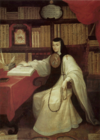
“Although Sor Juana abandoned her writing, the calibre of the body of work she left Mexico remains unparalleled. Sor Juana Inés de la Cruz soared as the most enlightened daughter of the new world. She challenged the foundation of the European Christian institution in her natural law perspective and understanding of the universe. Fearless, Sor Juana left the continent a mandate regarding the rights of women to think.”
“When she tries to speak of Machismo, she is immediately put down and told "We know all about it, there are many many books written on the subject." She receives nothing but censorship again. She tries so hard to say, "Yes, there is much on Machismo, but can't you Machos look at the women and children who are the VICTIMS of your Machismo?" She tries so much to speak up and instead finds herself speaking to deaf ears and a completely closed mind.”
What Enriqueta Vasquez Said About Others
Discover personal opinions Enriqueta Vasquez shared regarding contemporaries.
Enriqueta Vasquez on Juana Inés de la Cruz 3 quotes
“Although Sor Juana abandoned her writing, the calibre of the body of work she left Mexico remains unparalleled. Sor Juana Inés de la Cruz soared as the most enlightened daughter of the new world. She challenged the foundation of the European Christian institution in her natural law perspective and understanding of the universe. Fearless, Sor Juana left the continent a mandate regarding the rights of women to think.”
Quotes About Enriqueta Vasquez
Gain deeper perspective through quotes about Enriqueta Vasquez from others.
Elizabeth Martinez on Enriqueta Vasquez
“Enriqueta Vasquez's column "Despierten! Hermanos" became known for its eloquent efforts to combat sexism within the movimiento while also working for an anti-colonial liberation to benefit all Raza.”

About Enriqueta Vasquez
Enriqueta Vasquez (Born 1930) is a writer who has been a part of the Chicana Movement. She wrote for El Grito del Norte from 1968 to 1973 and has published two books.
QuotesCosmos Cross-Civilizational Archive
Explore Related Wisdom Pillars, Worldviews & Canonical Works
Discover how humanity's greatest philosophers, sacred scriptures, and literary masterpieces address the core questions of existence.
30 Wisdom Pillars
22 Worldviews & Traditions
Canonical Books & Scriptures