Link Copied!
Edward Bellamy Quotes (1850-1898)
Author, King
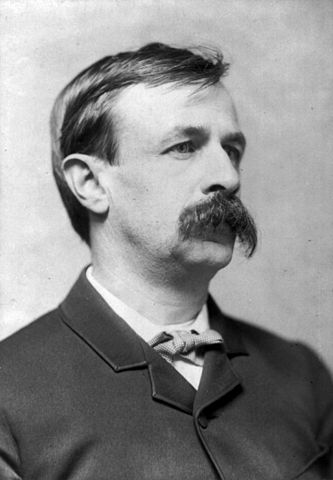


About Edward Bellamy
Edward Bellamy (March 26, 1850 – May 22, 1898) was an American author and socialist, most famous for his utopian novel, Looking Backward, a tale set in the distant future of the year 2000. Bellamy's vision of a harmonious future world inspired the formation of at least 165 "Nationalist Clubs" dedicated to the propagation of Bellamy's political ideas and working to make them a practical reality.
Best Edward Bellamy Quotes
Shortest
Earliest
Explore our curated collection of the most famous and impactful Edward Bellamy quotes.
“Buying and selling is essentially antisocial.”

“If bread is the first necessity of life, recreation is a close second.”

“Though the state will enforce no private contracts of any sort, it does not forbid them.”
“Power over others is necessarily demoralizing to the master and degrading to the subject.”
“If you own the things men must have, you own the men who must have them.”
“Badly off as the men, too, were in your day, they were more fortunate than their mothers and wives.”

“Looking Backward was written in the belief that the Golden Age lies before us and not behind us.”

“Manual labor meant association with a rude, coarse, and ignorant class of people. There is no such class now.”
“The nation guarantees the nurture, education, and comfortable maintenance of every citizen from the cradle to the grave.”

“On no other stage are the scenes shifted with a swiftness so like magic as on the great stage of history when once the hour strikes.”
“The profit system, by its necessary nature, operated to stop limit and cripple production at the point where it began to be efficient.”

“The old so-called ethics of property absolutely overlooked the whole ethical side of the subject--namely, its bearing on human relations.”
“Our economic system puts us in a position where we can follow Christ's maxim, so impossible for you, to 'take no thought for the morrow.'”
“Your system was liable to periodical convulsions...business crises at intervals of five to ten years, which wrecked the industries of the nation.”
“The greater efficiency which education gives to all sorts of labor, except the rudest, makes up in a short period for the time lost in acquiring it.”
“Hold the period of youth sacred to education, and the period of maturity, when the physical forces begin to flag, equally sacred to ease and agreeable relaxation.”

“As to the pretension of civilized persons to admire gems or gold for their intrinsic beauty apart from their value, I suspect that was a more or less unconscious sham.”
“Forgiving sins, I should have known, is not blotting them out. The blood of Christ only turns them red instead of black. It leaves them in the record. It leaves them in the memory.”
“But one thing it opened her eyes to, and made certain from the first instant of her new consciousness, namely, that since she loved him she could not keep her promise to marry him.”

“The whole acknowledged art of wealth-making on a large scale consisted in devices for getting possession of other people's product without too open breach of the law.”
“Government is actually now what it nominally was in the America of your day--the servant, tool, and instrument by which the people give effect to their will, itself being without will.”

“Under competition there was no free play whatever allowed for the capitalist's better feelings even if he had any. He could not be better than the system. If he tried to be, the system would crush him.”

Edward Bellamy Quotes by Topic
Find exactly what you are looking for by browsing this categorized list of Edward Bellamy quotes by topic.
Edward Bellamy on Competition 3 quotes
“The producers of the nineteenth century were not, like ours, working together for the maintenance of the community, but each solely for his own maintenance at the expense of the community.”

Edward Bellamy on Education 2 quotes
“The main difference is that nowadays all persons equally have those opportunities of higher education which in your day only an infinitesimal portion of the population enjoyed.”

Edward Bellamy on Equality
“As political equality is the remedy for political tyranny, so is economic equality the only way of putting an end to the economic tyranny exercised by the few over the many through superiority of wealth. The industrial system of a nation, like its political system, should be a government of the people, by the people, for the people. Until economic equality shall give a basis to political equality, the latter is but a sham.”

Edward Bellamy on Insanity
“In your day, riches debauched one class with idleness of mind and body, while poverty sapped the vitality of the masses by overwork, bad food, and pestilent homes. The... burdens laid on women, enfeebled the very springs of life. Instead of these maleficent circumstances, all now enjoy the most favorable conditions of physical life; the young are carefully nurtured and studiously cared for; the labor which is required of all is limited to the period of greatest bodily vigor, and is never excessive; care for one's self and one's family, anxiety as to livelihood, the strain of a ceaseless battle for life—all these influences, which once did so much to wreck the minds and bodies of men and women, are known no more. Certainly, an improvement of the species ought to follow such a change.Insanity, for instance, which in the nineteenth century was so terribly common a product of your insane mode of life, has almost disappeared, with its alternative, suicide.”
Quotes About Edward Bellamy
Gain deeper perspective through quotes about Edward Bellamy from others.
Erik von Kuehnelt-Leddihn on Edward Bellamy
“Progress is for the convinced ochlocrats a consoling Utopia of madly increased comfort and technicism. This charming but dull vision was always the pseudoreligious consolation of millions of ecstatic believers in ochlocracy and in the relative perfection and wisdom of Mr. and Mrs. Averageman. Utopias in general are surrogates for heaven; they give a meager solace to the individual that his sufferings and endeavors may enable future generations to enter the chiliastic paradise. Communism works in a similar way. Its millennium is almost the same as that of ochlocracy. The Millennium of Lenin, the Millennium of Bellamy, the Millennium as represented in H. G. Wells's, Of Things to Come, the Millennium of Adolf Hitler and Henry Ford — they are all basically the same; they often differ in their means to attain it but they all agree in the point of technical perfection and the classless or at least totally homogeneous society without grudge or envy.”

Arthur Ernest Morgan on Edward Bellamy
“It was the genius of Edward Bellamy that he took Utopia out of the region of hazy dreamland and made it a concrete program for the actual modern world. A reviewer of Looking Backward wrote: Men read the Republic or the Utopia with a sigh of regret. They read Bellamy with a thrill of hope. His picture of a better world, and the hope and expectation of its fulfillment, were transmitted through the years until those who looked to him as the source of their initial inspiration constituted an important part of the army of social progress.”
William Morris on Edward Bellamy
“Mr. Bellamy's ideas of life are curiously limited; he has no idea beyond existence in a great city; his dwelling of man in the future is Boston (U.S.A.) beautified. In one passage, indeed, he mentions villages, but with unconscious simplicity shows that they do not come into his scheme of economical equality, but are mere servants of the great centres of civilisation. This seems strange to some of us, who cannot help thinking that our experience ought to have taught us that such aggregations of population afford the worst possible form of dwelling-place, whatever the second-worst might be. In short, a machine-life is the best which Mr. Bellamy can imagine for us on all sides; it is not to be wondered at then this his only idea of making labour tolerable is to decrease the amount of it by means of fresh and ever fresh developments of machinery.”

Alfred Russel Wallace on Edward Bellamy
“From boyhood—when I was an ardent admirer of Robert Owen—I have been interested in socialism, but reluctantly came to the conclusion that it was impracticable, and also to some extent repugnant to my ideas of individual liberty and home privacy. But Mr. Bellamy has completely altered my views on this matter. He seems to me to have shown that real, not merely delusive liberty, together with full scope for individualism and complete home privacy, is compatible with the most thorough industrial socialism—and henceforth I am heart and soul with him.”

Margaret S Marsh on Edward Bellamy
“Charlotte Perkins Gilman's socialism was non-Marxist; Edward Bellamy, the author of Looking Backward and a sequel, Equality, had influenced her profoundly. Both of Bellamy's utopian visions, but particularly the latter, advocated participation of women in the work force in traditionally masculine occupations such as engineering and the skilled crafts as well as in more conventionally feminine pursuits; economic equality; and the removal of domestic tasks, including child care, to the public realm.”
Ida Tarbell on Edward Bellamy
“Each generation repeats its leaders. Each sees men endowed with superior inventiveness, energy, and genius for business, inspired by love of power and possession, launch selfish schemes-Carnegies, Rockefellers, Goulds…Each generation has had its Henry George, its Bellamy, its Bryan, intent on persuading mankind that he had found the way, could lead men to the good life. In each generation employer and employee have faced the decision-war or cooperation.”

About Edward Bellamy
Edward Bellamy (March 26, 1850 – May 22, 1898) was an American author and socialist, most famous for his utopian novel, Looking Backward, a tale set in the distant future of the year 2000. Bellamy's vision of a harmonious future world inspired the formation of at least 165 "Nationalist Clubs" dedicated to the propagation of Bellamy's political ideas and working to make them a practical reality.
QuotesCosmos Cross-Civilizational Archive
Explore Related Wisdom Pillars, Worldviews & Canonical Works
Discover how humanity's greatest philosophers, sacred scriptures, and literary masterpieces address the core questions of existence.
30 Wisdom Pillars
22 Worldviews & Traditions
Canonical Books & Scriptures