Link Copied!
Dio Chrysostom Quotes (115-)
Philosopher, Writer



About Dio Chrysostom
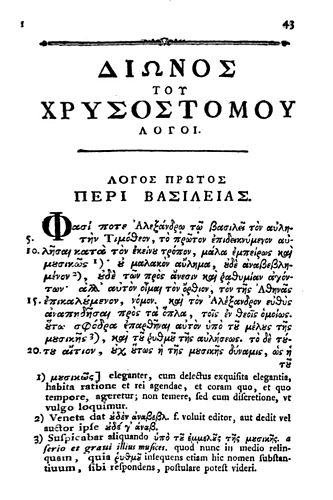
Dio Chrysostom (c. 40 – c. 115), was a Greek orator, writer, philosopher and historian of the Roman Empire.
Best Dio Chrysostom Quotes
Shortest
Earliest
Explore our curated collection of the most famous and impactful Dio Chrysostom quotes.
“Just as the good physician should go and offer his services where the sick are most numerous, so, said [Diogenes], the man of wisdom should take up his abode where fools are thickest in order to convict them of their folly and reprove them.”

“You are devoted to interests from which it is impossible to gain intelligence or prudence or a proper disposition of reverence toward the gods, but only stupid contention, unbridled ambition, vain grief, senseless joy, and raillery and extravagance.”

“Should you be willing to read [Xenophon's Anabasis] very carefully you shall discover how ... to deceive one’s enemies to their harm and one’s friends to their advantage, and to speak the truth in a way that will not pain those who are needlessly disturbed by it.”
“If in the guise of philosophers, they [declaim speeches] with a view to their own profit and reputation, and not to improve you, that indeed is shocking. For it is as if a physician when visiting patients should disregard their treatment and their restoration to health, and should bring them flowers and courtesans and perfume.”
“Pleasure assails a man through each and every sense that he has; and while he must face and grapple with work, to pleasure he must give the widest berth possible and have none but unavoidable dealings with her. And herein the strongest man is indeed strongest, one might almost say, who can keep the farthest away from pleasures; for it is impossible to dwell with pleasure or even to dally with her for any length of time without being completely enslaved.”

“When some people urged that it is impossible for man to live like the animals owing to the tenderness of his flesh and because he is naked and unprotected, [Diogenes] would say in reply that men are so very tender because of their mode of life. ... Man’s ingenuity and his discovering and contriving so many helps to life had not been altogether advantageous to later generations, since men do not employ their cleverness to promote courage or justice, but to procure pleasure.”

“When [Diogenes] observed how other men were harassed throughout their whole lives, ever plotting against one another, ever encompassed by a thousand ills and never able to enjoy a moment’s rest, nay, not even during the great festivals nor when they proclaimed a truce; and when he beheld that they did or suffered all this simply in order to keep themselves alive, and that their greatest fear was lest their so-called necessities should fail them, and how, furthermore, they planned and strove to leave great riches to their children, he marvelled that he too did not do the like, but was the only independent man in the world.”
“[Diogenes] was surprised by the fact that had he claimed to be a physician for the teeth, everybody would flock to him who needed to have a tooth pulled; yes, and by heavens, had he professed to treat the eyes, all who were suffering from sore eyes would present themselves, and similarly, if he had claimed to know of a medicine for diseases of the spleen or for gout or for running of the nose; but when he declared that all who should follow his treatment would be relieved of folly, wickedness, and intemperance, not a man would listen to him or seek to be cured by him, ... as though it were worse for a man to suffer from an enlarged spleen or a decayed tooth than from a soul that is foolish, ignorant, cowardly, rash, pleasure-loving, illiberal, irascible, unkind, and wicked, in fact utterly corrupt.”
Dio Chrysostom Quotes by Topic
Find exactly what you are looking for by browsing this categorized list of Dio Chrysostom quotes by topic.
Dio Chrysostom on Esotericism
“Should you be willing to read [Xenophon's Anabasis] very carefully you shall discover how … to deceive one’s enemies to their harm and one’s friends to their advantage, and to speak the truth in a way that will not pain those who are needlessly disturbed by it.”

What Dio Chrysostom Said About Others
Discover personal opinions Dio Chrysostom shared regarding contemporaries.
Dio Chrysostom on Diogenes of Sinope 4 quotes
“When some people urged that it is impossible for man to live like the animals owing to the tenderness of his flesh and because he is naked and unprotected, [Diogenes] would say in reply that men are so very tender because of their mode of life. ... Man’s ingenuity and his discovering and contriving so many helps to life had not been altogether advantageous to later generations, since men do not employ their cleverness to promote courage or justice, but to procure pleasure.”

Dio Chrysostom on Alexander the Great
“[Diogenes speaking to Alexander] “Now perhaps you kings are also doing something like that: each of you has playmates — the eager followers on his side — he [Darius] his Persians and the other peoples of Asia, and you [Alexander] your Macedonians and the other Greeks.””

Dio Chrysostom on Antisthenes
“It was not long before [Diogenes] despised [all the philosophers at Athens] save Antisthenes, whom he cultivated, not so much from approval of the man himself as of the words he spoke, which he felt to be alone true and best adapted to help mankind. For when he contrasted the man Antisthenes with his words, he sometimes made this criticism, that the man himself was much weaker; and so in reproach he would call him a trumpet because he could not hear his own self, no matter how much noise he made. Antisthenes tolerated this banter of his since he greatly admired the man’s character; and so, in requital for being called a trumpet, he used to say that Diogenes was like the wasps, the buzz of whose wings is slight but the sting very sharp.”

About Dio Chrysostom
Dio Chrysostom (c. 40 – c. 115), was a Greek orator, writer, philosopher and historian of the Roman Empire.
QuotesCosmos Cross-Civilizational Archive
Explore Related Wisdom Pillars, Worldviews & Canonical Works
Discover how humanity's greatest philosophers, sacred scriptures, and literary masterpieces address the core questions of existence.
30 Wisdom Pillars
22 Worldviews & Traditions
Canonical Books & Scriptures