Link Copied!
Denis Healey Quotes (1917-2015)
Politician, King


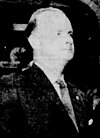


About Denis Healey
Denis Winston Healey, Baron Healey PC (30 August 1917 – 3 October 2015) was a British Labour Party politician who served as Secretary of State for Defence from 1964 to 1970 and Chancellor of the Exchequer from 1974 to 1979. He was a Member of Parliament for 40 years (from 1952 until his retirement in 1992) and was the last surviving member of the cabinet formed by Harold Wilson after the Labour Party's victory in the 1964 general election.
Best Denis Healey Quotes
Shortest
Earliest
Explore our curated collection of the most famous and impactful Denis Healey quotes.
“Keynesianism has failed.”

“We did not want middle class Robespierres.”


“Do we really want to nationalise Marks and Spencers to make it as efficient as the Co-Op?”
“I am a socialist who believes that the Labour Party offers the best hope for Britain's future.”
“By the end of next year, we really shall be on our way to that so-called economic miracle we need.”
“[Referring to the "Olive line"] That division makes federation impossible – inconceivable, in my opinion.”
“I would fight to change the policy before the General Election. If I failed then I wouldn't accept office in a Labour Government.”

“So long as the Soviet Union has nuclear weapons there have to be nuclear weapons somewhere in NATO to deter them from using them.”
“The US, whether we like it or not, has nuclear weapons. The US is a member of NATO. Possession by the US of nuclear weapons is obviously a deterrent.”

“I warn my hon. Friends...that once we cut defence expenditure to the extent where our security is imperilled, we have no houses, we have no hospitals, we have no schools. We have a heap of cinders.”
“If we can keep our heads—and our nerve—the long-awaited economic miracle is in our grasp. Britain can achieve in the Seventies what Germany and France achieved in the Fifties and Sixties.”
“The alternative to getting help from the IMF would be economic policies so savage I think they would produce riots in the streets, an immediate fall in living standards and unemployment of three million.”


“I think the Services can be rightly very upset at the continuous series of defence reviews which the Government has been forced by economic circumstances—and maybe economic mistakes too—to carry out...”
“The reason we were defeated in so far as defence played a role is that people believe we were in favour of unilaterally disarming ourselves. It wasn't the confusion. It was the unilateralism that was the damaging thing.”
“No Government can produce an economic miracle. An economic miracle depends on people on the shop floor, in the board room, in the sales office, working a bit harder and more efficiently than they have worked in the past.”
“NATO's nuclear strategy is an essential part of that balance [between East and West]. To threaten to upset it by refusing to let America base any of her nuclear weapons in Britain would make war more likely, not less likely.”
“We are spending 6 per cent more than we are earning... You can also bankrupt a nation by excessive wage demands... That is why I said that it is better to have a lower standard of life for all workers than for some of them to be unemployed.”
“The borrowing requirement was 'terrifying'. He just had to cut back public expenditure. The Social Contract wasn't working. Inflation was getting out of control.”

Denis Healey Quotes by Topic
Find exactly what you are looking for by browsing this categorized list of Denis Healey quotes by topic.
Denis Healey on Tax noncompliance
“The difference between tax avoidance and tax evasion is the thickness of a prison wall.”
Denis Healey on Conservatism
“Conservative theory must always base itself on some form of historical restorationism. The moderate seeks the world of Joseph Chamberlain—or if he is daring, of Disraeli. The really advanced radical looks still further back, to Prince Rupert, or the Middle Ages, particularly if he is a Catholic.”

Denis Healey on Colonialism
“Recent American research has shown that as early as 1880, the British Empire was producing an economic return lower than investment in Britain itself, while to preserve it the British taxpayer was paying two and a half times more for defence than the citizens of other developed countries. If its military, administrative, and financial costs were added together, the empire was a bad economic bargain. The Soviet Union is now learning from its own experience in Eastern Europe and Central Asia that Lenin's theory of imperialism is contrary to the facts; the cost of holding colonies abroad is greater than the value of the markets or raw materials they may provide.”
Denis Healey on Economy of Europe
“Recent American research has shown that as early as 1880, the British Empire was producing an economic return lower than investment in Britain itself, while to preserve it the British taxpayer was paying two and a half times more for defence than the citizens of other developed countries. If its military, administrative, and financial costs were added together, the empire was a bad economic bargain. The Soviet Union is now learning from its own experience in Eastern Europe and Central Asia that Lenin's theory of imperialism is contrary to the facts; the cost of holding colonies abroad is greater than the value of the markets or raw materials they may provide.”

Denis Healey on Economy of the United Kingdom
“Recent American research has shown that as early as 1880, the British Empire was producing an economic return lower than investment in Britain itself, while to preserve it the British taxpayer was paying two and a half times more for defence than the citizens of other developed countries. If its military, administrative, and financial costs were added together, the empire was a bad economic bargain. The Soviet Union is now learning from its own experience in Eastern Europe and Central Asia that Lenin's theory of imperialism is contrary to the facts; the cost of holding colonies abroad is greater than the value of the markets or raw materials they may provide.”

What Denis Healey Said About Others
Discover personal opinions Denis Healey shared regarding contemporaries.
Denis Healey on Enoch Powell 2 quotes
“I think the greatest parliamentary speech I ever heard was by Enoch Powell in 1959, castigating the Macmillan Government over the murder of African prisoners at Hola camp in Kenya; it had all the moral passion and rhetorical force of Demosthenes.”

Denis Healey on Keith Joseph
“A wonderful mixture of Rasputin and Tommy Cooper.”

Denis Healey on Margaret Thatcher
“A mixture of a matron at a minor public school and a guard in a concentration camp.”

Denis Healey on John Smith (Labour Party leader)
“[Smith's death was] one of the greatest tragedies to beset the Labour Party...the country was robbed of a great Prime Minister.”

Denis Healey on Michael Foot
“The fact is that if Michael had gone well before the [1983] election, we might have won. We had no chance whatever so long as he was Leader.”

Denis Healey on Aneurin Bevan
“In Place of Fear, which Bevan wrote in the white heat of his resignation, exhibits a broad-minded tolerance and intellectual imagination quite foreign to many of his disciples. At the same time he was too impatient of reality.”

Denis Healey on Tony Benn
“It is ironic that Tony Benn's ministerial career should have left only two monuments behind — the uranium mine in Namibia he authorised as Energy Secretary, which helps to support Apartheid and is in territory illegally occupied by South Africa, and an aircraft [Concorde] which is used by wealthy people on their expense accounts, whose fares are subsidised by much poorer taxpayers.”

Quotes About Denis Healey
Gain deeper perspective through quotes about Denis Healey from others.
Tony Blair on Denis Healey
“Denis Healey was a great champion for social justice, in and out of government, a stalwart of the Labour Party, a true patriot who fought for and cared deeply about his country and an extraordinary and vibrant character. ... He steered the Labour government and the country through some of the most difficult economic times; and in winning the deputy leadership of the Labour Party in 1981, he probably saved the Labour Party as an instrument of government and social change. All of us in the Labour Party owe him a huge debt. Britain has lost a dedicated and faithful public servant.”

Barbara Castle on Denis Healey
“I always had a sneaking affection for Denis Healey, even at his most outrageous. I liked his rumbustiousness, a quality which adds richness to politics provided it is combined with intellectual insight and personal incorruptibility, as it was in Denis's case. He is an instinctive bully, but bullies always bring out the best in me and I enjoyed our clashes in Cabinet. His autobiography is a masterly piece of work and, as I read it, I chuckled over the cunning way he skates over his confessions of past mistakes, leaving the impression that they did not adversely affect events, though of course they did.”
Jeremy Corbyn on Denis Healey
“Denis Healey was a giant of the Labour Party whose record of service to his party and his country stands as his testament. ... His wit and personality transcended politics itself, making him one of the most recognisable politicians of his era. Speaking personally, we had many interesting conversations when I was first elected to Parliament in 1983 and I found him a decent and very knowledgeable man who I enjoyed engaging with, particularly in his work as shadow foreign secretary.”

Edmund Dell on Denis Healey
“The art of John Dryden would be required to encompass the complex personality of the ambitious and many-sided politician who, in 1974, became Chancellor of the Exchequer. The most cultured of Chancellors, he could also be the greatest bully. Perhaps the most brilliant of Chancellors intellectually, he was possessed also of a common touch which attracted a wider public even when it most disliked his actions. His various disguises could confuse. A friendly commentator might attribute to him a deep seriousness worn lightly, sometimes perhaps flippantly. The flippancy could have been diagnosed as a defence mechanism for a man whose outward ebullience concealed inner doubts. Or it could have been interpreted as an expression of total self-confidence. The friendly commentator would have detected great courage, normally kept in reserve, as though courage was only for the decisive moment and it would be tedious to fight too hard when the issues appeared not of the first importance. A less friendly commentator might have criticised the flippancy, encountered not just in words but in deeds, as indicative of irresponsibility. Certainly it was not always to the taste of those who worked for him. By civil servants in the Treasury, he came to be admired for the excitement he generated and feared for his penetration of official work less than first class. But by those, Ministers and officials, who could not take his dismissive rudeness, he might even be hated. He came to dominate the international community of Finance Ministers by his intellectual brilliance and his committee skills.”
Michael Foot on Denis Healey
“He had a clear idea of the objectives he wanted to secure, and mostly, from a socialist point of view, they were good ones. He would listen; he could be endlessly patient in negotiations, which is the only way to negotiate with would-be friends or allies; he had an irrepressible intellectual curiosity deriving partly from his interest in matters which touched only the fringe of politics.”
Peter Jay on Denis Healey
“The greatest interest to economists of the Budget strategy will be in the way the Chancellor [Healey] has finally and totally broken with postwar economic orthodoxy, abandoned full employment as the sovereign purpose of the Budget, and decided that future stability of both prices and the foreign balance depended on achieving a better balance of the Budget itself.”
Roy Jenkins on Denis Healey
“He has long carried light ideological baggage on a heavy gun carriage.”
Neil Kinnock on Denis Healey
“He didn't suffer fools gladly or, indeed, at all. That partly explains why he was never leader of the party despite having rich political talent. He was brilliant in the Commons, an ebullient campaigner in the country, and his piano-thumping performances in by-election sing-songs were – like him – loud, lively, and uplifting. ... To know Denis Healey was to enjoy him.”

David Kogan on Denis Healey 2 quotes
“Healey is a strong fighter. He is intellectually gifted and capable of prodigious acts of endurance, but his aggressive approach is said to have alienated some of his potential supporters. In the 1976 leadership election he came a poor third behind Michael Foot and Jim Callaghan. By 1980, after a year of conflict and division within the Labour Party, he was portrayed by the left as one of those principally responsible for ignoring party policy. He looked increasingly, as one correspondent said, like a whale stranded on a beach being attacked by minnows.”
David Owen on Denis Healey 3 quotes
“The only hope was Denis Healey. ... But my hopes were shortlived. Soon after the party conference in October [1980], it became evident that Denis Healey, whether he became leader or not, was not going to fight head-on the unilateralist and anti-European policy of the Labour Party. He was not going to make the party face up to the electoral incredibility of being both in effect anti-Nato and anti-European. ... So, Denis Healey was not going to fight the left. That became clear. Denis does not have good political judgement. In that sense he is not a good politician. He has a first-class brain, he is extremely well informed and he's got good judgement about many things, but he's not been a very good judge of feelings and moods within the Labour Party. I think he calculated that by taking the soft approach, the emollient approach, he could woo the left and win the leadership and, having secured it, would then fight for his policies. But he wasn't going to fight beforehand.”
Ben Pimlott on Denis Healey
“On Wednesday 10 March [1976] members of the Tribune group of left-wing MPs launched their attack by abstaining on a motion from the Chancellor to 'level off' total public expenditure from April 1977... There were bitter exchange among MPs... Tribunites hurled vulgar abuse. Denis Healey...responded with characteristic vigour. 'Stalinist! Stalinist!' Eric Heffer shouted at him. 'Bastard! Bastard!' echoed Russell Kerr. Healey's own version is that, returning to the Chamber from the voting lobby, 'one of the rebels used demotic language to cast aspersions on my paternity, so I praised his virility in similar language several times.' According to one witness, the Chancellor's precise words to his critics were: 'Go and fuck yourselves.'”
Enoch Powell on Denis Healey
“The Chancellor of the Exchequer has been—I know this because I have watched him over the years—a monetarist much longer than anyone has ever suspected of him. I used to listen with enjoyment to his speeches in the years 1972 to 1974, and I would shake my head and say to myself, "He will be a good Chancellor of the Exchequer, for he understands the real causes of inflation." Oh, he understands them all right.”
Margaret Thatcher on Denis Healey 2 quotes
“The right hon. Gentleman will be known for ever as the only Chancellor in the post-war period who brought this country to the brink of bankruptcy.”
Shirley Williams on Denis Healey 2 quotes
“Denis is a colourful, ebullient personality, combative and life-loving, with an unusually rich hinterland outside politics. He is an exceptionally gifted photographer...and is immensely knowledgeable about music... Yet he was never a serious candidate for the leadership. He was unpredictable, behaving rather like a strongly served tennis ball hitting a soft spot and then bouncing sideways. You could never be sure what he might do. He was a loner, enjoying his family and a few close friends, mainly not politicians, so predictions about his behaviour from colleagues were not particularly helpful. He had been brusque with many of them, or scorched them with his brilliant, brutal humour. He was not a popular figure in the Commons tea room. I liked him very much.”

About Denis Healey
Denis Winston Healey, Baron Healey PC (30 August 1917 – 3 October 2015) was a British Labour Party politician who served as Secretary of State for Defence from 1964 to 1970 and Chancellor of the Exchequer from 1974 to 1979. He was a Member of Parliament for 40 years (from 1952 until his retirement in 1992) and was the last surviving member of the cabinet formed by Harold Wilson after the Labour Party's victory in the 1964 general election.
QuotesCosmos Cross-Civilizational Archive
Explore Related Wisdom Pillars, Worldviews & Canonical Works
Discover how humanity's greatest philosophers, sacred scriptures, and literary masterpieces address the core questions of existence.
30 Wisdom Pillars
22 Worldviews & Traditions
Canonical Books & Scriptures