Link Copied!
Colin Renfrew Quotes (1937-2024)



About Colin Renfrew
Andrew Colin Renfrew, Baron Renfrew of Kaimsthorn (25 July 1937 – 24 November 2024) was a British archaeologist, paleolinguist and Conservative peer noted for his work on radiocarbon dating, the prehistory of languages, archaeogenetics, and the prevention of looting at archaeological sites.
Best Colin Renfrew Quotes
Shortest
Earliest
Explore our curated collection of the most famous and impactful Colin Renfrew quotes.
“It is difficult to see what is particularly non-Aryan about the Indus Valley Civilization.”

“The significance of the horse for the understanding of the distribution of early Indo-European has been much exaggerated.”

“Many linguists have commented that these proposed dates of separation are 'too early,' but how . . . do they know this, or judge this?”

““[This] episode of elite dominance which brought the indo-Aryan branch of the Indo-European family to India (…) may have been as early as the floruit of the Indus civilization (…)””
“Certainly the assumption that the Aryas were recent ‘immigrants’ to India, and their enemies were ‘aborigines’, has done much to distort our understanding of the archaeology of India and Pakistan.”


“As Renfrew put it in his archly-titled review of Mallory’s book – ‘They ride horses, don’t they?’ – the horse has assumed “an almost mythical significance in traditional Indo-European studies” (1989: 845).”

“In this way it might be argued that, from the very earliest farming times, as represented by Mehrgarh and by other sites later, an early; lndo-European language was spoken in the Indus valley and in areas to the north and west.”
“As far as I can see there is nothing in the Hymns of the Rig Veda which demonstrates that the Vedic-speaking population were intrusive to the area: this comes rather from a historical assumption of the "coming of the Indo-Europeans." .. Nothing implies that the Aryans were strangers there.”
“The balance of the evidence, as recently usefully reviewed by Shaffer, is in favour of the presence of an Indo-European speaking population during the Harappan civilization, and not exclusively later. At the same time, the strong continuities between that Harappan civilization and its antecedents, right back to the earlier Neolithic, are becoming more and more evident.”
“In the Indo-European field, linguists have been willing to follow the archaeological orthodoxy of nearly a century ago, while archaeologists have taken the conclusions of the historical linguists at their face value, failing to realize that they were themselves based upon archaeological assumptions which had not been questioned, yet which were not, in some cases, justifiable.”
“When Wheeler speaks of “the Aryan invasion of the Land of the Seven Rivers, the Punjab,” he has no warranty at all, so far as I can see. If one checks the dozen references in the Rig Veda to the seven rivers, there is nothing in any of them that to me implies an invasion. . . . Despite Wheeler’s comments, it is difficult to see what is particularly non-Aryan about the Indus Valley.”

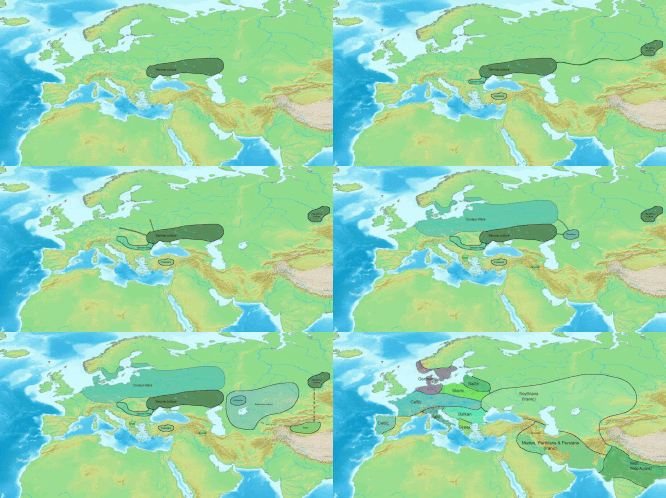
“This hypothesis that early Indo-European languages were spoken in north India with Pakistan and on the Iranian plateau at the sixth millennium BC has the merit of harmonizing symmetrically with the theory for the origin of the Indo-European languages in Europe. It also emphasizes the continuity in the Indus Valley and adjacent areas from the early neolithic through to the floruit of the Indus Valley civilization.”
“This area [east Macedonia], although firmly now part of Greece, has sometimes been a marginal one, and may at times have owed allegiance in different directions through a process of boundary displacement. It was indeed occupied in early classical times by Thracian tribes, barbarians who did not speak the Greek language. No doubt they did indeed speak a Thracian language akin to that in what is now Bulgaria, whose origins were suggested earlier.”

“Despite Wheeler's comments, it is difficult to see what is particularly non-Aryan about the Indus Valley Civilization, which on this hypothesis would be speaking the Indo-European ancestor of Vedic Sanskrit. Certainly there are elements of continuity from the Indus Civilization onto its aftermath. The main disruption was the ending of urban life, but as Raymond Allchin has emphasized, the rural life of northern India, and what is now Pakistan, carried on little changed.”
“We should, in other words, seriously consider the possibility that the new religious and cultural synthesis, represented by the Rigveda was essentially a product of the soil of India and Pakistan, and that it was not imported, ready-made, on the back of the steeds of the Indo-Aryans. Of course, it evolved while in contact with the developing cultures of other lands, most notably Iran, so that by a process of peer polity interaction, cultures and ideologies emerged which in many ways resembled each other. It is not necessary to suggest that one was borrowed, as it were, directly from the other.”
“This hypothesis that early Indo-European languages were spoken in north India with Pakistan and on the Iranian plateau at the sixth millennium ec has the merit of harmonizing symmetrically with the theory for the origin of the Indo-European languages of Europe. It also emphasizes the continuity in the Indus Valley and adjacent areas from the early Neolithic through to the floruit of the Indus Valley Civilization~ point that Jarrige has recently stressed. Moreover the continuity is seen to follow unbroken from that time across the Dark Age succeeding the collapse of the urban centres of the Indus Valley, so that features of that urban civilization persist, across a series of transformations, to form the basis for later Indian civilization. A number of scholars have previously developed these ideas of continuity.”
“The book encapsulating it was Centuries of Darkness in 1991. The authors were not fringe mavericks. Colin Renfrew, Professor of Archaeology at Cambridge University wrote in the book’s Forword, ‘They [the authors]indicate that the chronology for the time period in question, the so called “Third Intermediate Period”, is altogether shaky. They show that there are problems with the historical chronology of the Near East. And the sad fact is that the historical chronology for the rest of the Mediterranean until well after 700 BC rests on these. It is already widely known that the chronology for early Italy, during the Iron Age period, down to and including the foundation of Rome, is a complete shambles.’ He concluded, ‘I feel their critical analysis is right and that a chronological revolution is on the way.’”
“There are, in particular, some suggestions that the religion practised in the Indus valley may have had its effect on the later Hindu religion. The 'great bath' at Mohenjo-daro may well have had ritual purposes,' which reminds us today of the various Hindu ceremonies of purification. Among the few major stone objects from the Indus valley sites are shaped stones, which many observers have pointed out may hold a phallic significance,4 but they also resemble quite closely the lingam, the sacred stone dedicated to the Lord Shiva in modem Hindu practice. There arc other indications, for instance the seated figure, in yoga po&tion, seen on an Indus valley sealstone· has been equated by some with representations of the Lord Shiva himself. Of course, continuity of cult need not indicate continuity of language, but there is no inherent reason why the people of the Indus valley Civilization should not already have been speaking an Indo-European language, the ancestor of the Rigveda.”

Colin Renfrew Quotes by Topic
Find exactly what you are looking for by browsing this categorized list of Colin Renfrew quotes by topic.
Colin Renfrew on Indo-Aryan migrations 2 quotes
“Certainly the assumption that the Aryas were recent ‘immigrants’ to India, and their enemies were ‘aborigines’, has done much to distort our understanding of the archaeology of India and Pakistan.”

Colin Renfrew on Indus Valley Civilisation
“It is difficult to see what is particularly non-Aryan about the Indus Valley civilization.”

Colin Renfrew on Domestication of the horse
“As Renfrew put it in his archly-titled review of Mallory’s book – ‘They ride horses, don’t they?’ – the horse has assumed “an almost mythical significance in traditional Indo-European studies”.”

Colin Renfrew on Chronology of the ancient Near East
“They [the authors of Centuries of Darkness] indicate that the chronology for the time period in question, the so called “Third Intermediate Period”, is altogether shaky. They show that there are problems with the historical chronology of the Near East. And the sad fact is that the historical chronology for the rest of the Mediterranean until well after 700 BC rests on these. It is already widely known that the chronology for early Italy, during the Iron Age period, down to and including the foundation of Rome, is a complete shambles.... I feel their critical analysis is right and that a chronological revolution is on the way.”
Colin Renfrew on Chronological dating
“The book encapsulating it was Centuries of Darkness in 1991. The authors were not fringe mavericks. Colin Renfrew, Professor of Archaeology at Cambridge University wrote in the book’s Forword, ‘They [the authors]indicate that the chronology for the time period in question, the so called “Third Intermediate Period”, is altogether shaky. They show that there are problems with the historical chronology of the Near East. And the sad fact is that the historical chronology for the rest of the Mediterranean until well after 700 BC rests on these. It is already widely known that the chronology for early Italy, during the Iron Age period, down to and including the foundation of Rome, is a complete shambles.’ He concluded, ‘I feel their critical analysis is right and that a chronological revolution is on the way.’”
Colin Renfrew on Egyptian chronology
“The book encapsulating it was Centuries of Darkness in 1991. The authors were not fringe mavericks. Colin Renfrew, Professor of Archaeology at Cambridge University wrote in the book’s Forword, ‘They [the authors]indicate that the chronology for the time period in question, the so called “Third Intermediate Period”, is altogether shaky. They show that there are problems with the historical chronology of the Near East. And the sad fact is that the historical chronology for the rest of the Mediterranean until well after 700 BC rests on these. It is already widely known that the chronology for early Italy, during the Iron Age period, down to and including the foundation of Rome, is a complete shambles.’ He concluded, ‘I feel their critical analysis is right and that a chronological revolution is on the way.’”
Quotes About Colin Renfrew
Gain deeper perspective through quotes about Colin Renfrew from others.
Heaven on Colin Renfrew 2 quotes
““All the migrations postulated by Renfrew ultimately stem from a single catalyst: the crossing of Anatolian farmers into Greece… For all practical purposes, Renfrew’s hypothesis disregards Tocharian and Indo-Iranian.””

Jim Shaffer. South Asian archaeology on Colin Renfrew
“The linguistic designation of a category of “Indo-European/Aryan” languages is not the question here. However, the historical, and prevailing, use of the language designation is the issue. For two centuries, scholars concentrating on the South Asian data have described an Indo-European/Aryan migration/invasion into South Asia to explain the formation of Indian civilization. The conflating of language, people/culture, “race” to maintain the “myth of the Aryan invasion” continues, perhaps, as Leach so cogently notes, due to the academic prestige at stake. The distinguished scholar Colin Renfrew (1987) opts to distort the archaeological record rather than to challenge it. Failing to identify archaeological evidence for such a migration in the European post-Neolithic periods, Renfrew argues instead for an Indo-European/Aryan human migration associated with the spread of food production economies from Anatolia. In doing so, he ignores critical archaeological data from Southwest Asia and South Asia. The South Asian archaeological data reviewed here does not support Renfrew’s position nor any version of the migration/invasion hypothesis describing western population movement into South Asia. Rather, the physical distribution of prehistoric sites and artifacts, stratigraphic data, radio- metric dates, and geological data describing the prehistoric/proto-historic environment perhaps can account, in some degree, for the Vedic oral tradition describing a cultural discontinuity of what was an indigenous population movement in the Indo-Gangetic region.”
About Colin Renfrew
Andrew Colin Renfrew, Baron Renfrew of Kaimsthorn (25 July 1937 – 24 November 2024) was a British archaeologist, paleolinguist and Conservative peer noted for his work on radiocarbon dating, the prehistory of languages, archaeogenetics, and the prevention of looting at archaeological sites.
QuotesCosmos Cross-Civilizational Archive
Explore Related Wisdom Pillars, Worldviews & Canonical Works
Discover how humanity's greatest philosophers, sacred scriptures, and literary masterpieces address the core questions of existence.
30 Wisdom Pillars
22 Worldviews & Traditions
Canonical Books & Scriptures