Link Copied!
Cicero Quotes (-106--43)
Philosopher, Politician

































About Cicero
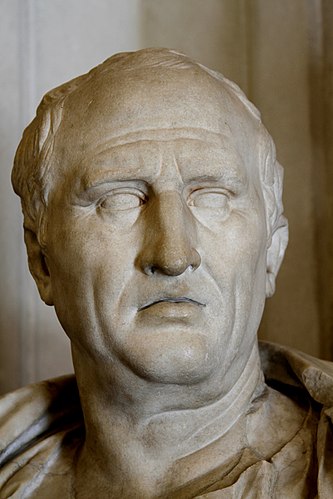
Marcus Tullius Cicero (3 January 106 BC – 7 December 43 BC), infrequently known by the anglicized name Tully in the Middle Ages and after, was a Roman philosopher, politician, lawyer, orator, political theorist, consul and constitutionalist. He came from a wealthy municipal family of the Roman equestrian order, and is widely considered one of Rome's greatest orators and prose stylists.
Best Cicero Quotes
Shortest
Earliest
Explore our curated collection of the most famous and impactful Cicero quotes.
“Laudandum adulescentem, ornandum, tollendum.”
“Si hortum in bibliotheca habes, deerit nihil.”
“Nec vero superstitione tollenda religio tollitur.”
“Honesta enim bonis viris, non occulta quaeruntur.”
“Morbi perniciosiores pluresque sunt animi quam corporis.”
“Malim equidem indisertam prudentiam quam stultitiam loquacem”
“O tempora! O mores!
• Variant: O the times! O, the customs!”
• Variant: O the times! O, the customs!”
Cicero Quotes by Topic
Find exactly what you are looking for by browsing this categorized list of Cicero quotes by topic.
Cicero on Life 8 quotes
“We think a happy life consists in tranquility of mind.”

Cicero on Death 6 quotes
“Undique enim ad inferos tantundem viæ est.
There are countless roads on all sides to the grave.”

Cicero on Ageing 4 quotes
View all 4 quotes on Ageing →Cicero on Time 2 quotes
View all 2 quotes on Time →Cicero on Writing style 2 quotes
View all 2 quotes on Writing style →Cicero on Syracuse, Sicily 2 quotes
View all 2 quotes on Syracuse, Sicily →Cicero on Friendship 2 quotes
“Friendship makes prosperity more shining and lessens adversity by dividing and sharing it.”

Cicero on Human nature 2 quotes
“It is essential to every inquiry about duty that we keep before our eyes how far superior man is by nature to cattle and other beasts: they have no thought except for sensual pleasure and this they are impelled by every instinct to seek; but man's mind is nurtured by study and meditation.”

Cicero on Hedonism 2 quotes
“It is essential to every inquiry about duty that we keep before our eyes how far superior man is by nature to cattle and other beasts: they have no thought except for sensual pleasure and this they are impelled by every instinct to seek; but man's mind is nurtured by study and meditation.”
Cicero on Parallel Lives
“?”
What Cicero Said About Others
Discover personal opinions Cicero shared regarding contemporaries.
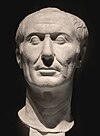
Cicero on Julius Caesar 2 quotes
“Wherever you are, remember that you are equally within the power of the conqueror."”
Cicero on Plutarch 2 quotes
“Cicero said loud-bawling orators were driven by their weakness to noise, as lame men to take horse.”

Cicero on Karl Popper
Cicero on Catiline
“He was intimate with many thoroughly wicked men; but he pretended to be entirely devoted to the most virtuous of the citizens. He had many things about him which served to allure men to the gratification of their passions; he had also many things which acted as incentives to industry and toil. The vices of lust raged in him; but at the same time he was conspicuous for great energy and military skill. Nor do I believe that there ever existed so strange a prodigy upon the earth, made up in such a manner of the most various, and different and inconsistent studies and desires.”
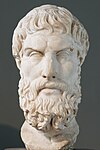
Cicero on Epicurus
“We know, that of all living beings man is the best formed, and, as the gods belong to this number, they must have a human form. ... I do not mean to say that the gods have body and blood in them; but I say that they seem as if they had bodies with blood in them. . . , Epicurus, for whom hidden things were as tangible as if he had touched them with his finger, teaches us that gods are not generally visible, but that they are intelligible; that they are not bodies having a certain solidity . . . but that we can recognize them by their passing images; that as there are atoms enough in the infinite space to produce such images, these are produced before us . . . and make us realize what are these happy, immortal beings.”
Quotes About Cicero
Gain deeper perspective through quotes about Cicero from others.
John Adams on Cicero
“As all the ages of the world have not produced a greater statesman and philosopher united in the same character, his authority should have great weight.”

H. P. Blavatsky on Cicero 4 quotes
“For, when Cicero tells us that he had seen the entire Iliad written on skin of such a miniature size, that it could easily be rolled up inside a nut-shell, and Pliny asserts that Nero had a ring with a small glass in it, through which he watched the performance of the gladiators at a distance—could audacity go farther? Truly, when we are told that Mauritius could see from the promontory of Sicily over the entire sea to the coast of Africa, with an instrument called nauscopite, we must either think that all these witnesses lied, or that the ancients were more than slightly acquainted with optics and magnifying glasses. p. 240”
Charles Dickens on Cicero
“If I could have known Cicero, and been his friend, and talked with him in his retirement at Tusculum (beau-ti-ful Tusculum l), I could have died contented.”

Aelius Donatus on Cicero
“As for Cicero, when he had heard some of the verses [of Virgil's Eclogues], his piercing judgement immediately perceived that these were productions of uncommon vigor, and ordered the whole eclogue to be recited from the beginning. Having familiarized himself with its every nuance, he declared it "the second great hope of Rome" [Magnae spes altera Romae], as if he himself were the first hope of the Latin language and Maro the second. These words Virgil later inserted in the Aeneid [12.168].”
Massimo Introvigne on Cicero
“Interestingly, Cicero saw the root of benevolence and charity in conscience, and in fact was the first scholar in history to use the word “conscience” (conscientia) in the moral sense we are familiar with. We can summarize his thought by stating that friendship is possible when two or more persons who have some common purposes in life systematically act towards each other with benevolence and charity (caritas, which is a non-erotic form of love), guided by conscience.”

Thomas Babington Macaulay on Cicero
“I have also read again Cicero's philosophical works, and think, as I thought at twenty two, when I read him under the chestnuts at Trinity, that the De Finibus is the best, that then comes the De Natura Deorum, and that the Tusculan Disputations are the least valuable,—mere anointing for broken bones.”

Michel de Montaigne on Cicero
“But to confess the truth boldly (for once you have crossed over the barriers of impudence there is no more curb), his way of writing, and every other similar way, seems to me boring. For his prefaces, definitions, partitions, etymologies, consume the greater part of his work; what life and marrow there is, is smothered by his long-winded preparations. If I have spent an hour in reading him, which is a lot for me, and I remember what juice and substance I have derived, most of the time I find nothing but wind; for he has not yet come to the arguments that serve his purpose and the reasons that properly touch on the crux, which I am looking for.”

It was not on Cicero
“Quare non inmerito ab hominibus aetatis suae regnare in iudiciis dictus est, apud posteros vero id consecutus ut Cicero iam non hominis nomen sed eloquentiae habeatur. hunc igitur spectemus, hoc propositum nobis sit exemplum, ille se profecisse sciat cui Cicero valde placebit.”
Ronald Reagan on Cicero
“... It was Seneca or it was Cicero, I don't know which, that said, "If it was not for the elders correcting the mistakes of the young, there would be no state."”

Alan Ryan on Cicero
“Cicero discusses justice as the second of the four cardinal virtues (wisdom, justice, courage, and temperance) whose presence constitutes moral goodness. Justice is the virtue that holds society together and allows us to pursue the common good for whose sake society exists. ... One interesting feature is his concern with in justice... The Stoic view that morality promotes the common good implies that we must try to restore the social relationship that has been violated.”
Disputed Quotes
Quotes attributed to Cicero that are questionable.
“The first duty of a man is the seeking after and the investigation of truth.”
“For as lack of adornment is said to become some women, so this subtle oration, though without embellishment, gives delight.”
Misattributed Quotes
Quotes mistakenly credited to Cicero
“The following three quotes are sometimes wrongly attributed to Cicero. In fact, they come from a novel about Cicero by Taylor Caldwell, and are not found in any of Cicero's actual writings.”
“Study carefully, the character of the one you recommend, lest their misconduct bring you shame.”
“"Do not blame Caesar, blame the people of Rome who have so enthusiastically acclaimed and adored him and rejoiced in their loss of freedom and danced in his path and gave him triumphal processions. Blame the people who hail him when he speaks in the Forum of the 'new, wonderful good society' which shall now be Rome, interpreted to mean 'more money, more ease, more security, more living fatly at the expense of the industrious.'"”
“Diem adimere aegritudinem hominibus.”
“"The evil was not in bread and circuses, per se, but in the willingness of the people to sell their rights as free men for full bellies and the excitement of the games which would serve to distract them from the other human hungers which bread and circuses can never appease."”
“Corruptissima re publica plurimae leges.”
About Cicero
Marcus Tullius Cicero (3 January 106 BC – 7 December 43 BC), infrequently known by the anglicized name Tully in the Middle Ages and after, was a Roman philosopher, politician, lawyer, orator, political theorist, consul and constitutionalist. He came from a wealthy municipal family of the Roman equestrian order, and is widely considered one of Rome's greatest orators and prose stylists.