Link Copied!
Cherríe Moraga Quotes (1952-)
Writer, Poet, Activist




About Cherríe Moraga
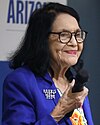
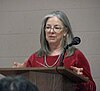
Cherríe Moraga (September 25, 1952) is a Chicana writer, feminist activist, poet, essayist, and playwright.
Best Cherríe Moraga Quotes
Shortest
Earliest
Explore our curated collection of the most famous and impactful Cherríe Moraga quotes.
“Silence is like starvation.”


“My real politicization began, not through the Chicano Movement but through the bold recognition of my lesbianism”

“the conditions of invasion, war, and terrorism have existed for people of color in this hemisphere since the mistaken arrival of Columbus to our shores.”
“I keep wanting to repeat over and over and over again, the pain and shock of difference, the joy of commonness, the exhilaration of meeting through incredible odds against it.”
“What the oppressor often succeeds in doing is simply externalizing his fears, projecting them into the bodies of women, Asians, gays, disabled folks, whoever seems most "other."”
“Chicanos with memory like our Indian counterparts recognize that we are a nation within a nation. An internal nation whose existence defies borders of language, geography, race.”
“it wasn't until long after my graduation from the private college I'd attended in Los Angeles, that I realized the major reason for my total alienation classmates was rooted in class and culture. CLICK.”

“Maybe to the young ones, I simply want to say, "Work tirelessly when your bodies do not yet ache at night. Do not waste your lives, your good health, strong bones, and resilient muscles. Use them." (p33)”
“After publishing Loving in the War Years (1983) which was very autobiographical, my own story had finally been told on the page. This allowed space within me for character (some one other than myself to enter) my unconscious…”
“I think: what is my responsibility to my roots-both white and brown, Spanish-speaking and English? I am a woman with a foot in both worlds; and I refuse the split. I feel the necessity for dialogue. Sometimes I feel it urgently”

“Both my essays and plays attempt to explore a political question or contradiction through the mind or the heart. By that I mean, both genres require analysis and a heart-felt honesty. But the essay is fundamentally one-voiced perspective, my own…”
“The danger lies in attempting to deal with oppression from a theoretical base. Without an emotional, heartfelt grappling with the source of our own oppression, without naming the enemy within ourselves and outside of us, no authentic, non-hierarchical connection among oppressed groups can take place.”

“I still believe in a Chicano literature that is hungry for change, that has the courage to name the sources of our discontent both from within our raza and without, that challenges us to envision a world where poverty, crack, and pesticide poisoning are not endemic to people with dark skin and Spanish surnames”

“I am not talking here about some lazy faith, where we resign ourselves to the tragic splittings in our lives with an upward turn of the hands or a vicious beating of our breasts. I am talking about believing that we have the power to actually transform our experience, change our lives, save our lives. Otherwise, why this book? It is the faith of activists I am talking about.”

“Within the context of the late 1970s utterly white-middleclass-dominated genre of feminist writings (mediated by white instructors), Bridge was the logical and necessary critical outcome to my feminist studies. The book was an enormous collective "fill in the blank"-of so much that had been missing in my own education. It was what never appeared on a reading list. (Afterward to 4th edition, 2014)”
“The amazing efficacy of patriarchy is that it is a covert operation. It is entre nos, just between us - man and woman, sister and brother, father and daughter, queer and not so queer. It takes place behind closed doors, inside la hacienda and back there in the slave quarters. It is so seamlessly woven into the fiber of our lives that to pull at that dangling thread of inequity is to rip open an entire life.”

“I don’t think femme-butch categories necessarily reproduce male-female gender relations and stereotypes about lesbians. I’m not sure Medea really thinks this either, but she does get angry at Luna when she perceives her as trying to act like a man and then resents Luna when she does not assume the power of a man. In other words, she is confused and a realistic, frightened character, afraid of losing her son and her land forever.”

“But it is not really difference the oppressor fears so much as similarity. He fears he will discover in himself the same aches, the same longings as those of the people he has shitted on. He fears the immobilization threatened by his own own incipient guilt. He fears he will have to change his life once he has seen himself in the bodies of the people he has called different. He fears the hatred, anger, and vengeance of those he has hurt.”
“Class, I think its class above all else. Because the way class operates in this country is related to race. What I have noticed is that when white women and white lesbians relate to women of color what they’re really sort of connecting with is that they’re middle class. What really divides queer people in general not just lesbians is class. If you look at working class lesbians, including white women, that’s a really different world…”
“One of the deepest wounds Chicanos suffer is separation from our Southern relatives. Gloria Anzaldúa calls it a "1,950-mile-long open wound," dividing México from the United States, "dividing a pueblo, a culture." This "llaga" ruptures over and over again in our writing, Chicanos in search of a México that never wholly embraces us. "Mexico gags," poet Lorna Dee Cervantes writes, "on this bland pocha seed." This separation was never our choice.”

“Revolution is not only won by numbers, but by visionaries, and if artists aren't visionaries, then we have no business doing what we do. I call myself a Chicana writer. Not a Mexican-American writer, not an Hispanic writer, not a half-breed writer. To be a Chicana is not merely to name one's racial/cultural identity, but also to name a politic, a politic that refuses assimilation It acknowledges our mestizaje-Indian, Spanish, and Africano into the US mainstream.”
Cherríe Moraga Quotes by Topic
Find exactly what you are looking for by browsing this categorized list of Cherríe Moraga quotes by topic.
Cherríe Moraga on Change
Cherríe Moraga on Artist
“Revolution is not only won by numbers, but by visionaries, and if artists aren't visionaries, then we have no business doing what we do.”

Cherríe Moraga on Tokenism
“Grassroots feminists continue to be undermined by single-issue liberals who believe that by breaking a class-entitled glass ceiling—'beating the boys at their own game'—there is some kind of "trickle down" effect on the actual lives of workingclass and poor women and children. This is the same "trickle down" of our share of corporate profit, secured by tax benefits for the wealthy, that has yet to land on our kitchen tables, our paychecks, or our children's public school educations. Social change does not occur through tokenism or exceptions to the rule of discrimination, but through the systemic abolishment of the rule itself.”

Cherríe Moraga on Occupy Wall Street
“In response to the federal government's "bailout" betrayal of its citizens, the Occupy Movement and its slogan of "we are the 99%" spilled onto Wall Street and onto the Main Streets of this country, spreading the dirtiest five-letter word in "America": C-L-A-S-S. The Emperor's nakedness had been revealed: the United States is a class-based society, with an absolutely unconscionable unequal distribution of wealth and resources upheld by our government. For that revelation alone, in that it inspired a critical view of class inequity in this country, I am beholden to the Occupy movement, misnomered as it is. Although women of color and workingclass people were not represented there in large numbers, these activists, of some social privilege, publicly (and en masse) acknowledged that they were being bamboozled by their own government. Just like us. This is what the "Occupy" movement proffered, the possibility of a one day aligned oppositional movement.”

What Cherríe Moraga Said About Others
Discover personal opinions Cherríe Moraga shared regarding contemporaries.
Cherríe Moraga on Toni Cade Bambara 4 quotes
“my "sisters of the corn," as Toni Cade Bambara called Native women.”

Cherríe Moraga on This Bridge Called My Back 3 quotes
“In a uniquely distinct way, Audre Lorde's and Toni Cade Bambara's presence in Bridge also impacted Bridge's success. Audre and Toni were exemplary sister-writers, emblematic of that great surge of Black feminist writing spilling into our hands in 1970s and 80s. As "sisters of the yam"... they stood up in unwavering solidarity with the rest of us "sisters of the rice, sisters of the corn, sisters of the plantain" and that mattered. It helped put Bridge, coedited by two "unknown" Chicana writers, on the political-literary map. All in all, it was a brave moment in feminist history.”

Cherríe Moraga on Adrienne Rich 2 quotes
“As a poet, Adrienne Rich had a great impact on me. I studied her work a great deal.”

Cherríe Moraga on Audre Lorde 2 quotes
“"Poetry of Heroism" was presented at "Sister Comrade: Celebrating the Lives of Audre Lorde and Pat Parker" on November 3, 2007, at the First Congregational Church in Oakland, California. Angela Davis, Judy Grahn, Jewelle Gomez, Holly Near, Linda Tillery, and Mary Watkins were among the presenters who gave memorial tribute to these foremothers of the lesbian-of-color movement.”
Cherríe Moraga on Lorna Dee Cervantes 2 quotes
“One of the deepest wounds Chicanos suffer is separation from our Southern relatives. Gloria Anzaldúa calls it a "1,950-mile-long open wound," dividing México from the United States, "dividing a pueblo, a culture." This "llaga" ruptures over and over again in our writing, Chicanos in search of a México that never wholly embraces us. "Mexico gags," poet Lorna Dee Cervantes writes, "on this bland pocha seed." This separation was never our choice.”
Cherríe Moraga on Thích Nhất Hạnh
“Our actions are our only true belongings, counsels Thich Nhat Hanh.”

Cherríe Moraga on Augusto Boal
“we, the kids and I, have fallen in love with theater's power to teach. Truth. Or lies. You choose, as Boal reminds us.”

Cherríe Moraga on Aurora Levins Morales
“Aurora Levins Morales's work should absolutely be supported. She has an impeccable progressive and visionary politic. Her prose has the literary eloquence of a pure poetry.”
Quotes About Cherríe Moraga
Gain deeper perspective through quotes about Cherríe Moraga from others.
Paula Gunn Allen on Cherríe Moraga
“The vision that impels feminists to action was the vision of the Grandmothers' society, the society that was captured in the words of the sixteenth-century explorer Peter Martyr nearly five hundred years ago. It is the same vision repeated over and over by radical thinkers of Europe and America, from François Villon to John Locke, from William Shakespeare to Thomas Jefferson, from Karl Marx to Friedrich Engels, from Benito Juarez to Martin Luther King, from Elizabeth Cady Stanton to Judy Grahn, from Harriet Tubman to Audre Lorde, from Emma Goldman to Bella Abzug, from Malinalli to Cherríe Moraga, and from Iyatiku to me. That vision as Martyr told it is of a country where there are "no soldiers, no gendarmes or police, no nobles, kings, regents, prefects, or judges, no prisons, no lawsuits... All are equal and free."”

Gloria E. Anzaldúa on Cherríe Moraga
“What you could say is that in the sixties and the early seventies the Chicanos were at the controls. They were the ones who were visible, the Chicano leaders. Then in the eighties and nineties, the women have become visible. I see a lot of Chicanas when I travel. They come up to me, and while we are talking I ask them about their role models. They mention names like Cherríe Moraga, Gloria Anzaldúa and other Chicana authors. It is, and will continue to be, women that they are reading, that they respect. Not the guys. So it-the Chicano Movement-has shifted into the Movimiento Macha.”

Evelyn Torton Beck "Why Is This Book Different from All Other Books?" on Cherríe Moraga
“In response to an upsetting confrontation between Jewish women and women of color in a New England regional Women's Studies Conference,** Cherríe Moraga (et al.) wrote in Gay Community News, "We don't have to be the same to have a movement, but we do have to be accountable for our ignorance. In the end, finally, we must refuse to give up on each other."”
Cristina Beltrán on Cherríe Moraga
“In the case of Moraga, her dream of a "unified Third World feminist movement" reflects a similar longing for immediacy and "harmony... consensus and mutual understanding." Here, Moraga would do well to take up Iris Marion Young's call to envision the political as "a relationship of strangers who do not understand one another in a subjective and immediate sense, relating across time and distance."”
Michael Bronski on Cherríe Moraga
“the contributions of people whom we may now identify as lesbian, gay, bisexual, or transgender are integral and central to how we conceptualize our national history. Without the work of social activists, thinkers, writers, and artists such as We'Wha, Walt Whitman, Emily Dickinson, Martha "Calamity" Jane Cannary Burke, Edith Guerrier, Countee Cullen, Ethel Waters, Bayard Rustin, Roy Cohn, Robert Mapplethorpe, Cherrie Moraga, and Lily Tomlin, we would not have the country that we have today.”
Sandra Cisneros on Cherríe Moraga
“Working-class women's literature, women of color, specifically Latina women's writing like my friend Ana Castillo's, or my friend Cherrie Moraga's, Helena Viramontes's, Elena Poniatowska's, and Marguerite Duval's sends me all the way to my typewriter as much as Manuel Puig's stories.”

Audre Lorde on Cherríe Moraga
Elizabeth Martinez on Cherríe Moraga 3 quotes
“The most striking change during the past 20 years can be seen in attitudes toward homophobia. In the late 1960s and early 1970s, an almost total silence hung over gay and lesbian advocacy. No openly gay person could be a movement leader. Today homophobia persists; most progressive, straight Chicanos as well as Chicanas still fail to see gay and lesbian rights as another struggle of other oppressed people. Too still fail to see homophobia as a sometimes murderous force of discrimination. But the situation has improved, especially in some major cities, in academia and among youth. A lesbian caucus of NACCS was formalized at its 1992 national conference in Albuquerque, thus establishing an official rejection of homophobia toward lesbians. Gay and lesbian Raza groups and individuals are out there now, as they never could be before. The work of Chicana lesbian artists and intellectuals such as Gloria Anzaldúa and Cherrie Moraga has been crucial to this liberation, with benefits going beyond las lesbianas. Wherever one finds strong voices for women among Chicanas, they often come from Lesbians.”

Aurora Levins Morales on Cherríe Moraga
“Cherríe and I — for about, I don’t know, a year or two — were a two-woman writing support group. We just got together and shared our work, which was wonderful. So that I was somebody who was in her life when she and Gloria [Anzaldúa] got together and talked about putting out This Bridge Called My Back.”
Mary Helen Ponce interview on Cherríe Moraga
Vicki L. Ruiz on Cherríe Moraga
“The works of Chicana lesbian writers Gloria Anzaldúa, Cherrie Moraga, Emma Pérez, Ana Castillo, Alicia Gaspar de Alba, Carla Trujillo, and many others bring out the pain and isolation, but, as important, their joys, self-respect, courage, and dignity.”
Luz María Umpierre on Cherríe Moraga 2 quotes
“We realized we were on our own and started bonding together, Latina women writers like Cherrie Moraga, Jewel Gómez, black writers like Audre Lorde and Ntozake Shange, who wrote For Colored Women, we understood we had to support each other or nobody would.”
About Cherríe Moraga
Cherríe Moraga (September 25, 1952) is a Chicana writer, feminist activist, poet, essayist, and playwright.
QuotesCosmos Cross-Civilizational Archive
Explore Related Wisdom Pillars, Worldviews & Canonical Works
Discover how humanity's greatest philosophers, sacred scriptures, and literary masterpieces address the core questions of existence.
30 Wisdom Pillars
22 Worldviews & Traditions
Canonical Books & Scriptures