Link Copied!
Charlotte Perkins Gilman Quotes (1860-1935)
Writer, Poet, Novelist


About Charlotte Perkins Gilman
Charlotte Perkins Gilman (July 3, 1860 – August 17, 1935) was an American poet, non-fiction writer, short story writer, novelist, lecturer, and social reformer.
Best Charlotte Perkins Gilman Quotes
Shortest
Earliest
Explore our curated collection of the most famous and impactful Charlotte Perkins Gilman quotes.
“I do not want to be a fly,
I want to be a worm!”
I want to be a worm!”
“There are things in that wallpaper that nobody knows about but me, or ever will.”

“I'm getting really fond of the room in spite of the wallpaper. Perhaps because of the wallpaper.”
“Only as we live, think, feel, and work outside the home, do we become humanly developed, civilized, socialized.”
“Where young boys plan for what they will achieve and attain, young girls plan for whom they will achieve and attain.”
“The color is repellent, almost revolting: a smouldering unclean yellow, strangely faded by the slow-turning sunlight.”
“Said I, in scorn all burning hot,
In rage and anger high,
"You ignominious idiot,
Those wings are made to fly!"”
In rage and anger high,
"You ignominious idiot,
Those wings are made to fly!"”
“A normal feminine influence in recasting our religious assumptions will do more than any other one thing to improve the world.”
“The latest and highest form of Feminism has great promise for the world. It postulates womanhood free, strong, clean and conscious of its power and duty.”
“This wallpaper has a kind of sub-pattern in a different shade, a particularly irritating one, for you can only see it in certain lights, and not clearly then.”
“Through watching so much at night, when it changes so, I have finally found out. The front pattern does move-and no wonder! The woman behind shakes it!”
“The labor of women in the house, certainly, enables men to produce more wealth than they otherwise could; and in this way women are economic factors in society. But so are horses.”

“You think you have mastered it [the wallpaper pattern], but just as you get well under way in following, it turns a back-somersault and there you are. It slaps you in the face, knocks you down, and tramples upon you.”

“To-day there is hardly a woman of intelligence in all America, to say nothing of other countries, who is not definitely and actively concerned in some social interest, who does not recognize some duty besides those incident to her own blood relationship.”

“Many years later I was told that the great specialist had admitted to friends of his that he had altered his treatment of neurasthenia since reading The Yellow Wallpaper.
It was not intended to drive people crazy, but to save people from being driven crazy, and it worked.”
It was not intended to drive people crazy, but to save people from being driven crazy, and it worked.”
“The stony-minded orthodox were right in fearing the first movement of new knowledge and free thought. It has gone on, and will go on, irresistibly, until some day we shall have no respect for an alleged "truth" which cannot stand the full blaze of knowledge, the full force of active thought.”

“The mother as a social servant instead of a home servant will not lack in true mother duty.... From her work, loved and honored though it is, she will return to her home life, the child life, with an eager, ceaseless pleasure, cleansed of all the fret and fraction and weariness that so mar it now.”

“It becomes bars! The outside pattern, I mean, and the women behind it is as plain as can be. I didn't realize for a long time what the thing was that showed behind, that dim sub-pattern, but now I am quite sure it is a woman. By daylight she is subdued, quiet. I fancy it is the pattern that keeps her so still.”

“For many years I suffered from a severe and continuous nervous breakdown tending to melancholia — and beyond. During about the third year of this trouble I went, in devout faith and some faint stir of hope, to a noted specialist in nervous diseases, the best known in the country. This wise man put me to bed and applied the rest cure, to which a still-good physique responded so promptly that he concluded there was nothing much the matter with me, and sent me home with solemn advice to "live as domestic a life as far as possible," to "have but two hours' intellectual life a day," and "never to touch pen, brush, or pencil again" as long as I lived. This was in 1887.
I went home and obeyed those directions for some three months, and came so near the borderline of utter mental ruin that I could see over.
Then, using the remnants of intelligence that remained, and helped by a wise friend, I cast the noted specialist's advice to the winds and went to work again — work, the normal life of every human being; work, in which is joy and growth and service, without which one is a pauper and a parasite — ultimately recovering some measure of power.
Being naturally moved to rejoicing by this narrow escape, I wrote The Yellow Wallpaper, with its embellishments and additions, to carry out the ideal (I never had hallucinations or objections to my mural decorations) and sent a copy to the physician who so nearly drove me mad. He never acknowledged it.”

What Charlotte Perkins Gilman Said About Others
Discover personal opinions Charlotte Perkins Gilman shared regarding contemporaries.
Charlotte Perkins Gilman on Women 2 quotes
“There is no female mind. The brain is not an organ of sex. As well speak of a female liver.”
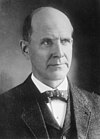
Charlotte Perkins Gilman on Eugene V. Debs
“Eugene Debs is a good American citizen as well as a good Socialist, and a man beloved by all who know him. To punish such a social servant for standing by his principles is a historic mistake — the world has made many such.”
Quotes About Charlotte Perkins Gilman
Gain deeper perspective through quotes about Charlotte Perkins Gilman from others.
Gloria E. Anzaldúa interview on Charlotte Perkins Gilman
Ellen DuBois on Charlotte Perkins Gilman
“As the drive for the vote heated up in the years before World War I, another less sharply defined movement emerged among more radical women, who called themselves feminists. While women like Charlotte Perkins Gilman and Crystal Eastman supported the suffrage campaign, their ideas moved beyond women's political rights to include more modern themes of economic independence and more modern sexual relationships and marriages…Unlike the votes-for-women movement, feminism placed the cutting edge of change in women's private lives, not in their public roles. Charlotte Perkins Gilman was a feminist favorite for her conviction that the family-oriented life of the middle class was narrow and inefficient, a point she explored in her pathbreaking books Women and Economics (1890) and The Home (1903).”
Mary Ritter Beard on Charlotte Perkins Gilman 2 quotes
“The theory that women had been members of a subject sex throughout long history, but coupled with a plan for their emancipation by socialism or communism, found expression with increasing force in the United States as the twentieth century advanced. Among the women who expounded this theory of woman none was more influential than Charlotte Perkins Stetson who long before her death in 1935 attained national and international fame as an exponent of a new feminism...In her writings she ranged from light, humorous verse and witty narrative poetry, through articles gravely gay and wholly serious books, to novels. Captivated by Edward Bellamy's Looking Backward, published in 1888, Mrs. Stetson discovered in idealistic socialism what she deemed the clue to the emancipation of women and joined the disciples of Bellamy. Henceforward, with growing stress, she dwelt on the economic aspects of the "woman question"...Her belief in woman's long subjection to man was embodied in the following lines, quoted from a poem in her collection entitled In This Our World: "Close, close he bound her, that she should leave him never/Weak still he kept her, lest she be strong to flee;/And the fainting flame of passion he kept alive forever/With all the arts and forces of earth and sky and sea." But the future could be different, she believed. It had been and was woman's economic dependence on man that kept her in thrall. This was Mrs. Gilman's contention, especially, in Woman and Economics. Hence, she concluded, woman - especially the mother as guardian of the social spirit in social evolution - when freed from economic bondage to her mate would achieve liberty and make her "culture" and her "religion" prevail over his culture and his religion. And this economic freedom was to be won through various economic institutions of a collectivist nature, especially a form of cooperative living that would ease, if not abolish, the home drudgery of woman. To the old doctrine, so often advanced by parsons and lay men, that "woman's place is in the home," Mrs. Gilman opposed the doctrine that woman's place is in community and public life. In a poem on the assumption of male prerogatives, she stated the case in boasting words by the male: "I sing to the wide world/And she to the nest." But Mrs. Gilman did not deride singing to the nest. She approved it and gave it social significance. She proposed, however, that henceforward there should be a common singing to the wide world, her idea being that such singing had been done by man alone.”

Source on Charlotte Perkins Gilman 4 quotes
“The anarchist-feminists' denial of gender-based distinctions precluded their use of many of the arguments for equality utilized by the mainstream feminists during the late nineteenth and early twentieth centuries...even Charlotte Perkins Gilman, who almost alone among the younger generation of mainstream feminists stressed the similarities between men and women, also on occasion found it necessary or expedient to exploit the concept of a special relationship between woman's biology and her drive for equality. In 1912 Gilman wrote: "We are the makers of men, and because we are the makers of men, it is requisite that we should be citizens of the world we live in."”
About Charlotte Perkins Gilman
Charlotte Perkins Gilman (July 3, 1860 – August 17, 1935) was an American poet, non-fiction writer, short story writer, novelist, lecturer, and social reformer.
QuotesCosmos Cross-Civilizational Archive
Explore Related Wisdom Pillars, Worldviews & Canonical Works
Discover how humanity's greatest philosophers, sacred scriptures, and literary masterpieces address the core questions of existence.
30 Wisdom Pillars
22 Worldviews & Traditions
Canonical Books & Scriptures