Link Copied!
Charles Perrow Quotes (1925-)
Author
About Charles Perrow
Charles B. Perrow (born February 9, 1925) is an American Emeritus Professor of sociology at Yale University and visiting professor at Stanford University. He is the author of several books and many articles on organizations, and is primarily concerned with the impact of large organizations on society.
Best Charles Perrow Quotes
Shortest
Earliest
Explore our curated collection of the most famous and impactful Charles Perrow quotes.
“Where and how will official goals be subverted?”
“Unambiguous pursuit of official goals is not likely to be common.”
“Most normal accidents have a significant degree of incomprehensibility.”
“Apparent leadership problems are often problems of organizational structure.”

“The power structure will generally dictate the operative goals of the organization.”

“Organization theory...has been altogether too accommodating to organizations and their power.”
“In research terms, the issue is to examine and explain the variations within and among residential institutions.”
“For many purposes of organizational analysis technology might not be an independent variable but a dependent one.”

“People's attitudes are shaped at least as much by the organization in which they work as by their pre-existing attitudes.”

“Once a definition is embedded in a program, the opinions of personnel who remain at the institution become congruent with it.”

“Technology is a technique or complex of techniques employed to alter “materials” (human or nonhuman, mental or physical) in an anticipated manner.”
“Since organizations are established to do something, to perform work directed to some end, all organizations have goals – some implied, some explicit.”
“I once believed that if organizations had a better fit between their technology and their structure, they would be more efficient and thus more profitable.”
“Barnard comes close to joining Roethlisberger and Dickson in their assumption that management behavior is mainly rational and workers' behavior nonrational.”
“Organisations are viewed as systems which utilise energy in a patterned, directed effort to alter the condition of basic materials in a predetermined manner.”
“It takes just the right combination of circumstances to produce a catastrophe, just as it takes the right combination of inevitable errors to produce an accident.”
“Without this form of social technology, the industrialized countries of the West could not have reached the heights of extravagance, wealth and pollution that they currently enjoy.”
“Organizations are seen primarily as systems for getting work done, for applying techniques to the problem of altering raw materials - whether the materials be people, symbols or things.”
“Chapter Five deals with the messiest problem of all— but the one to which all analytical roads should lead : the nature of organizational goals and the strategies used to achieve them.”
“The burning cry in all organizations is for “good leadership,” but we have learned that beyond a threshold level of adequacy it is extremely difficult to know what good leadership is.”
“As an organizational sociologist, I was interested in the system characteristics of large accidents, but the discipline also made me aware of the organizational genesis of male-made disasters.”
“People do not exist just for organizations. They track all kinds of mud from the rest of their lives into the organization, and they have all kinds of interests that are independent of the organization.”
“Executives were closely observed at work at their desks, at staff meetings, while talking with inmates or moving about the grounds and so on, and again in the feedback sessions when we gave them findings.”
Charles Perrow Quotes by Topic
Find exactly what you are looking for by browsing this categorized list of Charles Perrow quotes by topic.
Charles Perrow on Contingency theory 2 quotes
“Organizational theorists, at least since the pioneering work of Burns and Stalker, 1961 and Joan Woodward, 1965 and others in what came to be called the contingency school, have recognized that centralization is appropriate for organizations with routine tasks, and decentralization for those with nonroutine tasks. For an early statement see Perrow 1967, and Lawrence and Lorch, 1967.”

Charles Perrow on Organization
“People do not exist just for organizations. They track all kinds of mud from the rest of their lives into the organization, and they have all kinds of interests that are independent of the organization.”
Charles Perrow on Principal–agent problem
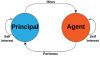
“As with all theories, we can learn something from agency theory and transaction-costs economics, since they emphasize something others hide. But as with all theories, they also distort; in fact, I will argue that their distortions outweigh the value of what they highlight.”
Charles Perrow on Linear programming
“In another part of the management forest, the mechanistic school was gathering its forces and preparing to outflank the forces of light. First came the numbers men — the linear programmers, the budget experts, and the financial analysts — with their PERT systems and cost-benefit analyses. From another world, unburdened by most of the scientific management ideology and untouched by the human relations school, they began to parcel things out and give some meaning to those truisms, "plan ahead" and "keep records." Armed with emerging systems concepts, they carried the "mechanistic" analogy to its fullest—and it was very productive. Their work still goes on, largely untroubled by organizational theory; the theory, it seems clear, will have to adjust to them, rather than the other way around.”

What Charles Perrow Said About Others
Discover personal opinions Charles Perrow shared regarding contemporaries.
Charles Perrow on Joan Woodward
“Organizational theorists, at least since the pioneering work of Burns and Stalker, 1961 and Joan Woodward, 1965 and others in what came to be called the contingency school, have recognized that centralization is appropriate for organizations with routine tasks, and decentralization for those with nonroutine tasks. For an early statement see Perrow 1967, and Lawrence and Lorch, 1967.”
Charles Perrow on Chester Barnard
“In 1938... a business executive with academic talents named Chester Barnard proposed the first new theory of organizations: Organizations are cooperative systems, not the products of mechanical engineering. He stressed natural groups within the organization, upward communication, authority from below rather than from above, and leaders who functioned as a cohesive force. With the spectre of labor unrest and the Great Depression upon him, Barnard's emphasis on the cooperative nature of organizations was well-timed.”

Charles Perrow on Max Weber
“Then the works of Max Weber, first translated from the German in the 1940s — he wrote around 1910, incredibly — began to find their way into social science thought. At first, with his celebration of the efficiency of bureaucracy, he was received with only reluctant respect, and even with hostility. All writers were against bureaucracy. But it turned out, surprisingly, that managers were not. When asked, they acknowledged that they preferred clear lines of communication, clear specifications of authority and responsibility, and clear knowledge of whom they were responsible to. They were as wont to say "there ought to be a rule about this," as to say "there are too many rules around here," as wont to say "next week we've got to get organized," as to say "there is too much red tape." Gradually, studies began to show that bureaucratic organizations could change faster than non-bureaucratic ones, and that morale could be higher where there was clear evidence of bureaucracy.”

Quotes About Charles Perrow
Gain deeper perspective through quotes about Charles Perrow from others.
Christiane Diehl-Taylor. "Charles Perrow on Charles Perrow
“If one has heard of Charles Perrow, it is usually in connection with the book Complex Organizations. While this monograph provides an excellent overview of various schools of organizational thought, it deals only marginally with Perrow's own theories. The scholarship that focuses solely on his conception of organization, however, is far less known and well received for a number of reasons. Perrow is an organizational sociologist working in a field dominated by management theorists and economists whose scholarship revolves around human relations and econometric models - approaches Perrow largely reject.”
Nick Pidgeon. "In retrospect on Charles Perrow
“Normal Accidents contributed key concepts to a set of intellectual developments in the 1980s that revolutionized the conception of safety and risk. It made the case for examining technological failures as the product of highly interacting systems, and highlighted organizational and management factors as the main causes of failures. Technological disasters could no longer be ascribed to isolated equipment malfunction, operator error or acts of God... Perrow concluded that the failure at Three Mile Island was a consequence of the system's immense complexity. Such modern high-risk systems, he realized, were prone to failures however well they were managed. It was inevitable that they would eventually suffer what he termed a 'normal accident'. Therefore, he suggested, we might do better to contemplate a radical redesign, or if that was not possible, to abandon such technology entirely.”
About Charles Perrow
Charles B. Perrow (born February 9, 1925) is an American Emeritus Professor of sociology at Yale University and visiting professor at Stanford University. He is the author of several books and many articles on organizations, and is primarily concerned with the impact of large organizations on society.
QuotesCosmos Cross-Civilizational Archive
Explore Related Wisdom Pillars, Worldviews & Canonical Works
Discover how humanity's greatest philosophers, sacred scriptures, and literary masterpieces address the core questions of existence.
30 Wisdom Pillars
22 Worldviews & Traditions
Canonical Books & Scriptures