Link Copied!
Charles Lyell Quotes (1797-1875)
Author
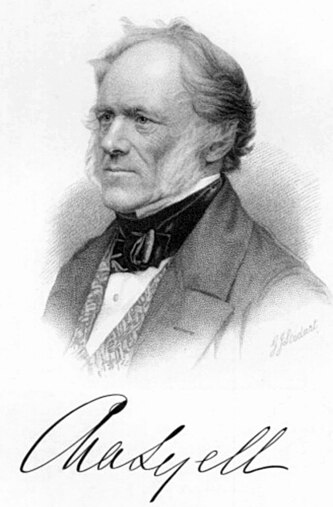

About Charles Lyell
Sir Charles Lyell, 1st Baronet (14 November 1797 – 22 February 1875) was the foremost geologist of his day. He is best known as the author of Principles of Geology, which popularized James Hutton's concepts of uniformitarianism. Lyell was a close and influential friend of Charles Darwin.
Best Charles Lyell Quotes
Shortest
Earliest
Explore our curated collection of the most famous and impactful Charles Lyell quotes.
“In a rude state of society all great calamities are regarded by the people as judgments of God on the wickedness of man.”
“Now, if it would be reasonable to draw such inferences with respect to
the future, we cannot but apply the same rules of induction to the
past.”
“When we study history we obtain a more profound insight into human nature by instituting a comparison between the present and former states of society.”
“It seems, then, that the Greeks had not only derived from preceding nations, but had also, in some slight degree, deduced from their own observations, the theory of great periodical revolutions in the inorganic world.”
“Many distinguishing features of the surface may often be ascribed to the operation at a remote era of slow and tranquil causes-to the gradual deposition of sediment in a lake or in the ocean, or to the prolific increase of testacea and corals therein.”
“Respecting the cosmogony of the Egyptian priests, we gather much information from writers of the Grecian sects, who borrowed almost all their tenets from Egypt, and amongst others that of the former successive destruction and renovation of the world.”
“The Egyptian philosophers ventured on the perilous task of seeking out some analogy to the mode of operation employed by the Author of Nature in the first creation of organized beings, and they compared it to that which governs the birth of new individuals by generation.”

“We find in certain localities subterranean deposits of coal consisting of vegetable matter formerly drifted into seas and lakes. ...These seas and The commercial prosperity and numerical strength of a nation may now be mainly dependent on the local distribution of fuel determined by that ancient state of things.”
“Hitherto no rival hypothesis has been proposed as a substitute for the doctrine of transmutation; for 'independent creation,' as it is often termed, or the direct intervention of the Supreme Cause, must simply be considered as an avowal that we deem the question to lie beyond the domain of science.”
“In the Egyptian and Eastern cosmogonies, and in the Greek version of them, no very definite meaning can, in general, be attached to the term 'destruction of the world,' for sometimes it would seem almost to imply the annihilation of our planetary system, and at others a mere revolution of the surface of the earth.”

“Pliny had no theoretical opinions of his own concerning changes of the earth's surface... But his enumeration of the new islands which had been formed in the Mediterranean, and of other convulsions, shows that the ancients had not been inattentive observers of the changes which had taken place on the earth within the memory of man.”
“The system of scholastic disputations encouraged in the Universities of the middle ages had unfortunately trained men to habits of indefinite argumentation, and they often preferred absurd and extravagant propositions, because greater skill was required to maintain them; the end and object of such intellectual combats being victory and not truth.”
“'''As breeders of domestic animals, when they choose certain varieties in preference to others to breed from, speak technically of their method as that of 'selecting,' Mr. Darwin calls the combination of natural causes, which may enable certain varieties of wild animals or plants to prevail over others of the same species, 'natural selection.''''”

“It was not till the earlier part of the sixteenth century that geological phenomena began to attract the attention of the Christian nations. At that period a very animated controversy sprung up in Italy, concerning the true nature and origin of marine shells, and other organized fossils, found abundantly in the strata of the peninsula.”

“By the multiplying of slight modifications in the course of thousands of generations, and by the handing down of the newly-acquired peculiarities by inheritance, a greater and greater divergence from the original standard is supposed to be effected, until what may be called a new species, or, in a greater lapse of time, a new genus, will be the result.”
“Variation and natural selection would also afford a key to a multitude of geological facts otherwise wholly unaccounted for, as, for example, why there is generally an intimate connection between the living animals and plants of each great division of the globe and the extinct fauna and flora of the post-tertiary or tertiary formations of the same region...”
“Scilla, a Sicilian painter, published in 1670, a work on the fossils of Calabria, illustrated by good engravings. This was written in Latin, with great spirit and elegance, and it proves the continued ascendency of dogmas often refuted; for we find the wit and eloquence of the author chiefly directed against the obstinate incredulity of naturalists, as to the organic nature of fossil shells.”
“We know that the Egyptian priests were aware, not only that the soil beneath the plains of the Nile, but that also the hills bounding the great valley, contained marine shells; and it could hardly have escaped the observation of Eastern philosophers, that some soils were filled with fossil remains, since so many national works were executed on a magnificent scale by oriental monarchs in very remote eras.”

“Mr. Darwin labours to show, and with no small success, that all true classification in zoology and botany is, in fact, genealogical, and that community of descent is the hidden bond which naturalists have been unconsciously seeking, while they often imagined that they were looking for some unknown plan of creation.”

“The title of a work of Cardano's, published in 1552, ''''De Subtilitate'''' (corresponding to what would now be called Transcendental Philosophy), would lead us to expect, in the chapter on minerals, many far fetched theories characteristic of that age; but when treating of petrified shells, he decided that they clearly indicated the former sojourn of the sea upon the mountains.”

“So long as Geology had not lifted up a part of the veil... it was easy to treat these questions as too transcendental... But it is no longer possible to restrain curiosity from attempting to pry into the relations which connect the present state of the animal and vegetable worlds, as well as of the various races of mankind, with the state of the fauna and flora which immediately preceded.”

“For many years after the promulgation of Lamarck's doctrine of progressive development, geologists were much occupied with the question whether the past changes in the animate and inanimate world were brought about by sudden and paroxysmal action, or gradually and continuously by causes differing neither in kind nor degree from those now in operation.”
“The era, it is true, of the expected millennium had passed away; and for five hundred years after the fatal hour, when the annihilation of the planet had been looked for, the monks remained in undisturbed enjoyment of rich grants of land bequeathed to them by pious donors, who, in the preamble of deeds beginning 'appropinquante mundi termino'-'appropinquante magno judicii die,' left lasting monuments of the popular delusion.”
Charles Lyell Quotes by Topic
Find exactly what you are looking for by browsing this categorized list of Charles Lyell quotes by topic.
Charles Lyell on Geology 3 quotes
“As late as the middle of the eighteenth century, when Buffon attempted to state simple geological truths, the theological faculty of the Sorbonne forced him to make and to publish a most ignominious recantation which ended with these words: "I abandon everything in my book respecting the formation of the earth, and generally all which may be contrary to the narrative of Moses."”

What Charles Lyell Said About Others
Discover personal opinions Charles Lyell shared regarding contemporaries.
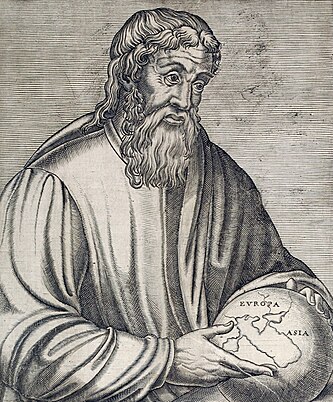
Charles Lyell on Strabo 3 quotes
“We learn from a passage in Strabo, that it was a dogma of the Gaulish Druids that the universe was immortal, but destined to survive catastrophes both of fire and water. That this doctrine was communicated to them from the East, with much of their learning, cannot be doubted.”
Quotes About Charles Lyell
Gain deeper perspective through quotes about Charles Lyell from others.
Thomas Henry Huxley on Charles Lyell 2 quotes
“The publication of 'The Principles of Geology,' in 1830, constituted an epoch in geological science. But it also constituted an epoch in the modern history of the doctrines of evolution, by raising in the mind of every intelligent reader this question: If natural causation is competent to account for the not-living part of our globe, why should it not account for the living part?”

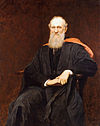
William Thomson on Charles Lyell
“It is certain that either the earth is becoming on the whole cooler from age to age, or the heat conducted out is generated in the interior by temporary dynamical (that is, in this case, chemical) action. To suppose, as Lyell, adopting the chemical hypothesis, has done, that the substances, combining together, may be again separated electrolytically by thermo-electric currents, due to the heat generated by their combination, and thus the chemical action and its heat continued in an endless cycle, violates the principles of natural philosophy in exactly the same manner, and to the same degree, as to believe that a clock constructed with a self-winding movement may fulfil the expectations of its ingenious inventor by going for ever.”
Andrew Dickson White on Charles Lyell
“In 1863... Sir Charles Lyell the most eminent of living geologists, a man of deeply Christian feeling and of exceedingly cautious temper, who had opposed the evolution theory of Lamarck and declared his adherence to the idea of successive creations, then published his work on the Antiquity of Man, and in this and other utterances showed himself a complete though unwilling convert to the fundamental ideas of Darwin. The blow was serious... withdrawing all foundation in fact from the scriptural chronology and... discrediting the creation theory. ...Lyell, like the honest man he was, yielded unreservedly to the mass of new proofs arrayed on the side of evolution against that of creation. ...At the same time came Huxley's Man's Place in Nature, giving new and most cogent arguments in favour of evolution by natural selection.”
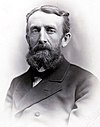
About Charles Lyell
Sir Charles Lyell, 1st Baronet (14 November 1797 – 22 February 1875) was the foremost geologist of his day. He is best known as the author of Principles of Geology, which popularized James Hutton's concepts of uniformitarianism. Lyell was a close and influential friend of Charles Darwin.
QuotesCosmos Cross-Civilizational Archive
Explore Related Wisdom Pillars, Worldviews & Canonical Works
Discover how humanity's greatest philosophers, sacred scriptures, and literary masterpieces address the core questions of existence.
30 Wisdom Pillars
22 Worldviews & Traditions
Canonical Books & Scriptures