C. S. Lewis Quotes (1898-1963)









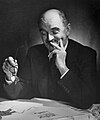





















About C. S. Lewis
Best C. S. Lewis Quotes
Explore our curated collection of the most famous and impactful C. S. Lewis quotes.

































‘What would the third be?’
‘Some have thought that all these loves were copies of our love for the Landlord.’”

I note what you say about guiding your patient's reading and taking care that he sees a good deal of his materialist friend. But are you not being a trifle naive? It sounds as if you suppose that argument was the way to keep him out of the enemy's clutches. That might have been so if he had lived a few centuries earlier.”






"Hush," he said sternly. "Do not blaspheme. Hell is a state of mind — ye never said a truer word. And every state of mind, left to itself, every shutting up of the creature within the dungeon of its own mind — is, in the end, Hell. But Heaven is not a state of mind. Heaven is reality itself. All that is fully real is Heavenly."”



The new age, the new art, the new ethic and thought,
And fools crying, Because it has begun
It will continue as it has begun!
The wheel runs fast, therefore the wheel will run
Faster for ever. The old age is done,
We have new lights and see without the sun.
(Though they lay flat the mountains and dry up the sea,
Wilt thou yet change, as though God were a god?)”





'Everyone who wishes it does. Never fear. There are only two kinds of people in the end: those who say to God, "Thy will be done," and those to whom God says, in the end, "Thy will be done." All that are in Hell, choose it. Without that self-choice there could be no Hell. No soul that seriously and constantly desires joy will ever miss it. Those who seek find. To those who knock it is opened.' ”
It was allowed to One, we are told, and I find I can now believe again, that He has done vicariously whatever can be done. '''He replies to our babble, 'you cannot and dare not. I could and dared.''''”






And then, of her, and every created thing I praise, I should say 'in some way, in its unique way, like Him who made it.'
Thus up from the garden to the Gardener, from the sword to the Smith. to the life-giving Life and the Beauty that makes beautiful.”
‘Our relations with the cow are not delicate—as you can easily see if you imagine eating any of her other secretions.’ ...
John said, ‘Thank heavens! Now at last I know that you are talking nonsense. You are trying to pretend that unlike things are like. You are trying to make us think that milk is the same sort of thing as sweat or dung.’
‘And pray, what difference is there except by custom?’
‘Are you a liar or only a fool, that you see no difference between that which Nature casts out as refuse and that which she stores up as food?’”





• Variant: "The only people who object to escapism are jailers." Mistakenly attributed solely to Lewis by Arthur C. Clarke in God, The Universe and Everything Else (1988). Also see "Aspects of Science Fiction" in Greetings, Carbon-Based Bipeds!: Collected Essays 1934-1998 (1999) by Arthur C. Clarke, edited by Ian T. Macauley, St. Martin's Press, New York.”

Nearly they stood who fall;
Themselves as they look back
See always in the track
The one false step, where all
Even yet, by lightest swerve
Of foot not yet enslaved,
By smallest tremor of the smallest nerve,
Might have been saved.
Nearly they fell who stand,
And with cold after fear
Look back to mark how near
They grazed the Siren's land,
Wondering that subtle fate,
By threads so spidery fine,
The choice of ways so small, the event so great,
Should thus entwine.
Therefore oh, man, have fear
Lest oldest fears be true,
Lest thou too far pursue
The road that seems so clear,
And step, secure, a hair-breadth bourne,
Which, being once crossed forever unawares,
Denies return.”






"Because they are too terrible, Sir?"
"No. Because all answers deceive. If ye put the question from within Time and are asking about possibilities, the answer is certain. The choice of ways is before you. Neither is closed. Any man may choose eternal death. Those who choose it will have it. But if ye are trying to leap on into Eternity, if ye are trying to see the final state of all things as it will be (for so ye must speak) when there are no more possibilities left but only the Real, then ye ask what cannot be answered to mortal ears. Time is the very lens through which ye see — small and clear, as men see through the wrong end of a telescope — something that would otherwise be too big for ye to see at all. That thing is Freedom: the gift whereby ye most resemble your Maker and are yourselves parts of eternal reality. But ye can see it only through the lens of Time, in a little clear picture, through the inverted telescope. It is a picture of moments following one another and yourself in each moment making some choice that might have been otherwise. Neither the temporal succession nor the phantom of what ye might have chosen and didn't is itself Freedom. They are a lens. The picture is a symbol: but it's truer than any philosophical theorem (or, perhaps, than any mystic's vision) that claims to go behind it. For every attempt to see the shape of eternity except through the lens of Time destroys your knowledge of Freedom."”
“Life is greater than any system of morality; her claims are absolute. It is not by tribal taboos and copy-book maxims that she has pursued her relentless march from the amoeba to man and from man to civilization.”
“She——” began Weston.
"I’m sorry,” interrupted Ransom, “but I’ve forgotten who She is.”
“Life, of course,” snapped Weston. “She has ruthlessly broken down all obstacles and liquidated all failures and to-day in her highest form—civilized man—and in me as his representative, she presses forward to that interplanetary leap which will, perhaps, place her for ever beyond the reach of death.”
“He says,” resumed Ransom, “that these animals learned to do many difficult things, except those who could not; and those ones died and the other animals did not pity them. And he says the best animal now is the kind of man who makes the big huts and carries the heavy weights and does all the other things I told you about; and he is one of these and he says that if the others all knew what he was doing they would be pleased. He says that if he could kill you all and bring our people to live in Malacandra, then they might be able to go on living here after something had gone wrong with our world. And then if something went wrong with Malacandra they might go and kill all the hnau in another world. And then another—and so they would never die out.”
“It is in her right,” said Weston, “the right, or, if you will, the might of Life herself, that I am prepared without flinching to plant the flag of man on the soil of Malacandra: to march on, step by step, superseding, where necessary, the lower forms of life that we find, claiming planet after planet, system after system, till our posterity—whatever strange form and yet unguessed mentality they have assumed—dwell in the universe wherever the universe is habitable.”
“I may fall,” said Weston. “But while I live I will not, with such a key in my hand, consent to close the gates of the future on my race. What lies in that future, beyond our present ken, passes imagination to conceive: it is enough for me that there is a Beyond.”
”
This false certainty comes out in Professor Haldane's article. [...] It is breaking Aristotle's canon—to demand in every enquiry that degree of certainty which the subject matter allows. And not on your life to pretend that you see further than you do.
Being a democrat, I am opposed to all very drastic and sudden changes of society (in whatever direction) because they never in fact take place except by a particular technique. That technique involves the seizure of power by a small, highly disciplined group of people; the terror and the secret police follow, it would seem, automatically. I do not think any group good enough to have such power. They are men of like passions with ourselves. The secrecy and discipline of their organisation will have already inflamed in them that passion for the inner ring which I think at least as corrupting as avarice; and their high ideological pretensions will have lent all their passions the dangerous prestige of the Cause. Hence, in whatever direction the change is made, it is for me damned by its modus operandi. The worst of all public dangers is the committee of public safety. The character in That Hideous Strength whom the Professor never mentions is Miss Hardcastle, the chief of the secret police. She is the common factor in all revolutions; and, as she says, you won’t get anyone to do her job well unless they get some kick out of it.”

C. S. Lewis Quotes by Topic
Find exactly what you are looking for by browsing this categorized list of C. S. Lewis quotes by topic.
C. S. Lewis on Christianity 3 quotes
C. S. Lewis on Moment 2 quotes

C. S. Lewis on Second Coming 2 quotes
C. S. Lewis on Goodness 2 quotes
C. S. Lewis on Books 2 quotes
What C. S. Lewis Said About Others
Discover personal opinions C. S. Lewis shared regarding contemporaries.
C. S. Lewis on The Faerie Queene 5 quotes
View all 5 quotes on The Faerie Queene →C. S. Lewis on J. R. R. Tolkien 2 quotes
View all 2 quotes on J. R. R. Tolkien →C. S. Lewis on Percy Bysshe Shelley 2 quotes

C. S. Lewis on William Morris 2 quotes

Quotes About C. S. Lewis
Gain deeper perspective through quotes about C. S. Lewis from others.
Arthur C. Clarke on C. S. Lewis

Walter Hooper on C. S. Lewis
C. E. M. Joad on C. S. Lewis
Zadie Smith on C. S. Lewis

Margaret Thatcher on C. S. Lewis


Misattributed Quotes
Quotes mistakenly credited to C. S. Lewis