Link Copied!
Bart D. Ehrman Quotes (1955-)
Author


Best Bart D. Ehrman Quotes
Shortest
Earliest
Explore our curated collection of the most famous and impactful Bart D. Ehrman quotes.

“Christianity may well have succeeded even if Constantine had not converted.”

“The very idea that society should serve the poor, the sick, and the marginalized became a distinctively Christian concern.”
“Even though Jesus may be the only miracleworking Son of God that people know about today, there were lots of people like this in the ancient world.”
“From the historians' perspective it is striking that all forms of early Christianity claimed authorization of their views by tracing their lineage back through the apostles to Jesus.”
“One could argue as well that Jesus is the most important person in the history of the West, looked at from a historical, social, or cultural perspective, quite apart from his religious significance.”

“My thesis can be stated simply: scribes occasionally altered the words of their sacred texts to make them more patently orthodox and to prevent their misuse by Christians who espoused aberrant views.”
“Very few people who devote their lives to studying the historical Jesus actually want to find a Jesus who is completely removed from our own time. What people want ... is relevance.”
“There are several points on which virtually all scholars of antiquity agree. Jesus was a Jewish man, known to be a preacher and teacher, who was crucified (a Roman form of execution) in Jerusalem during the reign of the Roman emperor Tiberius, when Pontius Pilate was the governor of Judea.”
“For the only reason (I came to think) for God to inspire the Bible would be so that his people would have his actual words; but if he really wanted to have his actual words, surely he would have miraculously preserved those words, just as he had miraculously inspired them in the first place.”

“I am not saying that churches should be mini-universities where pastors function as professors from the pulpit. But surely the ministry involves more than preaching the "good news" (however that is understood) every week. It also involves teaching. Most churches have adult education classes. Why aren’t adults being educated?”
“If there is an all-powerful and loving God in this world, why is there so much excruciating pain and unspeakable suffering? The problem of suffering has haunted me for a very long time. It was what made me begin to think about religion when I was young, and it was what led me to question my faith when I was older. Ultimately, it was the reason I lost my faith.”

“The question is then how can we decide what anybody in the ancient world said. We can't. We wish we could. It would be nice if we could. You would like to think that because you can go to the store and buy an edition of Plato that you are actually reading Plato, but the problem is that we just do not have the kind of evidence that we need in order to establish what ancient authors actually wrote.”

“One of the ironies of modern religion is that the absolute commitment to truth in some forms of evangelical and fundamentalist Christianity and the concomitant view that truth is objective and can be verified by any impartial observer have led many faithful souls to follow the truth wherever it leads— and where it leads is often away from evangelical or fundamentalist Christianity.”

“I could no longer reconcile the claims of faith with the facts of life. In particular, I could no longer explain how there can be a good and all-powerful God actively involved with this world, given the state of things. For many people who inhabit this planet, life is a cesspool of misery and suffering. I came to a point where I simply could not believe that there is a good and kindly disposed Ruler who is in charge of it.”

“Miracles, by our very definition of the term, are virtually impossible events. [...] We would call a miracle an event that violates the way nature always, or almost always, works so as to make the event virtually, if not actually, impossible. The chances of a miracle occurring are infinitesimal. If that were not the case it would not be a miracle, just something weird that happened. And weird things happen all the time.”
“Historians can establish only what probably happened in the past, but miracles, by their very nature, are always the least probable explanation for what happened. This is true whether you are a believer or not. [...] If historians can only establish what probably happened, and miracles by their definition are the least probable occurrences, then more or less by definition, historians cannot establish that miracles have ever probably happened.”
“Many Christians don't want to hear this, but the reality is that there are lots of other explanations for what happened to Jesus that are more probable than the explanation that he was raised from the dead. None of these explanations is very probable, but they are more probable, just looking at the matter historically, than the explanation of the resurrection. ... Historians can only establish what probably happened in the past, and by definition, miracles are the least probable of occurrences.”

“A storyteller who made up an account about Jesus in order to prove a point may well have known that he was passing off a fiction as a historical event. A scribe who wanted a text to say something other than what it did may well have changed the text for just that reason. In some cases it is hard to imagine how else the resultant deception could have come about. Whoever added the final twelve verses of Mark did not do so by a mere slip of the pen.”

“Not a single one of our ancient sources indicates that Jesus was married, let alone married to Mary Magdalene. All such claims are part of modern fictional reconstructions of Jesus' life, not rooted in the surviving accounts themselves. The historical approach to our sources may not be as exciting and sensationalist as fictional claims about Jesus (he kept a lover! he had sex! he made babies!), but there's something to be said for knowing what really happened in history, even if it is not as titillating as what happens in novels.”
“How does it help us to say that the Bible is the inerrant word of God if in fact we don't have the words that God inerrantly inspired, but only the words copied by the scribes—sometimes correctly but sometimes (many times!) incorrectly? What good is it to say that the autographs (i.e., the originals) were inspired? We don't have the originals! We have only error-ridden copies, and the vast majority of these are centuries removed from the originals and different from them, evidently, in thousands of ways.”
“The only way to make sense of a text is to read it, and the only way to read it is by putting it in other words, and the only way to put it in other words is by having other words to put it into, and the only way you have other words to put it into is that you have a life, and the only way to have a life is by being filled with desires, longings, needs, wants, beliefs, perspectives, worldviews, opinions, likes, dislikes— and all the other things that make human beings human. And so to read a text is, necessarily, to change a text.”
“There were numerous ways to lie in and through literature in antiquity, and some Christians took advantage of the full panoply in their efforts to promote their view of the faith. It may seem odd to modern readers, or even counterintuitive, that a religion that built its reputation on possessing the truth had members who attempted to disseminate their understanding of the truth through deceptive means. But it is precisely what happened. The use of deception to promote the truth may well be considered one of the most unsettling ironies of the early Christian tradition.”
“If the findings of historical criticism are right, then some kinds of theological claims are certainly to be judged as inadequate and wrong-headed. It would be impossible, I should think, to argue that the Bible is a unified whole, inerrant in all its parts, inspired by God in every way. It can’t be that. There are too many divergences, discrepancies, contradictions; too many alternative ways of looking at the same issue, alternatives that often are at odds with one another. The Bible is not a unity, it is a massive plurality. God did not write the Bible, people did.”

Bart D. Ehrman Quotes by Topic
Find exactly what you are looking for by browsing this categorized list of Bart D. Ehrman quotes by topic.
Bart D. Ehrman on Christ myth theory 9 quotes
“[The Mythical Jesus viewpoint holds that a historical Jesus—if he did exist—] had virtually nothing to do with the founding of Christianity.”

Bart D. Ehrman on Gospel of Judas
Bart D. Ehrman on Books
“The Bible is the most widely purchased, most thoroughly revered, and probably most broadly misunderstood book in the history of human civilization.”

Bart D. Ehrman on Son of God
“Even though Jesus may be the only miracleworking Son of God that people know about today, there were lots of people like this in the ancient world.”
Bart D. Ehrman on Jewish views on Jesus
“One of the ironies of early Christianity is that Jesus himself was a Jew who worshiped the Jewish God, kept Jewish customs, interpreted the Jewish law, and acquired Jewish disciples, who accepted him as the Jewish messiah. Yet, within just a few decades of his death, Jesus's followers had formed a religion that stood over-against Judaism. How did Christianity move so quickly from being a Jewish sect to being an anti-Jewish religion?”

Bart D. Ehrman on Gehinnom
“The valley is mentioned several times in the Old Testament, first in Joshua 15:8, where it is called "the valley of the son of Hinnom", which in Hebrew is gei ben Hinnom. We don't know who Hinnom was, but his son apparently owned the valley at one point. A later reference calls it instead Hinnom's own valley—that is, in gei-hinnom. Later, that term, gehinnom, came to be Gehenna. It is normally identified as the ravine southwest of Old Jerusalem.”

Bart D. Ehrman on Hades (New Testament)
“Lazarus is carried off by the angels to "Abraham's bosom", a phrase that never occurs in early Jewish literature but probably simply means that Lazarus has been brought to paradise to recline at table beside the great patriarch of Israel. The rich man, on the other hand, is buried and ends up in Hades. It is not a happy place. ... Moreover, the respective fates of the two appear to be permanent. There is a vast chasm separating them. Neither will ever leave the place he is in.”
Bart D. Ehrman on Bosom of Abraham
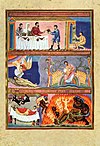
“Lazarus is carried off by the angels to "Abraham's bosom", a phrase that never occurs in early Jewish literature but probably simply means that Lazarus has been brought to paradise to recline at table beside the great patriarch of Israel. The rich man, on the other hand, is buried and ends up in Hades. ... It is hard to know what to make of the physicality of both descriptions. Abraham has a "bosom", Lazarus has fingers, the rich man has a tongue and obviously a nervous system susceptible to torment by fire. ... Moreover, the respective fates of the two appear to be permanent. There is a vast chasm separating them.”
Bart D. Ehrman on Son of man
“Some recent scholars have proposed that Jesus ... preached a "radically egalitarian society"—that is, that he set about to reform society by inventing a new set of rules to govern social relations ... There is little to suggest that Jesus was concerned with pushing social "reform" in any fundamental way in this evil age. In his view, present-day society and all its conventions were soon to come to a screeching halt, when the Son of Man arrived from heaven in judgment on the earth. Far from transforming society from within, Jesus was preparing people for the destruction of society. Only when God's Kingdom arrived would an entirely new order appear, in which peace, equality, and justice would reign supreme.”
Bart D. Ehrman on Sheol
“The Jewish scriptures contain a variety of views about what happens to a person at death. Most commonly, a person who dies is simply said to have gone to "death"—a term used some thousand times in the Bible. Better known but far less frequent, a person's ultimate destination is sometimes called "Sheol", a term whose meaning and etymology are debated. It occurs over sixty times in the Hebrew Bible, and there is unanimity among critical scholars that in no case does Sheol mean "hell" in the sense people mean today. There is no place of eternal punishment in any passage of the entire Old Testament. In fact—and this comes as a surprise to many people—nowhere in the entire Hebrew Bible is there any discussion at all of heaven and hell as places of rewards and punishments for those who have died.”

Bart D. Ehrman on Gnosticism
“The term gnosticism comes from the Greek word gnōsis, which means knowledge. Gnostics are those who are "in the know." And what is it that they know? They know secrets that can bring salvation. For gnostics, a person is saved not by having faith in Christ or by doing good works. Rather, a person is saved by knowing the truth—the truth about the world we live in, about who the true God is, and especially about who we ourselves are. In other words, this is largely self-knowledge: Knowledge of where we came from, how we got here, and how we can return to our heavenly home. According to most gnostics, this material world is not our home. We are trapped here, in these bodies of flesh, and we need to learn how to escape. For those gnostics who were also Christian (many gnostics were not), it is Christ himself who brings this secret knowledge from above. He reveals the truth to his intimate followers, and it is this truth that can set them free.”

What Bart D. Ehrman Said About Others
Discover personal opinions Bart D. Ehrman shared regarding contemporaries.
Bart D. Ehrman on Jesus
“Not a single one of our ancient sources indicates that Jesus was married, let alone married to Mary Magdalene. All such claims are part of modem fictional reconstructions of Jesus' life, not rooted in the surviving accounts themselves. The historical approach to our sources may not be as exciting and sensationalist as fictional claims about Jesus (he kept a lover! he had sex! he made babies!), but there's something to be said for knowing what really happened in history, even if it is not as titillating as what happens in novels.”
Bart D. Ehrman on Mary Magdalene
“Not a single one of our ancient sources indicates that Jesus was married, let alone married to Mary Magdalene. All such claims are part of modern fictional reconstructions of Jesus' life, not rooted in the surviving accounts themselves. The historical approach to our sources may not be as exciting and sensationalist as fictional claims about Jesus (he kept a lover! he had sex! he made babies!), but there's something to be said for knowing what really happened in history, even if it is not as titillating as what happens in novels.”

Bart D. Ehrman on Albert Schweitzer
“Few authors in modern times can be said to have redirected the course of an entire field of study. In 1906, Albert Schweitzer did, with his brilliant monograph, ''The Quest of the Historical Jesus'''''... Schweitzer was convinced that Jesus was an apocalypticist. Schweitzer is best known, of course, for his humanitarian endeavors. After giving up an extraordinarily promising academic career as a philosopher-theologian in Strasbourg to establish a medical mission in French Equatorial Africa, he spent his life curing the sick in his jungle clinic, far removed from the ivy towers of the European intellectual scene. ... The bulk of his book recounts the attempts since the Enlightenment to produce a life of Jesus. With scathing wit, penetrating analysis, and inimitable turns of phrase, Schweitzer shows that every generation of scholars that attempted to write a life of Jesus in fact portrayed Jesus in its own image.''' ... Schweitzer demonstrates this thesis through an exhaustive analysis of the entire history of scholarship on Jesus—from its beginnings in 1776 with a posthumously published account of a German scholar named H. Reimarus, who argued that Jesus was a political revolutionary whose violent activities were covered up by the Gospel writers, to the rationalist views of Heinrich Paulus and the myth-oriented response of D. F. Strauss... on down to his own day. ... he scorns every attempt to make Jesus into a modern man, who promoted, in substance, the religious, political, cultural, or social agenda of modern European intellectuals. For Schweitzer, Jesus was a man of the past. To understand what he was really like, we must situate him in his own context, not pretend that he fits perfectly well into our own. ... Schweitzer did not think that the historical Jesus shared the problems or perspectives of the twentieth century. Instead, Jesus was a first-century apocalypticist, who never expected that there would be a twentieth century. He thought that the end of the world was coming within his own lifetime. In fact, he expected it to come before the year was out. When it didn't come, Schweitzer argued, Jesus decided that he himself needed to suffer in order for God to bring the heavenly Kingdom here to earth. And so he went to his cross fully expecting God to intervene in history in a climactic act of judgment. When at his last meal he told his disciples that he would not drink wine again until he drank it anew with them in the Kingdom, he was not thinking that this would be two thousand years hence, but in the next day or two. It turns out that Jesus was wrong. He died on the cross mistaken about his own identity and the plan of God.”

About Bart D. Ehrman
Bart D. Ehrman (born 5 October 1955) is an American New Testament scholar.