Arthur Koestler on Teleology
← Back to Arthur Koestler Profile
“If time is treated in modern physics as a dimension on a par with the dimensions of space, why should we a priori exclude the possibility that we are pulled as well as pushed along its axis? The future has, after all, as much or as little reality as the past, and there is nothing logically inconceivable in introducing, as a working hypothesis, an element of finality, supplementary to the element of causality, into our equations. It betrays a great lack of imagination to believe that the concept of "purpose" must necessarily be associated with some anthropomorphic deity.”
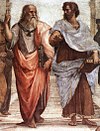
“[An] example of the hubris of contemporary science is the rigorous banishment of the word "purpose" from its vocabulary. This is probably an aftermath of the reaction against the animism of Aristotelian physics, where stones accelerated their fall because of their impatience to get home, and against a teleological world-view in which the purpose of the stars was to serve as chronometers for man's profit. From Galileo onward, "final causes" were relegated into the realm of superstition, mechanical causality reigned supreme. ...The mechanistic universe gradually disintegrated, but the mechanistic notion of causality survived until Heisenberg's indeterminacy principle proved its untenability.”
“Today we know that on the sub-atomic level the fate of an electron or a whole atom is not determined by its past. But this discovery has not led to any basically new departure in the philosophy of nature, only to a state of bewildered embarrassment, a further retreat of physics into a language of even more abstract symbolism. Yet if causality has broken down and events are not rigidly governed by the pushes and pressures of the past, may they not be influenced in some manner by the "pull" of the future—which is a manner of saying that "purpose" may be a concrete physical factor in the evolution of the universe, both on the organic and unorganic levels. In the relativistic cosmos, gravitation is a result of the curvature and creases in space which continually tend to straighten themselves out—which, as Whittaker remarked, "is a statement so completely teleological that it certainly would have delighted the hearts of the schoolmen."”
QuotesCosmos Cross-Civilizational Archive
Explore Related Wisdom Pillars, Worldviews & Canonical Works
Discover how humanity's greatest philosophers, sacred scriptures, and literary masterpieces address the core questions of existence.
30 Wisdom Pillars
22 Worldviews & Traditions
Canonical Books & Scriptures