Link Copied!
Anatol Rapoport Quotes (1911-2007)
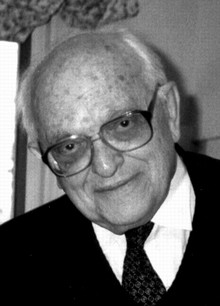

About Anatol Rapoport
Anatol Rapoport (May 22, 1911 – January 20, 2007) was a Russian-born American Jewish mathematical psychologist. He was one of the founders of the general systems theory. He also contributed to mathematical biology and to the mathematical modeling of social interaction and stochastic models of contagion.
Best Anatol Rapoport Quotes
Shortest
Earliest
Explore our curated collection of the most famous and impactful Anatol Rapoport quotes.
“A theorem is a proposition which is a strict logical consequence of certain definitions and other propositions”
“It is misleading in a crucial way to view information as something that can be poured into an empty vessel, like a fluid or even energy.”
“The outstanding feature of behavior is that it is often quite easy to recognize but extremely difficult or impossible to describe with precision.”
“The outcome of a non-constant-sum game may be dictated by the individual rationality of the respective players without satisfying a criterion of collective rationality.”
“A thorough understanding of game theory, should dim these greedy hopes. Knowledge of game theory does not make one a better card player, businessman or military strategist.”

“[It is a] well-known fact that the likely contacts of two individuals who are closely acquainted tend to be more overlapping than those of two arbitrarily selected individuals”
“The transition from the concept of information in the technical (communication engineering) sense to the semantic (theory of meaning) sense was indeed difficult, if not impossible.”

“The "flow of information" through human communication channels is enormous. So far no theory exists, to our knowledge, which attributes any sort of unambiguous measure to this "flow".”
“It is one thing to say that the dwelling has symbolic and cosmological aspects... and another to say that it has been erected for ritual purposes and is neither shelter nor dwelling but a temple.”

“[Education] seems to be the only hope: to spread enlightenment sufficiently wide so that people can no longer be manipulated to give consent to policies that will surely eventually lead to their own destruction.”
“We live in an age of belief-belief in the omnipotence of science. This belief is bolstered by the fact that the problems scientists are called on to solve are for the most part selected by the scientists themselves.”

“In a game, the potentialities and evaluations of alternative outcomes must be taken into account, if the reactions of the opponents to each other's moves are to moves are to be understood or described systematically.”
“The American Revolution was ignited by the slogan ‘no taxation without representation’, a slogan suggested by democratic ideals... Ought not the present day version of the old slogan be ‘No annihilation without representation?”
“It is the shortcomings of game theory (as originally formulated) which force the consideration of the role of ethics, of the dynamics of social structure, and of social structure and of individual psychology in situations of conflict.”

“The usefulness of the models in constructing a testable theory of the process is severely limited by the quickly increasing number of parameters which must be estimated in order to compare the predictions of the models with empirical results.”

“Whether sociology can ever become a full-fledged "science" (a description of a class of events predictable on the basis of deductions from a constant rationale) depends on whether the terms which sociologists employ to describe events can be analyzed into quantifiable observables.”
“(Game theory is) essentially a structural theory. It uncovers the logical structure of a great variety of conflict situations and describes this structure in mathematical terms. Sometimes the logical structure of a conflict situation admits rational decisions; sometimes it does not.”
“The military forces of the revolutionary adversary are diffuse. One is never sure whether one has destroyed them unless one is ready to destroy a large portion of the population, and this usually conflicts with the political aim of the war and hence also violates a fundamental Clausewitzian principle”
“Game theory applies to a very different type of conflict, now technically called a game. The well-known games such as poker, chess, ticktacktoe and so forth are games in the strict technical Bark and counterbark sense. But what makes parlor games games is not their entertainment value or detachment from real life.”

“In the US. Infantry Manual published during World War II, the soldier was told what to do if a live grenade fell into the trench where he and others were sitting: to wrap himself around the grenade so as to at least save the others. (If no one "volunteered," all would be killed, and there were only a few seconds to decide who would be the hero.)”
“Whether game theory leads to clear-cut solutions, to vague solutions, or to impasses, it does achieve one thing. In bringing techniques of logical and mathematical analysis gives men an opportunity to bring conflicts up from the level of fights, where the intellect is beclouded by passions, to the level of games, where the intellect has a chance to operate.”

“For a general semanticist, communication is not merely words in proper order properly inflected (as for the grammarian) or assertions in proper relation to each other (as for the logician) or assertions in proper relation to referents (as for the semanticist), but all these together, with the chain of 'fact to nervous system to language to nervous system to action.”
Anatol Rapoport Quotes by Topic
Find exactly what you are looking for by browsing this categorized list of Anatol Rapoport quotes by topic.
Anatol Rapoport on Game theory 2 quotes
“(Game theory is) essentially a structural theory. It uncovers the logical structure of a great variety of conflict situations and describes this structure in mathematical terms. Sometimes the logical structure of a conflict situation admits rational decisions; sometimes it does not.”
Anatol Rapoport on Map 2 quotes
“A fundamental value in the scientific outlook is concern with the best available map of reality. The scientist will always seek a description of events which enables him to predict most by assuming least. He thus already prefers a particular form of behavior. If moralities are systems of preferences, here is at least one point at which science cannot be said to be completely without preferences. Science prefers good maps.”

Anatol Rapoport on Semantics 2 quotes
“Who Are the Semanticists? To answer this question, let us go to the writings of those who make frequent references to semantics or to equivalent terms which have to do with the study of meaning. We find that a number of prominent thinkers have occupied themselves with this study. In England these include Whitehead, Russell, Ogden, Richards, Ayer, and others; in Austria (later scattered, fleeing from fascism), a group of writers who called themselves the Vienna Circle, which included Carnap and Frank (now in in the United States), Wittgenstein (now in England), and Neurath (deceased); the United States is represented by Charles Morris, and Poland by Tarski and Korzybski (deceased), both of whom emigrated to the United States.”

Anatol Rapoport on System
“A system is recognized as such by remaining recognizable as 'itself' in spite of changes in its detailed appearance.”

Anatol Rapoport on Knowledge
Anatol Rapoport on Sociology
“Whether sociology can ever become a full-fledged "science" (a description of a class of events predictable on the basis of deductions from a constant ra~onale) depends on whether the terms which sociologists employ to describe events can be analyzed into quantifiable observables.”
Anatol Rapoport on Reality
“A fundamental value in the scientific outlook is concern with the best available map of reality. The scientist will always seek a description of events which enables him to predict most by assuming least. He thus already prefers a particular form of behavior. If moralities are systems of preferences, here is at least one point at which science cannot be said to be completely without preferences. Science prefers good maps.”

Anatol Rapoport on Scientists
“A fundamental value in the scientific outlook is concern with the best available map of reality. The scientist will always seek a description of events which enables him to predict most by assuming least. He thus already prefers a particular form of behavior. If moralities are systems of preferences, here is at least one point at which science cannot be said to be completely without preferences. Science prefers good maps.”
What Anatol Rapoport Said About Others
Discover personal opinions Anatol Rapoport shared regarding contemporaries.
Anatol Rapoport on Herman Kahn
“The author of "On Escalation" is revealed not as a detached analyst, nor even as a cynically bemused observer of human folly, but rather as an enthusiastic choreographer of the dance of death. He relishes the obscene pranks he invents and the cataclysmic phantasies he invokes.”
Anatol Rapoport on Alfred Korzybski
“"What is good in Korzybski's work," they say, "is not new, and what is new is not good." On the other hand, many "Korzybski-ites" proclaim that Korzybski's work has "nothing to do" with semantics. They go so far as to say that the very term "general semantics" was an unfortunate choice; that had Korzybski known what confusion would arise between semantics and general semantics he would not have used it at all. Korzybski himself has maintained that while semantics belongs to the philosophy of language and perhaps to the theory of knowledge, general semantics belongs to empirical science: that it is the foundation of a science of man, the basis of the first "non-aristotelian system," which has had no predecessor and which no academic semanticist has ever achieved.”

Quotes About Anatol Rapoport
Gain deeper perspective through quotes about Anatol Rapoport from others.
Markus Schwaninger on Anatol Rapoport
“Anatol Rapoport is a pioneer and lead-figure of the systems sciences, studies in conflict & cooperation, and peace research. He is professor emeritus of Psychology and Mathematics at the University of Toronto, Canada... Rapoport has spearheaded many scientific innovations, including the application of mathematical methods, first to Biology and later to the Social Sciences. Moreover, he is one of the rare thinkers who have contributed significantly to "marrying" philosophy and science. The originality and rigor of his thinking make his theoretical oeuvre extraordinarily resourceful, as well as unique in its ethical substance and esthetical appeal. Rapoport operates from a multidimensional background of experience and studies (see the following C.V.), embodying a deep humanistic commitment (cf. Rapoport 1994), and a profoundly systemic thinking.”
Daniel Dennett on Anatol Rapoport
“The social psychologist and game theorist Anatol Rapoport (creator of the winning Tit-for-Tat strategy in Robert Axelrod's legendary prisoner’s dilemma tournament) once promulgated a list of rules for how to write a successful critical commentary on an opponent's work. First, he said, you must attempt to re-express your opponent's position so clearly, vividly and fairly that your opponent says “Thanks, I wish I’d thought of putting it that way.” Then, you should list any points of agreement (especially if they are not matters of general or widespread agreement), and third, you should mention anything you have learned from your opponent. Only then are you permitted to say so much as a word of rebuttal or criticism.”

About Anatol Rapoport
Anatol Rapoport (May 22, 1911 – January 20, 2007) was a Russian-born American Jewish mathematical psychologist. He was one of the founders of the general systems theory. He also contributed to mathematical biology and to the mathematical modeling of social interaction and stochastic models of contagion.
QuotesCosmos Cross-Civilizational Archive
Explore Related Wisdom Pillars, Worldviews & Canonical Works
Discover how humanity's greatest philosophers, sacred scriptures, and literary masterpieces address the core questions of existence.
30 Wisdom Pillars
22 Worldviews & Traditions
Canonical Books & Scriptures